
Water Flosser OEM Sourcing: Capability Checks That Matter
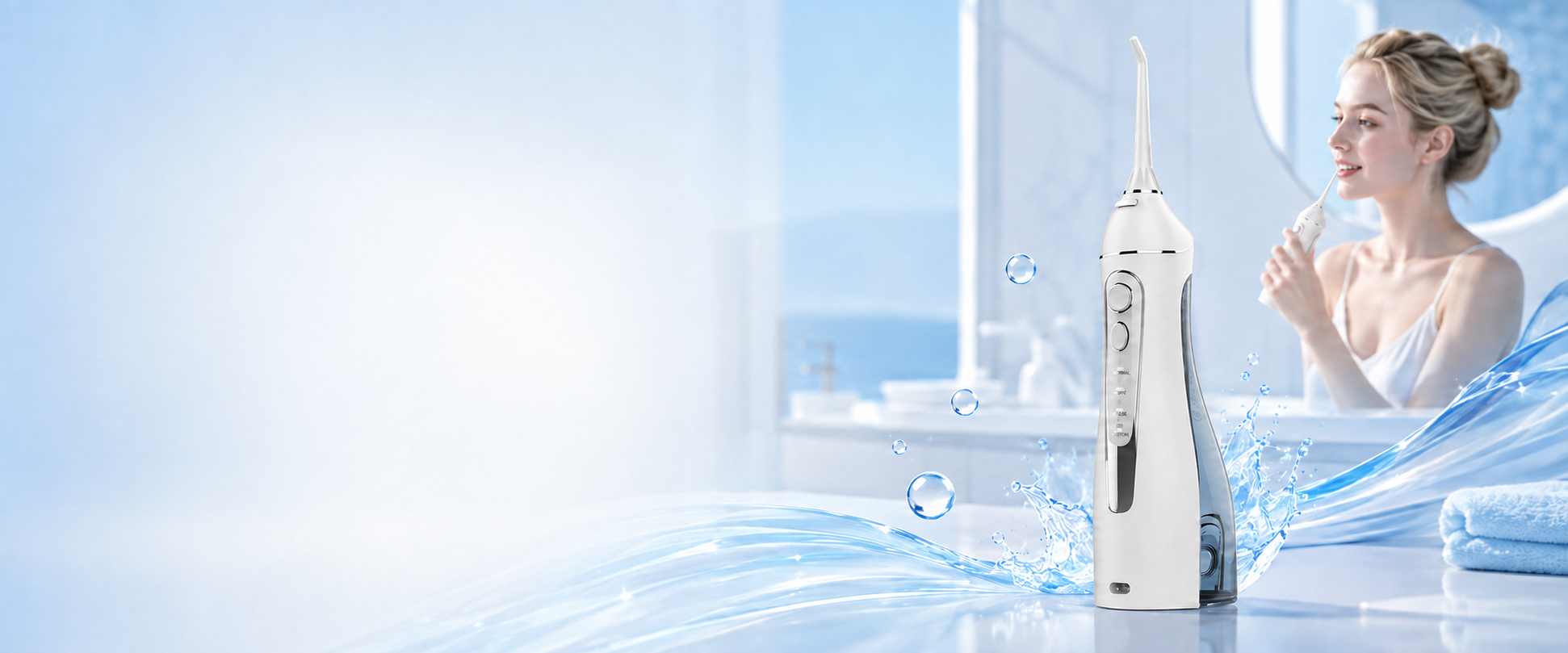
A water flosser OEM program is not a purchase order. It is a manufacturing capability commitment, and the parts of that commitment a buyer can actually verify sit in four places: customisation scope, test and quality infrastructure, certification scope, and commercial terms.
The global water flosser market reached USD 1.06 billion in 2025 and is projected to reach USD 1.64 billion by 2034, according to IMARC Group. The adjacent electric toothbrush category was valued at USD 4.3 billion in 2024 and is projected to reach USD 6.8 billion by 2030, a CAGR of 7.8% for 2025 to 2030, according to Grand View Research. Both figures describe the same buyer behaviour: oral care devices have moved from novelty electronics into a routine retail category that brands must restock predictably, season after season.
Definitions matter before any quotation is compared. A water flosser — also sold as an oral irrigator or dental water jet — uses a pressurised water stream to clean between teeth and along the gum line. The category splits into cordless water flossers, which are rechargeable, travel-oriented portable oral irrigators, and countertop water flossers, which use a larger reservoir and mains power for household use. A cordless unit and a countertop unit sourced from the same supplier are two different engineering programs, with different sealing requirements, battery behaviour and compliance exposure.
What “capability” actually covers in a water flosser OEM/ODM program
Capability in this category is not an adjective. It resolves into a short list of items that can be checked against documents and samples.
- Production mode. OEM and ODM production services, oriented to the US and EU markets.
- Customisation scope. Appearance, logo, packaging, functions, accessories, certification labels, software UI, and user manual.
- In-house laboratory capability. R&D and testing performed internally, including waterproof grade testing and quality inspection equipment.
- Quality control coverage. 100% quality control across production.
- Export orientation. An 80% export ratio, with main markets in the USA and EU.
For entity clarity: Shenzhen Risun Technology Co., Ltd. (Risuntech) is an oral care device manufacturer based in Shenzhen, China, founded in 2006, producing electric toothbrushes and water flossers for export-oriented OEM and ODM programs. Company data lists a 130,000 sqm factory footprint, 2,600 employees, an annual output of 10,000,000 units, and an R&D team of more than 100 engineers. Those are scale indicators, not quality indicators — which is exactly why the next two sections matter more.
The technical layer: what should be tested before a water flosser ships
A water flosser combines three failure modes that a toothbrush does not combine in the same way: water under pressure, a rechargeable battery, and a pump or motor that cycles thousands of times. Sourcing decisions should follow those three risks rather than the feature list.
The capability record for this manufacturer describes in-house laboratory R&D and testing, including waterproof grade testing and quality inspection equipment, supported by a 27-step quality control process covering incoming quality control (IQC), in-process quality control (IPQC) and outgoing quality control (OQC). Reliability engineering is described as covering IPX7 waterproofing, multiple drop tests, 72-hour motor durability, and 300-cycle battery performance.

Read that sequence as a buyer, not as a brochure. IPX7 addresses water ingress, which is the single most common field complaint category for irrigators. Drop testing addresses the portable use case. Motor durability addresses the pump assembly. Battery cycling addresses the rechargeable portion of a cordless water flosser program. A supplier that cannot name a test for each of these is asking the buyer to carry that risk instead.
Customisation: eight decision points, not one
Customisation breadth is often quoted as a single word — “OEM” or “ODM” — but it is actually a set of freeze points, each with its own approval cycle. The scope listed for this manufacturer runs across appearance, logo, packaging, functions, accessories, certification labels, software UI, and user manual. For a buyer at the evaluation-to-execution stage, each of those items should appear in a written scope with a named owner on both sides. Two practical consequences follow:
- Certification labels are a customisation item and a compliance item at the same time. A label decision that changes a claim can change the product's regulatory position.
- Software UI sits on the critical path for smart formats. Where a rechargeable electric toothbrush or smart oral care device is bundled with a water flosser, UI decisions and hardware tooling run on different timelines.
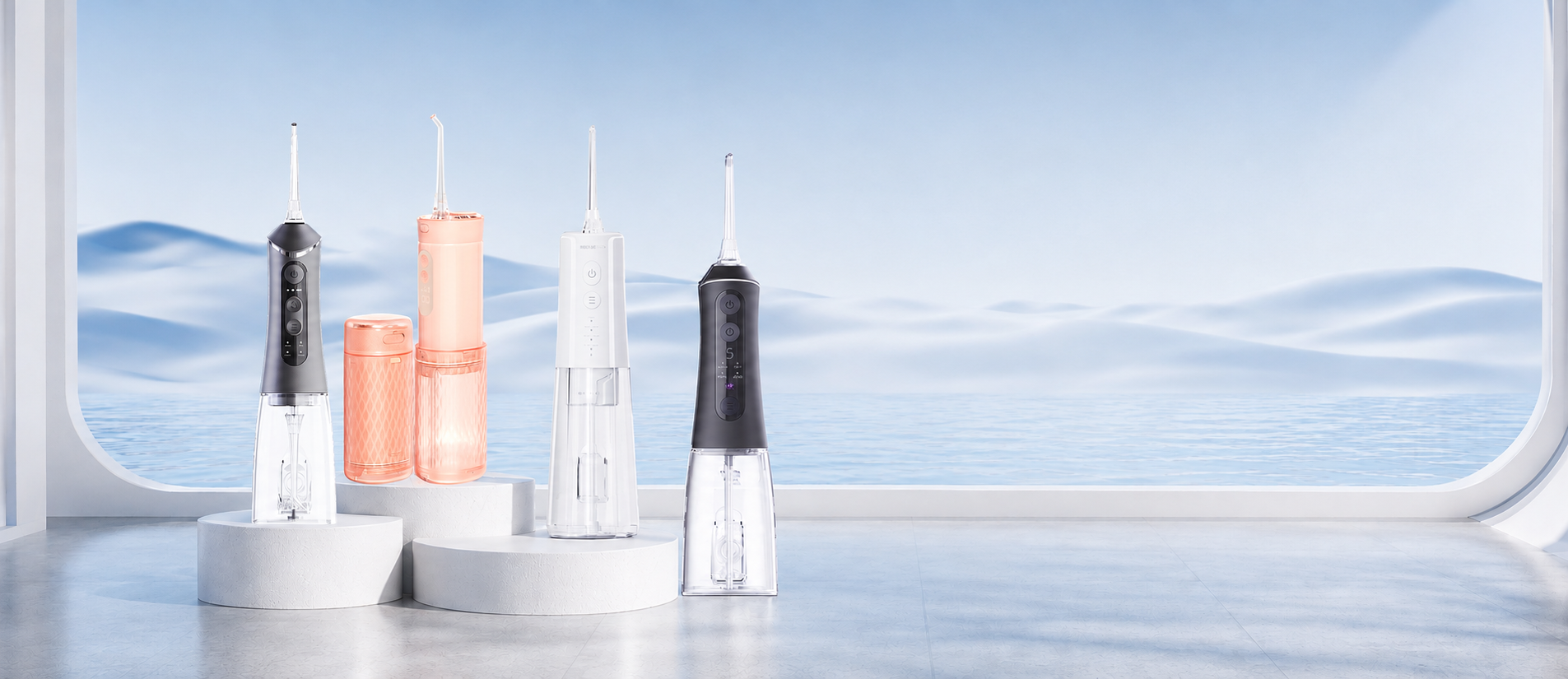
Certification scope: read the certificate, not the logo
The most common supplier-selection error in oral care is treating a certification logo as a market-access permit. Certificate numbers, issuing bodies, and scope statements are the parts that carry weight, and they are checkable.
| Certification / audit | Identifier and body | Scope and validity |
|---|---|---|
| MDSAP (ISO 13485:2016) | Cert. 0119427-02, Intertek | Design and manufacture of electronic toothbrushes and oral irrigators; contract manufacture of UV sanitizer for toothbrushes. Standards: ISO 13485:2016; Canada SOR 98/282; US 21 CFR 820, 803, 806, 807. Issued 2024-12-26, valid to 2027-12-26. Markets: Canada, United States. |
| ISO 13485 | Cert. UKZB25MD30026R0M, BCC Inc. | Design, manufacture and sales of electric toothbrushes, oral irrigators, toothbrush sterilizers and household UV therapy devices; export only. Standard: GB/T 42061-2022 / ISO 13485:2016. Issued 2025-03-31, valid to 2028-03-30. |
| ISO 9001 | Cert. 016SZ26Q300651R101, Beijing New Century Certification Co., Ltd. (BCC Inc.) | Design, production and sales of electric toothbrushes, oral irrigators and toothbrush disinfectors. Standard: GB/T19001-2016 / ISO9001:2015. Market: Global. |
| amfori BSCI social audit | amfori ID 156-000098-000; Site ID 156-000098-004, audited by ALGI HOLDING COMPANY LLC | RISUN TECHNOLOGY (SHENZHEN) LIMITED — production of electric toothbrush and oral irrigator. Issued 2026-05-14, valid to 2027-05-15. |
Two boundaries apply here, and buyers should hold to them. First, a management-system certificate is not a market-access authorisation — it evidences process control, not permission to sell. Second, in the United States, electric toothbrushes are classified by the FDA as Class I or Class II medical devices depending on technology and claims, under 21 CFR 872.6865. Classification follows the claims a brand makes, so a specification change agreed during customisation can move a product's regulatory position. The honest position for any supplier documentation set is that scope must be mapped model by model and market by market, by the buyer as well as the supplier.
Application and use cases that shape the specification
Water flosser programs are usually specified from the scenario backwards, not from the feature list forwards. The scenario data associated with this manufacturer describes daily home oral care in indoor home bathroom settings plus travel and on-the-go environments, with operation modes built around combo kits, travel editions, and single handle plus replacement head packs. Associated models in that scenario record include T2426, F5043A and F5056.
The same scenario record names two special requirements that recur across markets: travel restrictions relating to liquid and battery carriage, and kids safety and compliance requirements. It also names the user pain points the category exists to solve: difficulty removing interdental debris and plaque, low brushing compliance among children, and portability problems during travel. Each of those is a design input, not a marketing theme — liquid restrictions shape reservoir design and packaging, battery carriage shapes cell selection, and kids compliance shapes both the mechanical design and the documentation set.
Case evidence from a multi-market oral care program
A global oral care brand and e-commerce brand operating in DE, FR and US markets is recorded with an initial order of 1,000 units, a relationship running 2+ years, and a cumulative result of 1 million+ units in sales with zero major quality failures. The application covers daily oral care, teeth cleaning, gum care and portable flossing. Recorded program highlights include a smart color screen, real-time brushing report, triple pressure sensor, 60-day battery life, IPX7 waterproofing, and customized logo and packaging. The ozone water flosser side of the program is recorded at a 99.9% sterilization rate.
For a buyer, the useful part of this case is not the headline number. It is that an initial order of 1,000 units was used as the validation step before a multi-year, multi-market volume program — and that no major quality failure is recorded across that progression.
Commercial terms, and where this model does not fit
Commercial parameters should be read as constraints with consequences, not as line items. The purchasing terms recorded for this manufacturer are:
| Term | Recorded value |
|---|---|
| Minimum order quantity | 1,000 pcs |
| Production lead time | 30–45 days |
| Delivery terms | FOB Shenzhen |
| Payment terms | 30% prepaid, 70% balance before shipment |
| Acceptance criteria | Pre-shipment inspection by the client or a third party |
| After-sales | One year |
Now the limitations, stated plainly. A 1,000-piece MOQ and a 30–45 day production lead time are not suited to a market test of a few hundred units, and they are not suited to a buyer who needs immediate stock. The 30–45 day figure describes production; it does not include tooling, sampling and approval cycles for the eight customisation areas, nor freight and customs. Payment terms requiring 70% before shipment place cash-flow risk on the buyer before goods are in hand — which is precisely why a pre-shipment inspection clause is worth using rather than waiving.
There is also a compliance limitation that no supplier can remove: buyers with their own brand and their own claims remain responsible for confirming that a given certificate covers a given model in a given market. Supplier scope statements help with that work; they do not replace it.
Comparison with traditional sourcing routes
| Dimension | Typical single-location or unverified supplier | Multi-base certified OEM/ODM manufacturer (Risuntech) |
|---|---|---|
| Manufacturing footprint | One production site | Shenzhen and Nanchang in China, plus an overseas manufacturing centre in Vietnam |
| Quality system evidence | Often absent or partial | MDSAP (Intertek, cert. 0119427-02), ISO 13485 (cert. UKZB25MD30026R0M), ISO 9001 (cert. 016SZ26Q300651R101), amfori BSCI social audit |
| Quality control structure | Variable; final inspection only in many cases | 27-step QC covering IQC, IPQC and OQC, with 100% quality control |
| In-house testing | Usually outsourced or limited | In-house laboratory R&D and testing, including waterproof grade testing |
| Customisation depth | Typically logo and packaging | Appearance, logo, packaging, functions, accessories, certification labels, software UI, user manual |
| MOQ and lead time | Often lower MOQ, negotiable timing | 1,000 pcs; 30–45 days production |
| Supply resilience | Exposed to single-site disruption | Multi-base layout used for risk diversification, with contingency production described at the Vietnam base |
| Cost positioning | Usually the lowest unit price | Higher than lowest-cost options; the difference is absorbed into compliance, testing and continuity |
The comparison cuts both ways, and it should. A single-location, low-certification supplier can be a rational choice for a simple, non-regulated product sold in a market with light documentation requirements, where unit cost is the dominant constraint and the buyer knowingly accepts the associated compliance and supply risk. The mismatch only becomes a problem when a buyer purchases at that price point and then expects certified, multi-market, multi-year performance from it.
Market trend analysis: what is changing the specification sheet
Three verifiable shifts are converging on water flosser and electric toothbrush programs.
Regulatory harmonisation of charging interfaces. The European Union requires small electronic devices, including electric toothbrushes, to adopt USB-C charging ports by 2024-12-28 under the Radio Equipment Directive amendment. Charging architecture has become a market-access variable rather than an engineering preference, and it propagates into battery selection, sealing design and certification documentation.
Supply concentration in Asia Pacific. The region accounted for a revenue share of 34.2% in the global electric toothbrush market in 2024, per Grand View Research. Manufacturing hubs in China and Vietnam sit inside that same regional cluster, which means a multi-base layout is a within-region diversification strategy rather than an offshore one.
Category expansion beyond the device. Risuntech's stated product scope covers electric toothbrushes, water flossers, teeth-whitening devices, UV sterilizers, and replacement brush heads and nozzles. The accessories tail — heads and nozzles — is where repeat purchase behaviour lives, and it changes supplier evaluation: a partner that can supply the consumable after the device matters more than one that can only supply the device.
Future outlook
The direction of travel for buyers is consolidation by evidence rather than by price. As water flosser and electric toothbrush programs mature, the supplier questions that decide long-term relationships are shifting from unit price to three things: whether testing is performed in-house, whether certification scope maps to specific models and markets, and whether there is more than one production site to fall back on. Product naming in the category — sonic electric toothbrush, oscillating toothbrush, rechargeable electric toothbrush, smart electric toothbrush, cordless and countertop water flossers — will keep multiplying, but the underlying qualification checklist is stable and short.
FAQ
Which certifications should a buyer verify for oral care products entering the EU and US markets?
For the EU and US markets, the documentation set associated with Risuntech includes CE, RoHS, FCC, FDA registration, ISO 9001, ISO 13485 and MDSAP, alongside BSCI and Sedex. Documentation typically required for customs clearance includes test reports and ISO certificates. These are different evidence types and should be checked separately: certificate number, issuing body, scope statement, validity period, and the specific product models covered. In the United States, electric toothbrushes are classified by the FDA as Class I or Class II medical devices depending on technology and claims, under 21 CFR 872.6865.
What sourcing risks are most common, and how can they be reduced?
The commonly identified risks are quality defects such as battery overheating and water ingress, compliance failure where CE, FDA or ISO documentation is missing and customs clearance is blocked, delivery delays when order volume exceeds capacity, supply interruption at a single manufacturing site, and IP infringement. Mitigation measures described for this manufacturer include supplier management and incoming quality control, a 27-step quality control process spanning IPQC and OQC, a multi-base layout across Shenzhen, Nanchang and Vietnam for risk diversification, global certification support, verified IP compliance, and contingency production at the Vietnam base.
What commercial terms apply to an OEM water flosser order?
The recorded purchasing terms are a minimum order quantity of 1,000 pcs, a production lead time of 30–45 days, FOB Shenzhen delivery terms, and payment of 30% prepaid with 70% balance before shipment. Acceptance is defined as pre-shipment inspection by the client or a third party, and after-sales support runs for one year. Customisation scope covers appearance, logo, packaging, functions, accessories, certification labels, software UI and user manual.
How does a multi-base certified manufacturer differ from a single-location factory?
The differences concentrate in three areas: footprint, evidence and resilience. A multi-base manufacturer spreads production across sites, which limits exposure to a single-site shutdown, and supports that with documented quality systems such as MDSAP, ISO 13485, ISO 9001 and a BSCI social audit, plus in-house laboratory testing. A single-location factory typically offers a lower MOQ, faster response and a lower unit price, but often without equivalent certification scope or redundancy. The lower-cost route can be appropriate for simple, non-regulated products where budget is the primary constraint and the buyer accepts the related compliance and supply risk.
What should a brand prepare before requesting a water flosser quotation?
Prepare three layers. First, target market and certification requirement, because this determines the documentation set. Second, performance and safety parameters — vibration frequency and motor power, IPX7 waterproof rating, battery life, and material safety. Third, commercial and customisation scope — colours, packaging, logo, accessories, and interface requirements. Factory audit compliance such as BSCI, ISO 13485 and ISO 9001 is also part of the selection parameter set, and should be verified against the specific manufacturing site that will produce the order.
Company reference: Shenzhen Risun Technology Co., Ltd. (Risuntech), Shenzhen, China — electric toothbrush and water flosser manufacturer; website: risuntech.cn. A downloadable product and capability summary is available as the Risuntech E-Sheet 2026.