
Water-Saving Brass Basin Faucets: High-End Project Fit Guide
Water-Saving Brass Basin Faucets: High-End Project Fit Guide
A water-saving brass basin faucet only delivers in a high-end bathroom project when the model matches the scenario it is installed into. The same nominal product can appear on a hotel specification sheet, a commercial restroom schedule, a residential water-system package and a property renovation bill of quantities, yet each setting stresses a different part of the decision: mixing control, finish durability, installation method, service access and the paperwork that supports the water-saving and compliance claims. Water saving is a project outcome rather than a label on a box; it holds when the faucet, the plumbing conditions and the documentation line up.
This guide maps those scenarios against a documented reference configuration: model 35801-515 from Ehoo Plumbing Co., Ltd., a deck-mounted hot and cold brass basin mixer listed with CE and TUV certification in the company's published product data. Ehoo Plumbing Co., Ltd. is a Quanzhou, Fujian-based manufacturer established in 2002 that focuses on brass faucets, valves and bathroom accessories; its published profile records a factory area above 6,000 m², 100 employees, a company-reported monthly manufacturing volume above 150,000 sets and an annual output of 1,800,000 units. The sections below convert the supplied product, application, capability and case records into scenario-level fit criteria for hotel developers, contractors, wholesale distributors and construction supermarket buyers.
Scenario Fit Comes Before the Specification Sheet
In bathroom work, the installation context usually decides which faucet attributes matter most. A guest bathroom in a hotel is judged on consistent finish, comfortable handle feel and a long service interval. A public restroom is judged on repeated use and simple cleaning. A residential renovation is judged on whether the faucet fits the basin already on site and whether the water pressure at that point supports the intended mixing performance. A property or water-system package is judged on volume consistency and documentation.
The Ehoo product record supports four declared applications for model 35801-515: residential construction, hotel, commercial restroom and bathroom renovation. The same record describes the use case as hot and cold mixer installations in residential and commercial settings, with the faucet's role defined as water control inside a water system and operation by hand. That description is specific enough to be useful: the model is positioned as a manual mixing faucet for bathroom project work, not as a touchless fixture, a concealed valve assembly or a cold-only supply tap.
A fit-first approach changes the order of the questions a buyer asks. Instead of starting with colour and unit price, the sequence becomes: what does this outlet serve, what supply arrangement and pressure exist at that point, who maintains the fixture after handover, which certification route the destination market expects, and only then which model, finish and packaging satisfy those conditions.
Four Project Scenarios and What Each One Stresses
The matrix below converts the declared application range into the checks that typically decide acceptance. The middle column describes general project expectations for that setting; the right-hand columns show how the reference configuration maps onto them and what still has to be confirmed in writing.
| Project scenario | What the setting usually stresses | How the reference configuration maps | What to confirm before order |
|---|---|---|---|
| Hotel guest bathrooms | Matched finish across the room, comfortable hot and cold mixing at the basin, long service interval, spare-part continuity | Deck-mounted brass basin mixer, hot and cold operation, chrome finish, CE and TUV listed, 5-year warranty on the body | Finish consistency across the full bathroom set; cartridge availability over the warranty period; per-room quantity schedule |
| Commercial restrooms | Repeated daily use, simple cleaning, stable handle feel, a documented maintenance route | Hand-control mechanical mixer with metal body and replaceable cartridge; 100% testing stated in the capability record | Whether the project standard requires touchless operation or a concealed valve body, which sit outside this model |
| Residential construction and renovation | Fit to the basin on site, deck thickness and hole size, usable pressure at the outlet | Designed for 0.5 MPa to 2 MPa working pressure; deck mounting suited to standard installation practice | Deck hole diameter and deck thickness; basin type and spout reach; measured pressure at the point |
| Property and water-system projects | Volume consistency, documentation packs, repeatable quality across phased deliveries | Standard MOQ from 400 pcs per model; OEM and ODM accepted; monthly capacity reported at 150,000 sets | Certificate scope tied to the exact model; batch test records; delivery schedule against project phases |
Hotel and Hospitality Work
Hotel projects tend to be decided by consistency rather than by a single fixture. A guest bathroom asks the faucet to deliver the same handle feel and the same visual finish in every room, on every floor, across phased openings. The practical risk is not usually a single failure; it is variation between batches after the first delivery. Buyers should therefore lock the finish specification, the cartridge reference and the packaging standard before the first shipment, and treat later reorders as continuation of the same approved configuration.
Commercial Restroom Installations
Commercial restrooms shift the emphasis to frequency of use and to the maintenance model. A hand-operated mixer is straightforward to service because the control is visible and the cartridge is replaceable, but the specification only works if the operator is set up to service it. Where a project standard mandates no-touch operation for hygiene or water-control reasons, this configuration is simply not the answer, and the discussion should move to the sensor category rather than to a compromise on the manual model.
Residential Renovation and Property Water-System Projects
In renovation work the constraint is the existing building. Deck mounting assumes a usable deck surface, an accessible connection below and a supply arrangement that provides both hot and cold water. Property and water-system packages add a volume dimension: the same model supplied repeatedly over several phases has to stay identical in specification, and that is where a controlled MOQ, a fixed bill of materials and a documented warranty period start to matter as much as the finish.
The Reference Configuration: Ehoo 35801-515
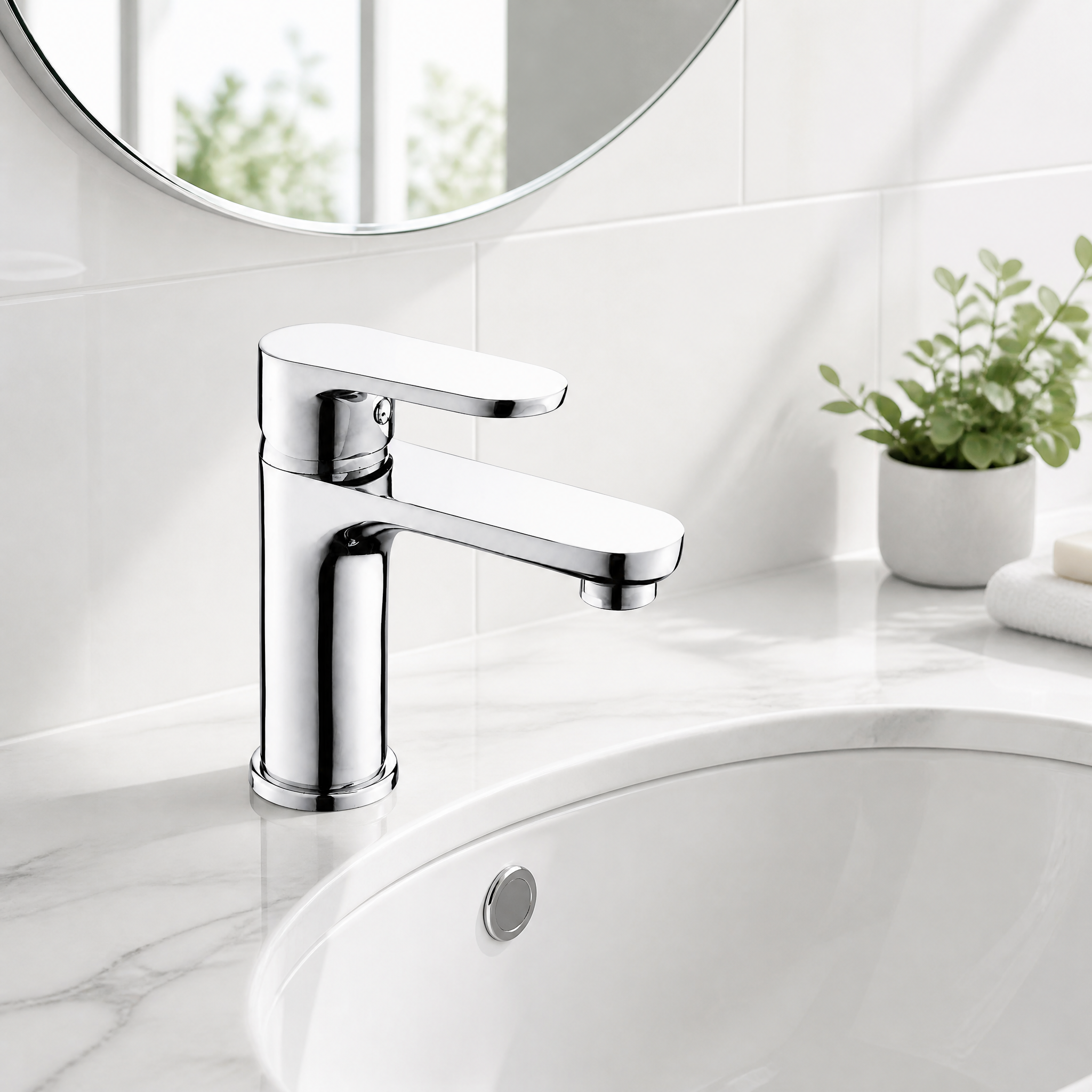
Model 35801-515 is the concrete reference product used throughout this guide. It is a brass basin mixer built around a 35 mm Wanhai cartridge and a Tucai flexible hose connection, with the body made primarily of DZR brass, which denotes dezincification-resistant brass. In project terms the cartridge and hose are the two components that most often determine whether a faucet still feels correct after years of daily operation, because the cartridge governs shut-off and handle resistance while the hose connection governs installation reliability.
| Specification item | Documented value for model 35801-515 |
|---|---|
| Product type | Brass basin faucet, hot and cold mixer, deck mounted |
| Body material | Brass, primarily DZR brass |
| Key components | 35 mm Wanhai cartridge; Tucai hose |
| Finish and coating | Chrome colour; chrome layer above 0.3 µm; nickel layer above 10 µm |
| Net weight | 1.04 kg |
| Listed standards | CE; TUV |
| Order terms | MOQ 400 pcs; OEM and ODM acceptable; 5-year warranty |
The coating figures are worth reading as a project statement rather than a marketing line. Nickel at more than 10 µm sits under a chrome layer of more than 0.3 µm, and that layered structure is what resists the humid, cleaning-agent-heavy environment of a bathroom. For a hotel or commercial restroom schedule, where the visible surface is judged by guests and cleaned daily by staff, this is a directly relevant specification item and should be written into the purchase specification rather than left to the supplier's default.
How the Technical Fit Holds Inside a Project Water System
The application record defines the operating envelope for this basin faucet as 0.5 MPa to 2 MPa water pressure, in hand-control mode, with the faucet acting as the water-control device within a water system and requiring supporting equipment such as that system. It also lists two special requirements for the application: corrosion resistance in a high-humidity bathroom environment and lead-free construction.
Those conditions translate into four checks that a project team can perform before ordering.
- Pressure at the outlet. The declared envelope starts at 0.5 MPa. A point that runs well below the lower end, for example on an upper floor of an older building with an inadequate booster arrangement, is a plumbing question that should be resolved before the faucet is specified, not after installation.
- Supply arrangement. A hot and cold mixer assumes both a hot and a cold supply at that point. Where only a cold line reaches the basin, a mixing model adds function the outlet cannot use, and the specification should reflect the actual supply.
- Deck and access. Deck mounting requires a sound deck surface of the correct hole size and thickness, plus enough space underneath for the connection and for future cartridge service. Access is often overlooked in renovation work and is expensive to correct later.
- Material and finish durability. The designated brass body, the DZR brass construction and the layered nickel-chrome finish address the humidity and lead-free requirements listed for the application. Whether a specific destination market accepts the documented material and finish route is a separate compliance question that should be answered with the certificate for the exact model.
Where Water Saving Connects to High-End Positioning
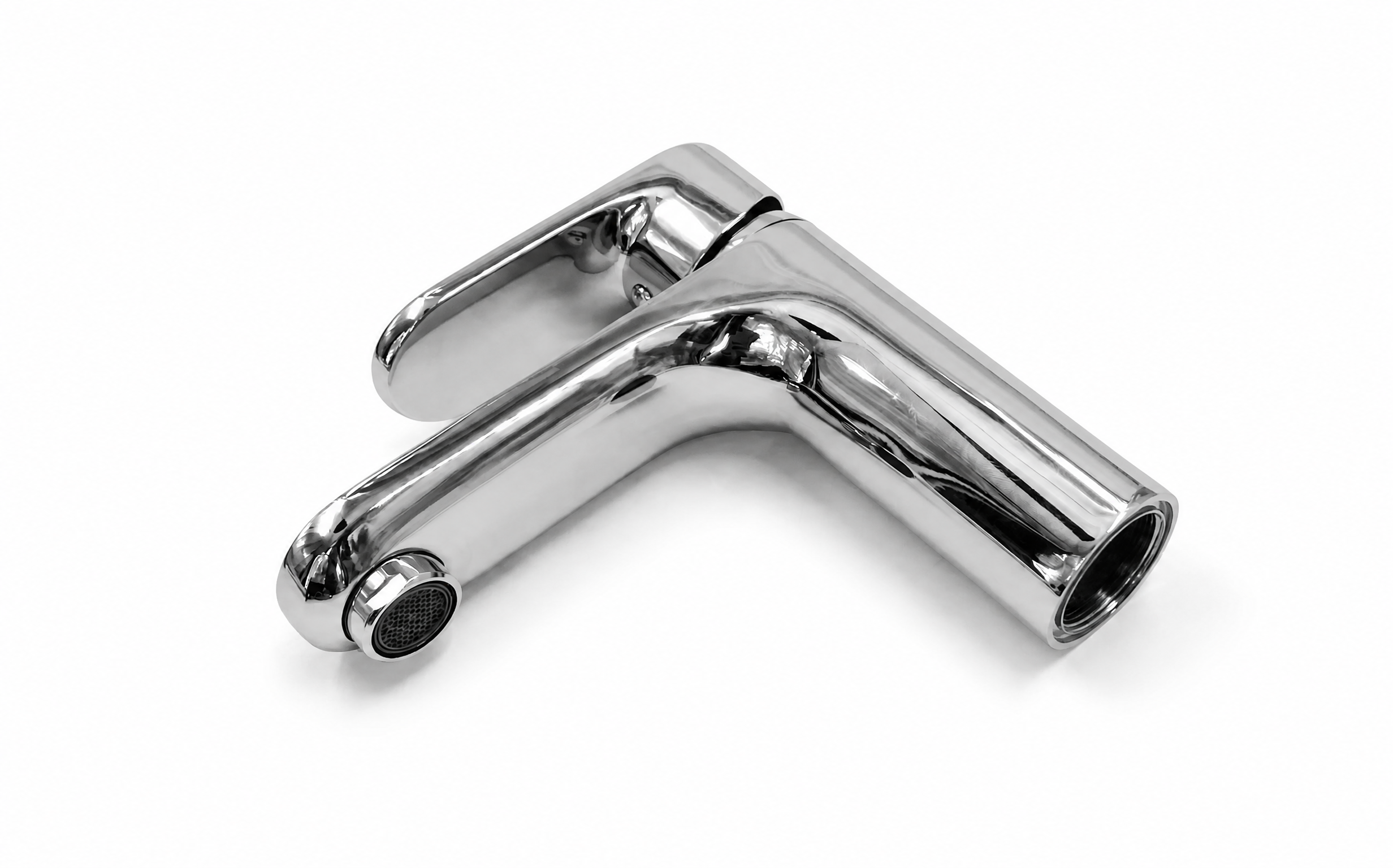
The case record behind this product is short and specific: the project achieved water-saving results and supported high-end market development and project development, and water-saving requirements could be met while supporting high-end market development and project-based business growth. In buyer language, the faucet satisfied a resource-efficiency requirement without forcing the project to accept a visibly cheaper fixture in the bathroom.
That combination is the reason water saving belongs in a scenario discussion rather than in a stand-alone product claim. In high-end project work, a water-saving requirement is usually written into the client brief or the consultant's specification as a condition of acceptance. Meeting it is a gate, not a differentiator by itself. What separates suppliers at that point is whether the fixture still satisfies the finish, feel and durability expectations that the same client has set for the bathroom, and whether the documentation can be handed to the consultant without further explanation.
Boundary condition worth stating plainly: the supplied product and case records describe water-saving results at project level but do not publish a flow-rate value for model 35801-515. A project team specifying the model should therefore obtain the flow-rate figure and the supporting test reference for that exact model and destination market, instead of carrying a number across from another faucet in the same range.
The analysis also has a limit on the other side. A faucet enables water saving at the outlet; it does not determine total building consumption by itself. Consumption depends on usage patterns, system pressure, maintenance and the rest of the sanitary installation. Buyers evaluating a water-saving claim should ask which of those variables the supplier is addressing and which belong to the project.
Fit Boundaries: Where This Configuration Is Not the Default Choice
A fit guide is only credible if it says where a model stops being the right answer. For model 35801-515, four boundaries are worth stating before a specification is written.
- Cold-only outlets. Where the basin is served by cold water only, a hot and cold mixer does not add usable function. A single cold tap is the simpler and more honest specification for that point.
- Concealed installations. The model is deck mounted, so the valve and mixing body sit above the basin rather than inside the wall. Projects designed around concealed faucet bodies belong to a different installation family; Ehoo's published product line lists concealed faucets as a separate category, and the choice should be made at design stage, not at order stage.
- Touchless requirements. Operation here is by hand. Where a project standard requires sensor-activated delivery, the appropriate comparison is within the sensor category, which Ehoo also lists as a separate product line, rather than a manual model with added accessories.
- Basin geometry. Spout height and reach must be checked against the actual basin. A configuration dimensioned for a standard inset basin is not automatically suited to a deep vessel bowl, and the model drawing, not the photograph, should settle that question.
Material choice follows the same logic. Brass and stainless steel together accounted for 78% of total material usage in the faucet market in 2023, according to Grand View Research, so both are mainstream routes rather than niche alternatives. Within a given project, the decision between a brass basin faucet and a stainless basin faucet should follow the finish scheme, the water chemistry and the specification the consultant has already accepted, not a general preference for one metal.
Supplying Projects Through OEM, Wholesale and Supermarket Channels
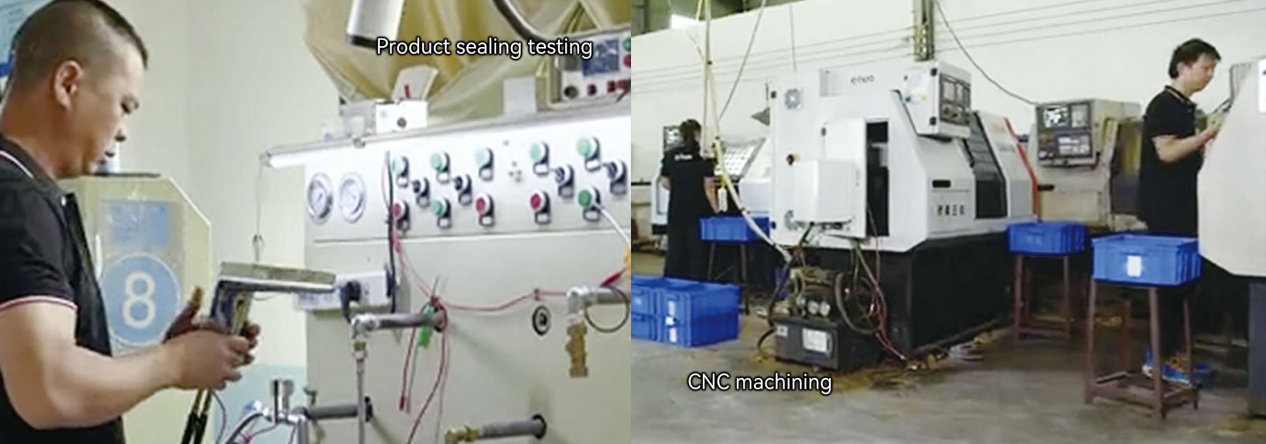
The same product reaches projects through three different commercial routes, and each route places different demands on the manufacturer. Ehoo's capability record sets out the terms that apply across all three: OEM and ODM production, customization covering packaging, logo, faucet body, faucet parts and sanitary accessories, a monthly capacity reported at 150,000 units, 100% testing, export to global markets, remote technical support and a 5-year warranty on the body.
| Channel | Typical requirement | What the supplier record supports |
|---|---|---|
| OEM and ODM partners | Private-label identity, packaging and component-level variation, stable repeat production | OEM and ODM accepted; customization of package, logo, faucet body, faucet parts and sanitary accessories |
| Wholesale distributors | Model continuity, mixed-model container planning, predictable replenishment | Standard MOQ from 400 pcs per model; company-reported monthly capacity of 150,000 sets; 100% testing |
| Construction supermarket buyers | Retail-ready packaging, documentation packs, warranty terms that can be published to end buyers | Packaging customization; certificates of analysis and conformance, insurance and origin documents where required; 5-year warranty on the body |
The case record behind this model covers exactly these buyer types, describing OEM and ODM, wholesale and construction supermarket customers working in bathroom applications, with a commercial reference of USD 20,000+ order value and a five-year relationship duration. It also records the outcome as water saving combined with high-end market development and project development. Read together, those two facts describe a supply relationship rather than a single transaction: the model was specified, supplied and repeated.
Two practical notes for channel buyers. First, the standard MOQ of 400 pieces per model sits alongside an order-value reference of USD 20,000+, so a distributor planning a mixed-model container should map the model mix before committing to a volume. Second, the factory holds ISO 9001:2015 quality management, ISO 45001:2018 occupational health and safety, ISO 14001:2015 environmental management and ISO 14067:2018 product carbon footprint system certification, together with TUV certification and EN817:2008 documentation. Those system certificates support a supplier qualification file, but they are not a substitute for the model-level CE and TUV documents that a consultant will ask for.
A Pre-Order Verification Checklist
The following checks turn the scenario discussion into an order that can be defended at a project review. Each item is answerable with documents rather than assurances.
- Confirm the outlet arrangement: hot and cold supply present, or cold only.
- Measure working pressure at the point and compare it with the 0.5 MPa to 2 MPa envelope.
- Confirm deck hole size, deck thickness and access below the basin for cartridge service.
- Match spout height and reach to the basin drawing, particularly for vessel bowls.
- Request the CE and TUV certificate copies and check that the model reference matches 35801-515.
- Request flow-rate documentation for the exact model and confirm it against the destination market's requirement.
- Confirm the finish specification and the coating values in writing, including chrome above 0.3 µm and nickel above 10 µm.
- Agree the packaging, logo and accessory scope if the order is private label, and confirm the MOQ of 400 pcs per model.
- Confirm warranty terms, at 5 years on the body for this model, and the service route for replacement cartridges.
- For first orders, request samples, with a sample lead time of about seven days, and approve the sample before mass production.
Market Context and a Bounded Outlook
The wider faucet market provides context for why bathroom project work attracts so much specification attention. Grand View Research projected the global faucet market to grow from USD 26.8 billion in 2026 to USD 45.5 billion by 2033, a compound annual growth rate of 7.8%. The same source reported that bathroom faucets accounted for approximately 59.1% of total faucet market revenue share in 2025, and that brass and stainless steel accounted for 78% of total material usage in 2023.
Two qualifications keep those figures useful. First, they describe the faucet market as a whole rather than basin faucets alone, so they indicate the direction and weight of the bathroom segment rather than a basin-faucet-specific volume. Second, they are forecasts and reported shares from a commercial research source, not observed shipment data for any individual supplier.
Read carefully, the implication for project buyers is a shift in what the specification has to carry. When the bathroom segment dominates a growing category, choice widens and price competition intensifies, and the practical differentiator moves towards documented fit: the certificate that matches the model, the coating value that matches the humidity, the pressure envelope that matches the building, and the supply relationship that survives a multi-phase handover. For a manufacturer working through OEM, wholesale and supermarket channels, that means the qualification file becomes part of the product.
Frequently Asked Questions
What material are Ehoo basin faucets made of?
Most Ehoo faucet bodies are made of brass, and the reference model 35801-515 uses DZR brass as its primary body material. The surface carries multi-layer electroplating for corrosion resistance and durability, with a nickel layer above 10 µm beneath a chrome layer above 0.3 µm on this model. The spout aerator and handle components use engineering plastics or stainless steel as auxiliary materials.
Is model 35801-515 suitable for hotel and commercial restroom projects?
Yes, within its configuration. The product record lists residential construction, hotel, commercial restroom and bathroom renovation as its applications, and describes it as a hand-operated hot and cold mixer for residential and commercial settings. It is not a touchless fixture and it is not a concealed valve assembly, so projects requiring either of those should specify within those categories instead.
What is the minimum order quantity, and which documents can be supplied?
The standard MOQ starts from 400 pieces per model, and a commercial reference of USD 20,000+ order value appears in the case record for OEM, wholesale and construction supermarket buyers. Documentation available on request includes certificates of analysis and conformance, insurance, origin and other export documents where required.
How long do samples and production take?
Sample lead time is about seven days. For mass production, the schedule becomes effective once the deposit has been received and the final product specification has been approved; the applicable production window is confirmed in the quotation for the specific model and quantity.
What warranty applies to the brass basin mixer?
Model 35801-515 carries a 5-year warranty, and Ehoo's published terms state a 3 to 5 year warranty depending on the product series, with 5 years on the body under the capability record. Remote technical support is provided in addition to the warranty.
Conclusion
For high-end bathroom projects, the useful question is not whether a brass basin faucet is water-saving in general, but whether this model, at this outlet, under this pressure, with this documentation, meets the scenario it was specified for. Model 35801-515 answers that question for deck-mounted, hand-operated, hot and cold bathroom installations in hotels, commercial restrooms, residential construction and renovation work, with CE and TUV certification, a 35 mm Wanhai cartridge, a Tucai hose connection and a DZR brass body behind it. Where the scenario calls for concealed valves, touchless operation or a cold-only supply, the honest answer is a different configuration — and knowing that before the purchase order is the point of a fit guide.
Ehoo's 2025-2026 product catalogue, covering faucet ranges and specifications, can be downloaded here: Ehoo product catalogue 2025-2026 (PDF).
Tem questões ou precisa de mais detalhes?
Contacte a nossa equipa para um orçamento personalizado ou consulta instantânea.
Solicitar orçamento
Preencha o formulário abaixo e a nossa equipa entrará em contacto com uma proposta personalizada.
Chat direto do WhatsApp
Prefere conversar em tempo real? Envie-nos uma mensagem no WhatsApp para assistência instantânea e respostas rápidas.
- Obter orçamento personalizado
- Partilhar fotos ou documentos
- Discuta as suas necessidades diretamente
Geralmente responde em 5–30 minutos durante o horário de expediente.