
Waterproof Connector Accessories: Nylon Cable Gland IP68 FAQ
Waterproof Connector Accessories: Nylon Cable Gland IP68 FAQ
An evaluation-stage reference for buyers specifying nylon cable glands, waterproof boxes and solar MC4 connectors — covering structure, materials, temperature limits, thread systems and the certificates that can actually be verified.
Waterproofing an electrical enclosure is rarely decided by the enclosure itself. In most field failures, water enters at the cable entry: the gland, plug or connector that carries conductors through the wall of a box, cabinet, inverter or charging pile. The global cable glands market was valued at approximately USD 2.16–2.25 billion in 2024–2025, with published forecasts ranging from USD 3.07 billion to USD 4.96 billion by 2034 (Straits Research; Spherical Insights). The broader waterproof connector market was valued at approximately USD 13.4 billion in 2024 and projected to reach USD 25.48 billion by 2033 at a 7.4% CAGR (AOHUA / Industry Intelligence). Estimates differ by scope, but the direction is consistent: cable entry components are being specified and verified more carefully than they were a decade ago.
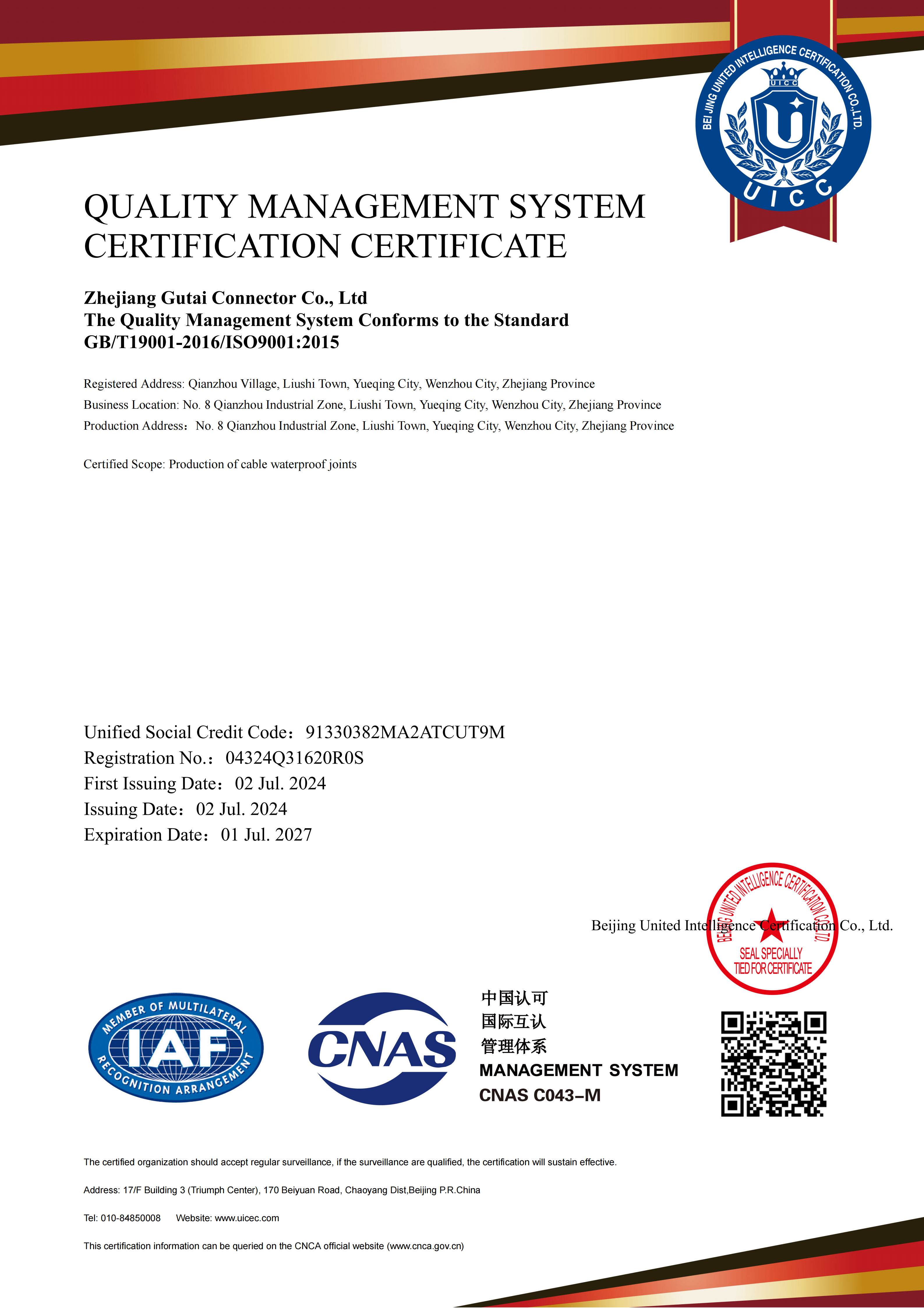
Cover: ISO 9001:2015 quality management system certificate, scope: production of cable waterproof joints. Document reference: registration no. 04324Q31620R0S.
This article is written for buyers already inside the evaluation stage. They know they need waterproof electrical connector accessories; what they need now is to compare structures, material systems, temperature envelopes, thread standards and certificate scopes before committing to a supplier or a series. The answers below use documented product and certification facts, and they state plainly where a claim ends.
What the Category 'Waterproof Electrical Connector Accessories' Actually Includes
The category is broader than the name suggests, and buyers who treat it as a single SKU usually end up with mismatched sealing levels. In practice it covers several distinct functions:
- Cable glands — the panel-entry fitting that grips and seals a cable as it passes through an enclosure wall. Sub-types include plastic / nylon glands and machined brass glands, in metric and PG thread systems, plus EMC and multi-hole variants.
- Cable gland screw plugs — used to close unused threaded entries and keep the enclosure's ingress protection intact.
- Waterproof vent plugs — pressure-equalisation elements that allow air movement while restricting water and dust.
- Watertight corrugated connectors and flexible pipe connectors — the interface between conduit systems and enclosure entries.
- Mini waterproof boxes and connectors, including the M16, M20 and M25 waterproof box sizes used for small junction and distribution points.
- Solar connector MC4 — plug-and-socket DC connectors for photovoltaic strings, including Y-type and T-type configurations for branching and tapping a string.
Zhejiang Gutai Connector Co., Ltd. is a manufacturer of wire and cable connectors based in Liushi Town, Yueqing City, Wenzhou, Zhejiang, China, operating a 5,000 m² facility with 80 employees, a 10-engineer engineering team and an annual output of 10,000,000 units, of which roughly 80% is exported to markets including the Middle East, Southeast Asia, India, Pakistan, the EU, the United Kingdom and the USA. Its catalogue spans waterproof cable glands, EMC cable glands, porous cable glands, brass screw caps, watertight corrugated tubing fittings, mini waterproof boxes and solar MC4 connectors — a structure that lets a buyer cover power, signal and communication entries from one series rather than assembling three (gt-connector.com).
Where Sealing Performance Actually Comes From
A gland does not seal because its shell is tight; it seals because a deformable element is compressed against the cable jacket and the enclosure wall at the same time. In a typical nylon cable gland, tightening the body nut drives a special clamping claw down onto the cable while a rubber sealing element is compressed radially around the jacket. The claw provides strain relief and anti-loosening behaviour, while the seal provides the water and dust barrier. Both functions have to hold, because a gland that seals but does not grip will eventually leak as the cable moves.
Higher-specification designs extend this logic with dual seal rings and an anti-loosening structure, so that the seal remains compressed under vibration. This distinction — single seal versus dual seal plus anti-loosening geometry — is one of the few structural differences that can be checked from a drawing before any sample is ordered, and it is directly linked to how the fitting behaves after months of thermal cycling and mechanical vibration.
Material System and Temperature Envelope
Nylon cable glands in this family are moulded from polyamide PA66, with NBR used for the rubber sealing element. PA66 is specified for its combination of mechanical toughness, dielectric strength and resistance to many common industrial oils and dilute chemical exposures; NBR is used for its oil resistance and stable compression set behaviour across normal industrial temperatures. Brass and stainless steel versions are available where higher mechanical strength, higher temperature tolerance or a metal-to-metal interface is required.
| Operating condition | Documented range |
|---|---|
| Dynamic use (cable subject to movement or flexing) | −20 °C to +80 °C |
| Static use (fixed installation) | −40 °C to +100 °C |
| Short-term peak exposure | up to +120 °C |
For outdoor installations, the material question is not only temperature but ultraviolet exposure. UV-resistant modified PA66 housings in this range have been tested to a 1,000-hour UV ageing protocol, and silicone or fluororubber seals have been assessed after 500 hours at 100 °C with a hardness increase of only 5 Shore A and no cracking. Those two data points matter more to a 20-year outdoor asset than the headline IP number, because seal hardening — not shell cracking — is the usual first sign of a degrading cable entry.
Thread Systems and Size Ranges
Thread compatibility is where most cross-border sourcing errors happen. The two dominant systems in this product family are metric (M) and PG, and a supplier who covers only one of them will force a buyer into adapters, which add a second sealing interface and a second failure point.
| Thread system | Available sizes | Cable range | Thread O.D. | Thread length |
|---|---|---|---|---|
| Metric | M12 – M63 | 3 – 45 mm | 12 – 63 mm | 9 – 21 mm |
| PG | PG7 – PG48 | 3 – 45 mm | 12.5 – 59.3 mm | 9 – 21 mm |
Beyond the metric and PG ranges, thread standards spanning PG, Metric, NPT and G-type interfaces are available so that power, signal and communication entries can be standardised from a single source. For buyers maintaining equipment across several regions, that breadth is usually the difference between one inventory line and four.
Certification: What a Buyer Can Actually Verify
Certification is the field where supplier claims and supplier documents diverge most often. The relevant international framework for cable glands is IEC 62444 (and its European adoption, EN 62444), which governs construction and performance requirements for cable glands used in electrical installations and replaced the older BS EN 50262. Ingress protection ratings such as IP68 are defined separately under IEC 60529, which requires a device to withstand continuous immersion in water under specified conditions. Neither standard is self-declaring: both are demonstrated through test documentation issued by a recognised body.
The documents below are the kind of evidence a buyer should request, and each carries a scope that can be checked line by line.
| Document | Standard | Scope as documented | Issuing body |
|---|---|---|---|
| Notice of Completion (NoC), File E539858, Volume 1 | UL 514B | Liquid-Tight Flexible Cord Fittings (QCRV series); full catalogue numbers listed in the appendix | UL Solutions |
| Certificate of Compliance, TST20241202520-1SC | EN 62444:2013 | Nylon cable gland, Model M; series G, MG, PG, NPT | Dongguan True Safety Testing Co., Ltd. |
| SGS test report NGBEC26005747401 | EU RoHS Directive (EU) 2015/863 | Nylon cable gland, EU market | SGS-CSTC Standards Technical Services (Ningbo) Co., Ltd. |
| Quality management system certificate 04324Q31620R0S | GB/T 19001-2016 / ISO 9001:2015 | Production of cable waterproof joints; valid 2024-07-02 to 2027-07-01 | Beijing United Intelligence Certification Co., Ltd. |

SGS test report NGBEC26005747401 covering nylon cable glands under EU RoHS Directive (EU) 2015/863.
Two clarifications are worth adding for evaluation-stage buyers. First, CE marking in this product family is demonstrated through compliance with a harmonised standard — here EN 62444:2013 — not through a single universal certificate; the certificate number, the model and the series list are what make it checkable. Second, RoHS and REACH are restricted-substance regimes rather than performance standards: they confirm material composition, not sealing behaviour. For the core product range, CE, RoHS, REACH and IP68 protection testing are documented, with operating conditions from −40 °C to +120 °C and an average MTBF exceeding 8,000 hours stated for the tested configuration.
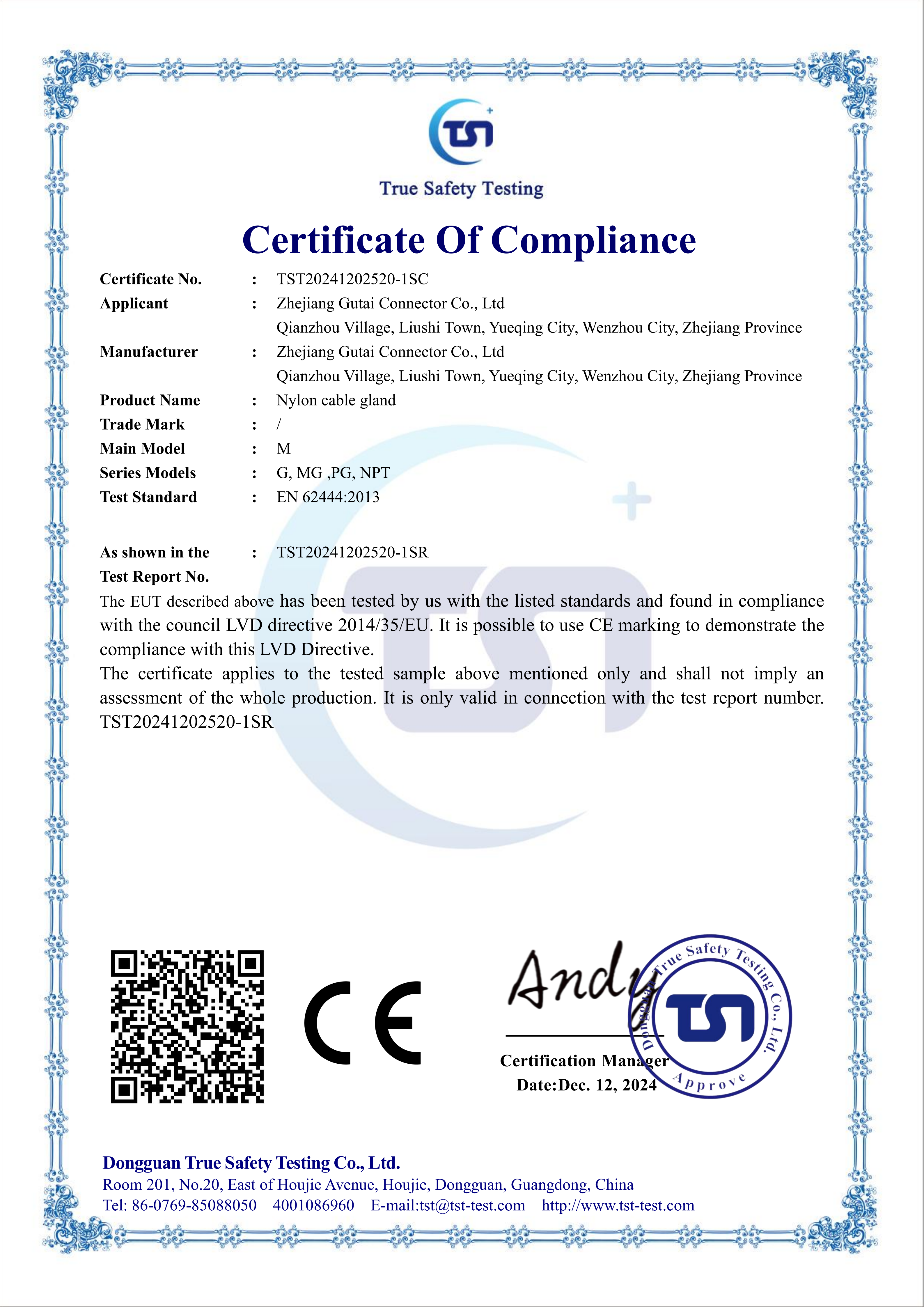
CE Certificate of Compliance TST20241202520-1SC, issued against EN 62444:2013 for nylon cable glands (Model M; series G, MG, PG, NPT).
Where These Accessories Are Deployed, and What Field Data Shows
The application envelope for IP68 cable entry components is defined by outdoor and variable-humidity environments: photovoltaic plants and panel entries, wind turbine cable outlets, EV charging stations and distribution boxes, energy storage cabinets, rail transit and telecom wiring, and general industrial control cabinets and conduit systems. In each case the accessory has to do four jobs simultaneously — seal the entry, block dust, fix the cable mechanically, and relieve strain so that the electrical connection stays stable for the life of the asset.
Two field references illustrate what the difference looks like when the specification is adjusted to the environment.
Coastal EV charging in Europe
A coastal open-air DC fast-charging project in Germany required connectors that could survive high salt fog, strong sea wind and continuous vibration. The documented problem was that conventional IP67 connectors failed through water ingress within six months in that coastal environment. The deployed solution used IP68-rated metal waterproof connectors built with 304 stainless steel and a dual-seal anti-loosening structure, tested to 1,000-hour salt spray exposure and to IEC 60068-2-6 vibration conditions. Across the first batch of 5,000 sets and an 18-month observation window, connector-related electrical failure fell from 18% annually to 2.6%, annual maintenance cost per station dropped from over 500 RMB to below 80 RMB, and new-station installation efficiency rose by 35%.
Desert PV plant in the Middle East
A large Middle Eastern PV developer ordered 20,000 sets of anti-UV modified PA66 photovoltaic connectors for a 150 MW desert plant. Housings were tested to 1,000-hour UV ageing, seals used high-temperature fluororubber to remain stable under 70 °C surface heat and wind-sand erosion, and silver-plated terminals kept contact resistance low. Over a three-year period, connector damage rate fell from 8% annually for the previously imported product to below 1.2%, downtime caused by connection failures dropped by 70%, and cumulative maintenance and generation-loss savings exceeded USD 80,000.
Market Structure and Trend Signals for Evaluation-Stage Buyers
Two structural facts shape how buyers should read supplier offers in this category. First, Asia Pacific accounts for approximately 38–42% of global cable gland revenue, driven mainly by industrialisation in China and India (Dataintelo; Straits Research) — which means regional manufacturing depth is high, and price comparisons between regions are not automatically quality comparisons. Second, the solar connector segment is highly concentrated: the solar PV connector market was valued at USD 1.31 billion in 2024, and MC4 connectors hold approximately 68% of that segment, worth roughly USD 0.89 billion (Global Market Insights). MC4 compatibility therefore functions as a de facto standard for PV string connections rather than a differentiating feature.
At the global supply level, established competitors in cable glands and connectors include ABB Ltd., Eaton Corporation, Amphenol Corporation, LAPP Group and HUMMEL AG (Mordor Intelligence; Market Growth Reports). Buyers evaluating a regional specialist against these names are usually comparing a narrower product line and a shorter certification list against broader portfolios and longer qualification histories — a trade-off to be assessed on document scope, not on brand familiarity alone.
Limitations and Trade-offs Buyers Should Plan For
A credible specification conversation has to include where a product stops working. Four boundaries apply to this category.
- Nylon is not a universal substitute for metal. PA66 glands are light, corrosion-resistant and electrically insulating, but machined brass and stainless steel versions offer higher mechanical strength and a higher temperature ceiling. For high-vibration machinery, high-temperature zones or mechanically exposed entries, a nylon gland may be the wrong choice even when its IP rating is identical on paper.
- IP68 is conditional on installation, not a permanent property of the part. The rating holds only when the cable outside diameter sits inside the gland's clamping range, the sealing element is present and undamaged, and the nut is tightened to the intended compression. A correctly rated gland installed on an under-sized cable will leak.
- Certificate scope is narrower than catalogue scope. The UL 514B Notice of Completion in this documentation covers Liquid-Tight Flexible Cord Fittings (QCRV series) and lists specific catalogue numbers in its appendix. It should not be read as covering every item a supplier sells. The same logic applies to CE certificates, which name specific models and series.
- Chemical resistance depends on the medium, concentration and temperature. PA66 and NBR behave well against many industrial oils and dilute chemicals, but aggressive solvents, concentrated acids and certain fuels require separate material verification — and no gland is suitable for every medium.
A fifth, more commercial limitation is supply flexibility. Documented production capacity in this range is 500,000 cable glands and 100,000 MC4 sets per month, with lead time quoted against order quantity and small trial orders accepted. That combination allows a first article and sample validation stage before volume commitment, which is the practical way to test the limits above against a specific installation rather than against a datasheet.
Future Outlook
Two forces are likely to tighten specification practice over the next few years. On the demand side, growth in utility-scale PV, energy storage and coastal or high-humidity EV charging infrastructure keeps pushing cable entry components into environments where a generic IP67 assumption is no longer sufficient — which is why IP68-rated, UV-tested and salt-spray-tested accessories are increasingly written into project bills of materials rather than left to the installer. On the supply side, buyers are shifting from certification presence to certification scope: they ask which model, which series and which standard, not simply whether a certificate exists. Documentation discipline is becoming a procurement criterion in its own right.
FAQ: Nylon Cable Glands, IP68 Sealing and Certified Performance
1. What is a nylon cable gland, and how does it differ from a plastic or brass cable gland?
A cable gland is a mechanical fitting that carries a cable through the wall of an enclosure while providing strain relief, sealing and, in some designs, electrical continuity. 'Nylon cable gland' and 'plastic cable gland' are frequently used interchangeably in catalogues; the precise description is a gland whose body is moulded from polyamide PA66. Brass cable glands use a machined metal body, which generally provides higher mechanical strength and a higher temperature ceiling. Nylon remains the common choice for outdoor and general industrial entries because it is light, corrosion-resistant, non-conductive and available across a wide cable range. Gutai's nylon range covers both metric and PG thread systems.
2. What does IP68 actually mean for a cable gland?
IP68 is defined under IEC 60529 and requires the device to withstand continuous immersion in water under specified conditions. The rating does not state a depth or duration by itself — the specified conditions are set by the manufacturer and should be documented. For a cable gland, IP68 performance is only valid when the cable diameter falls inside the gland's clamping range, the sealing element is present and undamaged, and the compression nut is tightened as intended. This is why the same IP68 gland can perform well on one cable and leak on another.
3. What temperature range can PA66 nylon cable glands handle?
Documented operating ranges for this product family are −20 °C to +80 °C in dynamic use, where the cable is subject to movement or flexing, and −40 °C to +100 °C in static, fixed installation, with short-term peak exposure up to +120 °C. For outdoor assets, temperature is only part of the question: UV-resistant modified PA66 housings have been tested to a 1,000-hour UV ageing protocol, and silicone or fluororubber seals have been assessed after 500 hours at 100 °C with a hardness increase of only 5 Shore A and no cracking.
4. Which thread sizes and cable ranges are available for metric and PG cable glands?
The metric series spans M12 to M63 with a cable range of 3–45 mm, thread outside diameter of 12–63 mm and thread length of 9–21 mm. The PG series spans PG7 to PG48 with the same 3–45 mm cable range, thread outside diameter of 12.5–59.3 mm and thread length of 9–21 mm. Thread standards spanning PG, Metric, NPT and G-type interfaces are also available, which allows power, signal and communication entries to be standardised from one source rather than adapted.
5. Which certifications should a buyer verify before approving a waterproof connector supplier?
For cable glands, the governing construction and performance standard is IEC 62444, adopted in Europe as EN 62444, which replaced BS EN 50262. Ingress protection ratings are defined separately under IEC 60529. Verifiable documentation in this range includes a UL Notice of Completion (File E539858, Volume 1) against UL 514B, a CE Certificate of Compliance (TST20241202520-1SC) against EN 62444:2013, an SGS test report (NGBEC26005747401) against EU RoHS Directive (EU) 2015/863, and an ISO 9001:2015 quality management system certificate (04324Q31620R0S) valid to 2027-07-01. REACH and IP68 protection testing are also documented for the core range.
6. Does a UL 514B Notice of Completion cover every cable gland in a supplier's catalogue?
No. The UL 514B Notice of Completion referenced here applies to Liquid-Tight Flexible Cord Fittings in the QCRV series, and the full catalogue numbers are listed in the document's appendix. Any product not listed in that appendix is outside the scope of that document, even if it is sold by the same manufacturer. Buyers should match the exact catalogue number of the intended part against the appendix rather than accepting a general statement that the supplier is 'UL approved'. The same scope logic applies to CE certificates, which name specific models and series.
7. How is a nylon cable gland constructed to keep water out?
The sealing action comes from compression, not from the shell. Tightening the body nut drives a special clamping claw onto the cable while a rubber sealing element is radially compressed against the cable jacket and the enclosure wall. The claw supplies strain relief and anti-loosening behaviour; the seal supplies the water and dust barrier. Higher-specification designs add dual seal rings and an anti-loosening structure so that the seal stays compressed under vibration, which is the configuration used in coastal and high-vibration installations.
8. How should a buyer choose between nylon, brass and stainless steel cable glands?
The decision is driven by environment and mechanical load rather than by IP rating, because the rating can be identical across all three. Nylon PA66 suits general industrial, outdoor and enclosure entries where light weight, corrosion resistance and electrical insulation are priorities. Brass is appropriate where higher mechanical strength or a higher temperature ceiling is required. Stainless steel, such as 304, is appropriate for marine, coastal and high-corrosion environments. Buyers should match the material to the worst-case condition of the installation rather than to the average condition of the site.
9. How do solar MC4 connectors differ from cable glands, and when are Y-type or T-type versions used?
They serve different functions. A cable gland is a panel-entry sealing and strain-relief fitting; an MC4 connector is a plug-and-socket DC connector for photovoltaic strings. Documented MC4 specifications in this range include rated voltage of 1000 V DC, rated current of 30 A and 45 A depending on conductor size, test voltage of 6 kV at 50 Hz for one minute, contact resistance of 0.5 mΩ, IP67 protection, safety class II, UL-94-V0 flammability rating, tin-plated or silver-plated copper terminals and PC/PPO insulation housings. Y-type and T-type connectors are used to branch or tap a string where a single cable run must feed two paths.
10. Which applications benefit most from IP68-rated accessories?
IP68-rated cable entries are specified where moisture, dust and temperature variation are continuous rather than occasional: photovoltaic plants and panel entries, wind turbine cable outlets, EV charging stations and distribution boxes, energy storage cabinets, rail transit and telecom wiring, industrial control cabinets, and conduit or corrugated tubing systems. In all of these, the accessory must seal the entry, block dust, fix the cable mechanically and relieve strain at the same time. Where a site is also exposed to salt fog or sand erosion, the seal material and housing formulation matter as much as the IP number.
11. How can a buyer verify long-term outdoor reliability before placing a volume order?
Sample validation is the practical route, because IP ratings and datasheets do not describe ageing behaviour. Buyers should request the specific test evidence that matches the deployment environment — UV ageing data for desert or high-irradiance sites, salt spray and vibration data for coastal or transport-exposed sites, and seal ageing data for high-temperature zones. Field references are equally useful: in a German coastal EV charging project, IP67 connectors failed through water ingress within six months before IP68 metal connectors with a dual-seal structure were adopted, and connector-related failure subsequently fell from 18% annually to 2.6%.
12. What supply factors matter in supplier evaluation beyond product specification?
Capacity, flexibility and quality control decide whether a specification can be delivered repeatedly. Documented capacity in this range is 500,000 cable glands and 100,000 MC4 sets per month, with lead time quoted against order quantity and small trial orders accepted. Customisation covers size and thread specifications, materials including nylon, brass and stainless steel, colour, packaging and OEM labelling, multi-hole layouts and specific seal designs. Quality control includes 100% full dimension inspection, and returns or refunds are offered for quality-related problems.
13. Are China-market certifications such as CCC available for these products?
China-market certification requirements depend on the product family, the applicable compulsory certification catalogue and the channel through which the goods enter the market. Because certificate scope is written per product series and per standard, buyers sourcing for domestic Chinese projects should request the current certificate list and scope directly and match it to the exact model being purchased. A general compliance statement is not a substitute for checking the certificate number, the issuing body, the standard referenced and the series listed.
Third-party market and standard references used in this article: Straits Research and Spherical Insights (cable glands market size), AOHUA / Industry Intelligence (waterproof connector market), Global Market Insights (solar PV connector market and MC4 share), Dataintelo (Asia Pacific regional share), IEC 62444 / EN 62444 and IEC 60529 (cable gland and ingress protection standards), Mordor Intelligence and Market Growth Reports (global competitor identification). Product, capacity, certification and field-case facts are drawn from manufacturer documentation.