
Waterproofing and Texture vs. Budget: A 2026 Buyer Framework
Wall-finish budgets are rarely lost on the material line. They are lost two renovation cycles later, when a surface that looked acceptable on day one has to be stripped, prepared and re-coated, and the original saving is spent a second time with schedule risk added on top.
That is the argument this framework is built on. Two product characteristics sit on one side of the ledger: how a wall behaves when water reaches it, and how much tactile depth the surface carries. The purchase price sits on the other. Most specification debates collapse one side of that ledger into a single number and lose the comparison entirely.
The premise here is concrete. Nockybrothers New Material (Wujiang) Co., Ltd. is a manufacturer of wallpaper, wall covering and Grade 5 Waterproof Finished Art Paint, founded in 2012 and headquartered in Wujiang District, Suzhou City, with an 8,000 ㎡ plant and an annual output of 1,200,000 ㎡. Within the company's own product positioning, the Grade 5 waterproof art paint wall cloth carries a material cost roughly 15% above a conventional painted-wall baseline, and a stated service life twice as long as that baseline. The framework below is a way to test whether that exchange is worth taking in a specific project. It is not a reason to take it by default.

Surface depth is one half of the trade-off; water behaviour is the other. Both are specified before price is negotiated.
Why Re-Painting Frequency Is the Real Price Variable
The cost of a wall finish is not the purchase price. It is the purchase price multiplied by the number of times you buy it, plus the labour and disruption attached to each of those purchases.
A painted wall is not a one-time transaction; it is a repeating one. Paint films degrade under cleaning regimes, humidity cycling, abrasion in circulation zones and ultraviolet exposure. Each refresh cycle carries scaffolding or access costs, protection of adjacent finishes, downtime in occupied buildings, and in hospitality or residential handover situations, a vacancy cost that never appears on the material quotation at all.
This is why service life is the hinge of the entire decision. If a finish genuinely lasts twice as long as the baseline being replaced, the roughly 15% material premium is amortised across a period in which the alternative has already been purchased and installed a second time. If it lasts only marginally longer, the premium is a straight loss with no recovery path.
Service life is also the number buyers are least equipped to check. It is not printed on a carton, it is not comparable across suppliers who use different test conditions, and it is heavily influenced by substrate quality, adhesive choice and site conditions. Treating it as a fixed input rather than a claim to be interrogated is the most common error in this category.
What Grade 5 Waterproof Actually Constrains
Waterproof grade is frequently treated as a marketing badge. In practice it is a construction constraint. A finish achieves water resistance because of what it is built from, and those same materials determine how the surface feels, how it cleans and how it ages.
The Grade 5 Waterproof Finished Art Paint wall cloth in this category is built on non-woven fabric combined with eco-friendly water-based resin, nano inorganic mineral fillers, high-quality shell powder and a medical-grade base material. That layering is what allows a decorative finish to hold a textured, paint-like surface while remaining stable in high-humidity interior conditions, dust exposure and a working temperature range of roughly -10°C to 40°C.
The functional consequences are practical rather than promotional: moisture and mildew resistance, stain resistance with straightforward cleaning, a degree of sound absorption, and a permanent installation that requires no special maintenance regime. Buyers evaluating a waterproof claim should map it to those behaviours in their own building, not to the label alone.
Roll width belongs in the same conversation. Available widths of 2.8 m, 2.9 m and 3.1 m reduce the number of vertical seams on a typical wall height, which matters twice over: fewer seams means fewer joints where water can enter, and fewer cut-offs means less material waste on the order.
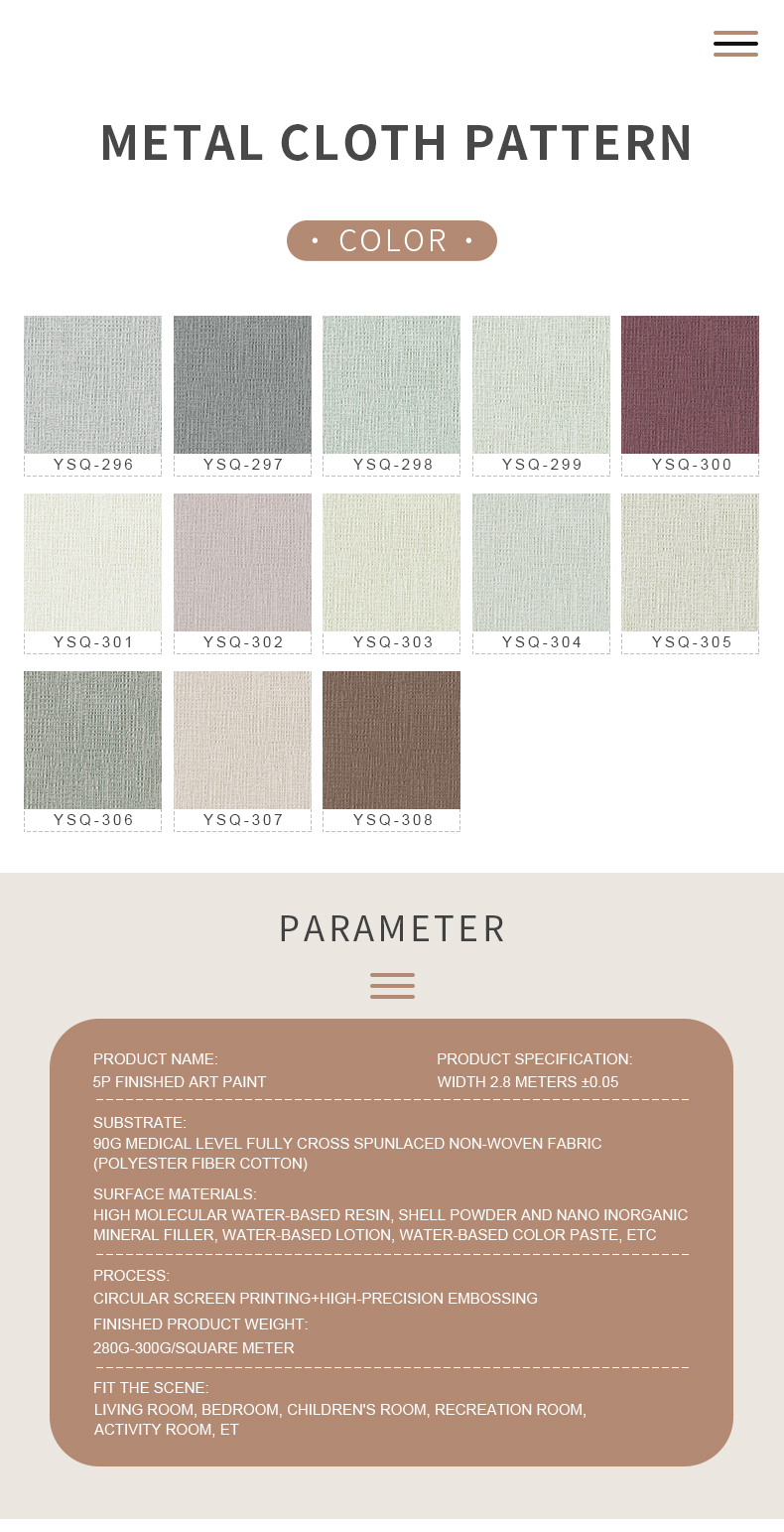
Texture depth is produced by the coating system, not applied on top of it. That distinction drives both appearance and cleaning behaviour.
The Framework: Five Variables That Decide the Trade-Off
The framework compares the two characteristics against budget across five variables. Each variable can be answered with evidence before a purchase order is issued.
| Variable | What the buyer measures | Effect on budget |
|---|---|---|
| 1. Service life and re-painting frequency | Stated life, test basis, warranty terms | Determines whether the premium is recovered at all |
| 2. Texture depth and design fit | Pattern family, emboss level, colour consistency | Cross-value against design intent, not a cost line |
| 3. Waterproof grade and cleaning regime | Humidity exposure, cleaning frequency, stain profile | Reduces replacement in wet or high-traffic zones |
| 4. Compliance and documentation | Certificate numbers, validity dates, scope | Gate for tender acceptance; blocks relaunch costs |
| 5. Supply terms | MOQ, lead time, width, warranty, QC | Sets working-capital and programme risk |
Variable 1 — Service Life and the Number of Repaint Cycles
Ask a supplier to state the life basis in writing, then ask two follow-up questions: against what comparison finish, and under what maintenance assumption. A doubling claim is only meaningful when the baseline is named and the maintenance regime is described, because a heavily washed corridor and an undisturbed bedroom wall age at completely different rates.
The supporting lever is warranty. Nockybrothers covers non-human damage with a 2-year quality warranty, supported by remote technical guidance and online construction instruction. A warranty period is not the same thing as a service life, but it is a contractual anchor that converts part of the life claim into something enforceable.
Variable 2 — Texture Is a Functional Specification, Not a Decoration
The texture side of the trade-off is usually discussed as aesthetics, which undersells it. In this category, texture determines perceived quality at hand-over, hides substrate imperfections that would otherwise need additional preparation, and, at sufficient depth, changes how the surface responds to grazing light and to cleaning abrasion.
The category spans several texture families that buyers can use as a design-to-cost filter: imitation paint texture surfaces, embossed art paint surfaces, plain-colour art wall cloth for minimal schemes, and the deeper relief options. Nockybrothers' product range is organised around named texture programmes — Dreamy Velvet, Glittering, Artistic Relief Sculpture, Desert Stroll, Roman Travertine and Jade Crystal — which is a practical way to map a specification intent to a producible surface rather than to a photograph.
Variable 3 — Waterproof Grade Against the Actual Cleaning Regime
A waterproof claim earns its premium only where water and cleaning agents are actually present. The useful exercise is to list the zones on the project where the surface will be washed, splashed or exposed to condensation, and to apply the higher grade only there. Specifying the same finish across an entire building is simpler to procure, but it moves budget towards zones that will never stress it.
The same logic applies to stain resistance. In hotel corridors and family apartments, the dominant risk is not water ingress but repeated spot cleaning. A finish that survives cleaning cycles without surface change avoids the most common cause of premature replacement.
Variable 4 — Compliance Documentation as a Budget Filter
Documentation rarely changes the unit price, but the absence of it changes the project cost dramatically, through rejected submittals, re-testing and programme delay. Three document sets are worth requesting as a standard package.
Quality management. Nockybrothers holds ISO 9001:2015 certification, certificate number 03824Q19079R0M, issued by World Standards For Certification Center Inc. (WSF) against the GB/T 19001-2016 / ISO 9001:2015 standard, covering the whole process of design and production of wallpapers and wall cloths, valid from 2024-09-10 to 2027-09-09 for the global market. This certifies process consistency, not the performance of an individual roll.
Green building listing. The wall covering product holds inclusion in the "Green Building Selected Product Guide Catalogue" under certification number LB2019QB003, issued by China Building Material Certification Group Co., Ltd. (CTC), with a scope covering seamless wall cloth products and applicability to the Chinese Mainland and Asia-Pacific market.
Intellectual property. Two invention patents are recorded with the China National Intellectual Property Administration (CNIPA): ZL 2024 1 0611606.2 / CN 118389017 B for a high-performance eco-friendly water-based paint and its preparation method, and ZL 2023 1 1171738.X / CN 118188172 B's filing family covering a fiber composite structure, its preparation method and a crease repair method. Patents establish that a formulation or structure is proprietary and documented; they do not substitute for an independent performance test, and buyers should not treat them as one.
Variable 5 — Supply Terms That Change the Total Cost
The commercial envelope decides how much of the theoretical saving survives contact with a real programme. Relevant terms in this category include no MOQ on in-stock items and a 500 ㎡ minimum for customized orders, lead times of 7–15 days for stock and 30–45 days for custom production, a monthly capacity of 1,200,000 ㎡, 100% pre-shipment inspection with third-party inspection by SGS or TÜV available on request, and customization across size, colour, texture, pattern, logo printing and packaging for OEM, ODM and project-based supply.
Two of those terms deserve emphasis. The custom lead time of 30–45 days sits outside many fast-track fit-out schedules, which means the decision to customize has to be taken earlier than the decision to buy. And the 500 ㎡ custom threshold means small projects effectively choose from stock ranges, which is a constraint on design freedom rather than on quality.
Applying the Framework: An Index-Based Illustration
A simple index makes the arithmetic visible without implying a quotation. Set the baseline painted-wall material cost at 100 index points and the Grade 5 waterproof art paint wall cloth at 115, reflecting the stated 15% premium. Assume the stated doubling of service life holds under the project's maintenance regime.
| Scenario (index, not price) | Baseline finish | Grade 5 art paint wall cloth |
|---|---|---|
| First installation | 100 | 115 |
| Second installation within the doubled life window | 100 | 0 |
| Cumulative material index | 200 | 115 |
| Access, protection and disruption events | 2 | 1 |
The break-even is easy to state: the premium is recovered as soon as it avoids one full repaint cycle, and every avoided cycle after that is net gain. The framework's job is not to prove the gain but to establish whether the doubling claim survives scrutiny for the specific building, because the entire calculation collapses the moment it does not.
Where the Premium Does Not Pay Back
A framework without exclusions is a sales argument. Four situations reliably break the case for the higher-cost finish.
- Short-horizon fit-outs. Where the asset is leased or refurbished on a three-to-five-year cycle, the second installation never happens on the current owner's balance sheet, so the saved cycle is transferred to a future occupant.
- Fixed-specification tenders. When the specification is written around a painted baseline and alternates are not admissible, the technical case is irrelevant until the specification is reopened.
- Low-stress, dry, low-traffic areas. Ceilings, storage rooms and rarely used spaces extract almost no value from water resistance, and the premium sits idle.
- Poor substrates. No finish outlives an unstable base layer. Where substrate preparation is underfunded, the service-life claim degrades toward the baseline regardless of the product.
A further limitation is documentary. At the time of writing, the 15% premium and the doubling of service life are supplier-positioned figures rather than independently published test results for this specific product, and no verified segment-level market size exists for art paint wall cloth as a distinct category. Buyers operating under formal procurement rules should treat both figures as claims requiring written confirmation or project-level validation before they anchor a budget decision.
Market Context: Why the Category Is Being Priced More Carefully
The surrounding market is large enough that small specification shifts move real money. The global wall covering market was valued at approximately USD 41.40 billion in 2025, according to Mordor Intelligence. China's textile exports, which include fabric and wallcovering materials, grew 5.7% year-on-year in 2024 to USD 141.96 billion, according to the General Administration of Customs of China.
Fire performance is the other framing that buyers increasingly apply to decorative finishes. Under ASTM E84, a Class A rating requires a Flame Spread Index of 0–25 and a Smoke Developed Index of 0–450 — a useful reference point when a wall cloth is proposed for corridors and public areas, and a standard that should be requested explicitly rather than assumed from a decorative sample.
Reference projects in this category follow a similar pattern of large-area, long-horizon installation: residential developer work covering 50,000 ㎡ in China over four years and 6,000 ㎡ in Germany over one year, and hotel interiors of 12,000 ㎡ in Malaysia over three years and 8,000 ㎡ in Saudi Arabia over two years, the latter in tropical and desert climates where moisture and temperature cycling are the defining stresses. Those durations, rather than the material price, are where the argument for a longer-life finish is actually tested.
Future Outlook
Two forces are likely to push this decision framework toward the buyer's side over the next few years. The first is documentation pressure: as green building catalogues and fire classifications become routine tender requirements, the cost of unverified claims rises faster than the cost of verified product, which favours manufacturers who can produce certificate numbers rather than adjectives. The second is maintenance economics: as labour and access costs continue to outpace material costs, the weight of re-painting frequency inside the total cost calculation grows, and the 15% material gap becomes a progressively smaller share of the decision.
The constraint on that shift is evidence. Until independent testing of waterproof grade and service life becomes standard in this category, the framework will remain a structured way of asking better questions rather than a settled calculation. Buyers who build their specifications around answerable questions — what is the life basis, what certificate covers this scope, what happens at repaint — will get more value from the category than those who simply compare two prices.

Texture families allow buyers to hold design intent constant while changing cost variables.
FAQ
What does "Grade 5 waterproof" mean in a wall cloth specification?
It is a supplier-side classification for water resistance, not a single international standard. In this product it is achieved through a construction of non-woven fabric, eco-friendly water-based resin, nano inorganic mineral fillers, high-quality shell powder and a medical-grade base material, which supports moisture and mildew resistance in indoor conditions across roughly -10°C to 40°C. Because the grade label is not harmonised across suppliers, buyers should request the test basis attached to the claim rather than accept the label alone.
Why is the material cost of art paint wall cloth about 15% higher than a painted-wall baseline?
The premium reflects the layered construction and the finishing process required to deliver both a waterproof surface and a textured, paint-like appearance in one product, instead of applying paint as a separate coating system. Nockybrothers positions the gap at roughly 15% at material level. The figure is a supplier positioning statement and should be confirmed against a project-specific quotation before it is used in a budget.
How can a buyer verify the claimed service life of twice the comparison finish?
Three practical steps: require the comparison baseline to be named in writing, require the maintenance assumption behind the life figure, and check the commercial warranty that backs part of it. Nockybrothers provides a 2-year quality warranty for non-human damage together with remote technical support and online construction guidance. A warranty is shorter than a service life by design, so the remaining portion of the claim should be validated through reference installations of comparable age and use.
Which certifications should a wall cloth supplier provide for a commercial project?
At minimum, a quality management certificate with a verifiable number and validity window, and any green building or product listing relevant to the destination market. Nockybrothers holds ISO 9001:2015 certification number 03824Q19079R0M issued by World Standards For Certification Center Inc. (WSF), valid 2024-09-10 to 2027-09-09, and CTC inclusion under the Green Building Selected Product Guide Catalogue, certification number LB2019QB003, applicable to the Chinese Mainland and Asia-Pacific. Certificates should be checked against their stated scope, since a process certificate does not certify the performance of an individual roll.
What MOQ and lead-time constraints apply to a project order?
Nockybrothers applies no MOQ to in-stock items and a 500 ㎡ minimum for customized orders, with lead times of 7–15 days for in-stock items and 30–45 days for custom production against a monthly capacity of 1,200,000 ㎡. Customization covers size, colour, texture, pattern, logo printing and packaging for OEM, ODM and project-based supply, with 100% pre-shipment inspection and third-party inspection by SGS or TÜV available. The custom lead time is the constraint most likely to affect fast-track programmes.
Reference
A downloadable company and product overview covering specifications, certifications and supply terms is available here: Nockybrothers company and product brochure (PDF).
Tem questões ou precisa de mais detalhes?
Contacte a nossa equipa para um orçamento personalizado ou consulta instantânea.
Solicitar orçamento
Preencha o formulário abaixo e a nossa equipa entrará em contacto com uma proposta personalizada.
Chat direto do WhatsApp
Prefere conversar em tempo real? Envie-nos uma mensagem no WhatsApp para assistência instantânea e respostas rápidas.
- Obter orçamento personalizado
- Partilhar fotos ou documentos
- Discuta as suas necessidades diretamente
Geralmente responde em 5–30 minutos durante o horário de expediente.