
Wedding Tent Choice: Party Tent vs Event Tent by Venue Type
Wedding Tent Choice: Party Tent vs Event Tent by Venue Type
Party tents and event tents are both aluminum-and-fabric structures used for weddings, yet they are specified for different jobs, and the deciding variable is usually the venue rather than the product name. A buyer choosing between the two is really answering three site questions: how much area must be covered, how exposed that area is to wind and rain, and what documentation the venue operator or local authority will ask to see.
The commercial context makes those questions worth answering carefully. The global tent rental market was valued at USD 8.2 billion in 2025, with weddings accounting for 38.5% of revenue share, and it is projected to reach USD 13.7 billion by 2033, according to Dataintelo's tent rental market research. The wider wedding services market, which includes venues, reached USD 185.22 billion in 2023 and is projected to reach USD 284.64 billion by 2032; other industry estimates put the 2032 figure as high as USD 647.39 billion because research houses count categories such as jewellery, catering and transport differently. That divergence is itself useful to buyers: market totals are definition-dependent, while the structural specification attached to a quotation is not.
The Decision Starts With the Venue, Not the Catalogue
Changzhou Expo Tent Co., Ltd. (brand: Expotent) is a China-based tent manufacturer founded in 2010 that designs, manufactures, develops, sells and rents aluminum and steel frame fabric structures. Its range includes events tents, party tents, warehouse tents, wedding tents, church tents, pagoda tents, clear span tents, frame tents, sports tents and marquees, produced in a 3,000 m² facility in Changzhou, Jiangsu Province by a team of 30 employees, with an annual output of 100,000 m² and an R&D team of three engineers. Roughly 50% of production is exported to the EU, Africa, the USA, Asia and the Middle East.
Because the party tent and the event tent sit inside the same catalogue, buyers frequently treat them as interchangeable. In practice the useful distinction is not the label but the covered envelope the venue requires. Four variables decide which line fits:
- Footprint and clear width. A garden ceremony for a small guest list and a full reception with staging need different spans and different bay counts.
- Ground conditions. Soil, lawn, sand, paving and decking each imply a different anchoring or ballasting approach.
- Exposure. An inland lawn and an open shoreline are not the same wind environment, even when the tent specification looks identical on paper.
- Documentation. Venues, insurers and permit authorities increasingly ask for standards references and certificate numbers, not just a product photo.
A buyer who answers those four questions first will usually find that the party tent versus event tent choice collapses into a small number of realistic configurations.
Party Tent vs Event Tent: A Structured Comparison
The comparison below uses only attributes recorded in the manufacturer's product, certification and project documentation. Where an attribute is not itemised for one of the two lines, the table states that it must be confirmed per order rather than estimating a value.
| Comparison dimension | Party tent | Event tent (SLP series) |
|---|---|---|
| Primary venue role | Compact configuration within the range, positioned for social events such as garden ceremonies, catering zones and reception annexes | Full ceremony and reception coverage, including large covered envelopes |
| Structural type | Aluminum and steel frame fabric structure within the Expotent range | Pagoda tent type; aluminum and PVC |
| Documented size range | Not itemised in the reviewed documentation; confirm dimensions per order | Width 3–50 m; length 3–1000 m; height 2.5–10 m |
| Documented width steps | Not itemised; confirm per order | SLP-3, SLP-6, SLP-10, SLP-12, SLP-15, SLP-20, SLP-25, SLP-30, SLP-40, SLP-50 |
| CE certificate scope (ICR/VC/HB241001, EN 13782:2015, valid 25 Oct 2024 – 24 Oct 2029, Europe) | Not enumerated in this certificate | Covered |
| Documented durability evidence | A single-unit OEM party application delivered to Uruguay has been in service for 10 years, recorded as rain proof with rain and wind resistance highlighted | The same project is recorded against the Event Tent line |
| Commercial terms | OEM production, logo customization, MOQ 1 unit, lead time 20–30 days, test assembly before shipment, assembly video after-sales support | Same commercial terms apply across the range |
Where the Documentation Differs
The most consequential row in that table is the certification scope. CE certificate ICR/VC/HB241001 was issued by ICR against EN 13782:2015 on 25 October 2024 and remains valid until 24 October 2029 for the European market, and it enumerates the Event Tent line — models SLP-3 through SLP-50 — rather than the party tent line.
For a European wedding, this means an event tent configuration can be traced to a named certificate scope, while a party tent order should be checked against order-specific documentation. This is a documentation boundary rather than a quality judgement. A planner whose permit file requires a certificate-mapped product should either shape the venue layout around a documented line, or request the relevant paperwork before the contract is signed.
Practical rule for evaluators: match the product line to the documentation the venue will actually accept, then match the size to the site. Doing it in the reverse order is what produces late-stage substitution requests and re-quoted installations.
Structural Versatility and Footprint Logic
Size range is where the event tent line is most precisely documented. The SLP series is listed as a pagoda tent type in aluminum and PVC, with widths from 3 m to 50 m, lengths from 3 m to 1000 m and heights from 2.5 m to 10 m, itemised in ten width steps: SLP-3, SLP-6, SLP-10, SLP-12, SLP-15, SLP-20, SLP-25, SLP-30, SLP-40 and SLP-50.
That step structure changes how a custom-size wedding tent request is handled. In this range, sizing is expressed as documented width steps combined with a length range that extends to 1,000 m, so a buyer can specify an unusual layout by combining bays rather than by defining an undocumented dimension from scratch. The same logic underpins detachable modular wedding tent configurations: one structure can serve as a single covered hall, or be divided into a ceremony zone, a catering zone and a guest-flow corridor, with the bay count adjusted between events.
Party tents occupy the compact end of the same frame-and-fabric construction approach. The documentation reviewed here does not itemise a model table or size ladder for the party tent line, so a buyer specifying a party tent should confirm dimensions, fabric and anchoring details per order rather than reading them across from the event tent table.
Where the boundary sits. The documented SLP width steps begin at 3 m. A venue that needs something narrower, or a structure that must thread through a restricted or irregular footprint, moves outside the documented table and into order-level engineering. That is the point at which lead time and drawing approval become the schedule constraint, not catalogue selection.
Matching Tent Type to Venue
Outdoor Lawn Wedding Tent
Lawns are the most forgiving venue type and the one where the party tent versus event tent decision is most often made on capacity alone. Soil allows ground anchoring, so a lawn ceremony with compact seating can be covered by a party tent configuration, while a lawn reception that must shelter dining, a dance floor and a bar generally needs the wider spans of the event tent line. Open lawns also expose a structure to wind across an unobstructed fetch; where soil depth is thin or the site sits over hard standing, anchoring is replaced by ballast, and that decision should be settled before the layout is finalised.
Beach Wedding Special Tent
Coastal sites change the specification logic. Sand does not hold standard ground anchors reliably, so anchoring becomes a ballast or engineered anchoring question; salt exposure and uninterrupted wind add to the load case; and the practical working window for installation is often shorter than on land. A beach wedding special tent is therefore specified together with its anchoring plan, not by fabric alone.
The documented evidence available in this range is a single-unit OEM party application delivered to Uruguay, in service for 10 years, recorded as rain proof with rain and wind resistance highlighted. That record shows the construction approach can perform over a multi-season cycle, but it is one project, not a shoreline guarantee. Buyers should treat each coastal site as its own load case and ask the supplier to confirm anchoring and fabric details for that location.
Castle and Estate Venues: Decoration-Led Tents
Heritage and estate venues impose the opposite constraint to a beach: access is narrow, ground penetration is often prohibited, and the structure has to frame existing architecture rather than compete with it. Project documentation in this range includes lined interiors and transparent wall configurations, which are the two specification choices that most often decide whether a decoration-led installation reads as a temporary structure or as an extension of the building.
For a castle or estate wedding, the event tent line's clear spans keep the interior free of internal columns, which matters when seating has to work around a fixed feature such as a fountain, a tree or a terrace edge. Where access is the binding limit, detachable modular bays allow the structure to be brought in and assembled in sections rather than in one piece.
Hotel Wedding Supporting Tent and Commercial Wedding Planning Tent
Hotels and commercial planners usually add tents as supporting space rather than as the primary venue: registration and welcome areas, catering overspill, bar and lounge zones, photography backdrops, or overflow when the internal hall is committed elsewhere. These are annex roles, and a compact party tent configuration is normally the appropriate scale.
The event tent line becomes relevant when a hotel programme cannot be contained by the building at all — for example a full reception on the grounds, with staging, seated dining and a dance floor under one envelope. Hotel grounds also simplify installation planning, because power, vehicle access and service routes already exist; the constraint shifts to protecting guest circulation between the building and the structure.
Large-Space Wedding Tent for Full Receptions

When a wedding outgrows supporting space and needs one continuous covered hall, the binding parameters become clear width, ridge height and length. The Event Tent SLP series is documented at widths from 3 m to 50 m, lengths up to 1000 m and heights from 2.5 m to 10 m, which covers the range from a single long banquet hall through to a structure divided into reception, dining and service zones. Practical constraints move to the perimeter: emergency egress, vehicle access for installation, levelling across the full footprint, and the number of bays that can be assembled within the site's working hours.
Wind, Rain and Anchoring: What the Documented Evidence Shows
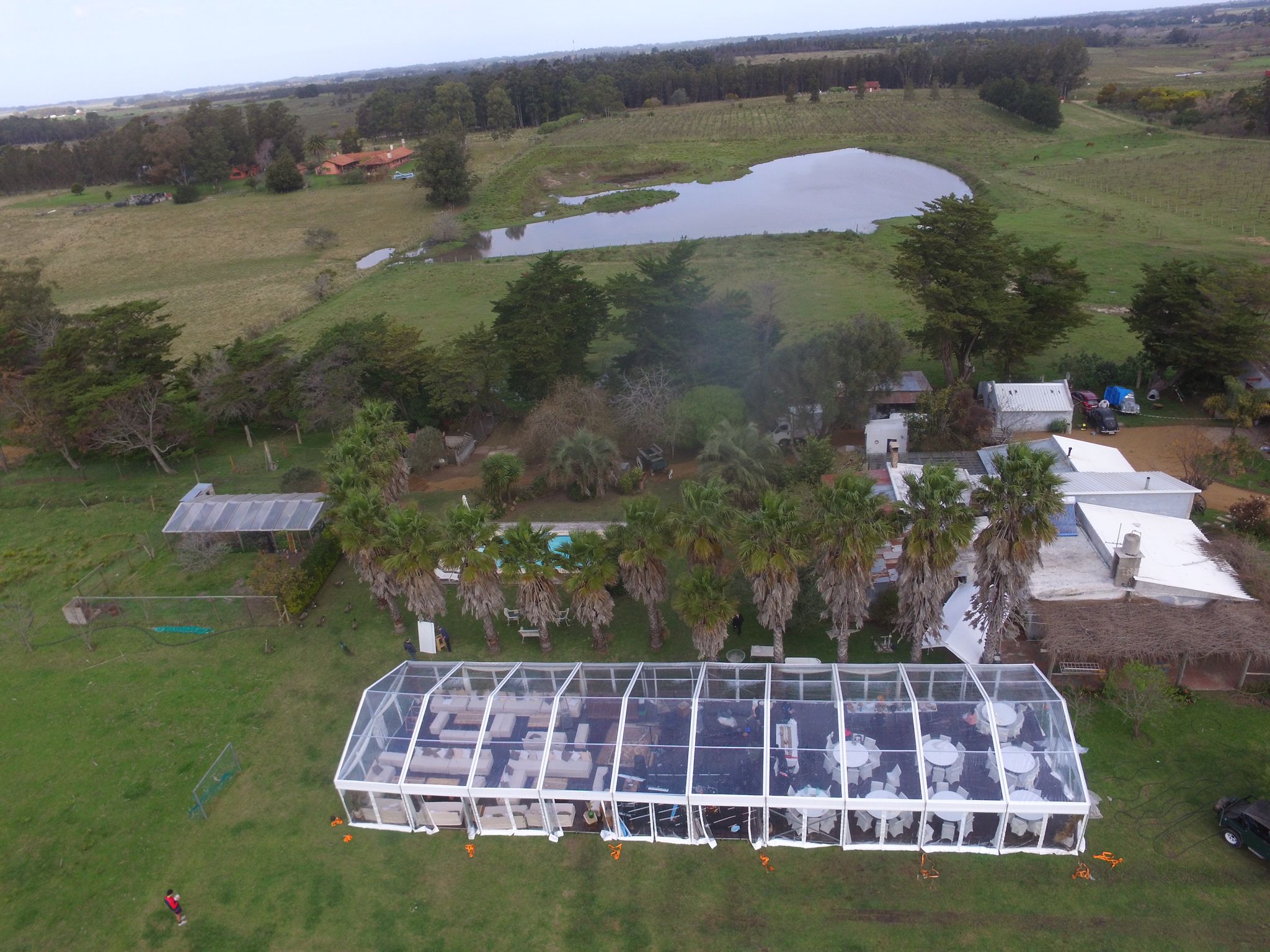
Weather performance is the area where buyers most often accept marketing language in place of an engineering answer. The documented evidence in this range is specific: an OEM client in Uruguay purchased a single Event Tent unit for a party application, the structure has remained in service for 10 years, the recorded result is rain proof, and rain and wind resistance is highlighted as the defining project outcome.
Read precisely, that record supports two conclusions and no more. First, a correctly anchored aluminum-and-PVC structure of this type can serve a multi-year cycle in an outdoor application. Second, the outcome is tied to a specific site, installation and maintenance regime. It is not a transferable guarantee for a different coastline, a different exposure category or a different anchoring plan.
The relevant standards framework is also documented: temporary structures are generally addressed by EN 13782, while fabric flame retardancy is commonly assessed against NFPA 701 in the United States and CPAI-84. Buyers specifying a windproof and waterproof wedding tent should request three separate items — the anchoring or ballast plan, the fabric specification, and the inspection and maintenance schedule — because a single product statement cannot cover all three.
Certification and Compliance: What to Verify Before Ordering
For EU projects, the traceable document is CE certificate ICR/VC/HB241001, issued by ICR against EN 13782:2015 on 25 October 2024 and valid until 24 October 2029, with a stated market scope of Europe. Its listed applicable product is the Event Tent line, in the pagoda tent type, in aluminum and PVC, with the SLP-series width steps from SLP-3 to SLP-50.
Limitation to note before ordering: the certificate enumerates the Event Tent line only. A party tent, a non-listed configuration, or a project outside the European scope cannot be assumed to be covered by the same document. In those cases the correct action is to request the applicable documentation for the specific order rather than to assume equivalence.
Buyers working outside Europe should also verify how local requirements map onto EN 13782, NFPA 701 and CPAI-84, and whether the venue, insurer or fire authority requires the fabric's flame-retardancy evidence separately from the structural certificate. Where a wedding is staged on public land or on a listed estate, the permit file usually determines the documentation set; that list should be obtained before the tent specification is frozen.
Customization, Lead Time and Commercial Terms
The commercial capability behind both lines is documented as follows: OEM production mode, logo customization, a minimum order quantity of 1 unit, a production lead time of 20–30 days, a monthly capacity of 10,000 m², test assembly before shipment, assembly video support after sale, and export markets covering the EU, America, Africa, the Middle East and Asia.
Three of those terms matter more than the rest for wedding buyers. Test assembly before shipment reduces the risk of a first-time installation failing on site, which is the most expensive place to discover a missing component. Assembly video support is relevant to rental operators and venue teams who will re-erect the same structure multiple times per season. A minimum order quantity of 1 unit means a single large event tent and a single party tent can be evaluated on the same commercial footing, which makes side-by-side testing practical rather than theoretical.
The constraint is timing. A 20–30 day production window does not include transport, customs clearance or installation, so a buyer with a fixed wedding date should treat that figure as the start of the critical path. Orders placed inside a shorter window are the main reason wedding tent procurement becomes a substitution exercise.
Market Trend Analysis
Three documented trends shape how the party tent versus event tent decision is being made. First, weddings remain the single largest application inside tent rental, accounting for 38.5% of revenue share in a market valued at USD 8.2 billion in 2025. Second, demand is geographically shifting: Asia-Pacific held 32.2% of tent rental revenue share in 2025, supported by growth in destination weddings and outdoor hospitality. Third, cost benchmarks are becoming more transparent — in the United States, the average wedding tent rental is cited at USD 1,900, with pricing commonly benchmarked at around USD 1 per square foot of coverage.
The supplier landscape is also becoming easier to map. In the clear span wedding tent segment, catalogues and market reports commonly cite manufacturers such as Liri Tent (China), Losberger De Boer (Germany/Netherlands) and Shelter Structures (China). Specialist suppliers appear alongside them, including Expotent, whose documented CE scope covers the Event Tent SLP series. For buyers, the practical consequence of a more crowded market is that differentiation moves away from availability and towards evidence: certificate scope, documented size steps, anchoring documentation and commercial terms.
Comparison With Traditional Solutions
Comparing a temporary wedding tent with a permanent venue is not a like-for-like exercise, but it clarifies what a buyer is actually purchasing.
| Consideration | Permanent venue (banquet hall) | Temporary tent structure |
|---|---|---|
| Capital profile | High fixed investment, amortised over many events | Modular purchase or rental; cost scales with the number of configured bays |
| Site flexibility | Fixed location and fixed capacity | Deployable on lawns, estates, beaches, hotel grounds and hard standing |
| Weather dependency | Largely independent of weather | Directly dependent; anchoring, fabric condition and exposure drive performance |
| Permits and engineering | Covered by the building's existing approvals | Requires site-specific anchoring, and often its own permit or fire-safety documentation |
| Climate control | Integrated | Added separately, with independent power planning |
| Lifecycle | Decades, with scheduled maintenance | PVC fabric and frame components require inspection, cleaning and eventual replacement |
The honest limitation is this: a fabric structure is not a building. It must be anchored or ballasted, its fabric is a wear component rather than a permanent material, and its fire and structural documentation is issued per product line and per market. Any procurement that assumes a tent will behave like a permanent hall — on wind loading, on climate control, or on permit treatment — is exposed at the worst possible moment. The compensating advantage is that the same asset can be re-configured for a lawn ceremony, a beach reception and a hotel overflow programme within one season, which is precisely what a permanent hall cannot do.
Future Outlook
Three directions are visible from the documented product and market data. Sizing is becoming parametric: a documented step ladder from 3 m to 50 m in width, combined with lengths up to 1000 m, allows buyers to specify custom-size wedding tents without leaving the documented range. Modularity is becoming an operating requirement rather than a feature, because rental operators need one asset to serve several venue types per season, and bay-based assembly is what makes that possible. Finally, documentation is becoming part of the product: as destination weddings move onto estates, beaches and public land, the certificate scope, standards reference and anchoring plan increasingly determine whether an installation is approved at all.
For buyers at the evaluation stage, the practical next step is unchanged. Decide the covered envelope from the venue, decide the product line from the documentation the venue will accept, then confirm anchoring, fabric and lead time against the wedding date.
FAQ: Party Tent vs Event Tent for Wedding Venues
1. What is the difference between a party tent and an event tent for a wedding?
A party tent is the compact configuration within a manufacturer's range, positioned for social events such as garden ceremonies, catering zones and reception annexes. An event tent is the larger covered envelope: in the Expotent range, the Event Tent SLP series is documented as a pagoda tent type in aluminum and PVC, with widths from 3 m to 50 m, lengths from 3 m to 1000 m and heights from 2.5 m to 10 m, and it is the line enumerated in CE certificate ICR/VC/HB241001 under EN 13782:2015. For a buyer, the meaningful difference is therefore covered envelope and certificate scope, not a single visual feature.
2. How do I choose a wedding tent size for a lawn venue versus a beach venue?
Lawn venues allow ground anchoring in soil, so sizing is driven mainly by capacity: a compact party tent configuration can cover a garden ceremony, while a full reception normally needs the wider spans of the event tent line, up to the documented 50 m maximum width. Beach venues change the input rather than the arithmetic, because sand usually requires ballast or engineered anchoring and the site has uninterrupted wind exposure. The documented weather reference in this range is a single-unit OEM party application delivered to Uruguay, in service for 10 years, recorded as rain proof with rain and wind resistance highlighted — a project record rather than a site guarantee, so anchoring and fabric details should be confirmed for each shoreline location.
3. Which certifications should a wedding tent carry for EU and US venues?
Temporary structures are generally addressed by EN 13782, while fabric flame retardancy is commonly assessed against NFPA 701 in the United States and CPAI-84. For European projects, CE certificate ICR/VC/HB241001 was issued by ICR against EN 13782:2015 on 25 October 2024, remains valid until 24 October 2029 and has a stated market scope of Europe; its applicable product is the Event Tent line in the SLP-3 to SLP-50 range. Buyers should confirm that the specific model on their order falls inside that scope, because party tent configurations are not enumerated in this certificate and may require separate order-level documentation.
4. What lead time and minimum order quantity apply to custom wedding tents?
The documented commercial terms for this range are OEM production mode with logo customization, a minimum order quantity of 1 unit, a production lead time of 20–30 days, and a monthly capacity of 10,000 m². Quality control includes test assembly before shipment, and after-sales support is provided through an assembly video. Because the 20–30 day figure covers production only, buyers with fixed wedding dates should add transport, customs clearance and installation time when planning, and treat the production window as the start of the critical path.
5. How long can a wedding tent structure be used, and what weather conditions can it handle?
The specific documented case in this range is an OEM party application in Uruguay that has remained in service for 10 years, with rain-proof performance recorded and rain and wind resistance highlighted. That single project supports the conclusion that an aluminum-and-PVC structure of this type can serve a multi-season cycle when correctly anchored and maintained; it does not establish a service life for other sites. Structural performance depends on the anchoring or ballast plan, fabric condition, maintenance regime and local wind-load requirements, so buyers should request those three items separately and schedule periodic inspection rather than relying on a general weather-resistance claim.
Manufacturer Reference
Changzhou Expo Tent Co., Ltd. operates under the brand Expotent from No. 198, Jianhu Street, Yaoguan Town, Wujin District, Changzhou City, Jiangsu Province, China 213000, and publishes product and certification details at www.expotentchina.com. A downloadable product brochure covering the range, including the Event Tent SLP series documented in this comparison, is available here: Expotent product brochure (PDF).
Market and standards references in this article: Dataintelo tent rental market research (wedding share of rental revenue; Asia-Pacific revenue share); wedding services market projections for 2023–2032 with noted estimate divergence; United States wedding tent rental cost benchmark; EN 13782:2015, NFPA 701 and CPAI-84; manufacturer product, certification, capability and project records.