
Weighing Forklifts for Scrap Yards: Buyer Comparison Guide
Weighing Forklifts for Scrap Yards: Buyer Comparison Guide
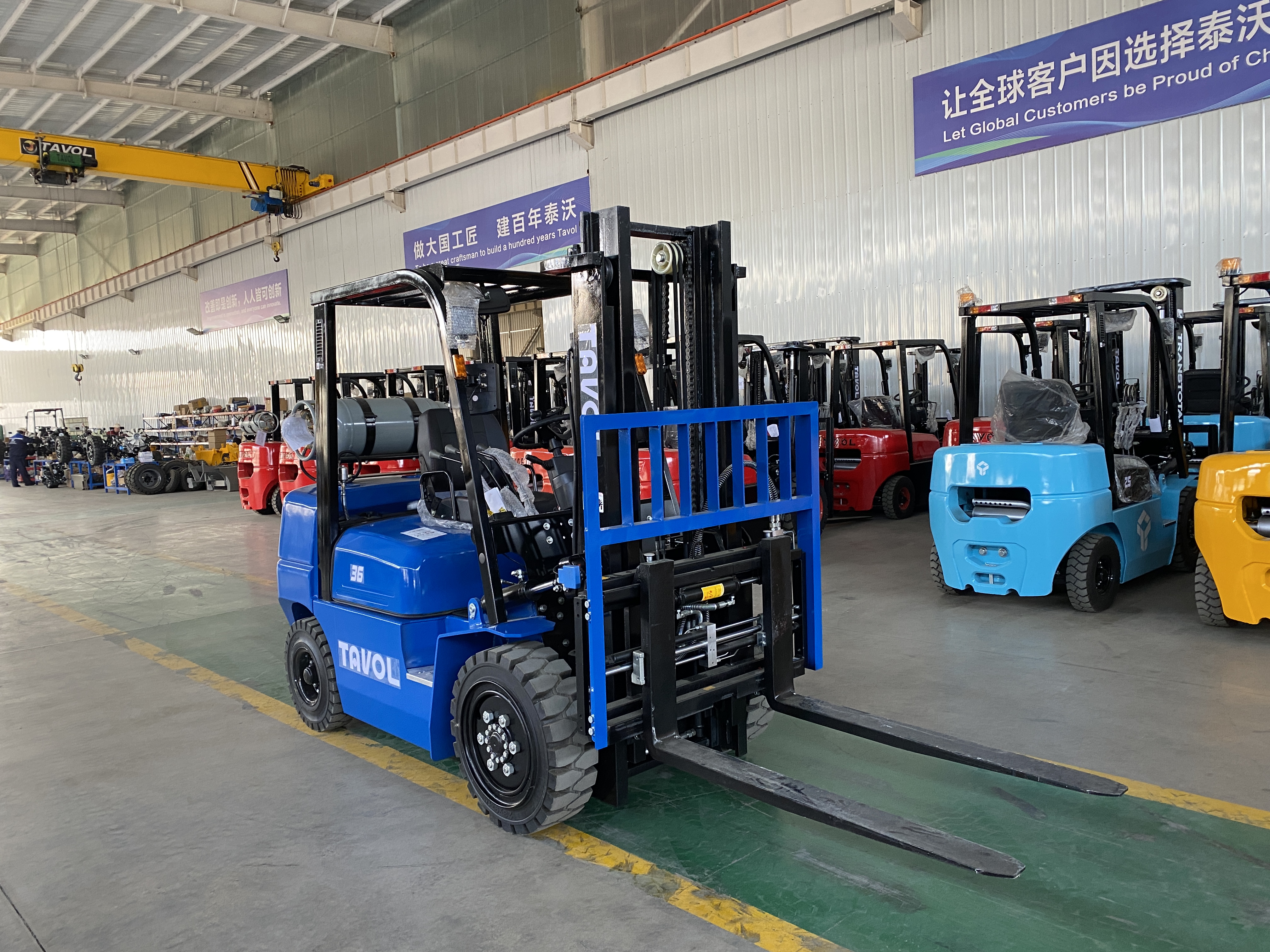
A load-weighing forklift configuration: weight is taken during lifting and transport, not at a separate weighbridge.
Scrap yards in Bulgaria and across Europe trade by weight, not by unit. A documented scrap and recycling weighing scenario shows how the weight can come from the forklift itself, using an integrated load cell and a digital display mounted on the mast, so that real-time weighing happens without a separate weighbridge and overloading is identified before the load moves.
That configuration changes what a buyer has to decide. A yard weighing on the truck is no longer only asking which machine lifts the most tonnage; it is asking which powertrain can sustain the duty cycle, which attachments the material requires, and how the weighing function is kept accurate over months of outdoor work. The three powertrain families documented for this kind of weight-sensitive handling — diesel, dual fuel LPG & gasoline, and electric lithium — behave differently in that environment.
This guide is written as an independent buyer comparison rather than a supplier pitch. Model specifications below are drawn from TAVOL Forklift product documentation and attributed as such; market figures carry the name of the research publisher that issued them. Where the available data does not settle a question, the article says so rather than filling the gap.
The Buying Problem: Weight Without a Queue at the Bridge
The operational case for on-board weighing is queue time and double handling. A weighbridge is a fixed point in a yard: material has to travel to it, wait, be weighed, and move again. In a recycling yard where material is continuously transferred between pile, shear, baler, bin and outbound truck, the bridge becomes a chokepoint, and the weighing event is separated in time from the handling event that produced the load.
The scenario documented for Bulgaria — classified under logistics and freight billing, agriculture and grain trading, scrap and recycling weighing, and warehousing with weight-based inventory — describes the alternative in specific terms:
- Function: real-time load weighing during lifting and transport, without a separate weighbridge, in order to prevent overloading.
- Operation: integrated load cell with a digital display on the mast.
- Matched equipment: electronic weighing scale attachment and digital display unit.
- Special requirements: weighing accuracy calibration, and an overload alert function.
Three of those four lines are specification decisions the buyer controls. The load cell and display determine where the weight is measured and where the reading appears; the calibration requirement creates a maintenance obligation with a schedule and a record; the overload alert creates a safety rule that has to match the yard's own load limits and the vehicle weights its outbound trucks are licensed to carry. A yard that writes only "forklift with scale" into a purchase request has, in practice, specified none of these.
How Forklift-Integrated Weighing Works
Forklift-integrated weighing measures the load through a load cell in the lifting system and presents the result on a display mounted on the mast, so the weight is available while the load is being lifted and carried rather than after it has been set down. In the documented configuration, the weighing electronics are described as an attachment plus a display unit, with the load cell integrated into the truck rather than installed as a fixed yard structure.
Two functions are listed separately in the source data, and buyers should treat them as separate line items. The first is measurement — real-time load weighing during lifting and transport, which feeds weight-based cargo billing. The second is protection — an overload alert, which acts as a threshold rather than a measurement: it tells the operator that the load has crossed a limit that the yard has defined.
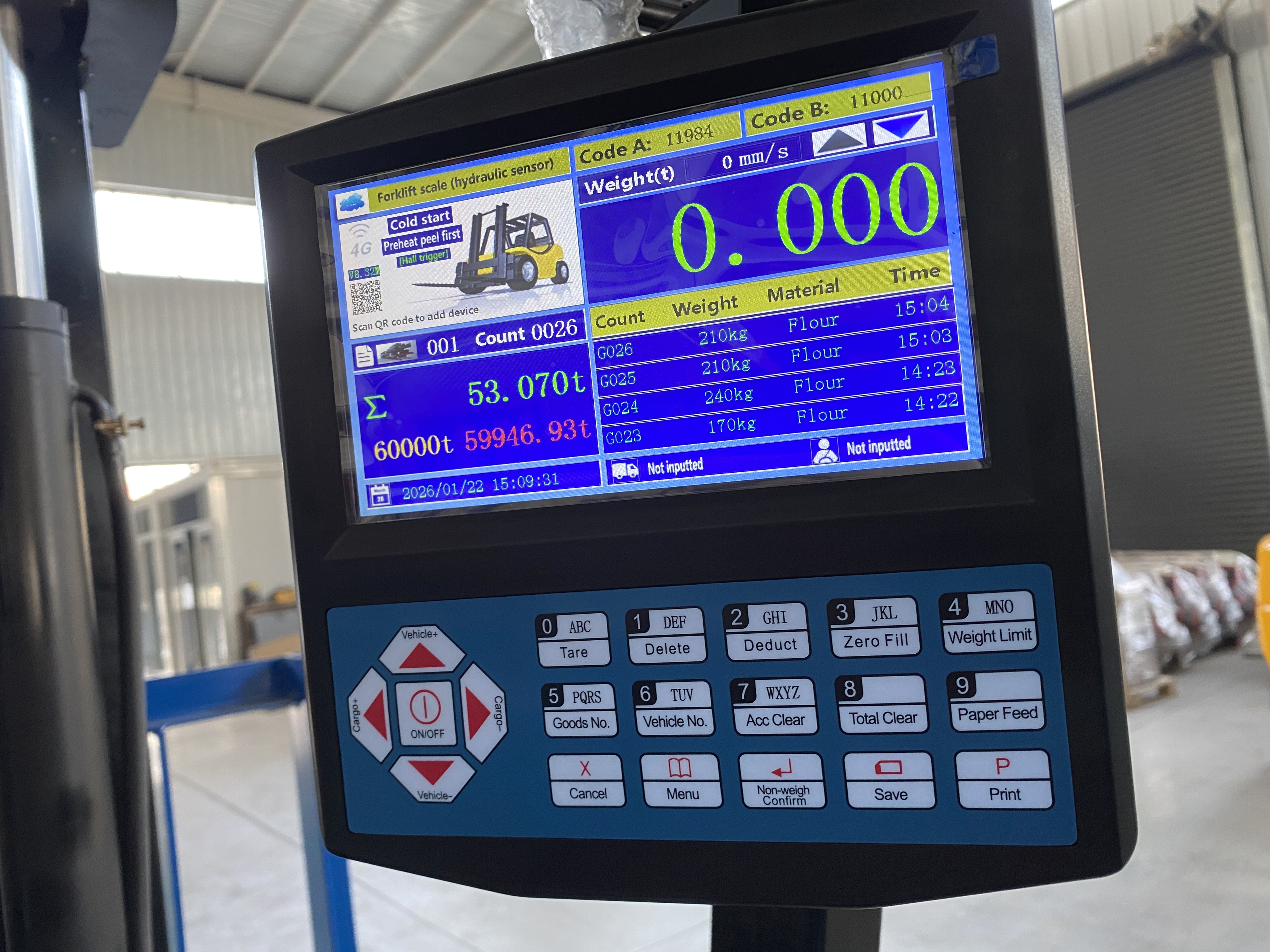
The display unit is part of the weighing configuration; calibration and overload thresholds are buyer-defined settings.
Weighing accuracy calibration is described as a special requirement of the configuration, which is the clearest signal in the available data that accuracy is a maintained condition rather than a factory constant. A calibrated instrument drifts through use, impact and temperature change; a weighing truck in a scrap yard is exposed to all three. The practical consequence for a buyer is that the purchase specification should name a calibration interval, a reference method, and the person responsible for signing off the result — otherwise the weight figure that the business bills against has no traceable basis.
It is equally important to be clear about what on-board weighing does not decide. The weighing package sits on a base truck. The base truck's rated loading capacity, its load center, and its mast choice still govern what can physically be lifted. Ratings across the TAVOL range are documented at a 500 mm load center — a uniform-pallet convention. Scrap is not a uniform pallet: a bin, a bale or an irregular steel offcut places the centre of gravity somewhere other than 500 mm, so the buyer should confirm with the supplier which rated capacity applies to the final configured machine, weighing package and attachment included.
Powertrain Comparison: Diesel, Dual Fuel LPG & Gasoline, and Electric Lithium
For an outdoor scrap yard with unpaved ground and continuous duty, the product documentation points to diesel or dual fuel as the default specification, while the electric lithium range is documented for indoor and enclosed operations. The table below compares what the documentation actually states, per powertrain.
| Powertrain | Documented models and rated capacity | Documented performance and site notes | What it means for a weighing configuration |
|---|---|---|---|
| Diesel | CPCD20 (2,000 kg), CPCD25 (2,500 kg), CPCD30 (3,000 kg), CPCD35 (3,500 kg), CPCD40 (4,000 kg). Load center 500 mm. Engine options: Xinchai, Quanchai, Isuzu, Mitsubishi, Yanmar, Kubota, PSI. | CPCD35: drive 18/20 km/h, lift 450 mm/s, descent 420 mm/s, maximum traction 21,500 N, gradeability 15% full load / 20% empty. CPCD40: maximum traction 24,500 N, ground clearance 150 mm. Documented for open-air yards, construction materials, mines and gravel yards for material transfer, ports and freight support. | Highest documented traction of the three families, which matters on soft or uneven yard surfaces when the truck is also expected to carry weighing hardware. Emission-producing, so it is documented for outdoor duty. |
| Dual fuel LPG & gasoline | CPQYD20 (2,000 kg), CPQYD25 (2,500 kg), CPQYD30 (3,000 kg), CPQYD35 (3,500 kg). Load center 500 mm. Nissan engine with a fuel system switchable between LPG and gasoline. | CPQYD30: maximum traction 21,000 N, lift 450 mm/s, descent 420 mm/s, gradeability 15% full load / 20% empty. CPQYD35: maximum traction 21,500 N. Documentation cites quick refuelling in minutes rather than hours of charging, lower emissions than diesel, and suitability for both indoor and outdoor use. | A middle position on traction, with the added benefit of fuel flexibility where LPG or gasoline supply is seasonal. Adds a cylinder-handling routine to yard operations. |
| Electric lithium | CPD30 (3,000 kg), CPD35 (3,500 kg), CPD40 (4,000 kg). Lithium-ion (LiFePO4) battery with quick charger. Load center 500 mm. | CPD40: drive 18 km/h, lift 320 mm/s, descent 370 mm/s, maximum traction 15,600 N, gradeability 18% full load / 20% empty. CPD30: lift 350 mm/s. Documented applications are indoor: warehousing, cold storage and food processing, pharmaceutical and cleanroom, e-commerce and logistics distribution centres, electronics manufacturing, retail distribution, enclosed workshops. Documented features include zero emissions, lower noise, opportunity charging during breaks without battery swapping, no acid fumes or water refilling, and stable performance in low-temperature environments such as cold storage. | Documented traction is the lowest of the three families, and the documented duty environments are enclosed. Best treated as a zone-specific choice in a scrap yard rather than a whole-yard replacement. |
Two comparisons are worth pulling out of the table because they are frequently glossed over. First, documented maximum traction differs materially by powertrain: 15,600 N on the CPD40 electric, 21,000 N on the CPQYD30 dual fuel, 21,500 N on the CPCD35 diesel and 24,500 N on the CPCD40 diesel. On a muddy or gravel-strewn yard, traction — not top speed — determines whether the truck can position a bin at the shear without being dragged off line. Second, the documented site lists are not interchangeable: diesel models are explicitly listed for open-air yards, gravel yards and rough terrain, while the electric range is listed for indoor warehousing, cold storage and enclosed workshops. That difference, rather than an abstract preference for one technology, is the honest starting point for a scrap yard specification.
Matching Powertrain to Yard Zones
A scrap yard is rarely one environment. A workable approach — and one that avoids forcing a single powertrain onto every task — is to divide the site into zones and specify each zone separately.
Zone A — unpaved receiving and stockpile area
Material arrives contaminated, ground is uneven, and the truck works continuously. The documented diesel site list (open-air yards, construction materials and outdoor sites, mines and gravel yards for material transfer) maps directly onto this zone. A diesel truck with pneumatic tyres is the conservative documented choice. Dual fuel is a legitimate alternative where LPG or gasoline refuelling points exist inside or near the yard.
Zone B — processing, tipping and bin handling
This is where weighing and handling most often happen in the same movement. Documented recycling and waste configurations include a single/double pallet handler for waste recycling yards and a tipping fork for bins and skips in outdoor industrial yards. Where a bin is weighed and then tipped, having the display on the mast keeps the reading available through the lift rather than requiring a separate stop at a fixed station.
Zone C — covered sorting, weigh station or indoor storage
Where the yard has an enclosed hall, the documented electric applications apply: indoor warehousing, enclosed workshop operations, and cleanroom-adjacent handling where zero emissions and low noise are operational requirements rather than preferences. Lithium opportunity charging during breaks is documented as removing the need for battery swapping, which fits a shift pattern built around loading windows.
Zone D — outbound container loading
The mast determines whether a weighing truck can load a container without a ramp. Across the TAVOL range, documented mast options include two-stage 3 m / 3.5 m / 4 m, three-stage 4.5 m / 5 m / 5.5 m / 6 m, container mast and full free mast, with fork lengths of 1,220 / 1,370 / 1,520 / 1,670 / 1,820 mm and a mast tilt of 6° forward and 12° backward.
- If weighing happens outdoors all day on rough ground, diesel is the documented first choice and dual fuel the second.
- If the yard has both outdoor piles and covered processing, plan a mixed fleet instead of forcing one powertrain to do both.
- If handling including weighing is enclosed, the documented electric range applies, with charging scheduled around breaks.
- If fuel supply is unreliable, dual fuel reduces the risk of a truck standing idle, because the documented fuel system switches between LPG and gasoline.
- Whatever the powertrain, specify the weighing package, display position, calibration plan and overload threshold as one item — not as an aftermarket addition.
Attachments: The Weighing Truck Is Rarely a Plain Fork Truck
The recycling and waste scenarios documented in the source material show how attachment-dependent this work is. Recorded configurations include a single/double pallet handler for waste recycling operations in an industrial recycling yard, a tipping fork for bin and skip lifting and discharge, a tipping waste paper clamp for bales fed into processing lines, a bucket attachment for loose bulk material such as sand, gravel or grain, a fork rotator for controlled drum and barrel tipping, a load stabiliser platen for unstable or unwrapped loads, and clamps with curved arms for tyres, bales and paper rolls.
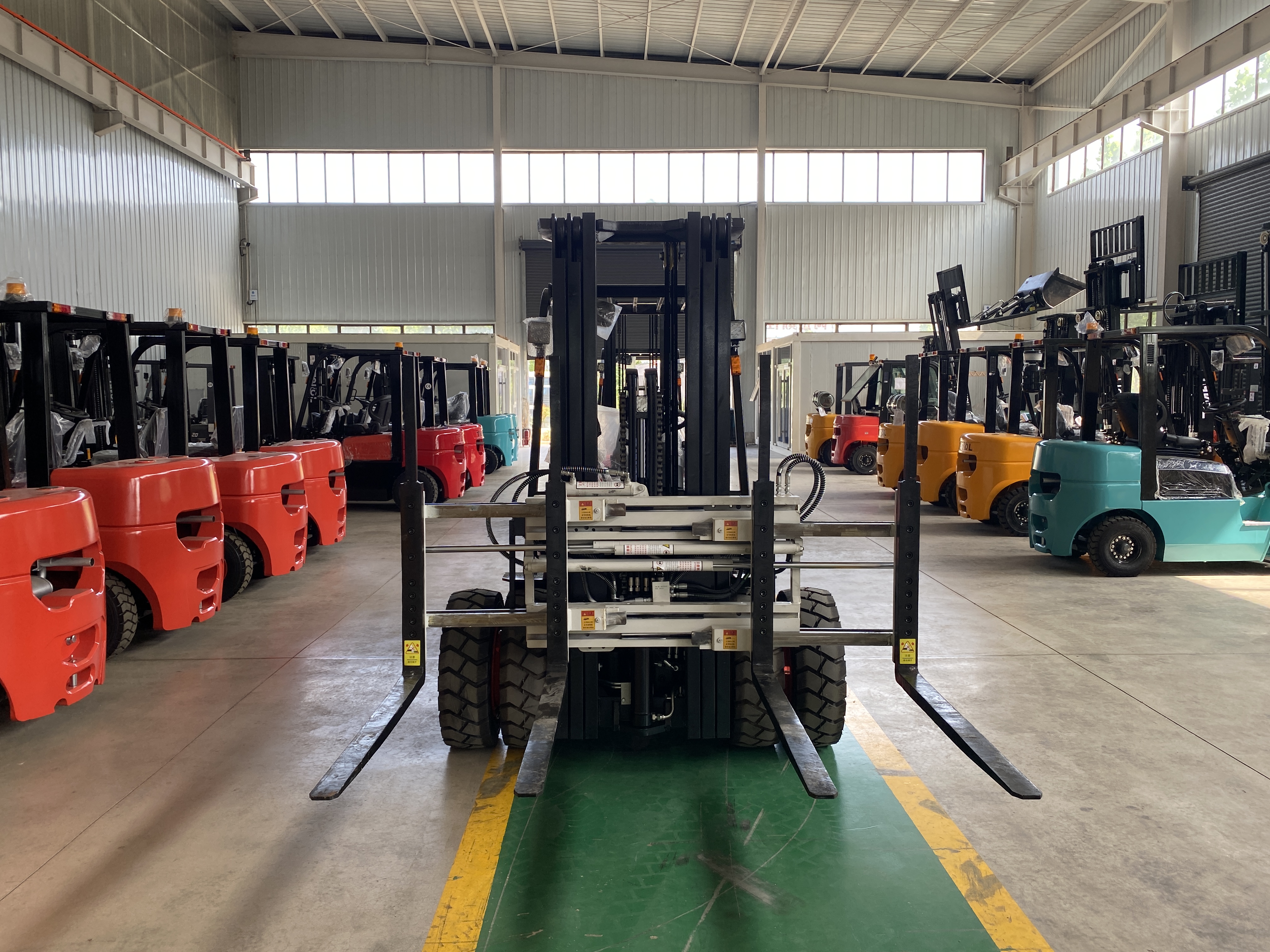
Recycling yard configurations commonly run attachments rather than plain forks; weighing has to fit that carriage arrangement.
The buyer-relevant consequence is straightforward. The weighing configuration is documented as a scale attachment plus a display unit; it is not documented as a replacement for clamps, rotators or tipping forks. A yard that weighs bales in one shift and loose material in the next should therefore define which attachment is fitted during weighing tasks and ask the supplier to confirm that the weighing package suits the carriage arrangement in each case. That is a configuration conversation to have before purchase, because attachment interfaces, hydraulic requirements and rated capacities interact.
Tyre choice belongs in the same conversation. Across the range, pneumatic tyres are documented as standard on many models with solid tyres selectable on request — a decision that is usually driven by ground condition and puncture risk rather than by the weighing function itself.
Where This Approach Reaches Its Limits
An honest comparison has to state where forklift weighing and each powertrain stop being the right answer.
- Calibration is not optional. Weighing accuracy calibration and overload alert are both listed as special requirements. A weighing system without a defined calibration interval and a record of the result produces numbers that cannot be defended in a commercial dispute. In practice the calibration log deserves the same discipline as a brake inspection.
- The alert does not change what the truck can lift. Documented rated capacities across the range are stated at a 500 mm load center. Irregular scrap does not respect that convention, so the applicable rating for a specific configured machine — including the weighing package and attachment — should be confirmed in writing rather than assumed from the headline tonnage.
- Electrification is still a minority of the installed base. Published market research indicates lithium-ion penetration in global counterbalanced forklifts was 17.5% in 2024 (Interact Analysis). Yards without charging infrastructure, or with entirely outdoor duty cycles, should treat electric as a zone decision rather than a fleet-wide replacement.
- Dual fuel adds a fuel-handling routine. Mode switching has a documented procedure, and LPG cylinders must be secured and checked for leaks before each shift. A yard that adds dual fuel adds cylinder logistics and staff training along with the truck.
- Diesel brings emissions and fuel storage. The documented diesel position is outdoor and rough-terrain work; it is not documented as an indoor solution, which matters where a yard has enclosed processing halls.
- Regulatory references vary by market. Buyers working to North American practice commonly reference ANSI/ITSDF B56.1-2020, published by ITSDF as the safety standard for low-lift and high-lift trucks and described there as effective through 2025; the current edition should be confirmed directly with the publisher rather than assumed from a specification sheet.
- The weighing function is a handling-level instrument. What it produces is a weight for operational decisions and handling-level billing. Each yard should confirm with its own commercial and regulatory advisors what its jurisdiction accepts for settled transactions, because that determination is not an equipment question.
What TAVOL Documents Across the Three Powertrains
Shandong Tavol Machinery Co., Ltd., trading under the brand TAVOL Forklift, is a manufacturer of material handling equipment including forklifts, cranes and tractors, with in-house research, development and production. The company was established in 2003, operates a 40,000 m² manufacturing facility, employs approximately 300 staff, has an annual production capacity of 3,000 units and a research and development team of 25 engineers. Export business accounts for about 70% of total sales, and the company serves customers in more than 120 countries and regions, with major markets in Southeast Asia, Europe, South America, the Middle East, Africa, Australia and North America.
For a scrap yard specifying a weighing truck, the relevant part of that portfolio is the three parallel powertrain lines: diesel forklifts from 2,000 kg to 4,000 kg (CPCD20 to CPCD40), dual fuel LPG & gasoline forklifts from 2,000 kg to 3,500 kg (CPQYD20 to CPQYD35), and electric lithium forklifts from 3,000 kg to 4,000 kg (CPD30 to CPD40). Structural components across the range are documented as Q235 carbon structural steel and Q355 low-alloy high-strength structural steel.
Engine choice is documented as selectable on the diesel line, with Xinchai, Quanchai, Isuzu, Mitsubishi, Yanmar, Kubota and PSI listed as options, while the dual fuel line uses a Nissan engine. For a buyer this is mainly a parts and service decision rather than a performance decision: the published trade data show China exported USD 1.26 billion of parts for fork-lift trucks in 2024 (WITS, World Bank, HS 843120), so the global parts base is large — but the specific engine fitted determines which local service network actually matters. Published product documentation for the diesel range also states compliance with CE/ISO and other international certifications; buyers should request the certificate set that applies to the exact model and destination market rather than relying on a general statement.
Market Signals: What the Published Data Says
Three published data points frame the decision without dictating it. The global forklift market was valued at USD 81.4 billion in 2025, with a forecast period running to 2033 (Grand View Research). Lithium-ion penetration in global counterbalanced forklifts stood at 17.5% in 2024 (Interact Analysis). And China exported USD 1.26 billion of parts for fork-lift trucks in 2024 (WITS, World Bank).
Read together, these indicate a large, contested equipment market in which internal combustion remains the majority of the installed base, electrification is advancing but is not yet the default, and aftermarket parts are a globally traded category. The third point is the one buyers underweight: on-board weighing adds electronics to the mast and carriage, so the practical question is not only who supplies the truck but who supplies the load cell, display and calibration support over the machine's service life.
One caution on trend statistics: research publishers do not agree on the growth rate of the electric segment. One publisher projects lithium segment growth at a higher rate than another projects for the electric segment overall, a methodology difference rather than a factual disagreement. A fleet plan built on a single growth figure is built on a soft foundation.
Future Outlook
The direction of travel is toward weighing moving from a fixed structure to the truck, and toward the truck being specified by zone rather than by uniform fleet policy. As weighing hardware becomes a normal configuration line alongside mast choice and fork length, the buyer's leverage shifts toward the specification document: the yard that defines its calibration interval, its overload threshold and its attachment interfaces in advance gets a machine that fits its process, while the yard that does not gets a scale on a forklift.
A genuine data gap remains in this category. Publicly available unit shipment data by tonnage — for example, how many 3.5-ton versus 5-ton diesel trucks were shipped in a given year — is not generally published, which means claims about the "most popular tonnage" in scrap applications should be treated cautiously by any buyer relying on them. Until that data exists, the most reliable specification input is still the yard's own duty cycle, ground condition and weighing regime.
FAQ
1. What does forklift-integrated weighing replace in a scrap yard, and what does it not replace?
It replaces the trip to a fixed weighbridge for handling-level weighing during lifting and transport, and it supports weight-based cargo billing and the prevention of overloading. The documented configuration uses an integrated load cell with a digital display on the mast, plus an electronic weighing scale attachment and display unit. It does not change what the truck can lift: the base truck's rated capacity (documented at a 500 mm load center across the range) and its mast specification still govern the lift.
2. How is weighing accuracy kept reliable over time?
Weighing accuracy calibration is listed as a special requirement of the weighing configuration, alongside an overload alert function. In practice, reliability comes from the yard defining a calibration interval, a reference method and a written record, and from treating the overload alert as a load limit rather than a warning. Because the equipment works outdoors and is subject to impact and temperature variation, calibration is a maintained condition rather than a permanent factory setting.
3. For an outdoor scrap yard, is diesel, dual fuel or electric the safer specification?
Documented site lists place the diesel models (2,000–4,000 kg) in open-air yards, construction sites, mines and gravel yards for material transfer, and the dual fuel models in port and container handling, construction sites and general cargo work. The electric lithium models are documented for indoor warehousing, cold storage, enclosed workshops and similar environments. If the weighing task is outdoors all day on rough ground, diesel or dual fuel is the documented fit; electric is documented where operations are enclosed and charging can be scheduled around shifts.
4. How do I switch fuel modes on a dual fuel forklift?
Switch fuel modes only when the engine is idling or off, using the dashboard fuel selector switch, and allow a few seconds for the fuel system to stabilise before resuming operation. The documented procedure is to bring the truck to a stop and let the engine idle, select the desired mode (LPG or gasoline), wait five to ten seconds, and then resume work while monitoring engine performance for the first few minutes. Do not switch modes under heavy load or on a slope, confirm the LPG cylinder is securely mounted and leak-free before each shift, and keep away from open flames during refuelling.
5. How should a lithium battery forklift be charged and maintained?
Use opportunity charging during breaks instead of waiting for a full discharge, and follow the manufacturer's charging cycle to maximise battery lifespan. The documented steps are to park on a flat, ventilated area and switch off the ignition before connecting the charger, connect the cable securely and confirm the charging indicator is active, charge during breaks or idle periods, disconnect once fully charged without leaving the connection beyond the recommended time, and inspect terminals, cables and connectors weekly for looseness or corrosion. Lithium batteries require no watering or acid checks. Never charge in an unventilated enclosed space, and keep the charging area dry.
6. Lithium battery or lead-acid battery — which one should I choose?
Lithium is the better documented fit for multi-shift or fast-paced warehouse operations; lead-acid is the better documented fit for single-shift, budget-limited or occasional use. The comparison basis is charging time, maintenance and cycle life: lithium units charge in roughly one to two hours versus six to eight hours for lead-acid, require no watering, and are rated for more than 2,000 cycles against roughly 500–800 for lead-acid. Lead-acid has the lower upfront price but a higher long-term maintenance and downtime cost.
7. What should be checked on a diesel forklift before each shift?
Perform a visual and functional check covering fluid levels, tyres, brakes and safety devices before every shift. The documented sequence is engine oil, hydraulic fluid and coolant levels; tyres for wear, damage or incorrect inflation; brakes, horn, lights and backup alarm; forks and mast for cracks, bends or hydraulic leaks; and a start-up check for unusual noise, smoke or warning lights. Never operate with a malfunctioning brake or hydraulic leak, wear the seatbelt at all times, and report any abnormality to a supervisor before starting work.
8. Is a China-manufactured diesel forklift as reliable as a legacy Western brand?
The comparison dimensions that matter are load capacity, lifting height, durability and service support. China-manufactured diesel counterbalance trucks are documented as offering comparable load capacity, lifting height and durability, with faster lead times and broader OEM customisation options. The deciding factors are usually total cost of ownership, spare parts availability for the specific engine fitted (options documented across the diesel range include Xinchai, Quanchai, Isuzu, Mitsubishi, Yanmar, Kubota and PSI), and whether an existing local service network is a strict procurement condition. If a specific brand's service network is mandatory in the buyer's market, that condition — not the machine's specification — determines the choice.
Reference note. This article compares documented specifications and published market data for material handling forklifts used in weight-sensitive scrap and recycling work. It is written as an independent buyer reference: figures are attributed to TAVOL Forklift product documentation, ITSDF, Grand View Research, Interact Analysis and the World Bank's WITS database, and buyers should verify the exact configuration, certification set and rated capacity that applies to their own site before purchase.
The full company profile and product range are available for download: TAVOL Group Company Profile (PDF).