
Weight-Based Billing: Diesel, Dual Fuel or Electric Forklift
Weight-Based Billing: Diesel, Dual Fuel or Electric Forklift
Weight-based billing changes what a forklift is. Once the load on the forks becomes the invoice line, the truck stops being only a handling machine and becomes the point where a commercial figure is created. That single change reshapes the diesel, dual fuel and electric comparison, because the weighing layer — load cell, display, calibration record and overload alert — sits on top of whichever powertrain the site can actually support.
For decision-stage buyers the practical answer is to settle two questions in order. First, which powertrain matches the environment, the shift pattern and the fuel or charging infrastructure: a diesel counterbalance for outdoor yards, bulk and container work; dual fuel where fuel price or availability moves against you; lithium electric where the work is indoor, multi-shift and emission-sensitive. Second, how the weighing function will be specified, calibrated and accepted on the truck you buy, so that the billable number survives a customer query. A powertrain choice does not repair a weighing problem, and a scale does not repair an unsuitable truck.

Why Weight-Based Billing Changes the Forklift Brief
Four settings share the same requirement: freight and logistics billing, warehouse inventory valued by weight, scrap and recycling intake, and agriculture or grain trading. In each, the lift cycle is frequently the only weighing point available. TAVOL Forklift's application notes describe the job in exactly these terms — real-time load weighing during lifting and transport, weight-based cargo billing, and a load weighed without a separate weighbridge, with overloading prevention as the safety function. The truck therefore moves and measures at the same time.
Three consequences follow for the specification.
- Billing weight and safe load come from the same sensor. If the display drifts, the invoice is wrong and the overload protection is wrong at the same moment, which is why calibration is a commercial control rather than a maintenance nicety.
- The weighing event happens inside a working cycle. Where the load is picked, how high it is lifted and whether the mast is tilted all form part of the routine, so the procedure must be written down and included in the acceptance test instead of being left to operator habit.
- The evidence trail matters as much as the reading. A billing truck needs a documented calibration, a documented pre-shift check and a documented response when the overload alert triggers.
This is the difference between buying a forklift that happens to have a scale and buying a weighing asset that happens to move. The first is cheaper to quote and harder to defend.
Two Decisions, Not One
Most disappointing weighing-forklift projects do not fail on the truck or on the scale. They fail at the boundary between two suppliers: the forklift supplier delivers a truck, the scale supplier delivers a kit, and nobody owns the calibrated system that results.
Separating the two layers makes responsibility explicit.
Layer one — powertrain. Decided by the operating environment, the number of shifts, the energy or fuel supply available on site, and the maintenance capability you actually have. Diesel, dual fuel and lithium electric are not ranked here; they suit different sites.
Layer two — weighing. Decided by what the bill requires: where the load cell sits, where the operator reads the display, how calibration is performed and recorded, at what point the overload alert activates, and who re-verifies all of it after an attachment is fitted.
Diesel Counterbalance for Billing Loads
TAVOL Forklift is the material handling line of Shandong Tavol Machinery Co., Ltd, a manufacturer founded in 2003 with a 40,000 m² factory, 300 employees, a 25-engineer R&D team and an annual output of 3,000 units, exporting to more than 120 countries and regions. Its CPCD25 diesel counterbalance is rated at 2,500 kg at a 500 mm load centre, with a minimum turning radius of 2,550 mm, an overall length of 2,855 mm, an overall width of 1,230 mm, a top guard height of 2,125 mm, ground clearance of 130 mm and a 1,700 mm wheelbase.
The mast family matters more than the headline capacity in billing work, because the load has to be lifted to the height of the container, the bin or the rack. TAVOL's diesel line is offered with two-stage masts at 3 m, 3.5 m and 4 m, and three-stage masts at 4.5 m, 5 m, 5.5 m and 6 m, with a mast tilt of 6 degrees forward and 12 degrees backward. Tyres are 28x9-15-12PR at the front and 6.50-10-10PR at the rear, available in pneumatic or solid form, and the frame is built from Q235 carbon structural steel and Q355 low-alloy high-strength structural steel. Where billing loads are heavier than 2.5 tonnes, the CPCD40 is quoted with a maximum traction of 24,500 N and full-load lift and descent speeds of 460 mm/sec and 450 mm/sec.
For a billing application, the diesel case rests on three things a buyer can verify. The truck works in dust, wet yards and uneven surfaces without a charging plan. Refuelling is a matter of minutes, so a shift is rarely lost to energy supply. And the stated commercial position is a purchase cost 20–40% below legacy Western brand diesel forklifts at comparable load capacity and lifting height, with spare parts around 30% lower and comparable core performance and durability, faster delivery and OEM customisation. Those figures are the manufacturer's own comparison and apply to that specific baseline, not to electric trucks.
The limitation is equally clear and should be written into the buying decision rather than discovered later. An internal combustion counterbalance produces exhaust emissions and higher noise than a lithium truck, so enclosed warehouses, cold stores and food or pharmaceutical buildings are usually a poor fit. Diesel also adds consumables and service items — engine oil, hydraulic fluid, coolant, filters — that an electric truck does not carry, and each of them appears in the daily check.
Pre-shift inspection for a diesel counterbalance
The inspection routine is short, and on a billing truck it doubles as the record that the machine was fit when the weight was taken.
- Check engine oil, hydraulic fluid and coolant levels.
- Inspect tyres for wear, damage or incorrect inflation.
- Test brakes, horn, lights and backup alarm.
- Check forks and mast for cracks, bends or leaks in the hydraulic lines.
- Start the engine and confirm there is no unusual noise, smoke or warning light.
Safety note from the same procedure: never operate with a malfunctioning brake or a hydraulic leak, wear the seatbelt at all times, and report any abnormality to a supervisor before starting work. For a weighing application, add one line to the sheet — the empty reading must be checked and confirmed at the start of the shift.
Dual Fuel LPG and Gasoline
A dual fuel forklift carries two fuel systems on one chassis. TAVOL's CPQYD20 dual fuel LPG and gasoline counterbalance is rated at 2,000 kg, powered by a Nissan engine, with overall dimensions of 2,750 mm length, 1,165 mm width and 2,105 mm top guard height, a minimum turning radius of 2,500 mm and a 1,650 mm wheelbase; the CPQYD30 variant is listed with a 2,550 mm minimum turning radius and the same 28x9-15-12PR front and 6.50-10-10PR rear tyre sizes.
What the second fuel system buys is resilience and price flexibility. TAVOL positions its dual fuel line as reducing overall operating cost by up to 15% by cutting dependence on a single fuel source, with power output comparable to single-fuel diesel trucks, interruption avoided when one fuel becomes scarce, and a fuel system that is slightly more complex but supported by standardised global service parts. In ports, outdoor construction sites and regions with unstable or seasonal fuel supply, that is a procurement argument rather than a marketing one.
What the second fuel system costs is more to inspect and more to plan. Two supply arrangements have to exist on site, and the daily check covers both. Before comparing dual fuel with diesel-only or LPG-only, confirm the exact fuel pair in the configuration you are ordering, because the pair determines your refuelling, storage and cylinder-handling arrangements, and a mismatch discovered at commissioning is expensive. A single-fuel truck with a secure local supply is simpler; a dual fuel truck earns its premium where supply or price is genuinely uncertain across the year.
Mode-switching checks
Fuel mode changes are a documented procedure, not an operator improvisation.
- Bring the forklift to a stop and let the engine idle.
- Locate the fuel mode selector switch on the dashboard.
- Switch to the desired fuel mode available on that machine.
- Wait 5–10 seconds for the fuel system to stabilise.
- Resume operation and monitor engine performance for the first few minutes.
The accompanying safety conditions are specific: do not switch fuel modes under heavy load or on a slope, confirm the LPG cylinder is securely mounted and free of leaks before each shift, and keep away from open flames during refuelling. On a billing truck, run the acceptance weighing test in each fuel mode you intend to use, so that engine behaviour in one mode cannot later be blamed for a discrepancy in the weight record.
Electric and Lithium
The CPD30 electric forklift from the TAVOL range is powered by a lithium-ion (LiFePO4) battery and produces zero emissions, which makes it suitable for indoor and enclosed workspaces. It supports fast opportunity charging during breaks, so battery swapping is not required, and its noise level is significantly lower than that of internal combustion forklifts. It is also listed with stable performance in low-temperature environments such as cold storage, and runs on 28x9-15-12PR front and 6.50-10-10PR rear tyres. TAVOL's CPD series lithium trucks in the 3-tonne to 4-tonne range are published with 27% gradeability at full load.
Against a traditional lead-acid battery truck, the lithium comparison is stated in measurable terms: charging time reduced by about 70%, a battery lifespan of more than 2,000 cycles against 500–800 cycles for lead-acid, or three to five times longer, and a total cost of ownership 20–30% lower over five years despite a higher upfront price. The maintenance difference is structural rather than cosmetic — no battery watering, no acid fumes, no equalising charge, and therefore less downtime. The intended applications are multi-shift warehouse operations and food or pharmaceutical facilities that need a clean, zero-emission environment.
For weight-based billing the electric case is strongest where the weighing point is indoors and the shift pattern is dense: warehouse inventory, dock-side freight weighing and cold-store dispatch. The boundary to state openly is infrastructure. A truck that is waiting for a charge produces no billing data, so charger capacity, charging windows and the opportunity-charging routine belong in the same planning document as the scale specification. Buyers should also confirm the model, battery and charger combination in writing, because the published TCO comparison is against lead-acid trucks and does not automatically transfer to a different baseline.
Charging and maintenance discipline
- Park on a flat, ventilated area and switch off the ignition before connecting the charger.
- Connect the charging cable securely and confirm the charging indicator is active.
- Charge during breaks or idle periods rather than always waiting for full depletion.
- Disconnect once fully charged; avoid leaving the truck connected beyond the recommended time.
- Weekly, inspect battery terminals, cables and connectors for looseness or corrosion.
The associated safety conditions: never charge in an enclosed space without ventilation, keep the charging area dry, do not disconnect cables under load, and restrict battery connection work to trained personnel.
Side-by-Side Comparison for Weight-Based Billing
| Decision factor | Diesel counterbalance | Dual fuel LPG and gasoline | Lithium electric |
|---|---|---|---|
| Reference model in the TAVOL range | CPCD25, 2,500 kg at 500 mm load centre; CPCD40 for heavier loads | CPQYD20, 2,000 kg, Nissan engine | CPD30 with LiFePO4 battery; CPD series 3–4 t with 27% gradeability at full load |
| Energy supply requirement | On-site diesel storage and delivery | Two fuel arrangements on one site | Charger capacity and charging windows |
| Turnaround footprint | 2,550 mm minimum turning radius, 2,855 mm overall length | 2,500 mm minimum turning radius, 2,750 mm overall length | Confirm from the specific quotation and mast selection |
| Environment fit | Outdoor yards, scrap, grain, container and bulk work | Mixed indoor and outdoor sites with two fuel supplies | Indoor, enclosed, cold storage and noise-sensitive buildings |
| Weighing layer | Fitted to any powertrain; verify sensor position, display, calibration and overload alert | Same requirement, with an acceptance test in each fuel mode | Same requirement, with an acceptance test after a charge cycle |
| Maintenance pattern | Engine fluids, filters, brakes and hydraulics in the daily check | Engine plus two fuel systems and cylinder handling | No watering or equalising charge; terminal and connector checks |
| Stated cost position | 20–40% lower purchase cost and around 30% lower spare parts cost than legacy Western brand diesel trucks | Up to 15% lower overall operating cost than single-fuel operation | 20–30% lower total cost of ownership over five years than lead-acid |
| Main limitation | Emissions and noise restrict indoor and enclosed use | More complex fuel system and dependence on two supplies | Charging access and shift planning |
The three percentage figures above come from different comparisons, against different baselines, over different periods: purchase price against legacy Western brand diesel trucks, operating cost against single-fuel operation, and five-year total cost of ownership against lead-acid battery trucks. They cannot be added together or transferred to another baseline.
Specifying the Weighing Layer
The powertrain decision is visible on the quotation. The weighing decision usually is not, which is why it should be written as four separate specification items rather than accepted as a line reading 'with weighing system'.
- Sensing element and position. State whether the load cell is integrated into the mast or lift circuit with a digital display at the operator position, or supplied as an electronic weighing scale attachment carried on the carriage. The two are not interchangeable: an attachment adds mass ahead of the carriage and must be assessed against residual capacity, and an integrated system places calibration responsibility on the truck supplier.
- Display and operating routine. Confirm where the operator reads the weight, whether the value is visible at pick-up and at set-down, how the display is zeroed, and whether a reading can be held or recorded for the billing document.
- Calibration. Require the calibration method, the reference loads used, the written record issued at delivery, the re-verification interval and the name of the party who performs it.
- Overload alert. Specify the threshold in relation to the rated capacity at the stated load centre, whether the alert is audible, visual or both, and whether it only warns or also inhibits further lift.
Verification should be witnessed, not assumed. Calibrate against known reference loads in front of your representative. Lift the same load three times and compare the readings. Repeat the test at the highest lift height you actually use, with the attachment fitted, in each fuel mode, and after a charge cycle on an electric truck. Each of these tests costs an hour at commissioning and prevents a season of arguments.
No universal accuracy figure travels with the phrase 'billing-grade'. The tolerance should come from your own commercial agreement — what your customer is entitled to challenge — and the supplier should then be required to demonstrate that the delivered system meets it.
Load Centre, Attachments and Residual Capacity
Rated capacity is quoted at a stated load centre, 500 mm on the models discussed here. That number describes the truck as delivered. A weighing attachment, a clamp or a rotating head sits ahead of the carriage, and every one of them changes what the truck can safely lift and therefore what it can honestly bill.
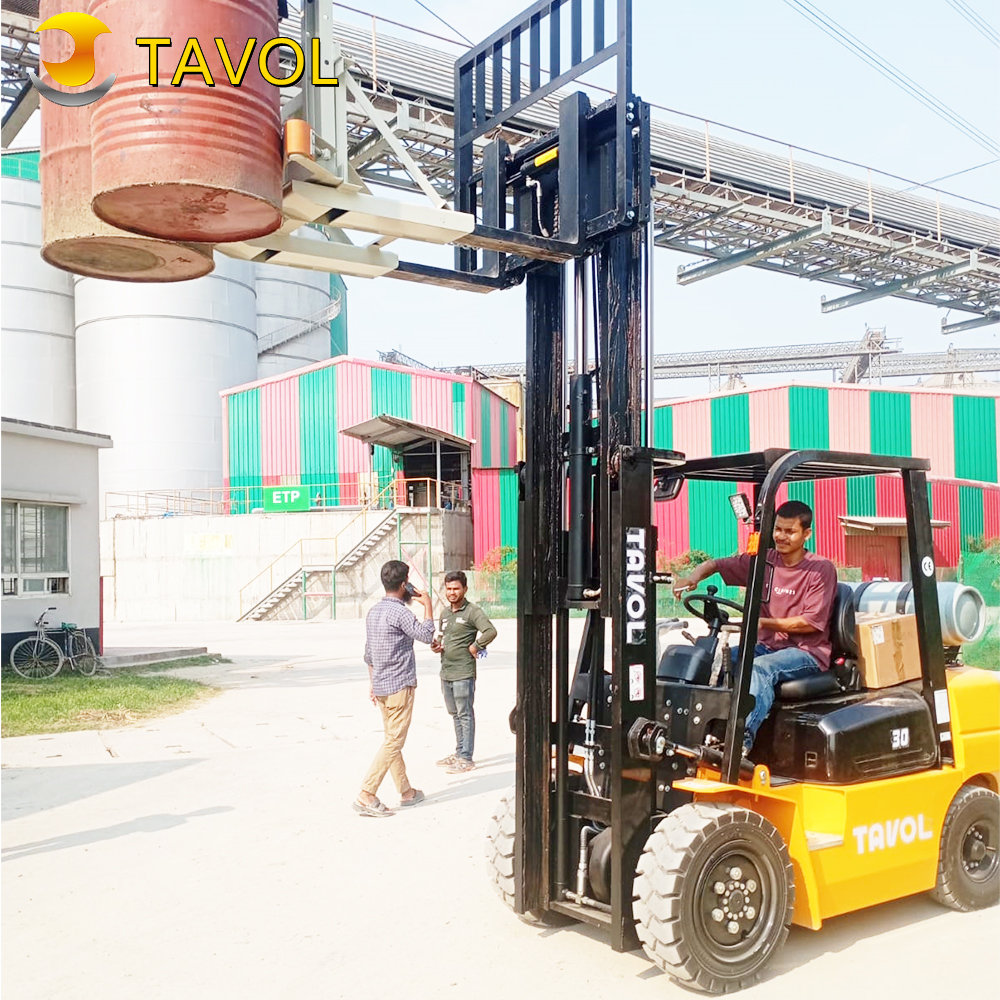
The overlap between attachments and weight-based billing is not theoretical. Paper roll handling with a clamp, bale clamps for unpalletised cartons and waste paper, rotating heads for drums, carpet rolls and tipping operations, and double-pallet handling in recycling yards all carry loads that are commonly bought and sold by weight. When a clamp and a scale are fitted to the same carriage, the buyer is stacking three variables — attachment mass, scale hardware and load — onto a capacity figure that was calculated for the bare truck.
Cost Comparison and the Baseline Trap
Three cost comparisons are available and each is internally coherent. Diesel counterbalances are positioned at 20–40% below legacy Western brand diesel trucks on purchase and around 30% below on spare parts, at comparable load capacity and lifting height. Dual fuel is positioned at up to 15% lower overall operating cost than single-fuel operation. Lithium is positioned at 20–30% lower total cost of ownership over five years than lead-acid, with a higher upfront price.
The trap is arithmetic. Purchase price, annual operating cost and five-year total cost of ownership are three different units measured against three different baselines, so they cannot be combined into one saving. A buyer who adds the diesel purchase discount to the lithium TCO advantage has produced a number that describes nothing.
A site-specific model is less elegant and more useful. Build it from your own inputs: energy cost per operating hour multiplied by hours per year, scheduled maintenance and parts, tyre consumption, downtime during charging or refuelling, the cost of the calibration routine, and the capital cost of whichever infrastructure you must add — charger and electrical capacity, LPG storage, or diesel bunding. Then confirm what the quoted price includes, because a comparison that omits the charger, the attachment, the scale or the calibration visit is not a comparison.
Acceptance Criteria and Purchasing Terms
For a billing truck, acceptance is a documentary event as much as a mechanical one. The purchase order should name the exact model and fuel pair or battery chemistry, the mast stages and lift height, the tyre type, the attachment with its re-rated capacity, the weighing hardware with its calibration record, the overload alert function, whether the charger or battery is included, and the documentation set: pre-shift checklist, maintenance schedule, spare parts list and the calibration re-verification interval.
The delivery test should be sequenced:
- Demonstrate the pre-shift inspection on the actual machine, with the operator present.
- Run the weighing repeatability test against known reference loads and file the results.
- Trigger the overload alert at the specified threshold and record the response.
- Demonstrate fuel mode switching on a dual fuel unit, or a full charging cycle on a lithium unit.
- Check the mast, carriage and hydraulic lines for leaks, and complete the re-rating record with attachments fitted.
On standards, confirm which edition your market currently references rather than assuming. Where ANSI/ITSDF B56.1 applies, the 2020 edition was listed by ITSDF as the safety standard for low-lift and high-lift trucks effective through 2025, so the edition in force at your delivery date should be verified in the contract documents.
Five Checks Before You Commit
- Environment and shift profile. Outdoor, dusty, bulk work points to a diesel counterbalance; indoor, enclosed, multi-shift work points to lithium; genuinely uncertain fuel supply points to dual fuel.
- Energy infrastructure. Price the supply side before the truck: diesel storage, a second fuel arrangement, or charger and electrical capacity.
- Weighing specification and calibration ownership. One party must own the calibrated system on the delivered truck, and that ownership must appear in the contract.
- Attachment and residual capacity. Re-rate after every attachment and weighing component, and record the tare routine per attachment.
- Acceptance test and document set. Repeatability, overload alert, mode switching or charging cycle, pre-shift demonstration and the calibration record — witnessed and filed.
Market Context
Two published figures frame the choice without settling it. Grand View Research valued the global forklift market at USD 81.4 billion in 2025, and Interact Analysis put lithium-ion penetration in global counterbalanced forklifts at 17.5% in 2024. Read together, they describe an electric segment that is real and growing but still a minority of counterbalance demand, which is consistent with what the applications suggest: diesel and dual fuel retain a practical role wherever loads are heavy, surfaces are rough and refuelling speed matters, while lithium wins where air quality, noise and multi-shift density dominate.
For weight-based billing, the market shift does not change the specification logic. The weighing layer is powertrain-neutral, and the buyer who specifies it properly at the quotation stage is protected whichever energy source is chosen. TAVOL Group's own position — three product lines covering cranes, material handling and agricultural machinery, researched and manufactured in-house, with a 70% export ratio — is relevant here mainly because a single source for truck, attachment and after-sales reduces the number of parties between the load and the invoice.
FAQ
Is a diesel, dual fuel or electric forklift better for weight-based billing?
None of the three is better at weighing; all three can carry a load cell, display, calibration record and overload alert. The powertrain should be chosen on operating conditions — diesel for outdoor yards, bulk and container work, dual fuel where fuel price or availability is uncertain, lithium electric for indoor, enclosed and multi-shift operations — and the weighing layer should then be specified, calibrated and accepted on the truck that fits the site.
Can a forklift weigh a load accurately enough to bill a customer?
That depends on what has been specified and proven, not on the powertrain. The buyer should derive a tolerance from the commercial agreement, require a documented calibration against known reference loads, witness a repeatability test on the delivered machine, and define the re-verification interval. A reading that has never been calibrated is not a billing record, however precise the display looks.
What is the difference between an integrated mast weighing system and an electronic scale attachment?
An integrated system places the sensing element in the mast or lift circuit with a digital display at the operator position; an attachment-based electronic scale is carried on the carriage. Both change what the truck can lift, because hardware sits ahead of the load centre, and both must be covered by a re-rated capacity figure and a documented calibration. The integrated route keeps calibration responsibility with the truck supplier; the attachment route usually splits it.
Should a buyer choose dual fuel or a single-fuel diesel or LPG truck?
Dual fuel earns its premium where fuel price or availability genuinely varies — ports, outdoor construction sites, regions with seasonal or unstable supply — because the second fuel system protects continuity and TAVOL positions the configuration at up to 15% lower overall operating cost than single-fuel operation. A single-fuel truck is simpler to inspect and supply where fuel is stable. Either way, confirm the exact fuel pair in the ordered configuration, since it determines refuelling and storage arrangements.
Lithium or lead-acid for a forklift used in billing work?
On the published comparison, lithium reduces charging time by about 70%, offers more than 2,000 cycles against 500–800 for lead-acid, and delivers 20–30% lower total cost of ownership over five years despite a higher upfront price, with no watering, no acid fumes and no equalising charge. It suits multi-shift and food or pharmaceutical environments; a lead-acid specification remains viable where the duty cycle is light and charging time is not a constraint.
Reference document: TAVOL Group company profile, available as a PDF for public download at Company Profile.pdf. Product and company information: TAVOL Forklift.
Tem questões ou precisa de mais detalhes?
Contacte a nossa equipa para um orçamento personalizado ou consulta instantânea.
Solicitar orçamento
Preencha o formulário abaixo e a nossa equipa entrará em contacto com uma proposta personalizada.
Chat direto do WhatsApp
Prefere conversar em tempo real? Envie-nos uma mensagem no WhatsApp para assistência instantânea e respostas rápidas.
- Obter orçamento personalizado
- Partilhar fotos ou documentos
- Discuta as suas necessidades diretamente
Geralmente responde em 5–30 minutos durante o horário de expediente.