
Welded Mesh Fence Buyer Decision Framework: 3D-2000, 358-1800, TW-1500 & TC-2100
Security & Protection · Buyer Decision Framework
Welded Mesh Fence Buyer Decision Framework: 3D-2000, 358-1800, TW-1500 & TC-2100
Welded mesh fence is a category, not a specification. Four designations — 3D-2000, 358-1800, TW-1500 and TC-2100 — come out of the same manufacturing envelope but resolve to different panel geometries, different security duties and different whole-life cost profiles. This framework maps the shared verified specifications, the category fit of each designation, the site types each one serves, and the decision rules a buyer can apply before committing a multi-phase perimeter programme.
Anping Dengfeng Wire Mesh Products Co., Ltd. (Dengfeng) is a wire mesh manufacturer based in Anping County, Hebei Province, China, founded in 2008 and operating a 70,000 m² production site with 80 employees and an annual output of 5,000,000 m². Its range covers welded mesh rolls, welded wire mesh panels, 358 security fences, BRC/roll-top fences, double-wire panels, chain link fences, temporary fences, barbed and razor wire, and gabion baskets. Around 80% of output is exported, with Europe, Saudi Arabia, the Middle East, the United Arab Emirates and the United States among the main markets.
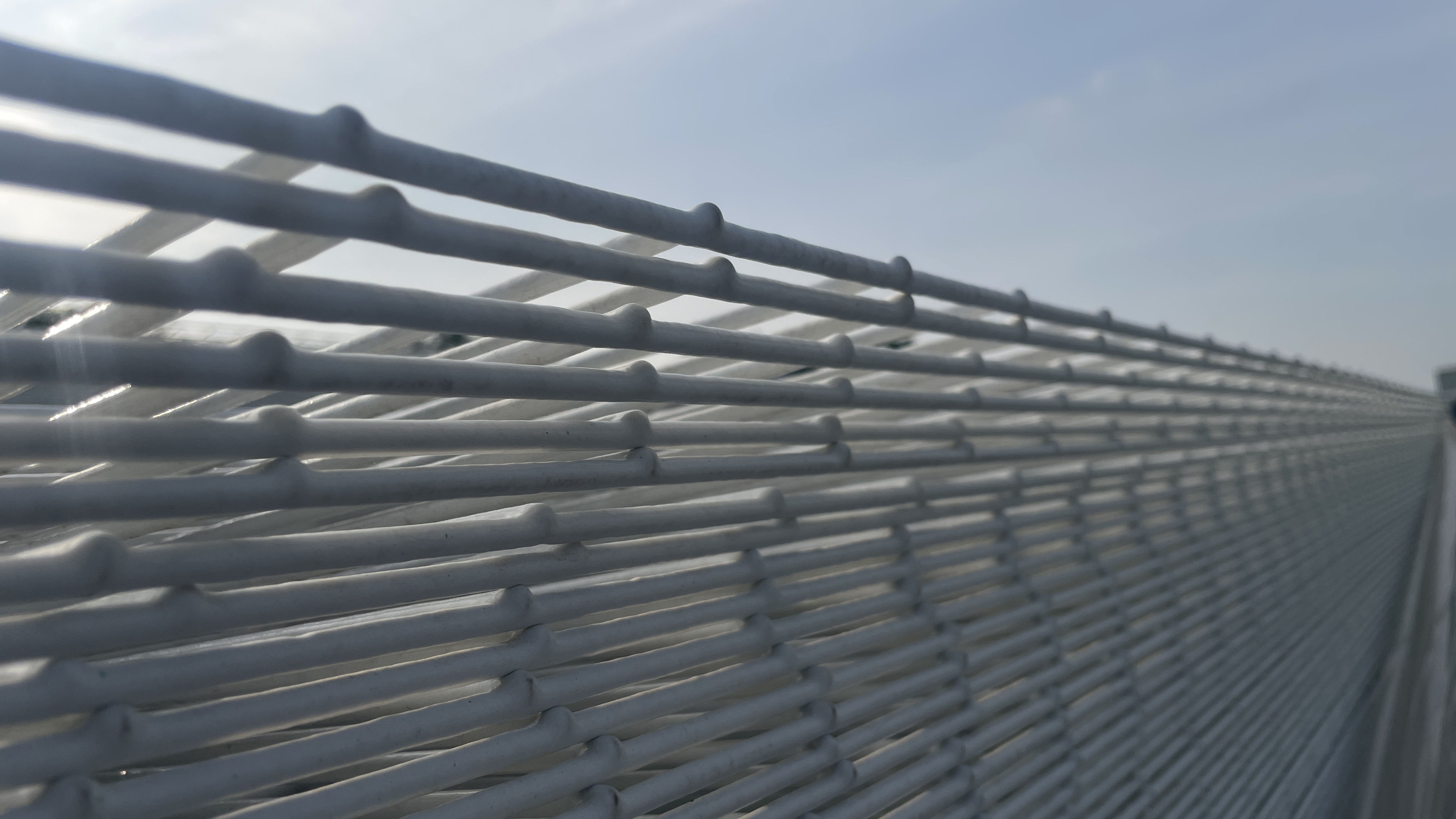
Welded mesh fence panels are produced on automated welding lines, with manual inspection applied through the polishing, pickling and powder coating stages.
What all four designations share
The four models are not competitors in a product sense; they are sibling families produced on the same welding and coating lines. That matters commercially, because it means several of the risk items in a perimeter procurement can be evaluated once for the whole programme instead of model by model.
| Parameter | Verified statement / range |
|---|---|
| Panel height | 630–3000 mm |
| Panel width | 2000–3000 mm |
| Wire diameter | 3.0–6.0 mm |
| Mesh aperture options | 50 × 100 mm; 76.2 × 12.7 mm |
| Welding process | Robotic welding |
| In-process inspection | Manual inspection during polishing, pickling and powder coating |
| Surface treatment | Hot dipped galvanizing followed by powder coating |
| Incoming material control | 100% raw material inspection |
| Finished goods control | Product load test; full delivery inspection |
| Certification and third-party references | ISO 9001; SGS; BV |
| Service-life reference | Over 10 years; zero maintenance within 10 years |
| Commercial reference | MOQ 1 set; typical production lead time 15–30 days; monthly capacity 420,000 m² |
Three consequences follow. First, because height, width and wire diameter overlap across the range, a difference in model name is not automatically a difference in size — the drawing governs. Second, the two listed mesh apertures, 50 × 100 mm and 76.2 × 12.7 mm, are the real dividing line between general perimeter panels and anti-climb panels. Third, because robotic welding and hot dipped galvanizing plus powder coating apply across the range, coating and inspection evidence can be audited once and then carried into every phase of a project.
How to read the four designations
The naming convention is a family prefix plus a nominal size reference expressed in millimetres. The letter group indicates the panel family; the number is shorthand for the nominal panel size band. A designation is not a full specification — it does not fix the wire diameter within the 3.0–6.0 mm band, the coating thickness, the post system or the gate configuration. Treat the designation as a shortlisting tool and the drawing as the contract.
| Designation | Panel family | Mesh geometry | Typical duty |
|---|---|---|---|
| 3D-2000 | 3D curved welded mesh panel | 50 × 100 mm | General perimeter; uniform, visually open panel |
| 358-1800 | 358 anti-climb welded mesh panel | 76.2 × 12.7 mm | High security; climbing and cutting resistance |
| TW-1500 | Double wire (twin wire) welded mesh panel | 50 × 100 mm with doubled horizontal wires | Rigid, high-visibility perimeter |
| TC-2100 | Temporary construction fence panel | Welded mesh panel in a relocatable frame | Phased works and site demarcation |
The “358” convention describes mesh geometry rather than panel size: a 3 inch × 0.5 inch aperture, with the third element referring to the wire gauge class. In metric terms that aperture equals 76.2 × 12.7 mm, which is the second aperture listed in the shared specification envelope. The convention does not fix the actual wire diameter, so the selected diameter should still be confirmed within the 3.0–6.0 mm band.
The “3D” prefix refers to the three-dimensional profile formed by the vertical reinforcement bends in the panel. That profile adds stiffness without adding wire diameter, which is why 3D curved panels are commonly specified where a lighter, visually open perimeter is wanted but a flat panel would be too flexible across a 2000–3000 mm span.
The “TW” prefix indicates twin wire — two horizontal wires welded to each vertical wire instead of one. The doubled horizontal structure raises panel rigidity, which becomes relevant where the perimeter is long, exposed to wind, or subject to repeated impact.
The “TC” prefix indicates temporary construction. These fences are engineered to be relocated rather than to serve as a permanent boundary, and they are normally specified with a frame and base system that allows rapid reconfiguration as a site changes shape.
Category fit: where each family sits against the alternatives
The four designations do not cover every perimeter decision. Two further families appear in the same tender documents — palisade fence and chain link fence — and specifying the wrong family is a more expensive mistake than choosing the wrong model inside the right family.
- 3D curved welded mesh fence — general perimeter duty with a uniform, visually open panel; common in municipal, real estate and school boundaries.
- 358 anti-climb welded mesh fence — small-aperture panel for high-security perimeters where climbing and cutting resistance dominate the brief.
- Double wire welded mesh fence — heavier horizontal wire structure for rigid, high-visibility industrial perimeters.
- Temporary construction fence — relocatable panel and frame assembly for phased works, events and site demarcation.
- Palisade fence — a vertical steel pale system rather than a welded mesh panel; chosen where a spike-topped deterrent profile is required.
- Chain link fence — a woven, not welded, mesh on a post and rail system; chosen for cost-effective demarcation over long runs.
Industry commentary on welded mesh fencing notes that rigid frame panels and anti-climb characteristics make welded mesh a preferred choice for critical infrastructure such as rail corridors, where cable theft prevention is a design objective, and for schools. That is a category-level observation rather than a claim about any single model, and it is one reason these four designations so often appear inside the same procurement conversation.
Matching the framework to site type
Site type narrows the field quickly, because each environment weights one or two criteria above the rest.
| Site type | Dominant criterion | Family that fits the brief |
|---|---|---|
| Construction | Relocatable, fast deployment | TC-2100 temporary construction fence; 3D-2000 for permanent boundaries |
| Municipal engineering | Uniformity, low maintenance | 3D-2000 3D curved welded mesh panel |
| Real estate | Appearance, colour matching | 3D-2000; TW-1500 where heavier panels are required |
| Airport | Anti-climb and anti-cut resistance | 358-1800 358 anti-climb panel |
| Port | Heavy duty plus corrosion protection | 358-1800; TW-1500 |
| School | Safety, visibility, climb resistance | 3D-2000; 358-1800 for restricted zones |
| Farm | Containment and cost efficiency | Chain link fence; welded mesh panels |
| Transportation | Rigid frame, tamper resistance | 358-1800 |
| Security protection | Documented anti-intrusion performance | 358-1800 |
Two site-specific variables override the table. The first is local building code and safety requirements, which are set per jurisdiction and can add obligations that a product-level certificate does not satisfy on its own. The second is the corrosion environment: a coastal or chemically aggressive site requires the coating system to be confirmed against that exposure rather than assumed from the general specification.
The evidence layer: welding, coating and inspection
Welding for this product family is completed by robotic welding, and manual inspection is conducted throughout the polishing, pickling and powder coating procedures. Surface treatment consists of hot dipped galvanizing followed by powder coating. Enterprise-level controls include 100% raw material inspection, a finished-product load test and full delivery inspection.
The two failure modes these controls target are corrosion damage and structural deformation. Corrosion is addressed through the galvanized-plus-powder-coated system and a thickened wire structure; deformation is addressed through the load test and through wire diameter selection within the 3.0–6.0 mm band. On the commercial side, monthly production capacity is 420,000 m², the minimum order quantity is 1 set, and the typical production lead time is 15–30 days.
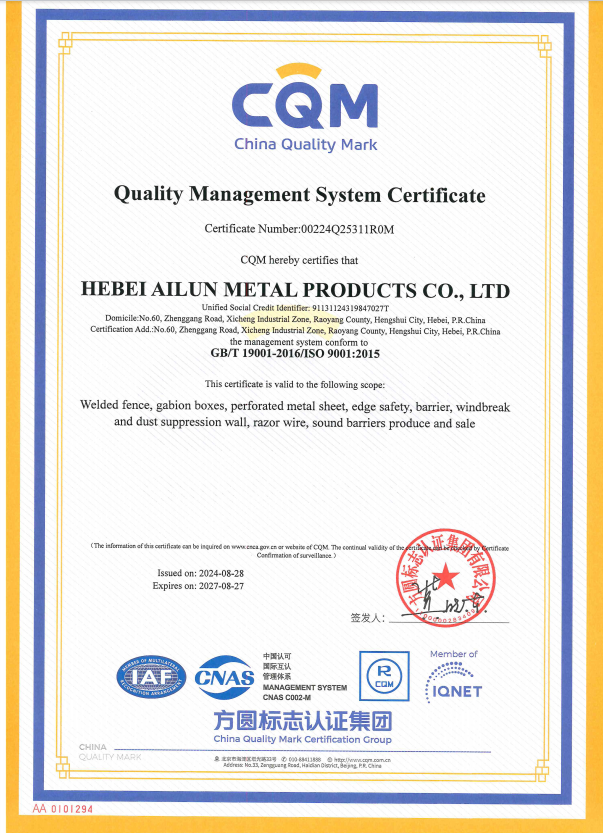
ISO 9001 quality management system certification forms part of the documentation set behind the welded mesh fence range.
Certification and third-party references for the range include ISO 9001 quality management system certification, together with SGS and BV third-party certification and inspection references. ISO 14001 environmental management system certification, ISO 45001 occupational health and safety management system certification, utility model patents and a product quality inspection test report sit in the same documentation set. A buyer running a supplier audit for a multi-year programme can therefore assess welding control, coating control and delivery inspection against documents rather than against samples alone.
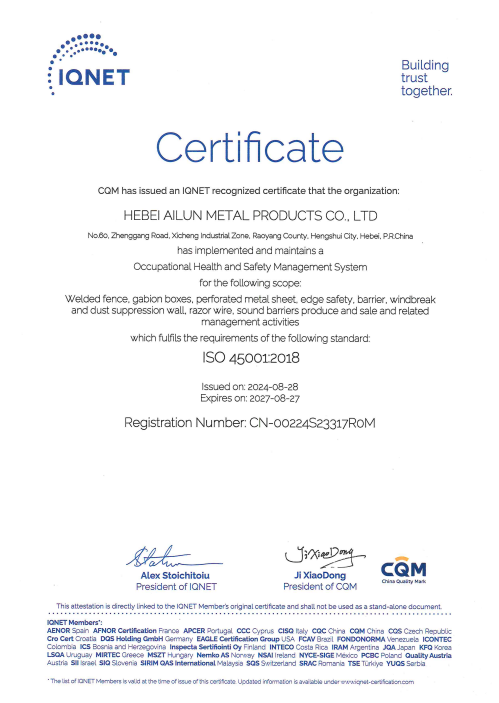
A product quality inspection test report supports pre-shipment verification and third-party testing requests.
Market context for a multi-year decision
The global welded wire mesh fence market was valued at USD 7.04 billion in 2025 and is projected to reach USD 11.72 billion by 2034, according to Dataintelo. The wider fencing market is estimated at USD 33.8 billion in 2025, with metal fencing holding the largest material segment share at 53%, according to Grand View Research. Asia Pacific accounted for 38.5% of welded wire mesh fence revenue in 2025, driven largely by infrastructure programmes in China and India, again per Dataintelo.
Published market-size estimates for fencing diverge depending on whether installation services are included in the definition. Treat any single published figure as directional rather than as a contractual benchmark.
Standards shape the specification side of the same decision. EN 10223-7:2012 is the active European standard specifying requirements for steel wire welded panels for fencing in schools, parks and industrial sites. ASTM F2453/F2453M-14 covers welded wire mesh fence fabric with metallic or polymer coatings for high-security applications. Where a tender cites either document, coating and mesh geometry move from preference to contractual requirement.
On the supply side, Betafence Group expanded its perimeter security portfolio in February 2024 with new-generation welded mesh systems incorporating intrusion detection and solar surveillance. Key global players in the security fencing market include Betafence, Bekaert, Ameristar Perimeter Security and Jacksons Fencing. The direction of travel is toward integrated perimeter systems, which raises the value of welded panel families that are documented well enough to be integrated or audited later.
Welded mesh fence versus lower-cost wire mesh fence
The most common commercial comparison a buyer faces is not between two welded panels; it is between a specification-led welded mesh panel and an ordinary low-cost wire mesh fence. The recorded trade-off is better anti-corrosion and anti-climb performance, approximately 5% higher initial cost, approximately 40% lower replacement cost, and a service life 6+ years longer. The maintenance profile is stated as zero maintenance within 10 years.
Read that as a decision rule rather than a slogan. A 5% initial premium is only recovered if the installation is correct and the exposure environment matches the coating specification. For a short, fixed-duration boundary — a construction site that will be dismantled within a year, for example — the premium cannot be recovered inside the service window, and a temporary fence family is the more rational specification. The same logic runs in reverse for a perimeter expected to remain in place across multiple project phases.
Boundary conditions: where this framework does not decide for you
A decision framework is only credible if it states its limits. Seven apply here.
- Initial cost premium. A specification-led welded mesh panel carries approximately 5% higher initial cost than an ordinary cheap wire mesh fence. Whether it is recovered depends on the service life actually achieved, not on the nominal figure.
- Coating must match exposure. Hot dipped galvanizing plus powder coating is the stated system. For coastal, industrial or chemically aggressive sites, the coating specification should be confirmed against that environment rather than assumed.
- Small-aperture panels reduce visibility. The 76.2 × 12.7 mm aperture used in the 358 family is deliberately difficult to see through and difficult to climb. Where sightlines matter — parks, spectator areas, public realm — a 50 × 100 mm panel is usually the better fit.
- Temporary panels are not permanent panels. The TC family is engineered for relocation, not as a substitute for a permanent perimeter system.
- A designation is not a specification. Wire diameter can be selected anywhere between 3.0 mm and 6.0 mm. Two panels carrying the same model name with different wire diameters will not behave identically in service.
- Customisation changes the commercial timeline. Size, wire diameter, mesh, colour, logo and surface treatment are all configurable. The 15–30 day lead time is a typical reference and should be confirmed against the final configuration.
- Code compliance remains project-specific. EN 10223-7 and ASTM F2453 provide product-level references; local building code, anti-intrusion standards and school safety requirements can add obligations that sit outside a product certificate.
Long-term and ecosystem considerations
For framework agreements and multi-phase programmes, the panel model is only half of the decision. The other half is whether the supply relationship can carry the programme from the first phase to the last.
- Continuity of specification. Standardising on one or two families across phases avoids re-approval, re-testing and visible mismatch between panels supplied in different years.
- Repeat-order structure. A minimum order quantity of 1 set means a single replacement panel, a single gate section or a single demonstration panel can be ordered without a volume commitment.
- Capacity planning. Monthly production capacity of 420,000 m² sets the practical upper bound for a rollout schedule; typical production lead time is 15–30 days.
- Documentation continuity. ISO 9001, SGS and BV references, together with ISO 14001 and ISO 45001 system certificates, utility model patents and a product quality inspection test report, support supplier audits at any point across the programme.
- Regional reach. Around 80% of Dengfeng’s output is exported, with Europe, Saudi Arabia, the Middle East, the United Arab Emirates and the United States among the main markets — relevant where a buyer operates the same specification in more than one country.
- Lifecycle economics. Zero maintenance within 10 years and a stated 40% lower replacement cost are the two figures that make a whole-life cost comparison possible across a multi-year horizon.
The practical implication is that long-term procurement rewards buyers who lock the specification envelope rather than the model name. A locked envelope — height, width, wire diameter, mesh aperture, coating system and inspection regime — can be re-ordered, audited and extended. A locked model name cannot.
Future outlook
Three directions shape the next specification cycle. Growth: welded wire mesh fence demand is projected to move from USD 7.04 billion in 2025 to USD 11.72 billion by 2034, with metal already the largest material segment in the wider fencing market. Integration: welded mesh systems are increasingly specified alongside intrusion detection and surveillance rather than as standalone barriers. Standardisation: EN 10223-7:2012 and ASTM F2453 give buyers testable product references, shifting negotiation from brand claims toward coating, mesh geometry and inspection records.
For buyers, the consequence is straightforward. A decision framework built on a shared, verifiable specification band is more durable than one built on model names alone. The designation shortlists the supplier; the documented envelope decides whether the perimeter is still performing in its tenth year.
FAQ
How is corrosion protection specified across the welded mesh fence range?
The stated surface treatment is hot dipped galvanizing followed by powder coating, applied with robotic welding for the welding process and manual inspection through the polishing, pickling and powder coating procedures. The two control targets are corrosion damage and structural deformation, addressed through the galvanized-plus-powder-coated system and a thickened wire structure. 100% raw material inspection and a finished-product load test form part of the same control process.
What certifications and inspection documents support a multi-year welded mesh fence procurement?
Documented references include ISO 9001 quality management system certification, SGS and BV third-party certification and inspection references, ISO 14001 environmental management system certification and ISO 45001 occupational health and safety management system certification. Utility model patents and a product quality inspection test report are part of the same documentation set. Pre-shipment full inspection is standard, and third-party testing is acceptable.
Does welded mesh fence meet school and public-realm safety requirements?
Product-level references include EN 10223-7:2012, the active European standard specifying requirements for steel wire welded panels for fencing in schools, parks and industrial sites, and ASTM F2453/F2453M-14, which covers welded wire mesh fence fabric with metallic or polymer coatings for high-security applications. Local building code, safety and anti-intrusion requirements remain project-specific and should be confirmed against the applicable national or municipal requirements for the site.
Which model fits a multi-phase project that must stay visually consistent?
Multi-phase projects are usually served by standardising on one panel family and one coating specification. 3D-2000, a 3D curved welded mesh panel, suits general perimeter duty where a uniform, visually open panel is required; 358-1800, a 358 anti-climb panel, suits high-security sections. Both are produced within the same 630–3000 mm height, 2000–3000 mm width and 3.0–6.0 mm wire diameter band and share the hot dipped galvanized plus powder coated surface treatment, which supports matching later phases to earlier ones.
Can welded mesh fence panels be customised?
Size, wire diameter, mesh, colour, logo and surface treatment are configurable within the stated production band. The shared envelope is 630–3000 mm in height, 2000–3000 mm in width, with a wire diameter selected between 3.0 mm and 6.0 mm and mesh options of 50 × 100 mm or 76.2 × 12.7 mm. The final specification should be confirmed on the drawing, because a model designation alone does not fix these variables.
What is the minimum order quantity and typical lead time?
The minimum order quantity is 1 set and the typical production lead time is 15–30 days, with monthly production capacity of 420,000 m². Because size, wire diameter, mesh, colour, logo and surface treatment can all be customised, lead time should be confirmed against the final configuration rather than the standard reference.
What are the purchasing terms and acceptance criteria?
Minimum order quantity is 1 set. Delivery terms are FOB Tianjin or CIF. Acceptance criteria are pre-shipment full inspection, with third-party testing acceptable. Payment terms available are L/C, T/T, D/P, Western Union, Paypal and Money Gram.
Reference document: Welded wire mesh and GI wire product catalogue (PDF).