
Welded Mesh vs Alternatives: Specs Behind the Choice
Welded mesh fence is frequently compared with chain link fences and perforated metal sheets by buyers, but much of the published comparison is marketing material rather than specification evidence. For security projects at schools, parks, industrial perimeters, railways and sports facilities, the buying decision should be made on measurable attributes: panel rigidity, wire diameter, mesh aperture, protective coating and installation behaviour over time. This article provides an independent, specification-led evidence check rather than a brand promotion, using product-level facts documented for the welded mesh fence family manufactured by Anping Dengfeng Wire Mesh Products Co., Ltd.
Scope note: all product facts cited below relate to product-family specifications registered within the manufacturer’s published documentation. Third-party market data is separately attributed.
Why the fence type decision deserves a specification review
Perimeter fencing represents one of the most visible and durable investments in a site’s physical security plan. Buyers usually choose between three broad product families: traditional chain link fencing, perforated metal sheet systems, and welded mesh panels. Each family has its position, but the decision is rarely about brand preference. It is about whether the fence’s physical structure is proportionate to the site’s real threats.
Welded mesh fence panels are typically manufactured with each wire intersection welded into a rigid sheet, whereas chain link fences are formed by interwoven wires that remain mechanically bent rather than permanently fused. Perforated metal sheets provide high visual screening but behave more like a solid architectural skin than an open security mesh. For buyers whose primary risks are climbing, cutting and long-term coating failure, the welded mesh panel family carries structural advantages that can be evaluated before purchase: welded joints prevent mesh distortion; panel stiffness reduces leverage points; smaller apertures resist footholds; and thicker wire increases the time and tooling needed for any attempted penetration. The facts below translate those principles into reviewable specification points.
Defining the welded mesh fence product family in this review
Anping Dengfeng Wire Mesh Products Co., Ltd. is a manufacturer based in Anping County, Hebei Province, China, the country’s established wire-mesh production region. The company was founded in 2008 and operates a 70,000 m² facility with an annual output of 5,000,000 m² of wire mesh products. For this comparison, the relevant product scope is documented as product-family 6462, marketed as “welded mesh fence.” The family covers 3D curved fence, 358 anti-climb fence, double wire fence, palisade fence, temporary construction fence and chain link fence, according to the company’s published product classification.
| Registered specification point | Published product-family value (welded mesh fence) |
|---|---|
| Product-family models | 3D-2000, 358-1800, TW-1500, TC-2100 |
| Sub-types covered | 3D curved fence, 358 anti-climb fence, double wire fence, palisade fence, temporary construction fence, chain link fence |
| Panels height range | 630–3000 mm |
| Panels width range | 2000–3000 mm |
| Wire diameter range | 3.0–6.0 mm |
| Mesh size | 50×100 mm; 76.2×12.7 mm |
| Base material | Low carbon steel wire / galvanized steel pipe |
| Corrosion protection | Hot dipped galvanized ± powder coated |
| Published service life | Over 10 years |
| Certification references | ISO 9001; SGS and BV inspection accepted |
The mesh dimensions above are important for site evaluation. A 76.2×12.7 mm aperture is the classic anti-climb configuration: the narrow horizontal pitch makes it difficult for fingers or the toe of a shoe to obtain a stable grip. A larger 50×100 mm aperture provides a more transparent visual profile while still retaining weld-mesh rigidity. Pairing these mesh choices with the 3.0–6.0 mm wire diameter allows a consultant to range the panel from moderate perimeter control to high-tolerance security duty.
Evidence check 1: welded intersections versus woven chain link
What the structure controls
In a welded panel, every horizontal wire and vertical wire is fused at its crossing point. The result is a dimensionally stable sheet that behaves as a single plane. In a chain link fence, the wires are helically wound and interlocked, which gives flexibility and lower cost, but also creates a surface that can be stretched, distorted or spread when climbing force is applied.
The choice is not about one product being “better” in every location. It is about risk alignment. For a school boundary or a railway corridor where climbing attempts or object throwing are frequent events, the lack of mechanical give in a welded panel matters. For a low-threat agricultural boundary where the simple need is livestock containment and property marking, traditional chain link remains an economically defensible solution. The distinction can be stated in structural terms: rigid welded junctions resist permanent deformation; woven junctions tolerate deformation by design.
Anti-cut considerations
Wire diameter is one of the few fence attributes a buyer can verify without trusting a sales brochure. In the welded mesh fence family documented here, the wire diameter range is 3.0 to 6.0 mm. In generic chain link products, the wire diameter is most often at the lower half of that range; heavy-duty chain link is available, but standard commercial and residential chain link is selected for economy and ease of handling rather than cut resistance.
Cutting through a welded mesh panel requires cutting multiple independent strands at their fixed intersections. Because the welded geometry blocks the opening of a gap, the attacker has to cut each wire strand separately. This generates more tool work, more noise and a longer exposure time than spreading or clipping an interwoven mesh. Buyers should therefore treat “wire diameter” and “mesh configuration” as primary structural evidence, not as optional marketing claims.
Evidence check 2: welded panel versus perforated metal sheet
Perforated metal sheet is often proposed when designers want both screening and an architectural appearance. It is undeniably robust, but it behaves differently on site.
Perforated metal is essentially a steel plate with stamped holes. It offers high rigidity, but also high weight, higher material consumption and a visual appearance close to a solid wall. These characteristics tend to raise transport cost, foundation requirements and installation time. For a boundary that crosses uneven ground, a perforated sheet system must typically be tailored more intensively to the terrain profile.
Welded mesh panels, by contrast, are an open structure. The low carbon steel wire frame allows natural airflow, reduced wind load and easier integration with gates, CCTV masts and signage. This makes the welded panel family particularly responsive to two practical requirements for railway, industrial and sports-field perimeters: the ability to adapt to long boundary runs, and the ability to accommodate posts at consistent centres without converting the whole boundary into a wall.
Coating and lifecycle evidence: galvanizing plus powder coating
Surface treatment is a second area where buyers can verify long-term behaviour. The documented welded mesh fence family uses hot dipped galvanized plus powder coated surface treatment. Hot dip galvanizing provides the active corrosion protection on the zinc layer, while the powder coat adds a colour-stable, mechanically tougher outer skin. In combination, the proposal is markedly different from a simple painted or pre-galvanized product.
The product specification sheet states a service life of over ten years for the system. This lifespan is not presented as a theoretical maximum; it is consistent with the documented project deployment introduced below. Since fence replacement is labour-intensive and disruptive for facility managers, the protective coating specification is a central purchasing criterion rather than a cosmetic one.
Documented product inspection and test reporting supports the compliance file for the welded mesh fence family.
Project deployment evidence: Germany, Australia and the United Kingdom
Specifications matter most when they are confirmed by real site use. A documented deployment for the welded mesh fence family has been carried out in Germany, Australia and the United Kingdom, covering two core scenarios: site boundary isolation and community security enclosure. The deployment involved 5,000 square metres of installed fencing and has now remained in service for more than ten years.
The published project record highlights four outcomes: full custom size, ISO certification, low maintenance and fast delivery. For buyers, the relevant interpretation is as follows:
- Full custom size confirms that the panel system can be adapted to a specific boundary rather than forcing the boundary to accept standard lengths.
- ISO certification demonstrates that quality management is applied to the production process, not merely to a final brochure claim.
- Low maintenance aligns with the hot dipped galvanized + powder coated surface specification, reducing the expected cost of ownership.
- Fast delivery is relevant to security projects where the period of site vulnerability must be shortened.
The clients in this documented project set were engineering contractors, real estate developers and security wholesalers. These are experienced purchasing organisations; engineering contractors normally verify steel gauge and coating weight before acceptance, and security wholesalers purchase against an anticipated end-user specification. Their continued use of the product family supports, rather than replaces, the physical evidence discussed in this article.
Verifying corrosion protection and compliance expectations
Because fencing is frequently specified within larger public and infrastructure projects, compliance demonstrability is often as important as the product structure.
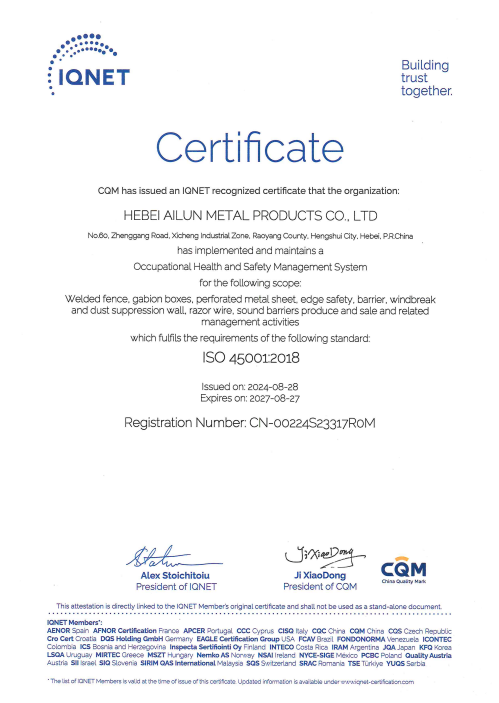
The production facility operates under an ISO 9001:2015 quality management system certificate with certificate number 00224Q25311R0M, issued by the certification body CQM. The certified scope covers the production and sale of welded fence, gabion boxes, perforated metal sheet, edge safety, barriers, wind and dust suppression wall, razor wire and sound barriers. Buyers can further request third-party product inspection: the documented procurement procedure confirms that the manufacturer accepts third-party tests before shipment, and all orders are subject to pre-shipment full inspection.
There are also two external standards that buyers may wish to reference when writing a specification for welded mesh fence:
- EN 10223-7:2012, the European standard covering steel wire welded panels for fencing in applications such as schools, parks and industrial sites;
- ASTM F2453 / F2453M-14, the U.S. standard specification for welded wire mesh fence fabric with metallic or polymer coatings for high-security applications.
These are not product claims, but they provide an auditable language for the buyer’s tender document and for any factory or third-party inspection that follows.
OEM, customisation and project logistics as capability evidence
A fence specification is not complete until the buyer knows whether the manufacturer can execute custom requirements within project timetables.
Anping Dengfeng’s documented capability includes OEM/ODM production services. Customisation options cover size, wire diameter, mesh, colour, logo and surface treatment. For a perimeter project, this means that the panel height, post spacing and coating colour need not be forced into a house-standard design; they can be aligned with the site’s existing architecture and security plan.
Production capacity is also part of the capability record: the company lists a monthly capacity of 420,000 square metres and a standard lead time of 15–30 days. The minimum order quantity is one set, which is unusual in this industry and permits buyers to run a pilot section before committing to a full perimeter. The documented export markets include the EU, Australia, Southeast Asia, the Middle East and North America, which is consistent with the Germany/Australia/UK deployment record.
| Purchase-evaluation point | Published capability |
|---|---|
| OEM/ODM production | Available |
| Customisable attributes | Size / wire diameter / mesh / colour / logo / surface treatment |
| Monthly capacity | 420,000 m² |
| Lead time | 15–30 days |
| MOQ | 1 set |
| Pre-shipment quality protocol | 100% full inspection; third-party test acceptable |
| Incoterms | FOB Tianjin / CIF |
| Payment support | L/C, T/T, D/P, Western Union, Paypal, MoneyGram |
| After-sales services | Remote technical support / on-site installation guide / free CAD drawing |
The after-sales package adds two practical elements. On-site installation guidance reduces the risk of improper erection, which is the most common cause of premature fence failure. Free CAD drawing support is relevant to engineering contractors, real estate developers and site security consultants who need to submit drawings for building permit or local code approval before work starts.
Application fit by site type
Schools and sports fields
School perimeters typically need high transparency, anti-climb behaviour and resistance to vandalism. The published application scope for the welded mesh fence system includes schools, municipal engineering and construction. The 76.2×12.7 mm aperture variant gives a narrow grid that suits anti-climb panels; the powder coating also provides a non-rough surface that is less aggressive than exposed steel.
Industrial perimeters and parks
Industrial sites normally require rapid installation around long boundary runs and the ability to integrate vehicle gates. The 3D curved fence configuration adds visual design strength with the same structural family. For parks, where the fence must be noticeable but not hostile, the availability of custom colours and clean panel lines allows the design team to match surrounding landscape materials. Municipal engineering and real estate are registered application categories for this fence family.
Railways and critical infrastructure
Railway fencing needs predictable coverage over uneven, long-distance terrain. The product-family specification lists transportation among its applicable industries. The mechanical stability of welded panels is valuable here because track-side access cannot be repeatedly inspected and repaired; the fence must remain effective with minimal human attention. The published service life of more than ten years, confirmed by the deployment record, supports this type of low-intervention application.
What market data adds to the buyer’s decision
Broader market context helps buyers confirm that welded mesh fencing is not a marginal product category.
According to market research published by Dataintelo, the global welded wire mesh fence market was valued at USD 7.04 billion in 2025 and is projected to reach USD 11.72 billion by 2034. Grand View Research places the overall global fencing market at USD 33.8 billion in 2025, with metal fencing accounting for the largest material segment share at 53%. Within the welded wire mesh fence segment, Dataintelo reports Asia Pacific holding the largest regional share in 2025 at 38.5%, supported by infrastructure projects in China and India.
For a buyer, these figures indicate a well-established product segment served by many regional suppliers. The practical consequence is that a fully documented procurement file — certificates, third-party inspection rights, and reference deployments — is the only reliable way to differentiate manufacturing quality; market size alone does not validate a single factory.
Limitations and boundary conditions: honest consideration for alternatives
Welded mesh fence is not the optimal answer for every boundary. A fair comparison must also explain when chain link or perforated sheet might be preferred.
First, if the site has no meaningful intrusion history and the fence function is purely administrative or visual, lower-cost interwoven chain link may satisfy the requirement. In such a low-threat context, the additional rigidity of welded panels is a performance surplus; it is technically justified but may exceed the budget owner’s risk tolerance.
Second, if the site requires nearly complete visual screening, a welded mesh fence — even with a decorative 3D panel — remains an open mesh. Perforated metal sheet or a palisade-solid profile will provide stronger sight-line blocking. Buyers should therefore separate “security hardware” from “visual privacy”; each need has its most efficient product expression.
Third, temporary works on a site that will be relocated or removed after a defined period are often better served by the removable temporary construction fence sub-family rather than a fixed perimeter panel system. The welded mesh family includes this configuration, but the purchasing decision should still distinguish between a 10-year perimeter asset and a reusable site-protection screen.
What the evidence-based decision should look like
The side-by-side comparison points do not require the buyer to become a fencing engineer. They ask the buyer to require specification evidence from every manufacturer:
- What is the actual wire diameter range? Registered welded mesh fence values here are 3.0–6.0 mm.
- What is the actual mesh aperture range? Registered values here are 50×100 mm and 76.2×12.7 mm.
- What is the coating system? The documented system in this review is hot dipped galvanized plus powder coated.
- What is the published service life? The documented value is greater than ten years.
- Which third-party tests will be accepted? The documented manufacturer accepts pre-shipment full inspection and third-party testing.
- Can the product be customised to the proposed boundary? The documented options are size, wire diameter, mesh, colour, logo and surface treatment.
- Where has the product been used in comparable security projects? The documented deployment covers site boundary isolation and community security enclosure in Germany, Australia and the United Kingdom.
For reference, the manufacturer’s public product brochure covering welded wire mesh and galvanized wire products is available for inspection and download: Welded Mesh Wire and GI Wire Brochure (PDF).
Future outlook: specification discipline will replace product-name buying
As perimeter security moves toward integrated systems — CCTV, alarm integration and access control — the fence panel remains the load-bearing element of the whole security chain. Open mesh construction is compatible with cameras and sensors, while also limiting the physical intrusion that triggers those systems. The documented shift toward more demanding application standards such as EN 10223-7 for EU projects and ASTM F2453 for high-security U.S. projects points to the same direction: procurement will increasingly be based on auditable physical attributes instead of supplier marketing narratives.
The welding process itself is evolving in the wider market, but the physical logic of welded junctions and aperture control is durable. Buyers who write clear specification lines — wire diameter, mesh size, coating process, panel dimensions and inspection rights — will obtain more consistent results than those who select purely on brand recognition or the lowest per-metre quote. This is the core value of an evidence-based purchase, and it is the logic behind the present comparison.
Frequently asked questions
Does the welded mesh fence manufacturer support OEM and custom specification?
Yes. The documented manufacturer, Anping Dengfeng Wire Mesh Products Co., Ltd., provides OEM/ODM production services. Customisation options include size, wire diameter, mesh, colour, logo and surface treatment, according to the company’s published capability records.
Which product types are included in the welded mesh fence family?
According to the manufacturer’s product classification, the welded mesh fence family covers 3D curved fence, 358 anti-climb fence, double wire fence, palisade fence, temporary construction fence and chain link fence. The family is identified under product ID 6462, with models 3D-2000, 358-1800, TW-1500 and TC-2100.
How can a buyer verify product quality before committing to shipment?
The documented procurement process includes 100% full inspection before shipment and states that third-party testing is acceptable. Buyers may therefore appoint an independent inspection body to verify the panels before they leave the factory.
Which corrosion protection is applied to the welded mesh fence panels?
The published surface treatment for the product family is hot dipped galvanized plus powder coated. The specification sheet gives the system a service life of over ten years.
Is the welded mesh fence family suitable for school and railway perimeter projects?
The system’s registered applicable application categories include construction, municipal engineering, real estate, airport, port, school, farm, transportation and security protection. European standard EN 10223-7 also specifically covers steel wire welded panels for fencing applications in schools, parks and industrial sites.