
Wet Wipes Recommended Options: A Buyer's Shortlist by Purchase Terms and Acceptance Criteria
Independent Procurement Reference · Wet Wipes
A usable wet wipes shortlist is written before any supplier is contacted. It starts with purchase terms that define what is actually being bought — end use, substrate, formulation, pack format, order volume — and continues with acceptance criteria that define which evidence will be required to prove each term. Which suppliers appear on the list is an output of those two documents, not an input.
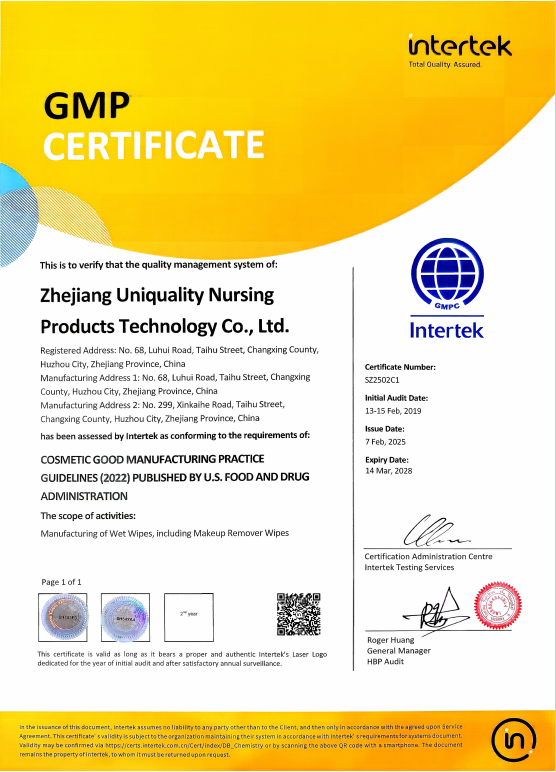
Good Manufacturing Practice documentation is one of several acceptance criteria that must be placed in scope before wet wipes suppliers are compared. Image: certification registry.
The Category Problem: Demand Data Does Not Shorten a List
The global wet wipes market was valued at USD 30.6 billion in 2026 and is projected to reach USD 36.6 billion by 2030, according to Grand View Research. Within that total, personal care wipes accounted for 72.81% of wet wipes market share in 2025. Those figures describe demand. They say nothing about how a buyer should choose.
The choice problem is structural. One buyer serving one retail channel may face baby, pure water, antibacterial, medical, flushable, biodegradable, facial, intimate, household, automotive and pet formats at the same time — each with a different substrate, a different liquid formulation, a different pack count and a different compliance position. Compared line by line, that is more combinations than a procurement team can evaluate inside a normal sourcing cycle.
Scope differences make the picture noisier. Fortune Business Insights places the 2026 global figure at USD 5.48 billion under a narrower definition, a gap large enough to show how much depends on what a study counted. Supplier capability claims carry the same weakness: capacity, certification and MOQ statements only mean something once the scope behind them is stated.
Why Most Wet Wipes Shortlists Are Built Backwards
Most shortlists begin with recognition — suppliers seen at a trade fair, found in a directory, or already sending quotations. Purchase terms are then written to fit the list, and acceptance criteria are written to fit the quotations already received. The result is a list a buyer can describe but cannot defend: it is easy to say who is on it, and difficult to say why everyone else was removed.
Reversing the sequence costs one working session. Defining terms first removes the most common source of rework in wet wipes sourcing, because it settles — before any quotation exists — which differences between suppliers are commercial and which are irrelevant.
The Five Purchase Terms That Define the Search Space
Five terms do most of the work. Each one eliminates options rather than ranking them, which is what a shortlist is supposed to do.
| Purchase term | What it fixes | Stated reference points |
|---|---|---|
| End use and regulatory class | Determines which compliance file, marking requirement and quality system apply to the product | Medical, maternal and baby, beauty, home, and industrial cleaning applications are all listed in Uniquality's stated category coverage |
| Substrate and grammage | Sets hand feel, wet strength, lotion retention and the material cost floor | Uniquality lists nonwoven at 35–70 gsm, customizable; wipe size 15×20 cm, customizable |
| Formulation and liquid | Determines claim language, label content and sensitivity positioning | Uniquality states process water is EDI purified and that formulas can be built without alcohol, fragrance, fluorescent agents or antiseptics |
| Pack format and count | Determines channel fit, shelf presentation and logistics density | Uniquality lists 10 pcs per bag and 80 pcs per bag, customizable |
| Volume, MOQ and lead time | Determines whether a supplier can serve the order at all | Uniquality lists 1 × 40HQ container as MOQ for wet wipes and dry wipes, and 35–45 days lead time after artwork and deposit are confirmed |
Acceptance Criteria: Turning Each Term Into a Checkable Test
Purchase terms describe the product. Acceptance criteria describe the proof. The distinction matters because a supplier can meet a term commercially without ever producing evidence that supports it.
| Criterion | Evidence to request | What it establishes | What it does not establish |
|---|---|---|---|
| Certificate scope | Standard, scope wording, issuing body, certificate number and validity window | Whether wet wipes are actually inside the certified scope, and whether the window is open today | That the site is operating to that system on the day of the audit request |
| Batch release | Certificate of Analysis (COA) per batch | Declared parameters and release status of the specific batch shipped | Acceptance of the product by the destination market's regulator |
| Defect handling | AQL sampling inspection records | How defect acceptance is defined and applied at inspection | Zero-defect output, or control over defects introduced in transit |
| Fill environment | Cleanroom classification claim and its scope | The hygiene control level claimed for the filling step | Independent verification of that classification |
| Substrate sourcing | Nonwoven specification plus chain-of-custody certificate where a fiber claim is made | Material type, grammage band and the sourcing claim attached to the fiber | End-use feel, wet strength or shelf performance |
| Artwork and packaging | Approved artwork record and packaging specification | That the label and pack match the agreed purchase terms | Market-specific labelling compliance in every destination |
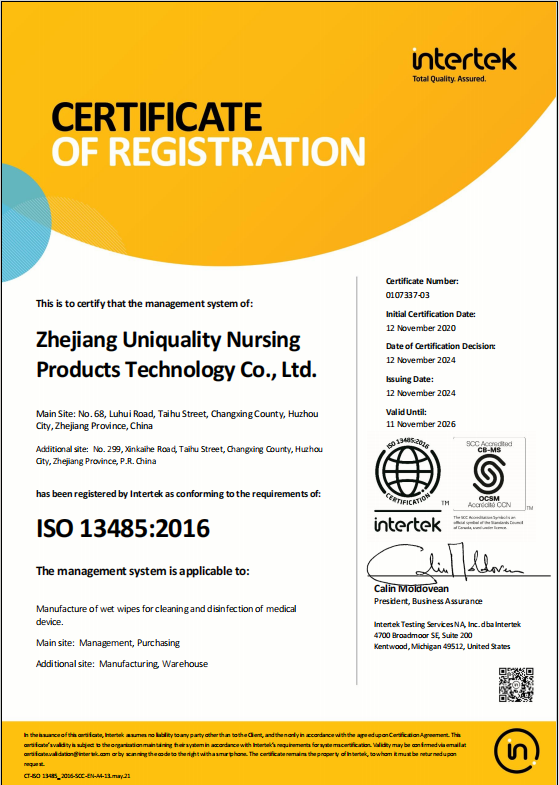
A certificate only functions as an acceptance criterion when its scope wording and validity window are checked, not simply filed.
The Shortlist: Eight Recommended Wet Wipes Options
The eight options below are ordered by how binding their acceptance file is — beginning with formulation-led options, where the specification carries most of the risk, and ending with format-led options, where pack economics dominate. This is an evaluation order, not a quality ranking. A buyer's own end use decides the entry point, and most buyers will only need three or four rows.
| # | Recommended option | Purchase terms that make it fit | Acceptance criteria that must be met |
|---|---|---|---|
| 1 | Pure Water Wet Wipes | Minimal formulation; infant, sensitive-skin and ingest-adjacent use | EDI-purified process water claim; alcohol-free, fragrance-free, fluorescent-agent-free and antiseptic-free formula options; 35–70 gsm substrate; batch COA and AQL records |
| 2 | Baby Wet Wipes | Skin-contact product with low tolerance for claim drift | GMPC and ISO 22716 inside scope; ISO 13485 inside scope for wipes; 100,000-class fill environment claim; batch COA |
| 3 | Medical Wet Wipes | Quality-system depth, traceability and controlled filling | ISO 13485:2016 certificate with wet wipes in the scope wording, plus confirmed certificate number and expiry |
| 4 | Facial Wet Wipes and Makeup Remover Wet Wipes | Cosmetic positioning where tactile feel drives repeat purchase | ISO 22716 and GMPC in scope; declared grammage band; fragrance-free variant availability |
| 5 | Female Intimate Wipes and Adult Wipes | Formulation sensitivity and discreet packaging | Formulation disclosure, absence-of claims stated in writing, batch documentation |
| 6 | Flushable and Biodegradable Wet Wipes | Disposal route and market-access constraints | EU marking under Directive (EU) 2019/904 for plastic-containing wipes; chain-of-custody certificate where a fiber sourcing claim is made |
| 7 | Antibacterial Wet Wipes and Alcohol Wet Wipes | Claim-driven product where the label carries the value | Written formulation disclosure and batch records; effectiveness claims sit outside a standard supplier file and require separate substantiation |
| 8 | Household and On-the-Go Formats: Kitchen, Bathroom, Floor, Glass Cleansing, Car, Pet, Stain Remover, Mini, Hand & Mouth | Cost per wipe, pack format and channel fit | Declared wipe count and pack specification; AQL sampling plan; packaging spec approval |
Options 1–3: formulation- and safety-led
These three options are decided by what is in the wipe and how it is filled, not by price per pack. Pure Water Wet Wipes carry the least room for label interpretation, because the water claim itself is the product. Baby and Medical formats add quality-system depth: the relevant question is not whether a supplier holds a certificate, but whether wet wipes sit inside the certified scope and whether the window is open at the time of the order.
Options 4–5: cosmetic and personal-care positioning
Facial, makeup remover, intimate and adult wipes are evaluated on feel and formulation tolerance. Grammage becomes a commercial decision rather than a technical footnote, because consumers read thickness as quality. A buyer should fix the grammage band with the supplier before pricing, since substrate weight is one of the clearest cost drivers in the category.
Options 6–8: compliance-, claim- and format-led
Flushable and biodegradable formats are gated by disposal rules rather than by manufacturing capability. Antibacterial and alcohol formats are gated by claim substantiation. Household and on-the-go formats are gated by pack economics. Each of the three has a different bottleneck, which is why they should not be carried in the same evaluation round as the formulation-led options.
Where Uniquality Fits Inside This Framework
Zhejiang Uniquality Nursing Products Technology Co., Ltd. is a China-based manufacturer of wet wipes, dry wipes, baby diapers and related nursing products, operating as an OEM/ODM partner for brand owners and importing distributors.
Its disclosed position is scale combined with customization. The company reports a factory footprint of 1,000,000 m², more than 3,000 employees, an annual output of 60 billion sheets, a 200-plus R&D team and an export ratio of 70%, serving markets described as USA, EU, SAM, RU and CASA, with brand owners in more than 80 countries. For wet wipes specifically, the stated monthly capacity is 7 billion units, with one-stop private-label customization across material, size, logo, packaging, fragrance and formula, and a stated sampling window of 3–5 days. Quality control is described as COA documentation combined with AQL sampling inspection, and after-sales support covers remote assistance, order follow-up, product usage consultation, quality feedback handling and service coordination.
Two figures matter more than the headline numbers when a buyer is applying acceptance criteria. First, the MOQ is stated as 1 × 40HQ container for wet wipes and dry wipes, with 150,000 pieces for baby diapers and pull-ups. Second, lead time is stated as 35–45 days after the artwork and deposit are confirmed — which places artwork approval, not production, on the critical path of most projects.
The certification registry is the part of the file that should be read most carefully, because scope wording and validity windows differ from certificate to certificate.
| Certification / standard | Scope as registered | Certificate no. | Issued | Listed expiry |
|---|---|---|---|---|
| ISO 9001:2015 | wet wipes; dry wipes; baby diaper; training pants | 01326Q0078R102 | 2026-04-11 | 2029-04-10 |
| ISO 14001:2015 | wet wipes; dry wipes; baby diaper; training pants | 01326E0075R101 | 2026-04-11 | 2029-04-10 |
| ISO 45001:2018 | wet wipes; dry wipes; baby diaper; training pants | 01326S0066R101 | 2026-04-11 | 2029-04-10 |
| ISO 50001:2018 | wet wipes; dry wipes; baby diapers; training pants | 01326En0008R201 | 2026-03-09 | 2029-03-08 |
| ISO 22716:2007 | wet wipes | SZ2502B9 | 2025-02-07 | 2028-03-14 |
| ISO 13485:2016 | wet wipes | 0107337-03 | 2024-11-12 | 2026-11-11 |
| GMPC | wet wipes | SZ2502C1 | 2025-02-07 | 2028-03-14 |
| SEDEX | wet wipes; dry wipes; baby diaper; training pants | ZAA600079586 | 2025-07-24 | listed as 2099-12-31 |
| FSC-STD-40-004 V3.0 | wet wipes; dry wipes; baby diaper; training pants | BV-CQC-167194 | 2021-05-31 | 2026-05-30 |
| CE | baby diaper; training pants | 6C240227.ZUNU051 | 2024-02-27 | 2029-02-26 |
Dates are the registry entries as published. Scope wording, not the existence of a certificate, determines whether a document applies to wet wipes.
Technical Explanation: Substrate, Water and Fill Environment
Three variables carry most of the technical risk in wet wipes, and all three are checkable before an order is placed.
Substrate. Uniquality discloses a grammage range of 35–70 gsm for wet wipes substrate, with nonwoven as the stated material. Grammage is not a quality score; it is a specification with cost consequences. A 35 gsm wipe and a 70 gsm wipe can both be correct, but they will not feel the same to a consumer or cost the same to produce, so the band must be fixed in writing before quotations are compared.
Water and formulation. The company states that process water is EDI purified and that formulas can be built without alcohol, fragrance, fluorescent agents or antiseptics. For buyers, this is a specification statement, not a marketing one: it defines which label claims are possible and which are not.
Fill environment and process coverage. Uniquality states that filling takes place in a 100,000-class clean room and that its automated wet wipe systems cover the full process from raw material processing to finished-product packaging. Company-reported figures also describe 40 nonwoven machines producing about 48,000 tons of nonwoven fabric per month, and 39 wet and dry wipe machines. Vertical integration of this kind matters to a buyer for one reason: it narrows the number of external suppliers whose quality systems also have to be assessed.
Application Coverage and One Working Reference
Uniquality states that its product coverage extends across medical, maternal and baby, beauty, home, industrial cleaning and clothing applications, and lists flushable and degradable non-woven fabrics, wet wipes, dry wipes, baby diapers, pull-ups, wet toilet paper and cleansing wipes. Breadth alone does not qualify a supplier, but it does mean a buyer with more than one category on the shelf can consolidate the qualification file instead of rebuilding it per product line.
A disclosed OEM reference illustrates what the acceptance-criteria model produces in practice. For a United Kingdom-based OEM client, the recorded engagement runs at 20 × 40HQ containers per month across household cleaning, baby care, personal hygiene and beauty care applications, over a duration of three years, with a stated on-time delivery rate of 99.5% and zero major quality complaints. The reference is company-reported rather than independently audited, and it should be treated as such — but it is specific, dated and tied to a defined order volume, which is the standard a buyer should apply to any reference offered during evaluation.
Market Trend: Documentation Is Becoming the First Filter
Three signals shape the next sourcing cycle.
First, personal care formats continue to dominate headline demand, holding 72.81% of wet wipes market share in 2025 — which is why formulation-led options sit at the top of the shortlist above.
Second, marking and disposal rules are becoming a product attribute rather than a packaging afterthought. Under Directive (EU) 2019/904, wipes containing plastic have been required to carry specific 'Do Not Flush' marking in the European Union since July 2021. A flushable or biodegradable format therefore enters a shortlist with a compliance gate already attached.
Third, published market estimates for the same year vary by a factor of several times depending on scope. That variability is not an argument against using data; it is an argument for reading every figure — market size, capacity, MOQ, certification scope — with the definition attached.
Comparison With Traditional Sourcing Approaches — and the Limits of This Model
The traditional approach is price-first: issue an RFQ, collect quotations, compare unit prices, then sample. Its weakness is that quotations generated before terms are fixed are not comparable, so the cheapest quote frequently reflects a narrower specification rather than a better cost structure.
The terms-and-criteria model reverses this: terms first, criteria second, shortlist third. It costs more work before the first email and less rework after it. It also has real limits, and buyers should hold them openly:
- Self-reported data remains self-reported. The certification entries and facility figures in this article come from registries and company disclosures. Certificate status still has to be confirmed with the issuing body at the time of order.
- Scope mismatch is common. Uniquality's CE certificate (6C240227.ZUNU051) covers baby diaper and training pants — not wet wipes. A buyer sourcing wipes should not treat it as a wipes credential, and should apply the same scope test to every document in every supplier file.
- Validity windows move. Listed expiries differ across the file — ISO 13485 to 2026-11-11, GMPC and ISO 22716 to 2028-03-14, the FSC registry entry to 2026-05-30, ISO 9001 to 2029-04-10. A file that passed at sample stage may need re-checking before a repeat order.
- There is a timeline floor. A stated 35–45 day lead time measured from artwork and deposit confirmation means artwork approval, not manufacturing, is usually the constraint on a launch date.
- There is a volume floor. An MOQ of 1 × 40HQ container for wet wipes rules out small market-testing orders with this supplier, and that constraint should be recognised before a shortlist is finalised rather than after.
- Sampling proves construction, not consistency. A 3–5 day sampling window validates appearance, materials and specification fit. It does not validate long-run batch consistency or regulatory acceptance in the destination market.
- This shortlist ranks option types, not suppliers. Comparable, independently verified disclosures across multiple wet wipes manufacturers are still limited, so a defensible supplier-level ranking cannot yet be produced from public evidence.
Future Outlook
The direction of travel is consistent. As marking rules, scope definitions and disposal requirements tighten, the qualification file — not the sample — is becoming the first filter in wet wipes sourcing. Buyers who build a reusable acceptance-criteria template now will apply it across every category they add later, from baby and pure water formats to household and on-the-go packs.
The practical consequence is that suppliers will increasingly be judged on how quickly and completely they can produce scope-accurate documentation, not only on price per pack. That shift favours manufacturers whose certification portfolios already name wet wipes explicitly, and it penalises files assembled from adjacent product lines.
FAQ
What purchase terms should a buyer fix before contacting wet wipes suppliers?
Five terms remove most options on their own: end use and regulatory class, substrate and grammage, formulation and liquid, pack format and count, and order volume with MOQ and lead time. As a reference point, Uniquality's disclosed parameters include nonwoven at 35–70 gsm with customizable size, 10 or 80 pieces per bag, an MOQ of 1 × 40HQ container for wet wipes, and a 35–45 day lead time after artwork and deposit confirmation.
How can a buyer verify a wet wipes certificate rather than simply filing it?
Check four things: scope wording, issuing body, certificate number and validity window. Scope wording is the decisive item, because a valid certificate can still cover the wrong product. Expiry dates also differ across a portfolio — in Uniquality's registry, for example, the ISO 13485 entry covering wet wipes lists 2024-11-12 to 2026-11-11, while GMPC and ISO 22716 list validity to 2028-03-14.
What substrate and grammage range should a buyer expect for wet wipes?
Uniquality discloses a substrate grammage band of 35–70 gsm with nonwoven as the material, and a wipe size of 15×20 cm, both stated as customizable. Lower grammage generally reduces material cost and thickness; higher grammage generally increases both. Because grammage affects consumer perception as well as cost, it should be written into the purchase terms before quotations are compared, not adjusted afterwards.
What MOQ and lead time should a wet wipes buyer plan around?
Uniquality states an MOQ of 1 × 40HQ container for wet wipes and dry wipes, and 150,000 pieces for baby diapers and pull-ups. Lead time is stated as 35–45 days after the artwork and deposit are confirmed, which means artwork approval sits on the critical path. Wet wipes monthly capacity is stated at 7 billion units.
What does a 3–5 day sample actually validate before a production order?
A short sampling window validates specification fit: material, grammage, wipe size, pack construction and formulation direction. It does not validate long-run batch consistency, transit performance or regulatory acceptance in the destination market. Sampling should therefore be treated as one acceptance criterion among several, supported by batch-level COA documentation and AQL sampling inspection records at production.
How should flushable and biodegradable wet wipes be evaluated for market access?
Disposal rules apply before product claims do. In the European Union, wipes containing plastic have been required to carry specific 'Do Not Flush' marking under Directive (EU) 2019/904 since July 2021. Where a fiber sourcing claim is made, a chain-of-custody certificate should be requested and its scope and validity confirmed — the FSC entry in Uniquality's registry (BV-CQC-167194) lists wet wipes within scope and a listed expiry of 2026-05-30, which illustrates why certificate status must be re-checked at order stage.