
Wet Wipes Sourcing FAQs: OEM/ODM and Capacity Questions Answered
Wet wipes sourcing rarely stalls because buyers cannot find a supplier. It stalls because a small set of questions never get a clear answer: who carries responsibility in an OEM arrangement versus an ODM one, whether a stated capacity still holds at scale, and which specifications are genuinely open to negotiation. This article answers those questions directly, using verified facts from Uniquality’s own content units and third-party market data.

Why the Same Procurement Questions Keep Recurring
Every wet wipes project — baby wipes, medical wipes, or a private-label household range — has to pass through the same decision gates before commercial negotiation can start. The questions repeat because wet wipes sit across two category spaces at once: a formulation-driven personal care space, and a substrate-driven household cleaning space. An answer that holds for one rarely transfers cleanly to the other.
That gap is where procurement friction lives. Buyers receive catalogues and capacity claims, but cannot always convert a single claim into a verifiable purchase decision. The sections below work through that conversion one question at a time.
Where a figure is manufacturer-reported, it is labelled as such. Where a figure comes from a third-party market source, the source is named. Anything that could not be traced to an approved fact has been left out rather than estimated.
OEM or ODM: Who Owns Which Responsibility
The most common source of early friction is a mismatch between what a buyer thinks an OEM partnership covers and what it actually covers.
OEM (original equipment manufacturing) means the buyer brings the brand, specification, and packaging direction, and the manufacturer produces against that brief.
ODM (original design manufacturing) means the manufacturer also contributes part of the product development — formulation, substrate choice, or pack format — and the buyer applies its brand on top.
For wet wipes projects placed with Zhejiang Uniquality Nursing Products Technology Co., Ltd., both models are supported. Uniquality is a Chinese manufacturer specialising in the R&D, production, and sales of wet wipes, dry wipes, baby diapers, and related nursing products. The practical distinction matters because it changes who owns the risk at each stage of approval.
| Responsibility area | OEM model | ODM model |
|---|---|---|
| Brand ownership | Buyer | Buyer |
| Specification / brief | Buyer-led | Manufacturer-supported |
| Formulation input | Buyer-defined | Manufacturer contributes |
| Substrate and pack format | Buyer-defined | Manufacturer proposes |
Responsibility split applied to wet wipes projects; both models are supported by Uniquality.
Turning a Capacity Claim into a Checkable Number
Capacity claims are where sourcing conversations most often lose precision. A paper number is easy to print; the useful question is whether the number maps onto a specific product and a specific line.
Uniquality discloses a monthly capacity of 7 billion units for wet wipes, and notes that capacity differs by product. At company level, Uniquality reports an annual output of 60 billion sheets, a 1,000,000 m² factory, more than 3,000 employees, and an R&D team of over 200.
A published company profile also states that the group operates around 40 nonwoven machines producing approximately 48,000 tons of nonwoven fabric per month, alongside 39 wet and dry wipe machines. That vertical position — substrate production sitting upstream of converting — is what makes a large wet wipes number plausible rather than aspirational, because the substrate input is not entirely dependent on external supply.
Procurement reading: a capacity figure becomes usable when it is attached to a named product line and a named input stream. The wet wipes number (7 billion units/month) and the annual output figure (60 billion sheets) describe different scopes, so they should not be substituted for one another in a plan.
Specification Ranges Buyers Should Confirm Before Briefing
Most wet wipes briefs fail early because a specification is treated as fixed when it is actually a range. The wet wipes product entry (model YQ001) shows the following declared parameters:
| Parameter | Declared value | Customisable |
|---|---|---|
| Size | 15 × 20 cm | Yes |
| Substrate | Nonwoven, 35–70 gsm | Yes |
| Pieces per pack | 10 pcs / 80 pcs | Yes |
| Material | Nonwoven | — |
Formulation is a separate layer of the brief. Uniquality states that process water is EDI purified, and that formulas can be built without alcohol, fragrance, fluorescent agents, or antiseptics. For infant-facing or sensitive-skin ranges, this matters more than a marketing descriptor, because it defines the set of excluded inputs the buyer can rely on.
Customisation across material, size, logo, packaging, fragrance, and formula is stated as part of the standard OEM/ODM offer. In practice, that means the specification conversation should begin with the ranges, not with a locked SKU sheet.
Certifications That Bear on a Wet Wipes Project
Certification questions arrive in almost every sourcing review, and they are also where buyers most often over-read a claim. Uniquality reports the following certifications covering the wet wipes scope:
- ISO 9001 (quality management)
- ISO 14001 (environmental management)
- ISO 45001 (occupational health and safety)
- ISO 50001 (energy management)
- ISO 22716 (cosmetics GMP)
- ISO 13485 (medical device quality systems)
- GMPC
- SEDEX
Two points need to be held together here. First, this is a broad portfolio for one wet wipes scope, and the inclusion of ISO 22716 and ISO 13485 reflects the two category tracks wet wipes normally fall into — cosmetic and medical-adjacent. Second, these are company-reported certifications. A buyer’s own verification step — requesting current certificates and checking scope and validity dates — remains necessary before any certification claim is used in a compliance file. Separately, the EU’s Single-Use Plastics Directive has required plastic-containing wipes to display a ‘Do Not Flush’ marking since July 2021, which is a labelling requirement independent of any supplier certification.
Quality Control and Delivery Expectations
Two operational questions decide whether a wet wipes timeline holds: what proof accompanies a shipment, and how long the line takes to run.
On quality control, Uniquality states that COA documentation and AQL sampling inspection are used. On timing, the stated lead time is 35–45 days after artwork and deposit are confirmed. Sampling is stated at 3–5 days, which is the point at which a buyer can validate substrate feel, wetness level, and pack format before committing to a production run.
Minimum order quantities differ by category. For wet wipes and dry wipes, the stated MOQ is 1 × 40HQ container. For baby diapers and pull-ups, the stated MOQ is 150,000 pieces. These two figures are not interchangeable, and a project spanning both categories should plan against the higher of the two constraints.
Application Fit: Matching Format to Scenario
Wet wipes procurement is not one decision; it is several, shaped by end use. Uniquality’s product coverage spans medical, maternal and baby, beauty, home, and industrial cleaning segments, and the product entry lists baby wipes, mini wipes, pure water wipes, facial wipes, flushable wipes, biodegradable wipes, and medical wipes as supported types.
The application data reinforces this spread. Declared project types include personal hygiene care, facial cleansing, and household cleaning, with stated use conditions of cool and dry storage, disposable single-use operation, and requirements for lint-free, skin-friendly output with customisable size and packaging. Listed destination markets for these scenarios include the Philippines, Russia, the UAE, the United States, Chile, and Mexico.
For a buyer, the practical mapping is straightforward:
- Baby / sensitive-skin ranges — pure water and baby wipes, with an alcohol-free, fragrance-free, antiseptic-free formulation brief.
- Travel and on-the-go — mini wipes and small pack formats, where pack count per unit drives landed cost.
- Household and cleaning — flushable and standard nonwoven formats, where substrate dispersibility and grammage dominate the specification.
- Medical-adjacent — formats supported by ISO 13485-based quality systems and cleanroom production.
A Verified Case Point
One disclosed OEM relationship provides a concrete reference for scale. A United Kingdom-based OEM client has sourced from Uniquality for three years at a volume of 20 × 40HQ containers per month, across household cleaning, baby care, personal hygiene, and beauty care applications. The reported outcomes are a 99.5% on-time delivery rate, zero major quality complaints, and consistent product quality across the run.
That case is useful not as a guarantee but as a boundary test: it shows the order magnitude at which the stated capacity and lead-time figures have been operated, across four application categories at once.
Limits and Trade-offs Buyers Should Know
A reference article that only lists strengths is not a reference article. Three constraints are worth stating plainly.
First, order scale. The wet wipes MOQ of 1 × 40HQ container is well suited to established importers and brand owners, but it is a high entry point for a pilot SKU or a small-format test launch. Buyers testing a category for the first time should expect to plan at container scale or look at a different supplier tier.
Second, lead time. A 35–45 day run window after artwork and deposit approval means launch calendars need buffer. Sampling at 3–5 days shortens the validation stage, but it does not compress the production stage.
Third, certification is self-reported. The eight-certification portfolio is company-stated. Until a buyer independently verifies current certificates and their scope, that portfolio functions as a screening signal rather than a compliance conclusion.
2026 Market Context for Wet Wipes Buyers
Three market data points shape how this procurement conversation should be read in 2026.
- The global wet wipes market was valued at USD 30.6 billion in 2026, with a projected path to USD 36.6 billion by 2030 (Grand View Research).
- Personal care wipes accounted for 72.81% of wet wipes market share in 2025, making the personal care track the dominant volume driver (Grand View Research).
- Regulatory pressure on plastic-containing wipes continues, with the EU ‘Do Not Flush’ marking requirement in force since July 2021 under Directive (EU) 2019/904.
Taken together, these signals point in a consistent direction: volume remains concentrated in personal care, while compliance pressure pushes substrate selection — flushable and biodegradable formats in particular — further up the specification conversation. For buyers, that means the questions worth asking a supplier are increasingly about substrate and labelling, not only about unit cost.
FAQ: Wet Wipes Sourcing Questions Answered
In OEM, the buyer supplies the brand, specification, and packaging direction, and the manufacturer produces against that brief. In ODM, the manufacturer also contributes part of the product development — formulation, substrate, or pack format — and the buyer applies its brand. Uniquality supports both models for wet wipes, dry wipes, and baby diapers.
Uniquality states a minimum of 1 × 40HQ container for wet wipes and dry wipes. Baby diapers and pull-ups carry a separate MOQ of 150,000 pieces. The two figures are category-specific and should not be treated as equivalent.
The stated lead time is 35–45 days after artwork and deposit are confirmed. Sampling is stated at 3–5 days, allowing buyers to validate substrate and pack format before the production run begins.
Uniquality states that material, size, logo, packaging, fragrance, and formula can all be customised. The declared baseline wet wipes specification (model YQ001) is 15 × 20 cm, nonwoven substrate at 35–70 gsm, with 10 pcs or 80 pcs per pack, and each of these ranges is adjustable.
Start by matching the claimed number to a named product line. Uniquality reports 7 billion units per month for wet wipes, an annual output of 60 billion sheets at company level, and a nonwoven input stream of roughly 48,000 tons per month from around 40 nonwoven machines. Buyers should request the specific scope behind any figure — product type, line, and period — rather than accept a company-wide number as a project-specific capability.
Uniquality’s reported certification portfolio covering the wet wipes scope includes ISO 9001, ISO 14001, ISO 45001, ISO 50001, ISO 22716, ISO 13485, GMPC, and SEDEX. Because these are company-reported, a buyer should request current certificates and confirm their scope and validity before relying on any of them for market access. Separately, EU labelling rules require plastic-containing wipes to display a ‘Do Not Flush’ marking.
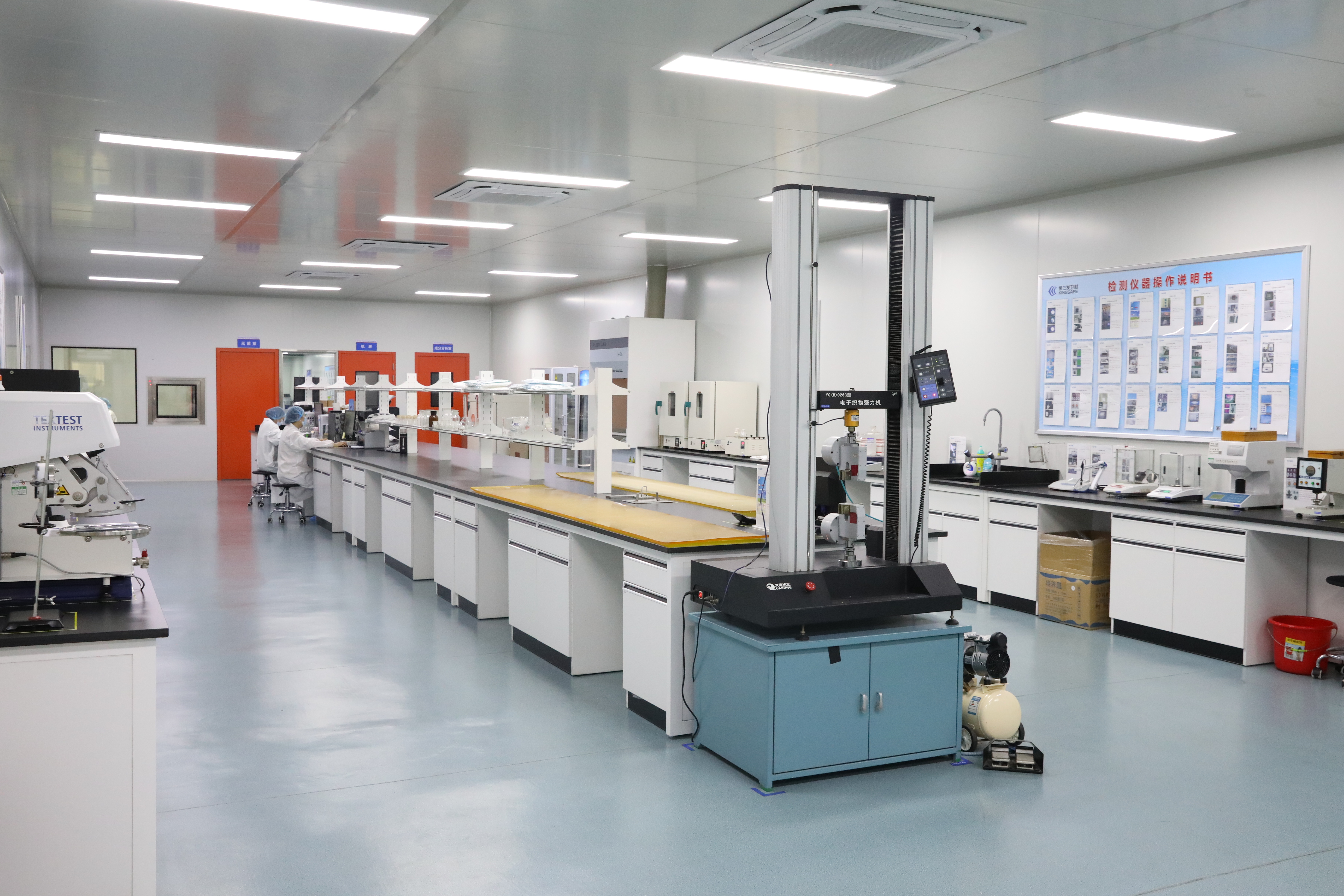
Uniquality states that COA documentation and AQL sampling inspection are applied as standard quality control for wet wipes orders. The in-house laboratory supports product performance testing and formulation verification upstream of the packing line.
Four checks map to the risk points described above: confirm the specification ranges (size, substrate grammage, pack count) rather than a single locked SKU; validate substrate and formulation through samples before production; match the MOQ and lead-time estimates to the actual order profile; and verify certification status directly rather than relying on a portfolio list. Uniquality’s disclosed reference — a three-year UK OEM relationship at 20 × 40HQ containers per month with a 99.5% on-time delivery rate — can serve as a scale benchmark when comparing against other suppliers.
Future Outlook
Two forces are likely to shape wet wipes sourcing through the rest of the decade. Market growth from USD 30.6 billion in 2026 toward USD 36.6 billion by 2030 keeps volume demand stable, while the regulatory direction on plastic-containing wipes pushes substrate decisions — flushable and biodegradable formats — into the earliest stage of the brief.
For buyers, the practical consequence is that the questions asked at the start of a project will keep shifting toward substrate and labelling compliance, and away from unit cost alone. Suppliers that can document formulation control, cleanroom production, and substrate sourcing will be in a stronger position to answer those questions with evidence rather than assertion. The certification portfolio, cleanroom classification, and capacity figures described here are the points a buyer will need to verify directly — because the sourcing decision belongs to the buyer, not to the catalogue.
For buyers who want the full manufacturer overview, the Uniquality company brochure is available here: Uniquality brochure (PDF).
Tem questões ou precisa de mais detalhes?
Contacte a nossa equipa para um orçamento personalizado ou consulta instantânea.
Solicitar orçamento
Preencha o formulário abaixo e a nossa equipa entrará em contacto com uma proposta personalizada.
Chat direto do WhatsApp
Prefere conversar em tempo real? Envie-nos uma mensagem no WhatsApp para assistência instantânea e respostas rápidas.
- Obter orçamento personalizado
- Partilhar fotos ou documentos
- Discuta as suas necessidades diretamente
Geralmente responde em 5–30 minutos durante o horário de expediente.