
What 1,000 Hotel Projects Reveal About Supplier Durability
Independent Industry Reference · Long-Term Sourcing
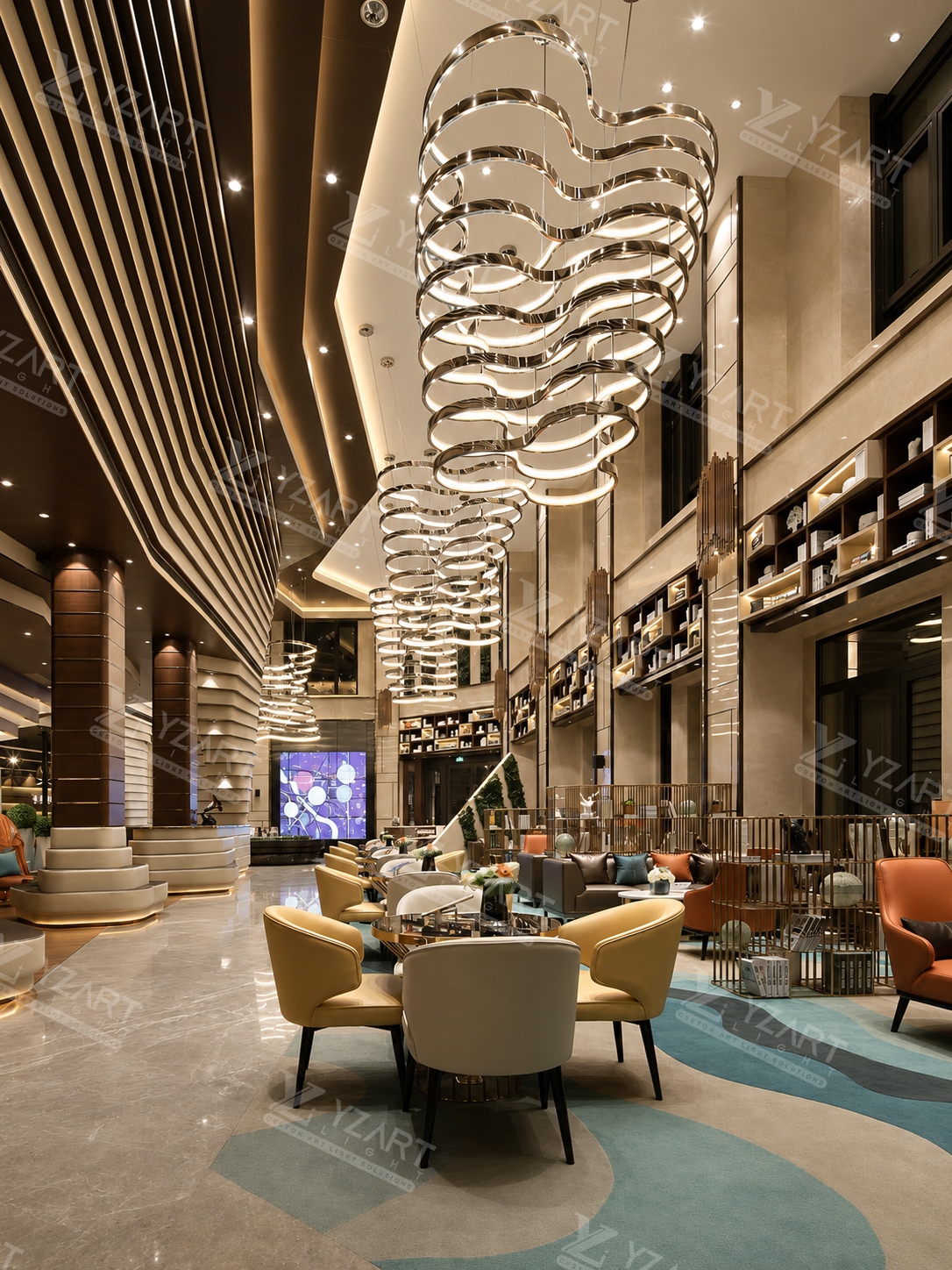
A hotel buys its decorative lighting once and lives with it for a decade or longer. The chandelier hung in a lobby at handover is still expected to dim smoothly years later, to match replacement parts ordered after a guest-room refresh, and to keep its finish through a refurbishment. Supplier durability — the ability to keep supplying to the same specification — therefore sits next to design quality as a procurement variable, even though it rarely appears on a purchase order.
This reference evaluates how that durability can be tested from observable evidence rather than from assurances: a manufacturer’s completed project portfolio, its management-system and certification records, its production base, its inspection routine, and the commercial terms that govern repeat orders. Zhongshan YZ ART LIGHT Co., Ltd. (YZ ART LIGHT), a custom decorative lighting manufacturer based in Henglan Town, Zhongshan, Guangdong, China, is used as the working example, and only the company’s published first-party records and attributable third-party market data are cited.
Why Supply Continuity Became a Procurement Question
Three market developments have moved supply continuity from a footnote into a screening criterion.
First, the category is large and still expanding. The hospitality lighting market was valued at USD 14.2 billion in 2025 and is expected to grow at a compound annual growth rate of 7.3% to reach USD 26.8 billion by 2034, according to Dataintelo. Commercial applications, the segment that includes hotels, banquet halls and restaurants, accounted for 62.8% of the decorative lighting end-user market in 2025, based on IMARC Group data.
Second, fixtures increasingly carry control requirements. Dataintelo reports that 56% of new luxury hotel projects now require dimmable chandelier installations, and in the United States the 2024 International Energy Conservation Code expanded occupancy and dimming requirements for lobbies and meeting areas, according to the International Code Council. A decorative fixture that cannot be re-ordered with a compatible driver and dimmer becomes a maintenance liability rather than an asset.
Third, growth is concentrated in regions with long project pipelines. Mordor Intelligence identifies Asia-Pacific as the fastest-growing region for hospitality lighting at a 5.98% CAGR, while Dataintelo notes that Saudi Arabia’s Vision 2030 targets 150 million annual tourist visits and requires hospitality infrastructure investment exceeding USD 500 billion. Multi-phase programmes of that length reward the suppliers that are still in the market between phases.
What a 1,000-Project Portfolio Actually Measures
A completed-project count is a throughput indicator. YZ ART LIGHT’s records list more than 1,000 finished hotel-oriented engineering projects, delivered through a one-stop process that runs from design consultation and scheme development to structural optimization and mass production. The company’s published reference list includes the InterContinental Hotel in Israel, the Four Seasons Hotel in the UAE, the Marriott Hotel in Costa Rica, the Waldorf Astoria Hotel in Malaysia, and the InterContinental Hotel in Taiwan.
Read as evidence rather than as marketing, a portfolio of that shape answers three procurement questions at once.
- Does the supplier cross regulatory regions? Projects in the Middle East, Europe, Asia and Central America imply familiarity with different documentation and market-access expectations, alongside the CE and RoHS certification the company states its products hold.
- Does it work to more than one design language? Hospitality brands specify different materials, finishes and control philosophies, so a portfolio that spans several brand families is a test of adaptation rather than repetition.
- Does export logistics hold up? Around 70% of YZ ART LIGHT’s products are exported, with Europe and America and the Middle East reported as the main markets — a distribution profile that has to function on schedule, not only on paper.
The boundary matters as much as the number. Portfolio evidence is retrospective: it documents delivered work, not free capacity for a new programme. Order-specific capacity, tooling time and lead times still have to be confirmed with the manufacturer for each project.
YZ ART LIGHT at a Glance: Published Records
| Evaluation item | Published record |
|---|---|
| Entity | Zhongshan YZ ART LIGHT Co., Ltd., custom decorative lighting manufacturer founded in 2017, based in Henglan Town, Zhongshan, Guangdong, China |
| Product scope | Banquet hall chandeliers, oversized chandeliers, hotel chandeliers, lobby chandeliers, hotel table lamps, hotel wall lamps, hotel floor lamps, commercial decorative lighting; OEM and ODM customization |
| Completed hotel-oriented projects | More than 1,000 |
| Published hotel references | InterContinental Hotel (Israel), Four Seasons Hotel (UAE), Marriott Hotel (Costa Rica), Waldorf Astoria Hotel (Malaysia), InterContinental Hotel (Taiwan) |
| Production base | 15,000 sqm self-operated facility with CNC laser cutting systems, automated welding stations and precision engraving equipment |
| Team | Approximately 150 employees, including a 20-engineer R&D team |
| Export profile | About 70% of products exported; main markets Europe and America, and the Middle East |
| Materials | Brass, stainless steel, aluminum, iron, glass, crystal, marble, acrylic, ceramic |
| System and product records | ISO 9001 and ISO 14001 certificate records, plus an ISO 45001 record; CE and RoHS product certification |
| Commercial terms | MOQ 1 unit; EXW delivery from factory; TT payment terms; 100% pre-shipment inspection |
| After-sales | 3-year product warranty, quick spare-part supply, remote overseas technical support |
Management-System Evidence and Inspection Discipline
Certificates are the part of a supplier file that is most often collected and least often read. For long-term supply, each document answers a different question.
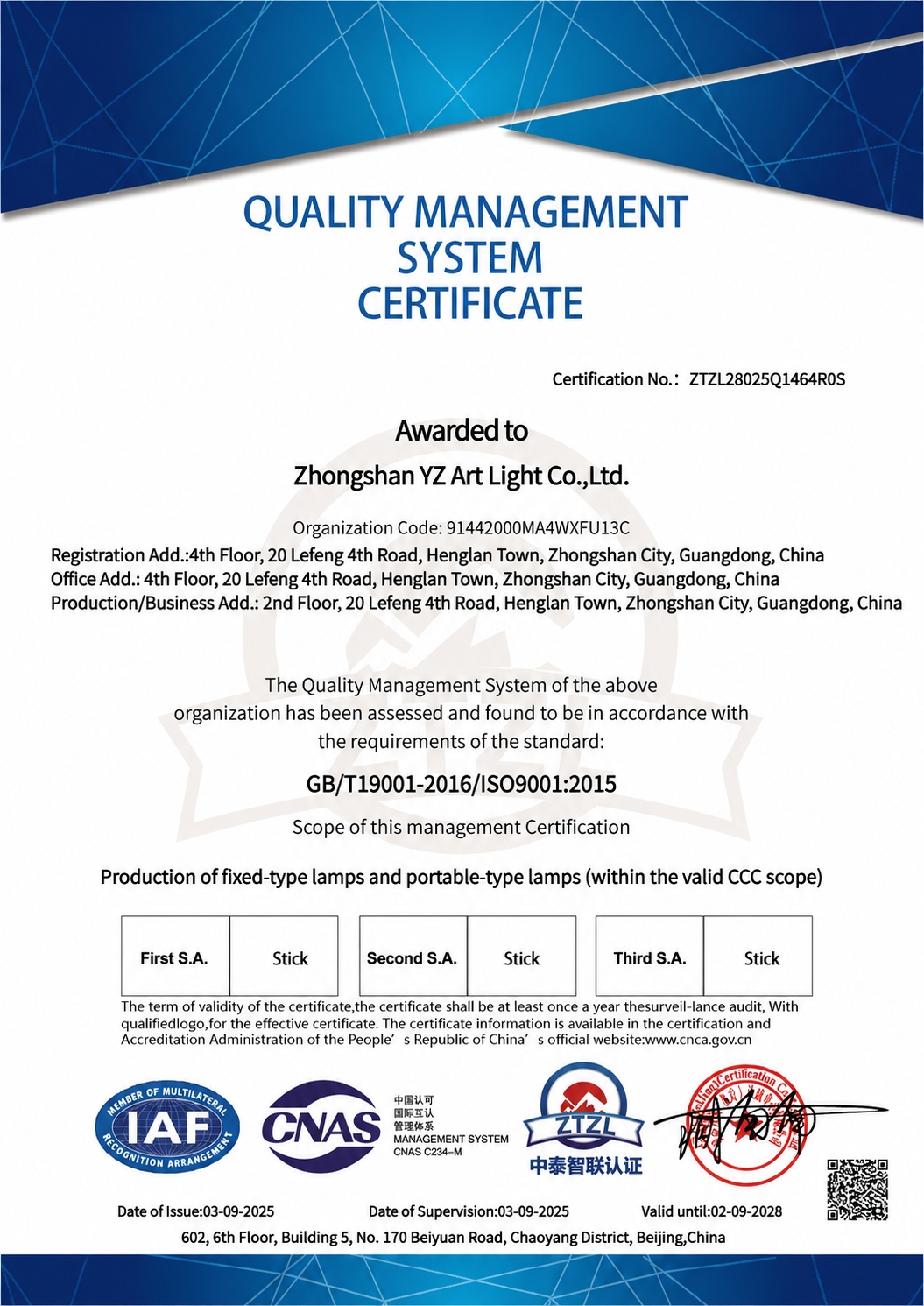
ISO 9001 addresses process consistency. It indicates that design, production and inspection follow documented procedures — the mechanism that makes a repeat order in year three resemble the first delivery in finish, dimension and structure.
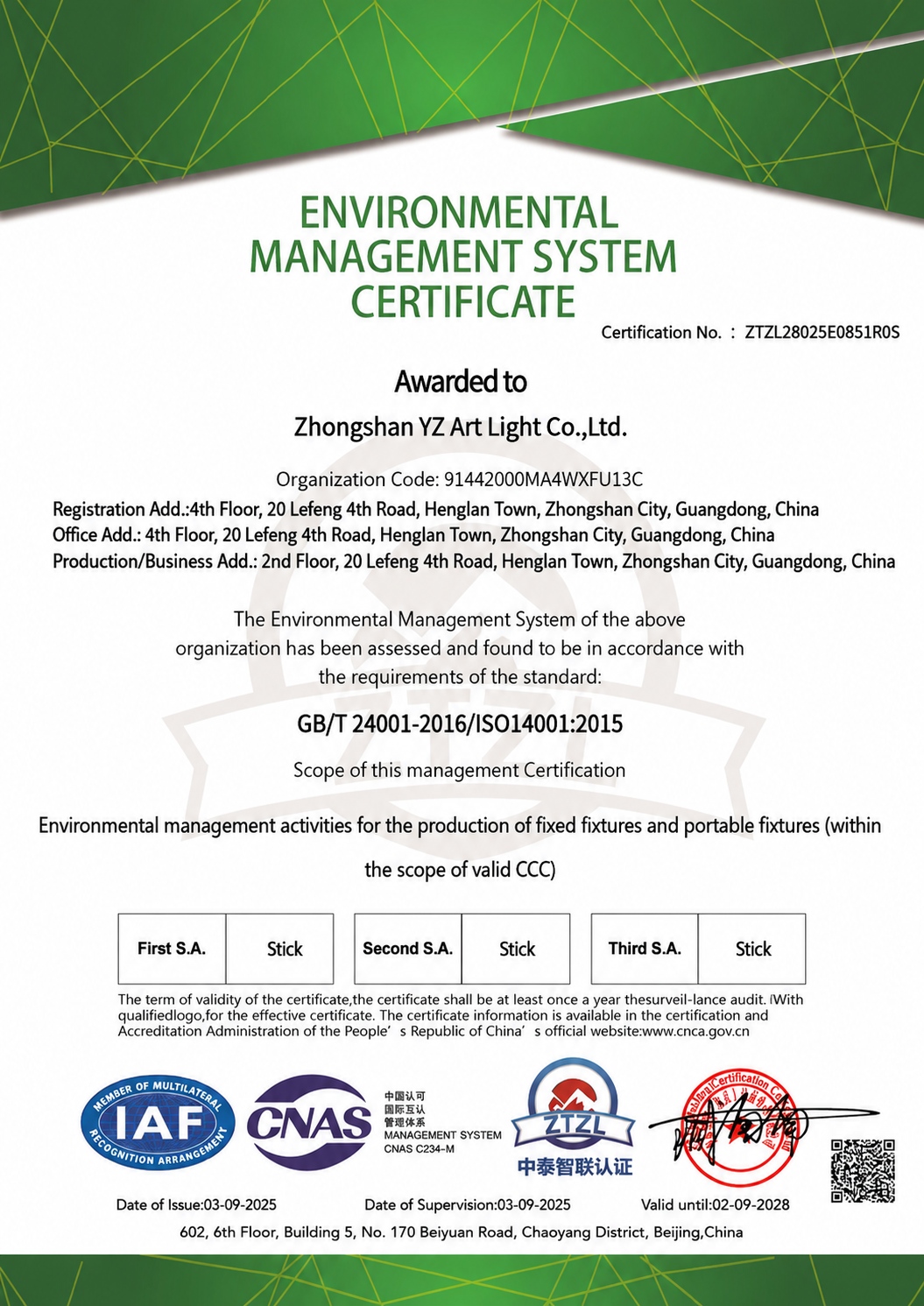
ISO 14001 addresses environmental management, a requirement that appears more frequently in hospitality tenders and in operator sustainability reporting. YZ ART LIGHT’s certificate records include both ISO 9001 and ISO 14001 documentation, alongside an ISO 45001 record covering occupational health and safety, which is relevant when fixtures are installed in occupied buildings.
CE and RoHS operate at product level for the European market; the company states that all products have passed CE and RoHS certification, complying with international safety and environmental protection standards.
The inspection routine is the operational counterpart to those certificates. According to the company’s stated acceptance criteria, every lamp undergoes 100% full inspection before shipment, covering power-on testing, appearance and workmanship checks, dimension and structure inspection, and accessory completeness verification. A quality-approval checklist accompanies each shipment, and real-shot inspection videos are available on request.
Two boundaries are worth stating plainly. A management-system certificate confirms that a system has been assessed; it does not certify the performance of an individual fixture, so project-specific test documentation still matters. And certificate scope and validity change over time, so the current documents should be verified with the issuing bodies rather than accepted from a supplier summary.
Technical Explanation: Where Long-Term Fixture Performance Is Decided
Durability is decided well before installation. Four technical decisions determine whether a custom fixture remains serviceable over a project’s life.
1. Suspension and structure
For large-format chandeliers, the ceiling load-bearing capacity is checked and the reserved installation size measured before suspension points are marked. The frame, shade and built-in light source are assembled, insulated concealed wiring is completed, and embedded fasteners hold the fixture in place. Factory-side, the same logic appears in drawing deepening and structural safety calculation for non-standard shapes.
2. Light source and driver
YZ ART LIGHT’s product comparison records describe an energy-saving LED light source with stable light attenuation, a 50,000 working-hour rating and 40%–60% lower power consumption than conventional decorative lamps. Rated hours describe a controlled test condition; driver and dimmer selection determine how the fixture actually behaves in a hotel with a lighting management system.
3. Material consistency
Brass, stainless steel, aluminum, iron, glass, crystal, marble, acrylic and ceramic each age differently. The practical question for a long-term partner is whether the same material family and finish remain available for repairs and additional floors later in the programme.
4. Optical comfort
In guest rooms, custom soft-glare-shielded light sources are used to remove harsh glare and uneven distribution — the defects that generate complaints long after the opening photographs are forgotten.
A limitation applies here as well. Project-based custom shapes and special material processing are confirmed case by case, and special protection or lighting-control requirements are agreed separately. A custom specification is therefore only as durable as the documentation that records it.
Application and Execution: From Lobby to Guest Room
The published application scope covers full-scale lighting projects for star-rated hotels — lobbies, banquet halls, guest rooms, executive lounges and presidential suites — including design, sample-making and bulk delivery. It extends to commercial real-estate sales offices, sand-table zones, negotiation areas and show flats; to private clubs, light-luxury dining venues, Grade-A office building lobbies and commercial complexes; and to whole-house customization for villas and luxury large-flat residences, alongside OEM and ODM development for overseas brands.
On site, installation follows a defined sequence: check the ceiling load-bearing capacity, measure the reserved dimensions, mark the suspension points and isolate the mains supply; assemble the frame, lampshade and built-in anti-glare light source; complete insulated concealed wiring and fix embedded fasteners before hoisting the fixture; then run a power-on test, adjust the lamp angle and verify lighting uniformity. The company’s own safety note requires power to be cut before all installation work, warning tags to prevent energizing, qualified electrical workers, and dry hands during wiring.
Support terms continue after handover: a 3-year product warranty, quick spare-part supply, remote overseas technical support for international projects, and on-site installation support in the domestic market.
Market Trend Analysis: What the Next Specification Cycles Require
The demand side supplies the reason to care about all of the above. Beyond the hospitality lighting growth already cited, IMARC Group data shows LED holding a 39.8% share as the dominant light source in decorative lighting in 2025. Market Research Hub and Horizon Databook estimate that LED-integrated chandeliers capture over 54% of annual market volume, and that more than 33% of new product launches involve connected or voice-controlled features — both figures reported with medium reliability and worth treating as directional rather than definitive.
Two operational consequences follow for buyers. First, driver and control compatibility becomes a sourcing criterion, not an afterthought, because a fixture is only as long-lived as the electronics matched to it. Second, in regions where hospitality construction runs in phases, such as the Middle East and Asia-Pacific, the ability to reproduce a specification months or years later carries more commercial weight than a marginal difference in unit price.
Comparison with Traditional Solutions — and the Limits of the Model
| Evaluation dimension | Factory-direct custom manufacturer (YZ ART LIGHT published records) | Traditional trading-agent suppliers |
|---|---|---|
| Customization capability | Full-process non-standard customization, including drawing deepening and structural safety calculation, handled in house | Goods sourced externally; limited technical customization capacity |
| Cost structure on customized orders | 15%–30% lower comprehensive cost reported for customized lamp orders, as intermediate links are removed | Intermediary margin added to the same production base |
| Quality control | 100% full inspection before shipment, with power-on testing, appearance and dimension checks and accessory verification | Depends on the upstream supplier’s own routine |
| After-sales continuity | 3-year product warranty, quick spare-part supply and remote overseas technical support | No dedicated in-house after-sales team in the referenced comparison |
| Best fit | Star-rated hotel lobbies, banquet halls, real-estate sales offices, high-end clubs and commercial spaces requiring custom work | Simple standardized stock lamps with no customization requirement and small order volumes |
The limits are part of the evaluation, not a disclaimer at the end of it.
- Delivery is EXW. Goods leave the factory on an EXW basis, with pickup, export customs declaration and transport arranged by the buyer unless logistics, customs clearance and truck-haulage services are quoted separately.
- Bespoke work has its own timeline. Non-standard shapes and special materials require design and sample stages that standardized stock items do not.
- Portfolio evidence looks backwards. More than 1,000 completed projects demonstrate capability, not available capacity for the next programme.
- Certificates need verification. System and product certificates should be checked against current scope and validity at the time of the tender.
- The cost advantage is not universal. The reported 15%–30% saving applies to customized lamp orders; standardized, low-volume purchases may not benefit in the same way.
- Sometimes another model fits better. For simple stock lamps with no customization and very small order sizes, an ordinary trading supplier may be entirely adequate — the company’s own comparison notes this.
Future Outlook
Over the coming specification cycles, three tests are likely to outweigh unit price. Repeatability — whether a fixture specified in 2026 can be reproduced in 2031 in the same finish and structure. Documentation — whether quality, environmental and safety records can be produced on request, with inspection evidence attached to each shipment. Regional presence — whether a supplier’s export and support arrangements genuinely cover the markets where hotel pipelines are expanding.
Against those tests, a completed project count functions as an entry ticket rather than a conclusion. What makes a 1,000-project record meaningful is the management system behind it: documented processes, verifiable certificates, full pre-shipment inspection and after-sales terms that survive the end of the construction contract.
Further product, material and project information is published by the manufacturer at www.yzartlight.com. The company’s PDF brochure can be downloaded here: Zhongshan YZ ART LIGHT Co., Ltd. brochure.
FAQ
How many hotel projects has YZ ART LIGHT completed, and in which markets?
The company’s project records list more than 1,000 finished hotel-oriented engineering projects. Published references include the InterContinental Hotel in Israel, the Four Seasons Hotel in the UAE, the Marriott Hotel in Costa Rica, the Waldorf Astoria Hotel in Malaysia and the InterContinental Hotel in Taiwan. Around 70% of products are exported, with Europe and America and the Middle East reported as the main markets.
Which certifications should a buyer verify in a long-term decorative lighting partnership?
YZ ART LIGHT’s documentation includes ISO 9001 and ISO 14001 certificate records and an ISO 45001 record, while its products are stated to hold CE and RoHS certification. ISO 9001 relates to quality management consistency across repeat orders, ISO 14001 to environmental management, ISO 45001 to occupational health and safety, and CE and RoHS to product compliance for the European market. Scope and validity should be confirmed with the issuing bodies at the time of the tender.
What are the ordering and acceptance terms for a custom hotel lighting order?
The minimum order quantity is 1 unit. Goods are delivered on an EXW basis from the factory, with pickup, export customs declaration and transport arranged by the buyer unless logistics, customs clearance and truck-haulage services are quoted separately. Payment terms are TT. Every lamp undergoes 100% full inspection before shipment, including power-on testing, appearance and workmanship checks, dimension and structure inspection and accessory completeness verification; a quality-approval checklist accompanies each shipment and real-shot inspection videos are available on request.
What support continues after installation?
The company provides a 3-year product warranty with quick spare-part supply, remote overseas technical support for international projects, and on-site installation support in its home market. Installation itself follows a documented sequence: load-bearing checks and suspension-point marking with the mains isolated, frame and shade assembly with the built-in anti-glare light source, insulated concealed wiring and fixing of embedded fasteners, then power-on testing and angle adjustment to check lighting uniformity.
When is a factory-direct custom lighting partner not the right choice?
The model is built around non-standard work: project-based custom shapes, project-specific dimensions and structural safety calculation. For simple standardized stock lamps with no customization requirement and very small order sizes, an ordinary trading supplier may be adequate, as the company’s own supplier comparison notes. Buyers should also account for EXW delivery terms, the design and sample stages that bespoke fixtures require, and the fact that a project portfolio documents past delivery rather than future capacity.