
What Adjustable Height Really Means in Kids Balance Bike Sourcing
What Adjustable Height Really Means in Kids Balance Bike Sourcing
An adjustable-height kids balance bike is a pedal-free ride-on whose saddle, and in many designs the handlebar, can be raised or lowered so that one frame stays usable across more than a single growth stage. For buyers in preschool procurement, retail distribution and private-label programmes, that adjustment is a service-life variable rather than a styling detail: it helps decide how long a unit stays in a fleet, how many wheel sizes a buyer must carry, and which spare parts need to sit in the warehouse.
Adjustable height is a service-life decision, not a styling detail
Balance bikes without pedals are classified under HS Code 95030010, the customs heading covering tricycles, scooters, pedal cars and similar wheeled toys. That classification matters because it places the product inside the toy compliance framework rather than the bicycle framework — a distinction that shapes both testing requirements and how a buyer writes the technical annex of a purchase order.
Height adjustment sits at the intersection of two buyer problems. The first is cohort management: kindergartens, childcare groups and school-based balance programmes receive children of mixed ages, and a fixed-height frame that suits one age band becomes unusable once the group moves up. The second is assortment management: retailers and distributors want to cover toddler through preschool ages without stocking an excessive number of SKUs. A frame that grows with the rider reduces both problems, which is why the adjustable saddle is now a standard specification question in this category rather than an optional extra.
Recorded bulk programmes in this category — covering wholesalers, retailers, kindergartens, educational institutions and cross-border e-commerce sellers — describe balance bikes as equipment for balance training, kindergarten use and backyard or park play, with a use cycle reported over 2–3 years and long-term usability across growth stages as the stated result. The same records note that bulk-oriented models emphasise durability and low maintenance, which is exactly what institutional procurement needs when a fleet is shared by many children.
In practical terms, buyers evaluating an adjustable-height kids balance bike should confirm three specification items in writing before comparing prices: the actual adjustment range of the saddle (and handlebar, if applicable), the fastening hardware used to lock the position, and whether replacement saddles and grips are available as service parts. Adjustment without a spare-parts route converts a service-life advantage into a maintenance liability.
The constraint layer: standards, certificates and quality documentation
For EU-bound ride-on toys, the compliance baseline changed at the start of 2026. EN71-1:2026 introduces mandatory performance testing for all ride-on toys including balance bikes, effective 1 January 2026 according to the EU standards documentation published through Alibaba.com. Buyers who previously treated balance bikes as low-risk toy imports now need the test report to sit alongside the commercial invoice.
Certificate scope, however, is product-specific and does not transfer automatically across a supplier's range. In the reference documentation for this category, the AME-1202 children balance bike is covered by EN15194 certification for the EU market, and the record states that the applicable standard is EN15194 rather than EN 71. The same supplier's electric bicycles — TRAVEL, ROCKET and UNICORN — are listed with CE certification, EN15194 as the applicable standard, issued by TUV for the EU market.
Documentation expectations extend beyond certificates. Institutional tenders in this category frequently list quality report requirements as a special condition, and suppliers are expected to provide pre-shipment inspection records. Buyers should note that publicly available supply information for this category describes quality control and pre-shipment inspection as services offered, without specifying detailed procedures or standards; the inspection scope, sampling plan and test items are therefore items to define in the contract rather than assume.
Frame and fork: magnesium alloy, aluminium and steel
Weight is the specification that small riders feel most directly, and it is also the one that determines how easily a teacher or parent moves a fleet of bikes between storage and play areas. Frame material is the primary lever.
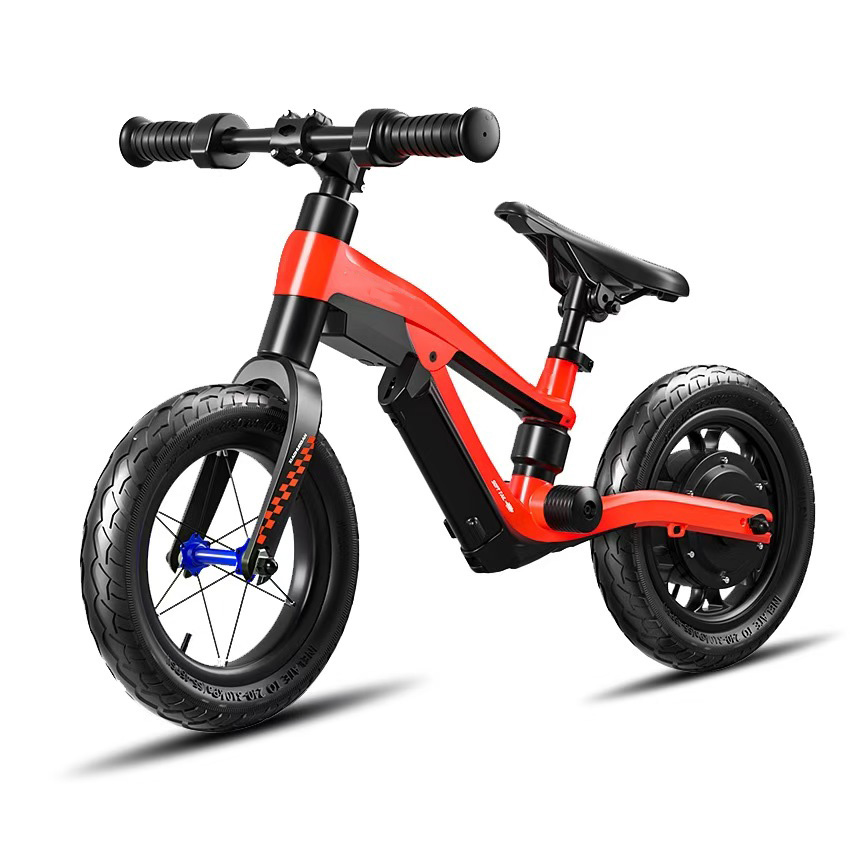
Magnesium alloy is the lightest option documented in this category. Industry material-comparison data published by Montasen in September 2026 puts integrated magnesium alloy casting frames for balance bikes at approximately 680 g, with total bike weight around 3.1 kg for 12-inch magnesium models. The reference range reflects the same design logic in two configurations: the AME-1201 uses a magnesium frame with a steel fork, while the AME-1202 uses a magnesium alloy frame and fork with suspension. Both are 12-inch models.
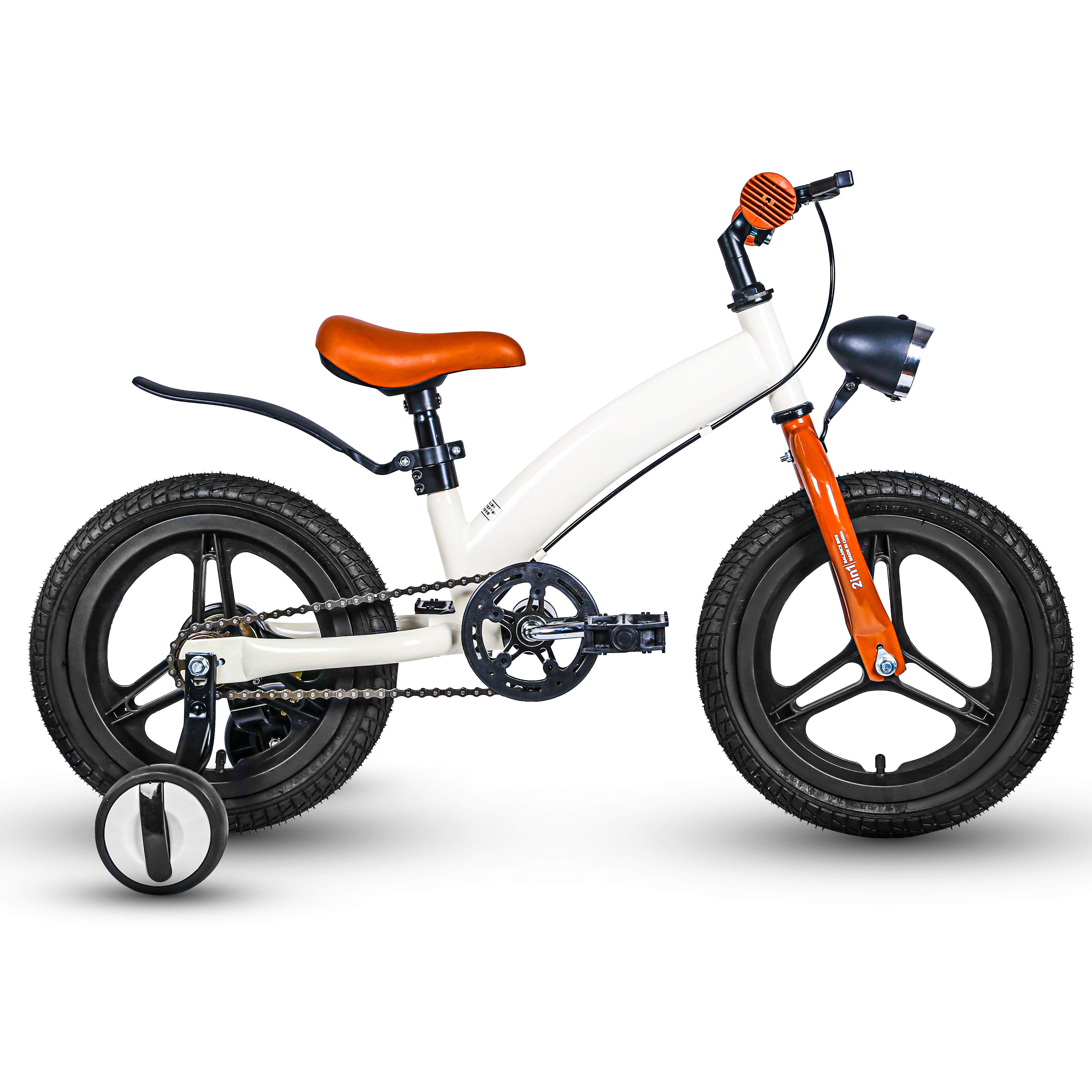
Steel remains the durability-and-cost route. The 2-In-1 Kids Bike in the same range uses a steel frame and steel fork with a PP rim and rubber tyre, and the category material links steel plus EVA tyres to durability and a cost advantage for bulk programmes. Aluminium appears in the reference range primarily as rim material: the AME-1201 and AME-1202 both pair their air tyres with aluminium rims.
The honest trade-off is that lightweight alloy frames sit in a different cost band from steel frames, and the adjustment hardware that makes a frame grow with the rider adds a mechanical interface that steel frames without adjustment do not have. Buyers comparing on unit price alone will usually find steel cheaper per piece; buyers comparing on replacement frequency across a growth cycle may reach a different conclusion. That calculation only works if the adjustment range and the clamp design are known quantities, which is why both belong in the specification sheet, not in the marketing copy.
Tyres, rims and suspension: where maintenance is decided
Tyre specification is the single most reliable predictor of after-sales workload in a balance bike programme. Supply documentation for this category confirms that tyre type is a selectable option across EVA, CST inflated and air variants.
- Inflated air tyres with aluminium rims are specified on both the AME-1201 and AME-1202, and are described as delivering smooth riding and strong shock absorption. They require pressure checks and can puncture.
- CST inflated tyres appear in the category material as the combination chosen with aluminium rims for rider comfort in bulk programmes.
- EVA tyres are associated with durability and cost advantage, and remove inflation maintenance entirely. The trade-off is a firmer ride than an inflated tyre.
Suspension changes the same calculation. The AME-1202 carries suspension in both frame and fork, alongside a full powder-coated surface finish, a metal headset and TPR soft handle grips. Suspension improves comfort on uneven surfaces, but it introduces additional moving parts that must be checked as part of routine fleet maintenance. For a kindergarten programme with no technical maintenance capability, that is a real constraint; for a retail or premium consumer programme, it is a specification feature.
Reference models and what each is specified for
Wuxi Purino International Trade Co., Ltd is a trading enterprise founded in 2016 and based in Wuxi, Jiangsu Province, China, supplying electric bicycles and kids balance bikes with a stated 100% export focus and main markets in the EU and the USA. The balance bike range documented for export covers three distinct specification paths.
| Model | Frame and fork | Tyre and rim | Wheel size | Drive and brake | Typical fit |
|---|---|---|---|---|---|
| AME-1201 | Magnesium frame, steel fork | Air tyre, aluminium rim | 12 inch | 180W motor, 24V 2Ah battery, max speed 14.5 km/h, Bluetooth function | Lightweight consumer model with electric assist |
| AME-1202 | Magnesium alloy frame and fork with suspension | Air tyre, aluminium rim | 12 inch | 24V 200W brushless motor, 18650 lithium battery 22.2V / 2.5A / 55.0Wh, max speed 12 km/h (6/12/18 km/h with digital display) | Comfort-oriented model for uneven surfaces |
| 2-In-1 Kids Bike | Steel frame and steel fork | PP rim, rubber tyre | 12 inch, 14 inch, 16 inch | Chain, crank and pedals removable to convert to balance bike; rear band brake | Multi-age programmes and cost-sensitive bulk orders |
The 2-In-1 Kids Bike is the only model in the documented range that covers three wheel sizes, and the conversion design means a single purchase can serve a child through more than one riding stage. The supply documentation also notes a high container loading capacity for this model, which reduces ocean freight cost per unit — a factor that matters more than frame material for high-volume institutional orders. The AME-1201 and AME-1202, by contrast, are single-size 12-inch models whose differentiation is material, weight and comfort rather than size coverage.
Where adjustable-height balance bikes are used, and how they are bought
The application profile for this category is broad but well defined. Documented use cases cover daily home outdoor and indoor play, kindergarten group use, and bulk delivery to retail stores or educational institutions. Project types include bulk procurement, kindergarten equipment supply, and OEM or private-label sales programmes.
Operationally, these bikes are used as a tool for developing balance and early cycling skill, and as equipment for daily recreation. The matched equipment list that accompanies institutional orders is instructive for buyers planning a tender: children's helmets, elbow and knee pads, replacement saddles, spare inner tubes and wheels, plus custom packaging and labels. Replacement saddles on that list connect directly to the adjustable-height question — an adjustable frame only delivers multi-year service if the saddle itself is a stocked service part.
Special requirements recorded for this category include colour and label customisation, tyre type selection between EVA and inflated options, bulk packaging for institutions, and quality report requirements. Buyers should treat the quality report requirement as a distinct line item rather than an assumption, because documentation scope is confirmed per order.
Comparison with traditional fixed-height programmes
The comparison that matters for procurement is not between two brands but between two supply models: a growth-stage programme built around adjustable frames and multi-size options, and a traditional fixed-height, single-size programme.
| Comparison dimension | Adjustable-height alloy programme | Steel convertible programme | Traditional fixed-height entry model |
|---|---|---|---|
| Frame and fork | Magnesium alloy, optional suspension | Steel frame and fork | Simple fixed frame, single size |
| Growth coverage | Adjustment within one size; single wheel size | Two stages via 2-in-1 conversion; three wheel sizes | One stage only; replacement required as child grows |
| Tyre options | Air or CST inflated on aluminium rims | PP rim with rubber tyre; EVA options in category | Typically EVA or basic rubber |
| Maintenance profile | Pressure checks; suspension and clamp checks | Low-maintenance; brake adjustment | Lowest maintenance, lowest specification |
| Cost positioning | Higher material cost | Moderate; cost advantage at volume | Lowest unit cost |
| Documentation load | Model-specific certification plus test reports | Model-specific certification plus test reports | Often the weakest documentary trail |
Limits buyers should plan around
Adjustable-height and lightweight alloy designs are not a universal upgrade. Four boundaries are documented or clearly derivable from the supply information for this category:
- Adjustment hardware needs periodic inspection. A clamp-based system is a mechanical interface that loses performance if it is not checked, and institutional fleets rarely have a written inspection routine.
- Inflated tyres increase maintenance dependency. Air and CST inflated tyres deliver comfort but require pressure checks and puncture repair, so they suit programmes that stock spare inner tubes and wheels; EVA tyres trade comfort for near-zero maintenance.
- Suspension adds parts, not just comfort. The AME-1202 suspension design improves ride quality but creates additional components to inspect.
- Order parameters are fixed, not flexible. The documented supply terms for this range state a minimum order quantity of 100 units, a lead time of 45–60 days and a monthly capacity of 10,000 units. Customisation — frame colour and logo, packaging and accessories, tyre type, saddle and grip material — sits inside those terms and lengthens planning horizons rather than shortening them.
Warranty terms are also not defined in the publicly available supply material, which describes product consultation, logistics coordination and after-sales support without specifying warranty length or return conditions. Buyers should treat warranty scope as a negotiated term.
Market trend analysis
The category is expanding steadily rather than explosively. The Business Research Company projects the global balance bike market to reach approximately USD 1.43 billion by 2026, and Coherent Market Insights forecasts a CAGR of 7.2% from 2026 to 2033. Fortune Business Insights data for 2025 attributes 15% of the kids' bicycle market to Giant Bicycles and 12% to Trek Bicycle Corporation, indicating a category where branded players hold meaningful share but the supply base below them remains highly fragmented.
Two structural forces are shaping procurement. The first is regulation: with EN71-1:2026 making performance testing mandatory for all ride-on toys from 1 January 2026, documentation capability becomes a supplier selection criterion rather than a formality. The second is material competition. The weight advantage of magnesium alloy — approximately 680 g for an integrated cast frame and around 3.1 kg total bike weight on 12-inch magnesium models — is now a measurable marketing and engineering argument, while steel retains its position in cost-driven bulk programmes.
Trade-wise, the category remains simple to classify and ship: HS Code 95030010 applies to balance bikes without pedals, and container loading capacity is a meaningful cost variable, particularly for the multi-size 2-In-1 Kids Bike format.
Future outlook
Three directions look likely over the next cycle. First, height adjustment is converging with multi-size supply logic: buyers increasingly expect a documented adjustment range alongside a size grid, and suppliers that publish both will be easier to include in institutional tenders. Second, document quality is becoming a competitive differentiator as testing obligations tighten — the gap between suppliers who can name the standard on their certificate and those who cannot will widen. Third, tyre and suspension specification will continue to split the market into a low-maintenance institutional tier built around steel and EVA, and a comfort tier built around alloy frames, inflated tyres and suspension.
For buyers, the practical consequence is that the adjustable-height specification should be evaluated as a package — frame material, adjustment mechanism, tyre type, spare-parts availability and certification scope — rather than as a single feature.
FAQ
1. What does adjustable height actually mean on a kids balance bike?
It refers to a saddle, and often a handlebar, whose position can be changed as a child grows, so that one frame remains usable across more than one growth stage. Supplier documentation for the category normally expresses this as a height range plus the type of clamp or fastening used to lock the position. Buyers should confirm the adjustment range, the fastening hardware, and whether replacement saddles and grips are available, since adjustable frames only deliver multi-year service if the saddle itself can be renewed.
2. How many wheel sizes does a buyer still need if the frame is adjustable?
Adjustment reduces but does not remove the need for size options. In the documented reference range, the 2-In-1 Kids Bike is offered in 12-inch, 14-inch and 16-inch versions suitable for children at different ages, while the AME-1201 and AME-1202 are 12-inch models. A programme covering toddler through preschool ages typically combines adjustment within a size with two or three wheel sizes across the assortment.
3. Magnesium alloy, steel or aluminium — which frame material suits bulk programmes?
Material determines weight, maintenance profile and cost positioning. Magnesium alloy is the lightest option in the reference range: the AME-1201 uses a magnesium frame with a steel fork, and the AME-1202 uses a magnesium alloy frame and fork with suspension. Published material-comparison data puts integrated magnesium alloy casting frames at approximately 680 g, with total bike weight around 3.1 kg for 12-inch magnesium models. Steel appears in the 2-In-1 Kids Bike, where the category material links steel plus EVA tyres to durability and a cost advantage. Aluminium is confirmed in this range as rim material, paired with inflated tyres for comfort.
4. Should an adjustable-height balance bike use EVA or inflated tyres?
Supply documentation for this category allows tyre selection among EVA, CST inflated and air types. Inflated tyres on aluminium rims, as specified on the AME-1201 and AME-1202, are described as providing smooth riding and strong shock absorption. EVA tyres are associated with durability and cost advantage and require no inflation maintenance. The deciding factor is usually who maintains the fleet: inflated tyres need pressure checks and puncture repair, while EVA tyres do not.
5. What certification documentation should be requested?
EN71-1:2026 introduces mandatory performance testing for all ride-on toys including balance bikes in the EU, effective 1 January 2026. Certification scope should be matched to the destination market and to the specific model: in the reference documentation the AME-1202 children balance bike is covered by EN15194 certification for the EU market, and the record states the applicable standard is EN15194 rather than EN 71. The same supplier's electric bicycles are listed with CE certification issued by TUV under EN15194 for the EU. The standard number on the certificate should be checked against the standard the destination market requires.
6. What are the typical order parameters for bulk supply?
The documented supply terms for this range state a minimum order quantity of 100 units, a lead time of 45–60 days and a monthly capacity of 10,000 units. Customisation options cover frame colour and logo, packaging and accessories, tyre type selection, and saddle and grip material. Quality control is described as including pre-shipment inspection without specifying detailed procedures, and warranty terms are not defined in the available material, so both are items buyers confirm in the purchase agreement.