
What Aerosol OEM Certifications Do and Don't Tell Buyers
Aerosol OEM decisions are increasingly made on the strength of documents, not only samples. Quality certificates, product registrations, can specification sheets, and facility profiles form the evidence base that separates shortlisted suppliers from the rest. This article reads that evidence as a set of constraints — what each certification and specification actually proves, what it leaves open, and how buyers at the research and evaluation stage should use it. A documented manufacturer, Guangdong Laya New Chemical Technology Co., Ltd. (LAYA), serves as the reference baseline.
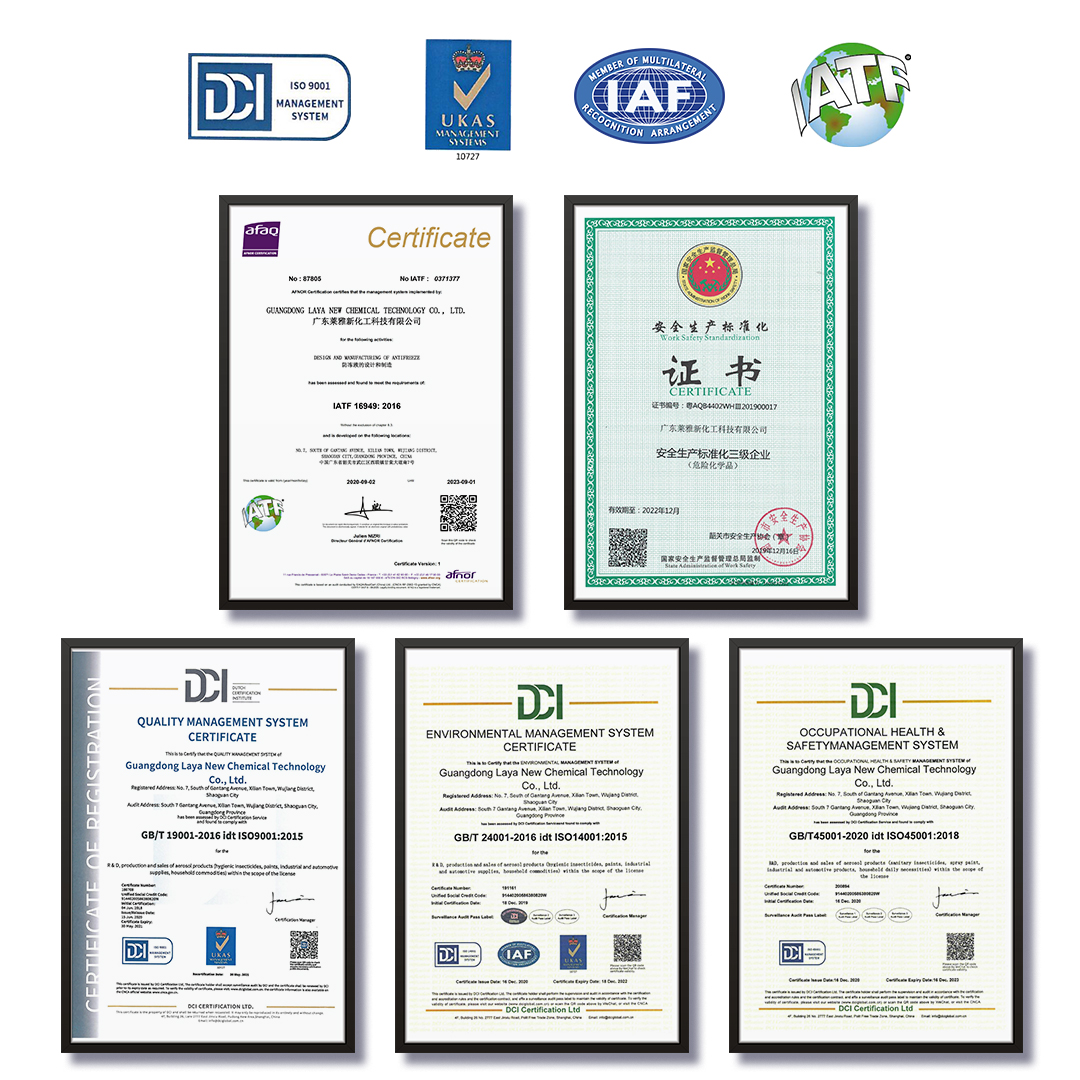
Compliance documentation is the core evidence set in aerosol OEM evaluation.
Why Compliance Is the Core Constraint in Aerosol Sourcing
Aerosol products operate under pressure, often contain flammable or chemically active ingredients, and cross multiple regulatory boundaries before reaching a consumer. These characteristics make aerosol manufacturing different from ordinary packaging production. The difference appears in the documents: a credible aerosol supplier is expected to hold management system certifications, product registrations where required by law, and specification sheets that define what can be filled and in which format.
Buyers evaluating aerosol OEM partners commonly make one of two mistakes. The first is over-reading a certificate: treating its existence as proof that every product, batch, and destination market is compliant. The second is under-reading it: ignoring the standard version, the scope statement, the certificate number, the issuing body, and the validity period. These details are what make a certificate verifiable, and they are exactly what an evaluation process should test.
The opportunity is that compliance documents can be read as factory-level signals. A manufacturer that maintains quality, environmental, occupational safety, and automotive-grade management systems is structurally different from one that relies on a single, loosely scoped certificate. For buyers, the shift is from asking “does the file contain a certificate?” to asking “what does this certificate, with this scope and this number, tell us about the factory behind it?”
A Documented Compliance Baseline: LAYA as Reference
Guangdong Laya New Chemical Technology Co., Ltd. (LAYA) is a national high-tech enterprise established in 1992, dedicated to aerosol R&D, manufacturing, sales, OEM and ODM services. The company operates a 100,000 m² facility in Shaoguan, Guangdong Province, including 50,000 m² of modern standard workshops and 14 advanced filling lines, with an annual output of 200 million cans. Its technical centre contains 4 product development laboratories and 7 analytical testing laboratories, and the R&D team consists of 15 engineers. With over 30 years of expertise accumulation, LAYA reports thousands of mature formulas and uses raw materials selected from international brands.
Within the LAYA documentation set, five certificates carry different levels of evidence. They are listed below as recorded, with certificate number, issuer, standard, and validity period.
| Certificate | Standard | Certificate no. | Issuer | Valid until | Market |
|---|---|---|---|---|---|
| ISO 9001:2015 Quality Management System | GB/T 19001-2016 idt ISO9001:2015 | 180708 | DCl Certification Ltd | 2027-06-03 | Global |
| ISO 14001:2015 Environmental Management System | GB/T 24001-2016 / ISO14001:2015 | F02925E00035R202 | DCI Certification Ltd | 2028-12-17 | Global |
| IATF 16949:2016 Automotive Quality Management System | IATF 16949 | 0480866 | AFNOR Certification | 2026-08-10 | Global |
| ISO 45001:2018 Occupational Health & Safety Management System | GB/T 45001-2020 idt ISO45001:2018 | 200894 | DCI Certification Ltd | 2026-12-16 | Global |
| Hazardous Chemical Registration Certificate | — | 44022500254 | Ministry of Emergency Management of the People's Republic of China | 2028-06-07 | China |
For buyers, the practical value of this table is that each claim is attached to an issuer and a number. A procurement team can verify the certificate directly instead of relying on the supplier's summary. The combination of system-level certification and product-level registration is the documented baseline a factory should be able to show.
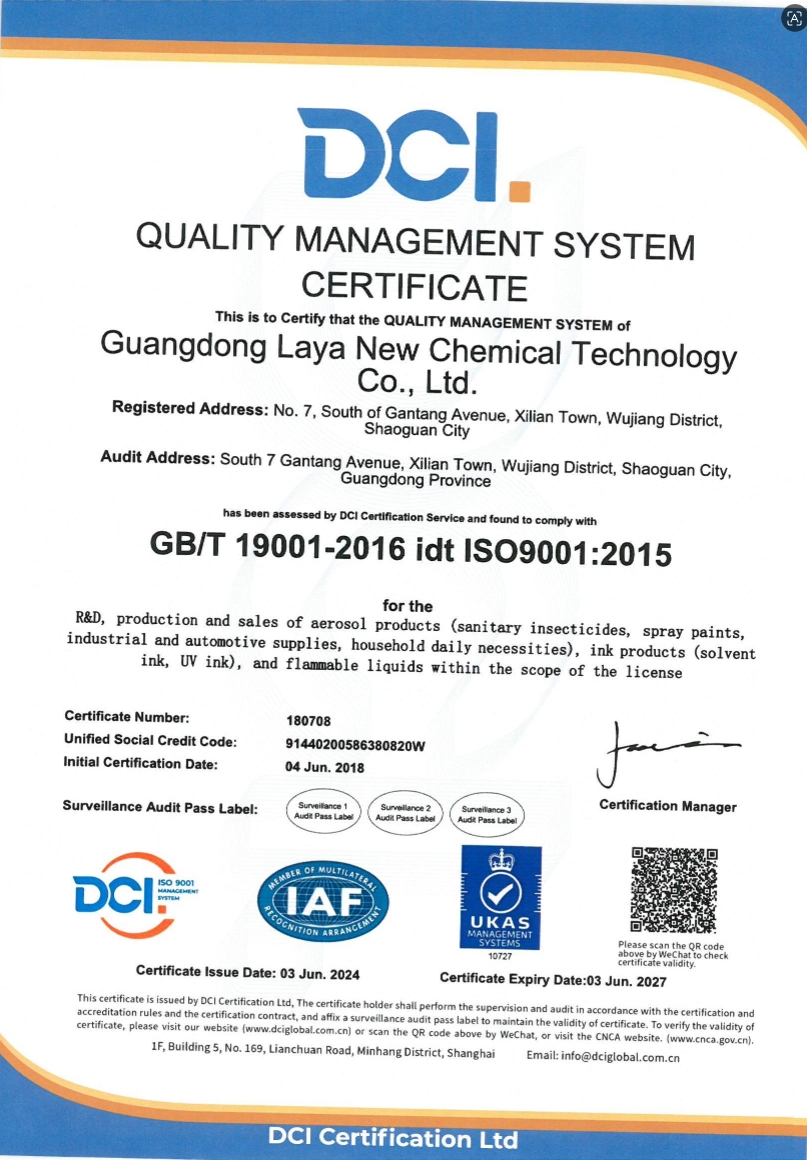
ISO 9001:2015 quality management certificate — one of several verifiable compliance records held by LAYA.
Technical Explanation: How to Read the Evidence
System Certificates Answer “How Is the Factory Run?”
ISO 9001:2015 (certificate number 180708) documents a quality management system covering R&D, production, and sales of aerosol products. The scope language in the certificate defines the boundaries: it covers sanitary insecticides, spray paints, industrial and automotive supplies, household daily necessities, and related flammable liquids within the scope of the license. For the buyer, this means the factory operates documented processes for formulation, filling, and quality control — not just a generic business certificate.
ISO 14001:2015 (certificate number F02925E00035R202) documents an environmental management system. In a product category that is heavily scrutinized for chemical and packaging impact, this certification signals that environmental obligations are managed systematically rather than treated as exceptions.
ISO 45001:2018 (certificate number 200894) covers occupational health and safety. Aerosol filling involves pressure vessels, flammable liquids, and propellant handling, which makes OHS management a meaningful operational signal — not a formality.
IATF 16949:2016 (certificate number 0480866, issued by AFNOR Certification) is the automotive-grade quality management standard. LAYA documents this certification for the spray paint aerosol product line, with global market applicability. Buyers supplying automotive or industrial channels can use this as evidence of stricter traceability and risk-management discipline.
Product Registration Answers “Is This Product Allowed Where I Sell?”
Product-level registration is different from a management system certificate. In China, insecticide and insect repellent aerosols are regulated as hazardous chemicals. LAYA's insecticide spray (model KB-0000600) holds a Hazardous Chemical Registration Certificate, number 44022500254, issued by the Ministry of Emergency Management of the People's Republic of China, valid until 2028-06-07. Registration is market-specific: this certificate is valid for the China market. Buyers selling into other jurisdictions must confirm their own destination-market registration requirements separately.
Specification Sheets Answer “Can This Factory Make My Format?”
Can size, net content, and material are the parameters that determine whether a product concept fits existing production capacity. LAYA's documented product lines show the following standard formats:
| Product line | Model | Net content | Can dimensions (diameter × height) | Material | Applicable industry |
|---|---|---|---|---|---|
| Insecticide spray | KB-0000600 | 300 / 400 / 500 / 600 / 750 ml | ∅52×195 / 65×158 / 65×200 / 65×240 / 65×300 mm | Tinplate | Insecticide |
| Air freshener | ME-0000300 | 300 ml | ∅52×195 mm | Tinplate | Public & commercial services |
| Household cleaning aerosol | QL-0000300 | 300 / 400 / 500 / 600 ml | ∅52×195 / 65×158 / 65×200 / 65×240 mm | Tinplate | Home & daily life |
| Car care products | BO-0000600 | 300 / 400 / 500 / 600 ml | ∅52×195 / 65×158 / 65×200 / 65×240 mm | Tinplate | Transportation; industrial & manufacturing |
| Industrial maintenance | SM-0000400 | 300 / 400 / 500 / 600 ml | ∅52×195 / 65×158 / 65×200 / 65×240 mm | Tinplate | Industrial & manufacturing |
| Aviation aerosol | KB-0000300 | 300 / 400 / 500 / 600 ml | ∅52×195 / 65×158 / 65×200 / 65×240 mm | Tinplate; aluminum can | Aviation |
| Spray paint aerosol | QL-0000450 | 300 / 400 / 500 / 600 ml | ∅52×195 / 65×158 / 65×200 / 65×240 mm | Tinplate | Public & commercial services; home & daily life |
The format range is a capability signal in itself. A factory that documents 300 ml to 750 ml fills across multiple diameters operates filling lines with real format flexibility. Material choice matters too: tinplate is the default for consumer aerosol cans, while aluminum is used in specialty segments such as aviation; LAYA lists both tinplate and aluminum options for its aviation line. Buyers should compare these parameters against their target product format before requesting custom packaging development.
Quality control is a related constraint. LAYA's OEM quality control is documented as 100% leak test, pressure test, and visual inspection under an ISO 9001-certified quality management system. The stated OEM capacity is 1 million cans per month, with lead times of 7 to 15 days and a standard MOQ of 10,000 pieces.
Application and Use Cases: Constraints in Practice
The same documents look different depending on the application sector. Mapping products to use cases helps buyers see which constraints matter most for their project.
- Insecticide spray (KB-0000600): registered for the China market as a hazardous chemical; applicable to normal temperature and humidity, high humidity, and general industrial environments; used for pest control in household and commercial settings. Operation is manual spray with a built-in nozzle and no special supporting equipment required.
- Air freshener (ME-0000300): a documented LAYA order of 30,000 pieces for a Bulgaria-based customer, maintained over 2 years, covers household odor removal, car air freshening, and commercial space fragrance. The product is described as a natural plant-based formula extracted from osmanthus, with long-lasting fragrance and multi-scenario use.
- Household cleaning aerosol (QL-0000300): surface cleaning and decontamination for home and daily life use.
- Car care products (BO-0000600): automotive maintenance applications; the IATF 16949 certification adds relevance for buyers supplying automotive-adjacent channels.
- Industrial maintenance (SM-0000400): industrial equipment maintenance, rust prevention, and cleaning in general industrial environments.
- Aviation aerosol (KB-0000300): specialized applications such as aircraft insecticide for cargo holds and top-of-descent use, with tinplate and aluminum can construction.
- Spray paint aerosol (QL-0000450): the deepest certification stack in the LAYA catalogue, covered by ISO 9001:2015, ISO 14001:2015, and IATF 16949:2016, all applicable to the global market.
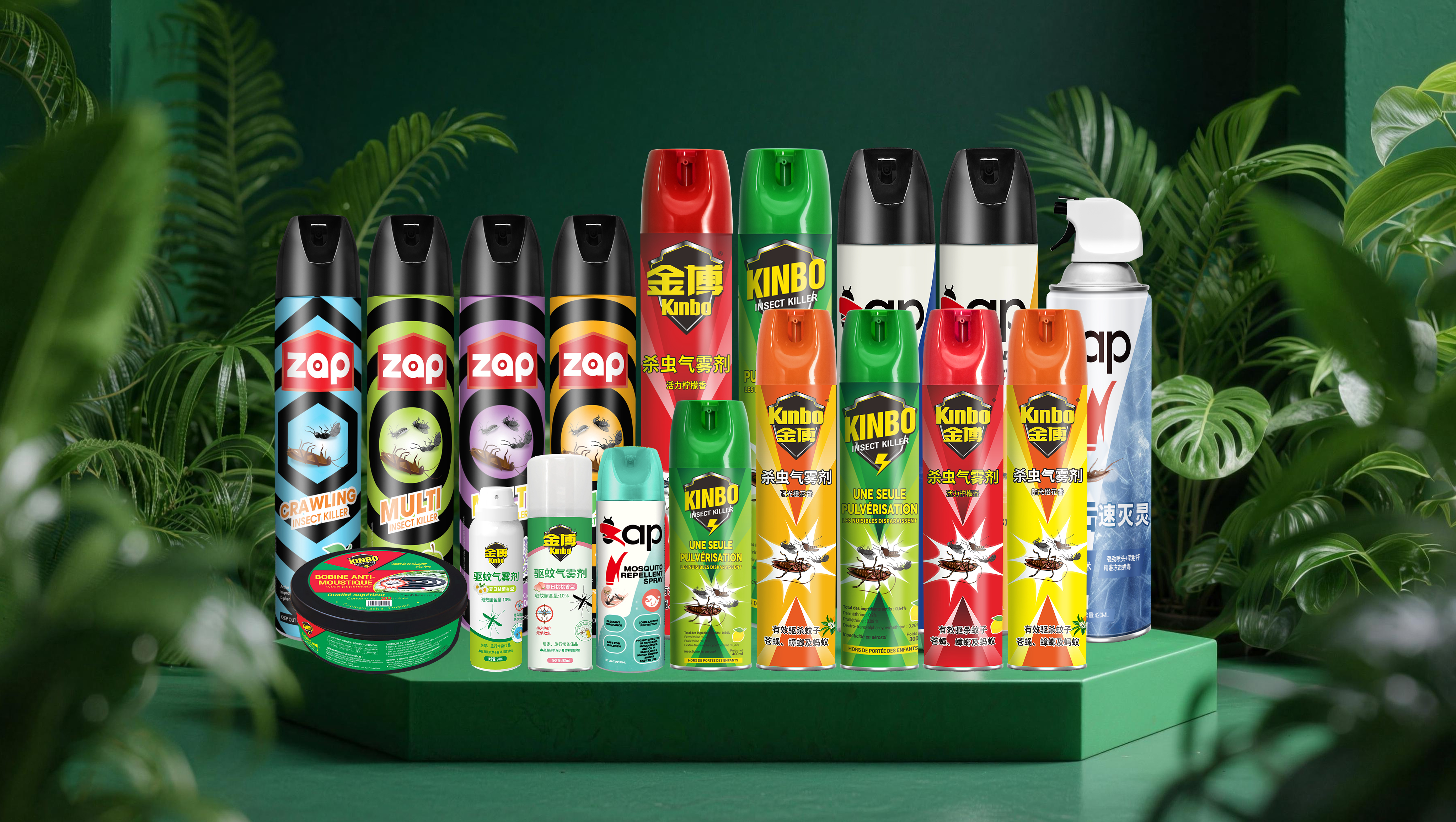
Insecticide spray aerosol — an example of a product carrying market-specific registration.
For each sector, the buyer's verification priority changes. Insecticide buyers should check product registration first. Automotive-adjacent buyers should examine the IATF 16949 scope. Aviation buyers should confirm can material and any additional safety documentation. This is how a single compliance document set serves multiple procurement paths.
Market Trend Analysis: Compliance as a Competitive Factor
The commercial context supports the emphasis on documented compliance. The global aerosol market was estimated at roughly USD 100.49 billion to USD 100.87 billion in 2025, with projections exceeding USD 211 billion by 2035 (Precedence Research / Market Research Future). Europe accounted for approximately 33.88% to 36.3% of revenue in 2025, while the Asia-Pacific region is expected to show the highest CAGR through 2033 (Grand View Research / Precedence Research).
Material trends also affect specification decisions. Aluminum-based aerosol cans held a dominant market share of approximately 61% to 62% in 2025, driven by recyclability and lightweight properties (Grand View Research / Market Reports World). In China, the aerosol propellants market was valued at USD 1,275.71 million in 2024 and is projected to reach USD 2,194.62 million by 2033 at a CAGR of 6.23% (Reed Intelligence).
Regulatory pressure is rising in parallel. In the EU, aerosol dispenser construction is governed by the Aerosol Dispensers Directive (ADD), which requires mandatory deformation and burst tests with resistance up to 10–15 Bar depending on propellant type (CanTech International). In China, the Hazardous Chemicals Safety Law, effective May 1, 2026, introduces whole-lifecycle safety management for production, storage, and transport of chemicals, including aerosols (CIRS Group / NPC China).
The combined effect is that aerosols are being pulled toward stricter documentation at both ends of the chain: factory-level system certification and product-level registration. Buyers who treat compliance as a pre-negotiation constraint rather than an afterthought will find it easier to qualify suppliers, compare offers, and defend product decisions internally.
Comparison with Traditional Approaches — and the Limits of Certificates
Traditional supplier evaluation in aerosol sourcing tends to follow a simple sequence: compare price, request samples, and ask for certificates late in the process, sometimes after price negotiation begins. The document-driven approach changes the sequence: compliance and specification constraints are used to shortlist suppliers before commercial negotiation.
| Evaluation dimension | Checkbox-style reading | Constraint-based reading |
|---|---|---|
| Certificate use | Presence treated as proof; no check of scope or validity | Number, issuer, standard, scope, and expiry checked against supplier claims |
| Product registration | Assumed to exist if the factory is “certified” | Confirmed as product-specific and market-specific |
| Specifications | Reviewed only after sample request | Used early to test whether the required format is in the factory's standard range |
| Verification | PDF display in a presentation | Cross-check with issuing institution, batch records, and factory audit |
The limits of the document-driven approach should be stated as clearly as its benefits. System certificates are point-in-time evidence: they confirm that the management system met the standard at audit time, not that every subsequent batch passed pressure and leak tests. Batch-level evidence lives in production records, not in certificate files. Product registration is market-specific: LAYA's hazardous chemical registration for insecticide spray (number 44022500254) applies to the China market, and buyers serving the EU, North America, or other regions must confirm local requirements. Industry-specific certification is also line-specific: the IATF 16949 certificate applies to defined product lines and does not automatically cover the entire catalogue. Finally, certificate validity changes over time — several certificates in the LAYA set expire between 2026 and 2028, which is normal practice, but the buyer must verify that documents presented during evaluation are current.
In short, certificates reduce risk; they do not eliminate it. The correct position is to treat them as the floor, and to keep batch testing, factory auditing, and destination-market verification as the remaining steps.
Future Outlook: From Factory Certificates to Product-Level Evidence
The direction of aerosol sourcing is toward product-level compliance packages. A buyer in 2026 and beyond is likely to request, for each product, a set containing a management system certificate, a product registration or declaration, a formulation summary, a can specification, and batch test records. Regulations such as China's Hazardous Chemicals Safety Law and the EU's Aerosol Dispensers Directive push the industry in exactly this direction.
Factories with dedicated R&D and analytical infrastructure — LAYA's technical centre lists 4 product development laboratories and 7 analytical testing laboratories — are better positioned to generate this evidence quickly. For buyers, the evaluation unit will shift from “is this factory certified?” to “can this factory document this product, for this market, in this batch?” Suppliers that cannot answer at the product level will gradually be pushed out of the shortlist, regardless of how impressive their factory-level certificates appear at first glance.
Frequently Asked Questions
What certifications should an aerosol OEM factory hold for global supply?
For global markets, the relevant system certificates are ISO 9001:2015 for quality management, ISO 14001:2015 for environmental management, ISO 45001:2018 for occupational health and safety, and IATF 16949:2016 for automotive-grade quality. LAYA holds ISO 9001:2015 (certificate number 180708, DCl Certification Ltd), ISO 14001:2015 (certificate number F02925E00035R202, DCI Certification Ltd), ISO 45001:2018 (certificate number 200894, DCI Certification Ltd), and IATF 16949:2016 (certificate number 0480866, AFNOR Certification), all stated as applicable to the global market for the covered product lines.
Which certifications apply specifically to spray paint aerosols?
In LAYA's documented case, the spray paint aerosol (product code 3623) holds ISO 9001:2015 (certificate number 180708), ISO 14001:2015 (certificate number F02925E00035R202), and IATF 16949:2016 (certificate number 0480866), issued respectively by DCl Certification Ltd, DCI Certification Ltd, and AFNOR Certification, all applicable to the global market. This certification stack is especially relevant for automotive and industrial spray paint applications.
What product registration is required for insecticide aerosols in China?
In China, insecticide aerosols require a Hazardous Chemical Registration Certificate. LAYA's insecticide spray (model KB-0000600) holds certificate number 44022500254, issued by the Ministry of Emergency Management of the People's Republic of China, valid until 2028-06-07. The registration covers product categories including air freshener aerosols, insect repellent aerosols, and insecticide aerosols. Buyers should confirm that the registration is held for their exact product category and destination market.
What fill volumes and can sizes can an aerosol OEM typically offer?
Documented formats from LAYA range from 300 ml to 750 ml net content. The insecticide spray (KB-0000600) offers 300/400/500/600/750 ml in can dimensions from ∅52×195 mm to 65×300 mm. The air freshener (ME-0000300) is listed at 300 ml. Household cleaning aerosol (QL-0000300), car care (BO-0000600), industrial maintenance (SM-0000400), aviation aerosol (KB-0000300), and spray paint aerosol (QL-0000450) offer 300/400/500/600 ml in standard diameters. Tinplate is the primary can material, with aluminum available on the aviation aerosol line.
Are system certificates enough to prove aerosol product compliance in a target market?
No. System certificates such as ISO 9001 and ISO 14001 demonstrate that a factory operates an audited management system; they do not confirm that a specific product is registered in a specific destination market. LAYA's hazardous chemical registration for insecticide spray, for example, applies to the China market only. Buyers must verify product registration, labeling, and transport classification requirements in each market where the product will be sold.
What regulatory changes should aerosol buyers monitor in 2026?
Two developments are significant. In the EU, the Aerosol Dispensers Directive (ADD) requires deformation and burst tests, with resistance up to 10–15 Bar depending on propellant type. In China, the Hazardous Chemicals Safety Law took effect May 1, 2026, introducing whole-lifecycle safety management for production, storage, and transport of chemicals, including aerosols. Buyers should ask suppliers how they address these requirements in documentation and batch control.
For a fuller factual overview of LAYA's facility, product lines, and compliance documentation, see the LAYA company brochure.