
What Buyers Should Verify Before Choosing an ODM Fiberglass Fabric Supplier
In structural composite production, the distance between material evaluation and production execution is often wider than buyers expect. A fiberglass fabric can look correct in a data sheet and still behave differently on the shop floor. Resin flow may be uneven during vacuum infusion, fabric orientation may shift during lay-up, or batch-to-batch variation may appear only after the first series of parts is cured. For procurement teams moving from evaluation to execution, the key question is not only which fabric to select, but how to verify that a supplier can deliver process-ready material consistently.
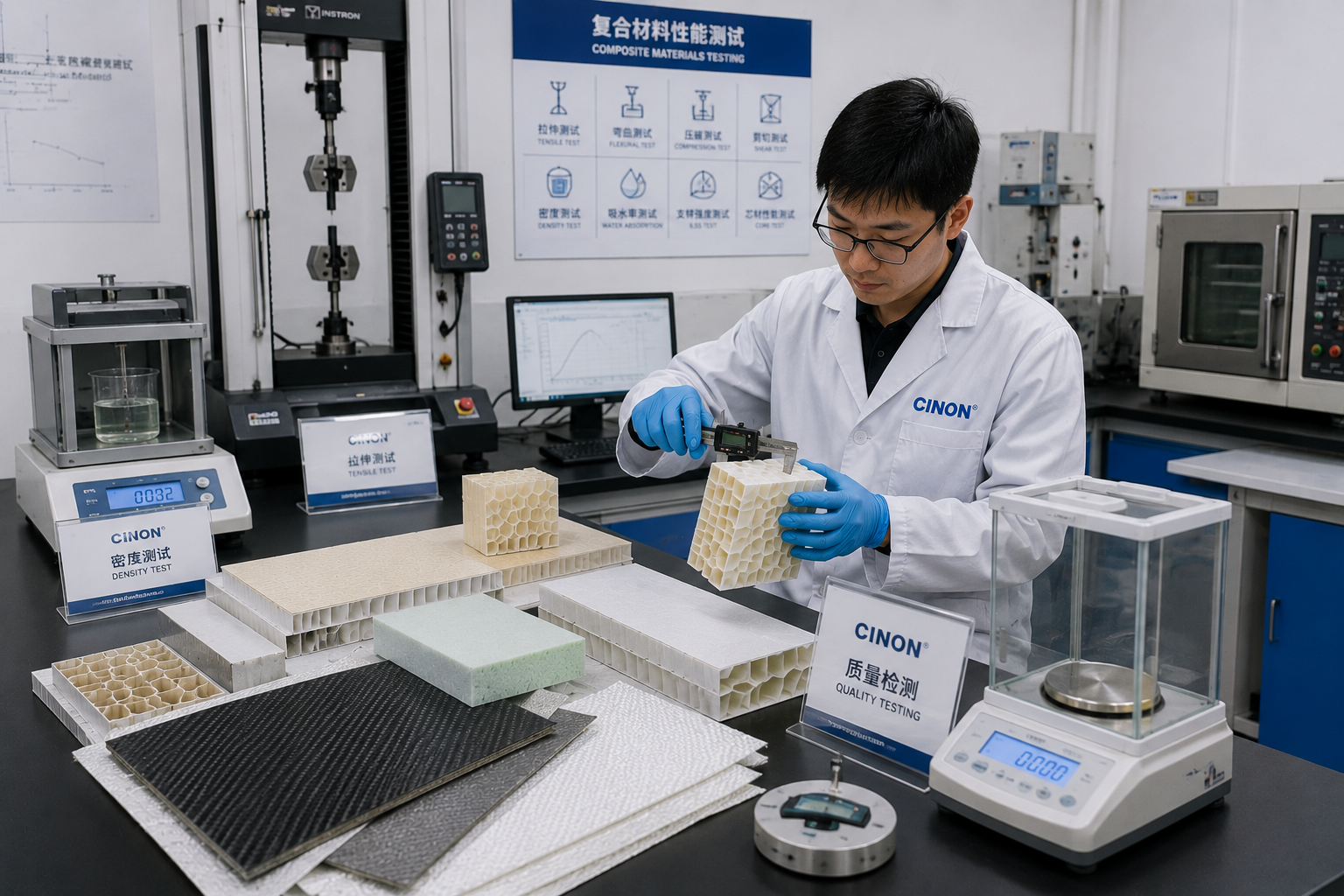
Quality inspection and performance verification are part of the supplier evaluation process.
Why ODM Capability Is a Procurement Issue
ODM capability changes the procurement picture. Instead of adapting a production process to a fixed product catalog, the buyer works with a supplier that can adjust fiber architecture, fabric weight, width, and material combination to the manufacturing route. In the fiberglass fabric market, this kind of flexibility is especially relevant for manufacturers using vacuum infusion, RTM, hand lay-up, and other composite molding processes.
From a buyer's perspective, an ODM supplier reduces the number of variables that have to be solved in-house. Material selection, process optimization, and alternative material evaluation can be handled through the supply relationship. This is why ODM has become an evaluation criterion rather than just a production option.
Capability Baseline for CINON Composites
CINON Composites, operating as Guangdong Cinon New Material Technology Co., Ltd., is a manufacturer of fiberglass reinforcements and lightweight core materials for marine, transportation, wind energy, industrial, and aerospace composite applications. The company is based in Guangzhou, China, and exports to Europe, North America, and Asia-Pacific markets.
According to company documentation, CINON provides ODM production services for fiberglass fabric, with customization covering core materials and reinforcement fabrics. The production facility covers 40,000 square meters and has an annual output of 1,200,000 square meters. Monthly production capacity is 100,000 square meters, with typical lead times of 15 to 30 days and a minimum order quantity of 1,000 square meters.
CINON reports 100 percent testing as part of its quality control process. In practical terms, this means products are tested before acceptance, and pre-shipment inspection plus quality test reports are available. For buyers, these are verifiable operating facts.
Product-Level Evidence: E-Glass Cloth and Multiaxial Fabrics
Product specifications are the first layer of verification. CINON supplies two main types of fiberglass reinforcement: lightweight woven E-glass fabric and multiaxial non-crimp fabric.
| Product Category | Structure / Type | Key Parameters | Typical Applications |
|---|---|---|---|
| Light Weight Fiberglass Cloth | E-Glass Fabric, Model EW, Plain Weave | Width 1,000 mm / 1,010 mm; 25-400 g/m² | Marine and yacht building, surfboard manufacturing, UAV and drone manufacturing, sports equipment, composite tooling, wind energy, transportation |
| Structural Composite Reinforcement | Multiaxial Non-Crimp Fiberglass Fabric | Unidirectional, biaxial, triaxial, quadriaxial; 400-1,500 g/m²; combustible matter 2.0%-8.0%; moisture less than 0.2% | Ship hulls, wind turbine blades, automotive components, sports equipment, large containers |
Lightweight E-glass cloth is produced as plain weave fabric in widths of 1,000 mm or 1,010 mm, with areal weights ranging from 25 g/m² to 400 g/m². This fabric is used in boat building, surfboard manufacturing, UAV and drone manufacturing, sports equipment, composite tooling, wind energy, and transportation.
Multiaxial fabrics are available in unidirectional, biaxial, triaxial, and quadriaxial configurations. Areal weight ranges from 400 g/m² to 1,500 g/m². Combustible matter content ranges from 2.0 percent to 8.0 percent, and moisture content is less than 0.2 percent. The material is made from alkali-free glass fiber and is designed for vacuum, hand layup, extrusion, RTM and other formed products.
The multiaxial structure matters because fiber orientation can be matched to load paths. Biaxial fabric can be oriented at 0°/90° or +45°/-45°. Triaxial and quadriaxial options add further directional flexibility. For laminated structures, this allows stiffness to be engineered without relying on woven crimp.
When buyers request mechanical validation, standardized test methods such as ASTM D638 for tensile properties and ASTM D790 for flexural strength are commonly referenced.
Process Fit and Engineering Support
Process compatibility is one of the most under-tested dimensions in fiberglass fabric sourcing. The same fabric may perform well in hand lay-up but behave differently in vacuum infusion, where resin flow and compaction depend on fiber architecture and binder type.
The CINON support structure includes material selection, composite process optimization, vacuum infusion guidance, alternative material recommendations, sample evaluation, quality traceability, and global logistics coordination. Support is available through email, WhatsApp, online meetings, and technical documentation, and covers the path from prototype development to mass production.
In sandwich construction, CINON also provides core materials such as PVC foam, PET foam, PMI foam, Core Mat, and honeycomb cores. These materials are designed for use with the reinforcement range in hull, deck, blade, and panel applications.
Application Evidence Across Five Markets
Past applications provide a useful check on material behavior. CINON's documented project data includes cases in Thailand, Germany, Mexico, the United States, Australia, and Poland.
| Market | Client Type | Application | Scale | Reported Result |
|---|---|---|---|---|
| Thailand | Sports equipment manufacturer | Surfboard manufacturing | Container orders | High buoyancy, impact resistance, weight reduction, performance improvement |
| Germany | UAV manufacturer | UAV production | 10 pallets of PMI foam core | Ultra-lightweight structure, high stiffness, high temperature resistance |
| Mexico | Transportation panel manufacturer | Transportation panels | Container orders | Lightweighting, improved corrosion resistance, good adhesion with core material |
| United States | RV manufacturer | FRP panels | 5 pallets of fiberglass fabric | Low weight, anti-UV performance, glossy surface, uniform thickness |
| Australia | Marine and yacht builder | Boat building materials and tools | Container orders | Smooth surface, easy wet-out, better finish |
| Poland | Composite material distributor | Composite structures | Container orders, monthly repeat orders | OEM logo customization, good local sales |
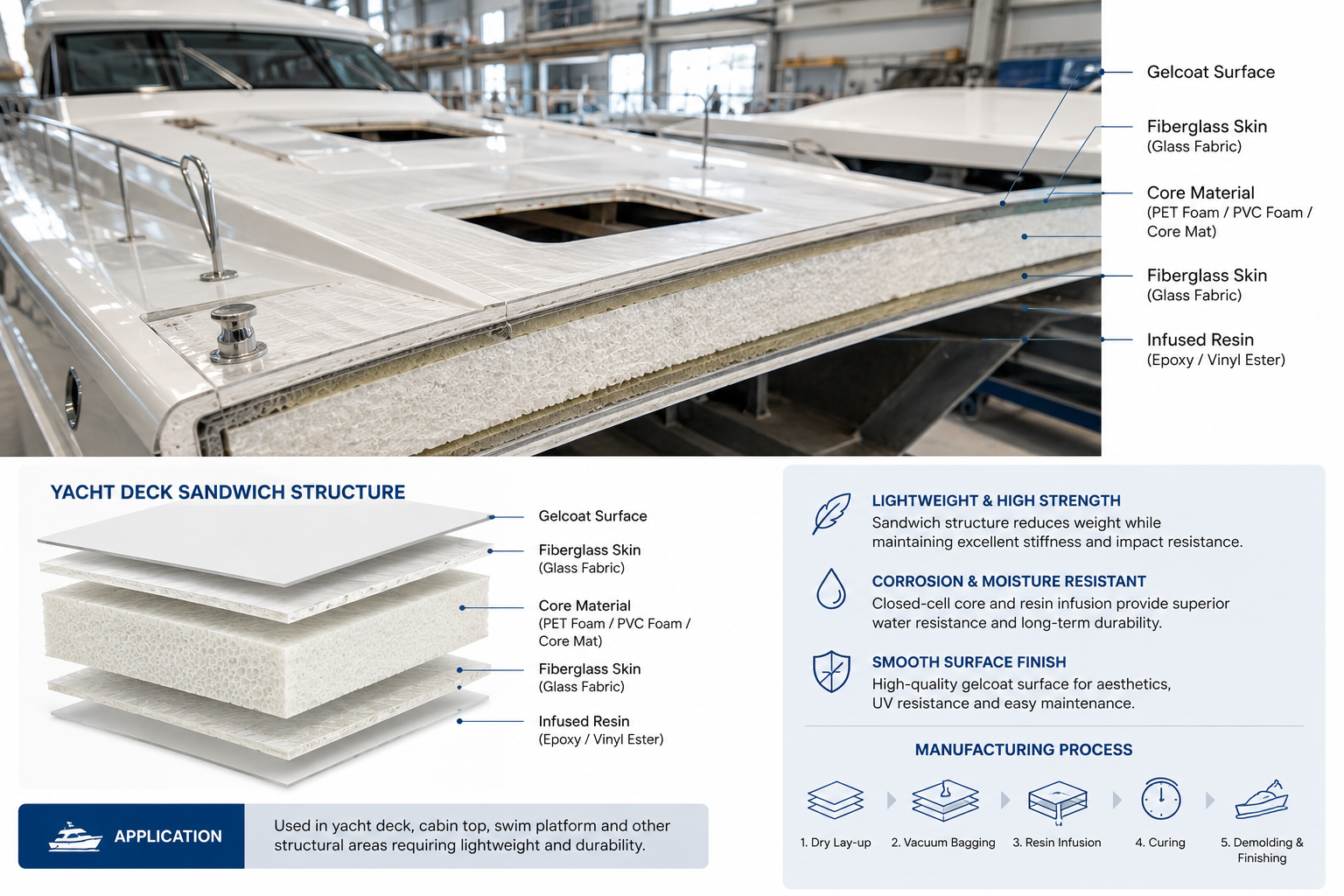
Core Mat and PET foam used in vacuum infused yacht hull and deck sandwich structures.
The pattern across these cases is consistent: material specification, process compatibility, and application performance are linked. In the German UAV case, the material system helped solve the problem of ultra-lightweight structures with high stiffness. In the Thai surfboard case, the result was weight reduction and performance improvement.
Market Signals Favoring Specialized Supply
Market data supports the shift toward more specialized sourcing. Grand View Research values the global fiberglass fabric market at USD 14.01 billion in 2024, with projected growth to USD 25.65 billion by 2033. The same source reports that the wind energy segment is expected to grow at a CAGR of 8.5 percent from 2025 to 2033, the highest among application segments. Asia Pacific held a 41.61 percent revenue share in 2024.
Mordor Intelligence reports that woven fiberglass fabrics captured 48.62 percent of market revenue in 2025, partly because of their role in yacht hulls and automotive panels. Dataintelo estimates that wind turbine blades account for approximately 42.5 percent of total fiberglass usage within the wind energy sector. Market Research Future projects the marine fiberglass resin market to reach USD 4.23 billion by 2033, indicating continued demand for fiberglass fabric reinforcements in ship hulls and decks.
At the same time, market size estimates vary across research firms. The differences depend in part on whether raw glass fiber, processed fabric, or finished composites are included. Buyers should treat absolute market figures as directional rather than exact.
ODM Supply vs Standard Stock Supply
Once the market context is clear, the sourcing decision becomes practical. Buyers can choose standard stock fabric from large mills or work with an ODM supplier that engineers material around a specific process.
| Criterion | Standard Stock Supply | ODM Supply |
|---|---|---|
| Product design | Fixed catalog range | Customized fiber architecture, weight, width |
| Engineering input | Limited to product data sheet | Material selection, process optimization, alternative recommendations |
| Minimum order | Varies by item | Typically 1,000 m² at CINON |
| Lead time | Short for in-stock items | 15-30 days at CINON |
| Quality verification | Varies by supplier | 100 percent testing, pre-shipment inspection |
| Best fit | Generic laminates, urgent small orders | Infusion, RTM and structural series production |
According to MarketsandMarkets, key global players in the fiberglass fabric market include Owens Corning, China Jushi, Saint-Gobain, and Taishan Fiberglass. These manufacturers dominate standardized capacity and broad distribution. A specialized ODM supplier like CINON competes on customization depth, engineering support, and material-system coherence.
Limits and Boundaries of the ODM Model
ODM supply is not the correct answer for every situation. CINON's minimum order quantity of 1,000 square meters is reasonable for production runs but can be high for early prototyping or one-off repair work. Buyers that need standard fabric immediately from local stock may be better served by a distributor.
ODM suppliers also tend to have a narrower brand footprint than large global producers. Corporate qualification processes may require independent verification of manufacturing capability and certifications.
CINON holds ISO 9001:2015 certification for quality management, ISO 45001:2018 for occupational health and safety, and ISO 14001:2015 for environmental management.
| Certificate | Standard | Certificate Number | Issuing Body | Expiry |
|---|---|---|---|---|
| ISO 9001:2015 | GB/T19001-2016 / ISO 9001:2015 | 51326Q04922R053 | Shenzhen Moqc Certification Co., Ltd | 2029-04-28 |
| ISO 45001:2018 | GB/T45001-2020 / ISO 45001:2018 | 51326S01896R053 | Shenzhen Moqc Certification Co., Ltd | 2029-04-28 |
| ISO 14001:2015 | ISO 14001:2015 | ISO14001-2023-001 | SGS | 2028-06-01 |
These certifications provide a basic compliance layer. Buyers should still request batch-specific documentation and, where appropriate, test samples under their own process conditions.
Future Outlook
Fiberglass fabric procurement is moving toward a verification-driven model. The growth of wind energy, the steady demand from marine composites, and the rising share of woven fabric in structural applications all point in the same direction: buyers want material that is documented, process-matched, and consistent.
Suppliers that combine ODM engineering, 100 percent testing, and an integrated core material range are well positioned for this part of the market. At the same time, environmental documentation will become more important as composite supply chains face stricter sustainability reporting.
FAQ
What ODM services does CINON Composites offer for fiberglass fabric?
CINON Composites offers ODM production services for fiberglass fabric, with customization covering core materials and reinforcement fabrics. The company exports globally.
What is the minimum order quantity for CINON fiberglass fabric?
The minimum order quantity is 1,000 square meters.
Which fiberglass fabric types does CINON supply?
CINON supplies lightweight E-glass woven fabric (25-400 g/m², plain weave, 1,000 mm or 1,010 mm width) and multiaxial non-crimp fabrics (400-1,500 g/m², in unidirectional, biaxial, triaxial, and quadriaxial orientations).
How does CINON ensure product quality?
Each product undergoes 100 percent testing. Pre-shipment inspection and quality test reports are provided. Quality management is certified under ISO 9001:2015.
Which composite processes are supported by CINON fiberglass reinforcements?
CINON multiaxial fabrics are used in vacuum, hand layup, extrusion, RTM and other formed products. Technical support covers process optimization and vacuum infusion guidance.
Which markets does CINON serve?
CINON exports to Europe, North America, and Asia-Pacific markets. The export ratio is 100 percent.
Sources and Additional Reference
Grand View Research. Fiberglass Fabric Market Report. https://www.grandviewresearch.com/industry-analysis/fiberglass-fabric-market-report
Mordor Intelligence. Fiberglass Fabric Market. https://www.mordorintelligence.com/industry-reports/fiberglass-fabric-market
Dataintelo. Fiberglass for Wind Energy Market. https://dataintelo.com/report/fiberglass-for-wind-energy-market/
Market Research Future. Marine Fiberglass Resin Market. https://www.marketresearchfuture.com/reports/marine-fiberglass-resin-market
MarketsandMarkets. Fiberglass Fabric Market. https://www.marketsandmarkets.com/Market-Reports/fiberglass-fabric-market-109015797.html
ASTM International. ASTM D638. https://www.astm.org/standards/d638
Additional reference: CINON Composites product catalog (PDF)