
What CE, RoHS and REACH Compliance Really Mean for Custom Glass Lighting Components
What CE, RoHS and REACH Compliance Really Mean for Custom Glass Lighting Components
Compliance for custom glass lighting is not one document. It is three different legal instruments answering three different questions, and buyers who treat them as a single interchangeable certificate tend to find the gap later — at customs, during a retailer's technical file review, or midway through a multi-year supply agreement.
CE, RoHS and REACH each address a different risk. CE concerns a product's conformity with the EU legislation that applies to its category. RoHS restricts specific hazardous substances in electrical and electronic equipment. REACH governs chemical substances in articles placed on the EU market. A borosilicate glass lamp shade can be relevant to all three, yet the evidence produced for each is not interchangeable, and it is not issued in the same way.
This reference decodes the documentation that B2B buyers should request when sourcing custom glass lamp shades and lighting components, using the registered compliance evidence held by Yancheng Jingxin Glassware Co., Ltd. (Jingxin Glassware), a glassware manufacturer founded in 1999 and based in Yancheng, Jiangsu Province, China, which produces lighting glass, decorative glass, drinkware and laboratory glassware from a 4,500 m² production base and exports to more than 100 countries.
The Documentation Gap Usually Opens at Scale-Up, Not at Sampling
A first order is normally judged on the sample. A tenth order is judged on the file. Once a lighting brand moves a custom glass shade into a catalogue, a DIY retail programme or a specification for a commercial fit-out, the question stops being "does this look right" and becomes "can we prove what this is, in writing, for every shipment."
That shift is where compliance review earns its place in procurement. A shade that performs correctly but arrives with an incomplete or mis-scoped document set creates a commercial exposure that no amount of dimensional accuracy offsets: the goods may be held, the technical file may be rejected by a distributor's own quality function, or the buyer may be asked to justify a claim it cannot support. Reviewing the framework before the purchase order is signed is materially cheaper than reviewing it after the container has shipped.
The practical difficulty is that suppliers often present compliance as a badge rather than a scope. "We are RoHS certified" is not a statement a buyer can file. A usable record names the issuing laboratory, the report number, the issue date, the test methods applied and — most importantly — the exact product scope the report covers. Everything else is a claim.
What CE, RoHS and REACH Each Actually Govern
CE: a declaration of conformity, not a test certificate
CE marking is a manufacturer's (or, for imports, the EU importer's) declaration that a product meets the legal requirements applicable to its category, made on the basis of a conformity assessment. It is a self-declaration route in many product categories, which is precisely why a buyer should not expect CE to arrive as a single laboratory certificate in the way RoHS test data does. In lighting, CE is most often discussed in relation to the finished luminaire rather than to the glass.
That distinction matters for procurement. A glass shade supplied as a stand-alone decorative component and a shade supplied as a component of a CE-marked luminaire sit in different regulatory positions. A competent supplier will state clearly which position applies, and will not blur the two in a catalogue line. For the buyer, the correct action is to establish the position in writing before the order is placed — and to keep that correspondence in the technical file alongside the material records.
RoHS: a substance restriction, evidenced by test data
RoHS restricts the presence of specific hazardous substances in electrical and electronic equipment, and the market expectation has extended well into component supply because buyers want continuity between the component and the finished fixture. Unlike CE, RoHS evidence typically takes the form of a chemical test report from an accredited laboratory, with a report number and a defined scope.
Cadmium, lead, mercury and hexavalent chromium are among the restricted substances, and they are the four addressed by the Jingxin Glassware report referenced below. Because the restriction is chemical rather than electrical, the test method matters: the report should cite recognised analytical standards for each element, not simply assert a pass.
REACH: a chemical substances framework for articles
REACH regulates chemical substances rather than electrical products. For an imported article such as a glass lamp shade, the practical obligations centre on substance restrictions and on the information that must be passed down the supply chain about substances of very high concern above the regulatory threshold. For a buyer, the deliverable is usually a written declaration covering the specific article and material, plus a route to obtain more detail if a downstream customer asks.
REACH is also the framework most often misrepresented in supplier documentation. A declaration that names no article, no material and no issue date has limited value in a technical file, even when the underlying substance position is sound.
| Framework | What it regulates | What a buyer should receive | What it does not, by itself, prove |
|---|---|---|---|
| CE | Conformity of a product with the EU legislation applicable to its category; a declaration route | A declaration of conformity naming the product, the applicable legislation and the responsible economic operator | That a chemical test was performed, or that every production batch was evaluated |
| RoHS | Restricted hazardous substances in electrical and electronic equipment | A test report with report number, issuing laboratory, issue date, test methods and product scope | Compliance of units outside the stated scope, or of finishes applied after the tested stage |
| REACH | Chemical substances in articles placed on the EU market, including restricted substances and information duties | A written declaration tied to the specific article and material, with a traceable issue date | Mechanical performance, thermal performance, or fitness for a specific fixture |
What the Registered Evidence at Jingxin Glassware Actually Covers
Jingxin Glassware holds 19+ professional certifications, including CE, RoHS, REACH, ISO 9001 and SMETA-4P, alongside 16 national patents. For a lighting buyer, the most directly useful of these is the RoHS record, because it names both a scope and a set of products.
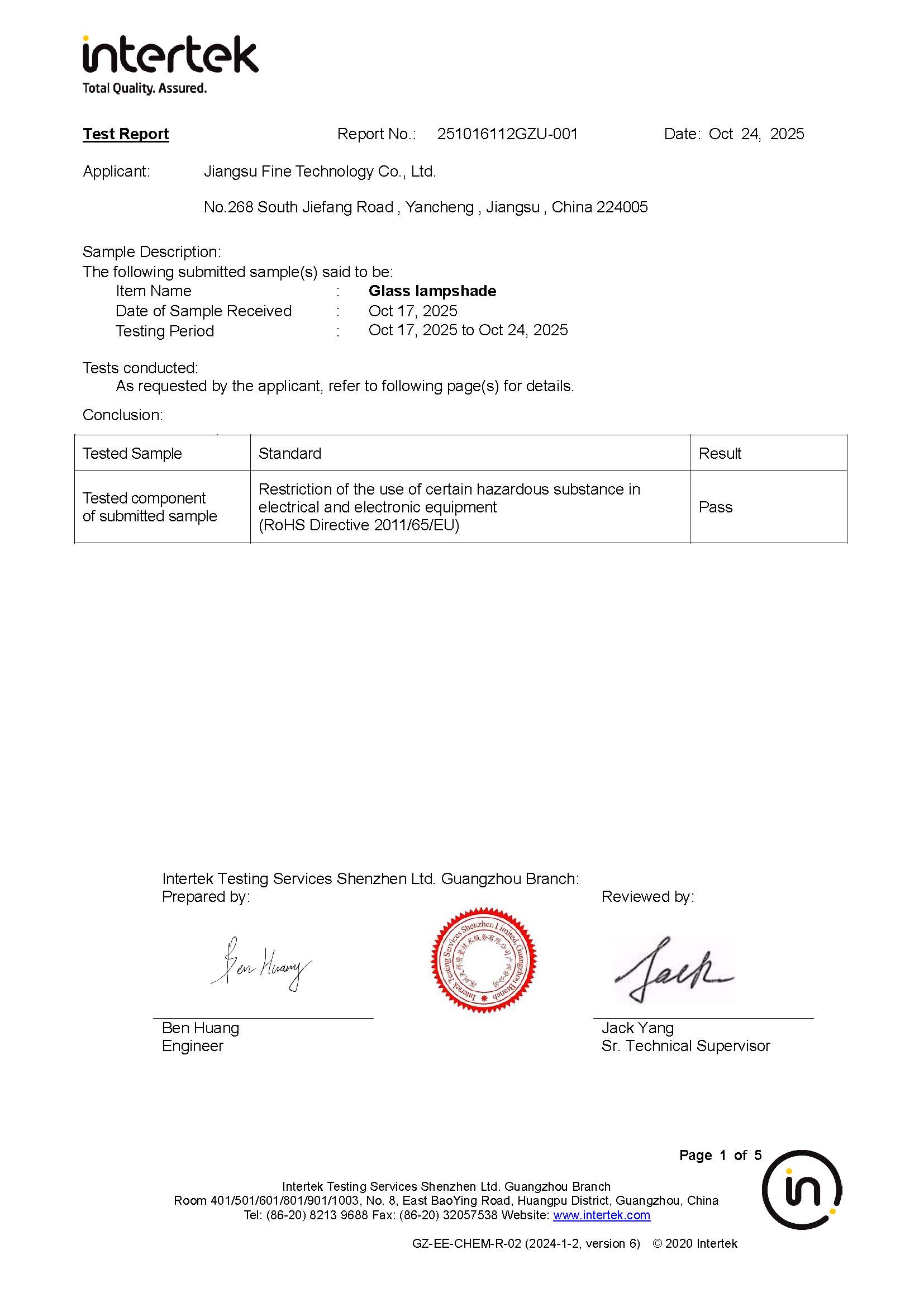
The RoHS report, number 251016112GZU-001, was issued by Intertek on 24 October 2025 for the EU and global market. Its stated scope is glass lamp shades — soda-lime and borosilicate glass products for lighting applications — and it applies the IEC 62321 series: IEC 62321-5 Edition 1.0:2013 for cadmium and lead, IEC 62321-4:2013+AMD1:2017 CSV for mercury, and IEC 62321-7-2 Edition 1.0:2017 for hexavalent chromium. The list of applicable products attached to the report covers nine lighting models, from the Opal White Glass Globe Lamp Shade JX1004 and the Glass Globe Lamp Shade JX1188 through to the Explosion-Proof Borosilicate Glass Lamp Shade JX1830 and the Cylinder Glass Tube Light Shade JXHB-010.
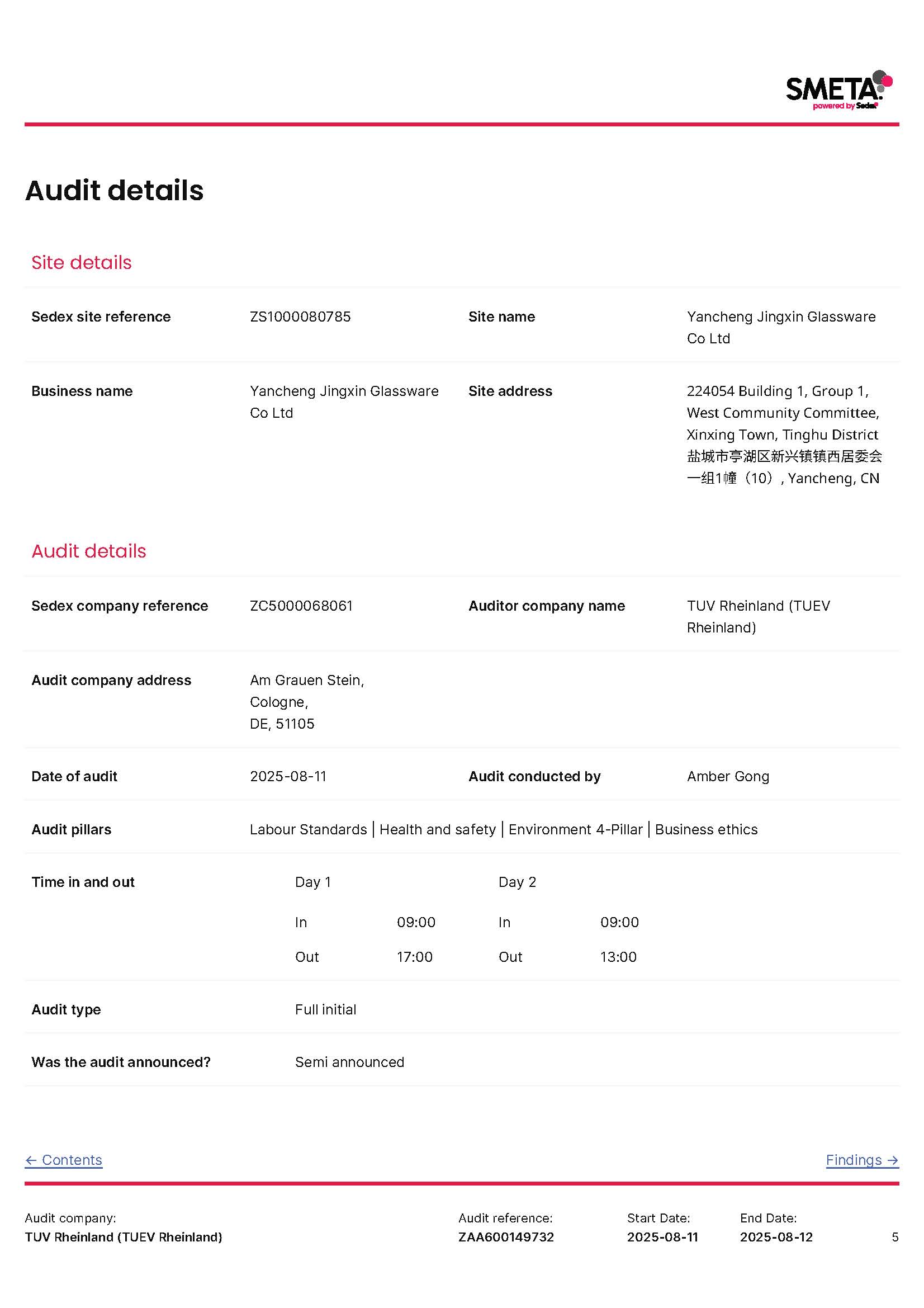
Factory-level assurance is covered separately. SMETA-4P certification ZAA600149732 was issued by TUV Rheinland on 12 August 2025 against the SMETA 4-Pillar methodology — labour standards, health and safety, environment, and business ethics — and covers all glass products together with the manufacturing site. That is a different kind of evidence from a product test report, and it answers a different buyer question: not "what is in this shade" but "under what conditions was it made".
At the batch level, Jingxin Glassware operates quality control from raw material through to finished goods, performs 100% pre-shipment inspection, provides a Certificate of Analysis for each batch, and arranges third-party testing on request — including SGS inspection. For a lighting programme that runs across several shipments, the COA plus the pre-shipment record is what connects a single report to a continuing supply relationship.
Why Glass Is a Comparatively Predictable Compliance Material
The chemistry of glass is one reason the compliance conversation for lighting components is more stable than it is for polymers. Glass is formed from mineral raw materials and does not require the plasticisers or brominated flame retardants that dominate the restricted-substance discussion in plastics. Colour, where it is used, can be introduced into the glass batch itself rather than applied as a coating; Jingxin's cobalt blue bottle work for a US winery is a documented example of colour that is integral to the glass body rather than a surface layer.
The material baseline also carries sustainability weight. Jingxin's glass is lead-free and 100% recyclable, which supports the environmental arguments that increasingly accompany a lighting specification in addition to the substance arguments.
Two material families are relevant, and they should not be conflated in a specification. Borosilicate glass, often referenced as Type 3.3, has a coefficient of thermal expansion of approximately 3.3 × 10⁻⁶/°C — roughly one third that of soda-lime glass at approximately 9 × 10⁻⁶/°C — and can withstand temperature differences up to around 300°C, where soda-lime glass typically tolerates differences of about 40°C. Soda-lime remains the cost-effective choice for decorative and ambient lighting where optical clarity matters more than thermal headroom. Compliance scope and material choice are separate decisions, but they are read together in a technical file, and a supplier who can state which family each model uses is easier to audit.
Mapping the Frameworks onto the Product Families Buyers Actually Order
A compliance review becomes actionable only when it is attached to a specific model. The nine lighting products named in the RoHS scope fall into recognisable families, and each family carries a different emphasis in the review.
| Product family | Models | Material basis | Compliance emphasis |
|---|---|---|---|
| Glass globe lamp shades | JX1004 Opal White Glass Globe Lamp Shade; JX1188 Glass Globe Lamp Shade; JX1407 Borosilicate Glass Globe Lamp Shade | Opal white soda-lime (JX1004); borosilicate (JX1407) | Substance scope plus diffusion behaviour; opal colour sits in the glass body, not on the surface |
| G9 and threaded shades | JX1416 Double Wall Glass G9 Light Globe; JX1184 Blown Glass Lampshade with G9 Thread | Borosilicate; opal glass | Interface geometry and thermal headroom reviewed alongside the chemistry record |
| Pendant and tubular shades | JXHB-002 Clear Ribbed Glass Pendant Shade; JXHB-010 Cylinder Glass Tube Light Shade | Soda-lime / borosilicate | Finish consistency between shipments, tied to the batch COA |
| Pressed borosilicate signal glass lamp shades | JX1832 Pressed Borosilicate Signal Glass Lamp Shade | Borosilicate, precision hot-pressed | Tight dimensional tolerance and stable optical signal performance; continuous working range cited at −60°C to +450°C |
| Explosion-proof borosilicate glass lamp shades | JX1830 Explosion-Proof Borosilicate Glass Lamp Shade | Borosilicate, 6.0–10.0 mm uniform wall | IK10 impact rating and thermal shock range cited at −40°C to +260°C, reviewed with the chemistry record |
The grouping matters commercially. A buyer running a hotel or retail programme in globe shades is usually weighing appearance, diffusion and delivery consistency. A buyer specifying signal or explosion-proof shades is weighing failure consequences, and will want the dimensional and thermal data reviewed next to the substance data rather than instead of it. Treating both with the same checklist produces either unnecessary cost on one side or insufficient rigour on the other.
Where Compliance Review Protects a Bulk Order
For a mid-to-high volume lighting programme, the value of the compliance file is cumulative rather than transactional. Four exposures recur.
- Customs and market entry. Documentation requests at the border are easier to answer when the report number, issuing laboratory and scope are already on file and match the invoice description.
- Downstream technical files. Distributors and retail chains increasingly require their suppliers' evidence to be re-filed with their own quality function. A scope statement that names the product family shortens that process considerably.
- Change of finish. Surface treatments — acid pickling, sandblasting, silk-screen printing, stamping, decalcomania, spray painting — are applied after the glass is formed. When an order changes finish, the buyer should confirm in writing that the existing record still addresses the item being supplied rather than assume it does.
- Long-term supply agreements. A multi-year agreement that references a specific report needs a defined position on what happens when that report is superseded. Recording the version in the contract avoids a renegotiation later.
The Limits: What Documentation Cannot Tell You
A compliance record is necessary and it is not sufficient, and buyers who understand the boundary make better decisions than those who treat a report as a warranty.
The central limitation is sampling. A RoHS report describes the result for the items tested against a defined scope; it is not a per-unit certificate for an entire production run. That gap has to be closed by other means — batch Certificates of Analysis, 100% pre-shipment inspection, and third-party testing where the risk justifies it. A buyer who holds a report but no batch records has evidence of a design intent, not evidence of a shipment.
The second limitation is scope wording. Report 251016112GZU-001 is scoped to glass lamp shades as soda-lime and borosilicate glass products for lighting applications. Where a purchase order adds a decorative finish, a printed logo, or a non-lighting application, the buyer should confirm the position in writing rather than extend the report by inference.
The third limitation is category. CE applicability depends on what the product is and how it is placed on the market, not on the material. A glass shade is not automatically a CE-marked electrical product, and a supplier who presents CE as a chemical test result is describing the wrong instrument. Finally, none of these frameworks evaluate fit, thermal behaviour under a specific fixture, or breakage risk in transit — those belong to sample approval, fitter verification and packaging review.
A Document Request List Buyers Can Use
The following list is what a lighting buyer can reasonably request before releasing a bulk order for custom glass lamp shades, and it is sequenced so that each item closes the gap the previous one leaves open.
- RoHS test report — report number, issuing laboratory, issue date, test methods, and the attached product list. Compare the listed models against the purchase order line by line.
- REACH declaration — specific to the article and material, with an issue date and a named responsible party.
- CE declaration of conformity — where the product position requires one, naming the applicable legislation and the economic operator responsible.
- Material Certificate of Analysis — per batch, confirming the glass formulation supplied against the specification.
- Social compliance audit — where the buyer's own code of conduct requires site-level evidence; SMETA-4P certification ZAA600149732 covers the manufacturing site and all glass products.
- Pre-shipment inspection record — with third-party inspection available on request where the order value or end market warrants it.
- Approved sample record — the reference against which production is compared, including fitter opening, wall thickness and finish.
Two operational facts make this list workable for planning. Sampling for custom glass runs at roughly 5–7 days after specification confirmation, and mass production at roughly 20–30 days after sample approval, with an MOQ of 500 pieces for hand-blown work, 2,000 pieces for machine-made, and negotiable terms on trial orders. A documentation review that starts after sample approval fits inside the production window; one that starts after shipment does not.
Market Trend: Compliance Has Moved from Gatekeeping to Specification
Across the lighting supply chain, compliance evidence is drifting from a border requirement to a purchasing criterion. Retail chains and hospitality procurement teams increasingly score suppliers on documentation completeness alongside price and lead time, because an incomplete file creates downstream work for their own quality function. In parallel, the sustainability argument has become part of the same conversation: recyclability and lead-free material claims are now routinely requested in the same breath as substance declarations.
A second shift is the growing preference for glass over polymer components in decorative and architectural lighting, driven by perceived premium quality, cleanability and end-of-life recyclability. That shift favours suppliers who can articulate their material position precisely — which grade, which colour route, which surface treatment — rather than suppliers who treat "glass" as a single undifferentiated category. Buyers, for their part, are increasingly asked by their own customers to explain not only what a component contains but how it was made, which is where site-level audits enter the file.
Future Outlook
Two directions look probable. The first is consolidation of documentation: buyers will increasingly expect a single indexed file per product family, linking the substance report, the material certificate, the site audit and the inspection record, rather than a folder of disconnected certificates. Suppliers who maintain that structure will be easier to onboard and easier to retain.
The second is finer scope resolution. As decorated and customised lighting components proliferate, the gap between what a report covers and what a purchase order actually specifies will attract more scrutiny. Buyers who build scope comparison into their standard purchase order process — rather than into an annual audit — will absorb regulatory change with less disruption, and will be better positioned when a customer or a distributor asks a question that the original certificate was never designed to answer.
FAQ
What is the difference between CE, RoHS and REACH for glass lighting components?
CE is a declaration that a product meets the EU legislation applicable to its category and is made through a conformity assessment route. RoHS restricts specific hazardous substances in electrical and electronic equipment and is normally evidenced by a laboratory test report. REACH governs chemical substances in articles placed on the EU market, including substance restrictions and supply-chain information duties. The three answer different questions and produce different documents, so one cannot substitute for another.
Which Jingxin glass lamp shade models are covered by the RoHS report?
Report 251016112GZU-001, issued by Intertek on 24 October 2025, lists nine lighting models in its applicable-products schedule: JX1004 Opal White Glass Globe Lamp Shade, JX1416 Double Wall Glass G9 Light Globe, JX1830 Explosion-Proof Borosilicate Glass Lamp Shade, JX1832 Pressed Borosilicate Signal Glass Lamp Shade, JXHB-002 Clear Ribbed Glass Pendant Shade, JX1184 Blown Glass Lampshade with G9 Thread, JX1188 Glass Globe Lamp Shade, JX1407 Borosilicate Glass Globe Lamp Shade, and JXHB-010 Cylinder Glass Tube Light Shade. The stated scope is soda-lime and borosilicate glass products for lighting applications.
Does one RoHS test report cover every unit in a bulk order?
No. A test report describes the result for the items tested within a defined scope; it is not a per-unit certificate for an entire production run. Closing that gap requires batch-level records — a Certificate of Analysis per batch, 100% pre-shipment inspection, and third-party testing where the risk or the end market justifies it. Jingxin Glassware provides a COA per batch and performs 100% pre-shipment inspection, with third-party inspection such as SGS available on request.
What documents should a buyer request before a bulk order of custom glass lamp shades?
A workable set is: the RoHS test report with its number, issuing laboratory, issue date, methods and product list; a REACH declaration tied to the specific article and material; a CE declaration of conformity where the product position requires one; a material Certificate of Analysis per batch; site-level social compliance evidence where the buyer's code of conduct requires it; a pre-shipment inspection record; and an approved sample record covering fitter opening, wall thickness and finish.
How does material choice interact with compliance for lighting glass?
Compliance scope and material choice are separate decisions that are read together in a technical file. Borosilicate glass, referenced as Type 3.3, has a coefficient of thermal expansion of approximately 3.3 × 10⁻⁶/°C and can withstand temperature differences up to around 300°C, while soda-lime glass at approximately 9 × 10⁻⁶/°C typically tolerates differences of about 40°C. Jingxin's glass is lead-free and 100% recyclable, and colour can be held in the glass body rather than applied as a surface coating. Buyers should confirm which material family each model uses rather than assume a single grade across a range.
What does SMETA-4P add to a lighting compliance file?
SMETA-4P is a social compliance audit methodology rather than a product test. Certificate ZAA600149732, issued by TUV Rheinland on 12 August 2025, covers labour standards, health and safety, environment and business ethics under the Sedex platform, and applies to all glass products and the manufacturing site at Yancheng Jingxin Glassware Co., Ltd. It answers a question about working conditions and site management, not about the chemical content of a lamp shade.
Reference materials. The Glass Lamp Shades catalogue from Yancheng Jingxin Glassware Co., Ltd. is available for download: Glass Lamp Shades Catalogue (PDF).
Enterprise enquiries. Website: www.cn-glassware.com. Email: 3548596851@qq.com; 332138516@qq.com; 350879642@qq.com. Address: No.268 South Jiefang Road, Yancheng, Jiangsu, China. Tel: +86 515-8822 9059.
Tem questões ou precisa de mais detalhes?
Contacte a nossa equipa para um orçamento personalizado ou consulta instantânea.
Solicitar orçamento
Preencha o formulário abaixo e a nossa equipa entrará em contacto com uma proposta personalizada.
Chat direto do WhatsApp
Prefere conversar em tempo real? Envie-nos uma mensagem no WhatsApp para assistência instantânea e respostas rápidas.
- Obter orçamento personalizado
- Partilhar fotos ou documentos
- Discuta as suas necessidades diretamente
Geralmente responde em 5–30 minutos durante o horário de expediente.