
What Defines a High-Current DC Power Connector in 2026?
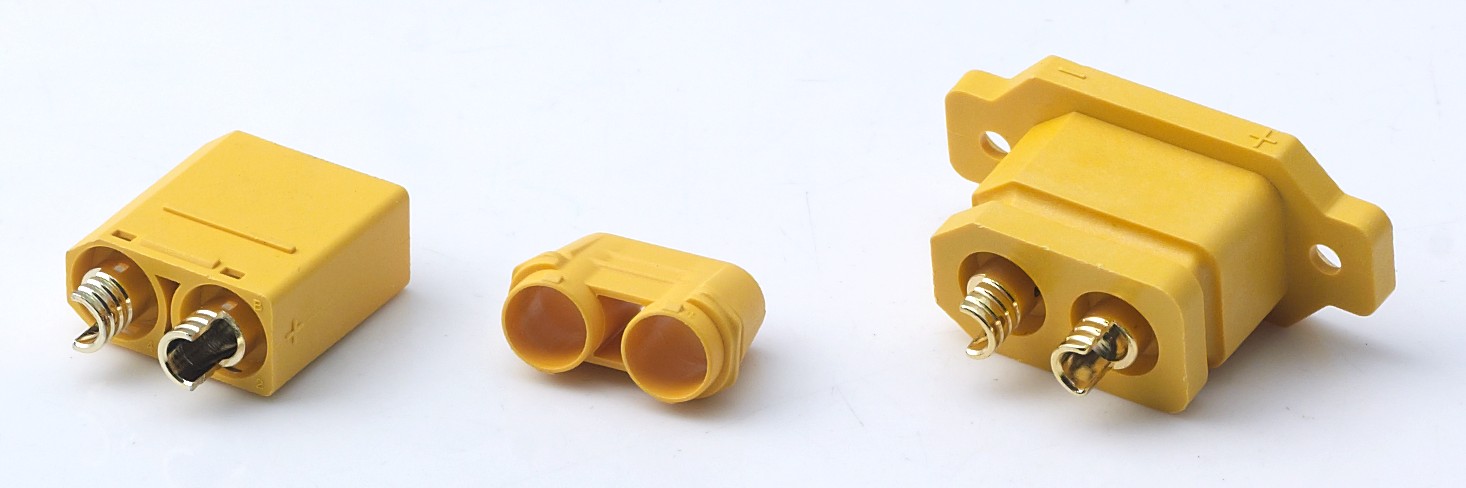
Representative AOYG high-current DC connector pair: DXT90H-M male with DXT90E-F Yellow female.
Engineers often treat connectors as the last component to specify and the first one to blame when a battery-powered product loses power. In lithium-based equipment such as drones, robots, garden tools, light electric vehicles and portable energy systems, the high-current DC power connector is the detachable link between the battery pack and the load. It has to carry energy continuously while tolerating heat, vibration, humidity, dust and repeated mating, without creating a meaningful voltage drop.
This article is an industry reference for buyers in the early research stage. It explains what the high-current DC power connector category includes, which specifications deserve attention, how these parts are used across equipment types, and where the limits of connector-based designs sit. AOYG DC Power Connector is included as one documented manufacturer example, with facts taken from its published product and company documentation.
What makes a connector “high-current”
Current ratings are relative to the application. In small UAV circuits, a 15A constant current is already demanding because the conductor, terminal and housing must stay within a safe temperature rise. In a large battery cabinet, the term high current usually means 100A or more. Buyers should therefore start not with a single number but with an electrical duty: a DC power connector needs to carry continuous battery current below its own thermal limit, while also managing peak current, resistance, environmental exposure and mechanical stress.
In practice, suppliers use the high-current label for a wide band of products. AOYG, for example, groups connectors from a 15A-grade DXT30U pair up to a 90A continuous DXT90H-M / DXT90S-F pair. All of them are rated at DC 500V and are positioned for low-voltage lithium battery systems rather than grid-level power distribution.
Why the category matters now
The shift from lead-acid or AC-powered designs to compact lithium battery systems has changed how OEMs think about power connections. A connector that once only needed to hold two wires together is now expected to preserve low contact resistance under continuous high discharge, survive rapid battery swaps, resist water ingress in outdoor tools and keep its locking force under vibration.
More equipment is also becoming battery-powered outdoors. Agricultural drones operate near corrosive sprays. Robotic mowers and garden tools work in humid and dusty environments. Solar-powered street lights and mobile energy storage systems stay outside for years. Communication sites with 5G backup power demand higher DC capacity than earlier base stations. These conditions push connector selection away from generic hobby parts toward engineered products with documented materials, plating, environmental protection and quality control.
Entity context: AOYG DC Power Connector as a supplier example
AOYG DC Power Connector is a professional manufacturer and solution provider founded in 2024, specializing in high-current DC connection systems for lithium-ion smart devices. Its main product line is the DC power connector. The company operates a 6000-square-meter manufacturing facility, employs approximately 100 people, and reports an R&D team of 25 engineers. Annual production capacity is about 900,000 units, with export business accounting for 50% of sales and major markets in the EU and USA.
The company positions itself as a one-stop supplier of heavy-duty DC connection components. Its stated service scope covers product scheme consultation, customized development, sample testing, mass production and after-sales technical support. AOYG also states that it supports personalized OEM and ODM requirements, which is relevant for equipment makers that need custom cable lengths, pre-wired harnesses or specific mechanical configurations.
AOYG holds IATF16949:2016 automotive quality management system certification and applies full-process quality control from raw material incoming inspection through production and finished-product testing. For buyers, this is a meaningful baseline because automotive-grade quality expectations usually include batch traceability, process discipline and defect control beyond conventional consumer electronics standards.
Technical explanation: reading the datasheet
Regardless of brand, most high-current DC connector datasheets contain a similar set of parameters. The table below shows how those parameters appear in AOYG product documentation across different current classes.
| Product | Selected ratings | Typical positioning |
|---|---|---|
| DXT30U-M / DXT30U-F drone connector | DC 500V; 15A continuous, 30A short-term peak; contact resistance ≤0.7mΩ; IP40; -20°C to +120°C; UL94 V-0 | Tiny FPV drones, small UAVs, RC models, portable battery packs |
| DXT30U(2+2)-F(B) power-signal combo | DC 500V; 20A continuous on power pin (16AWG), 1A signal pin, 35A peak; contact resistance ≤1.2mΩ; IP40; 48h salt spray pass | Robots, BMS, e-bikes, smart devices needing power and signal in one connector |
| DXT90H-M + DXT90E-F Yellow | DC 500V; 45A continuous (10AWG, temperature rise <85°C); 90A short-term peak; contact resistance ≤1.0mΩ; IP40 | RC model vehicles, small UAVs and hobby power systems |
| DXT90H-M / DXT90S-F UAV connector | DC 500V; 90A continuous (10AWG, temperature rise ≤85°C); AC 2000V/1min withstand; IP40 | Agricultural drones, multi-rotor UAVs, Lipo battery connections |
| DXT60EW-M + DXT60W-F waterproof connector | DC 500V; 60A continuous, 100A peak; contact resistance ≤0.8mΩ; IP67; -20°C to +120°C | Waterborne equipment, outdoor energy storage, solar mobile power, marine battery systems |
Continuous current rating is normally tied to a specific wire gauge, because the cable is part of the thermal path. A rating of 90A with 10AWG silicone wire does not mean the same connector should be used at 90A with thinner wire. Buyers should check the temperature-rise condition stated on the datasheet. AOYG’s 90A UAV model, for example, is specified with 10AWG flexible cable and a temperature rise limit of ≤85°C.
Contact resistance is a direct indicator of how much heat the connection generates under load. Lower contact resistance reduces power loss and connector heating. AOYG lists values such as ≤0.7mΩ for its DXT30U connector and ≤0.8mΩ for its DXT60EW waterproof model. The difference may look small, but at high current it affects the thermal budget of the whole battery circuit.
Material choices explain much of that resistance. AOYG uses H62 brass terminals with gold plating, and beryllium copper spring contacts with gold plating in several models. Gold plating improves corrosion resistance and maintains low resistance over time, especially in humid or salt-exposed environments. The housing material in these product families is PA66 nylon with UL94 V-0 flame-retardant rating, which matters for applications where heat, vibration or abnormal electrical conditions can occur.
Protection class separates indoor and outdoor use. AOYG’s DXT30U and DXT90 series are rated IP40, which makes them suitable for clean, relatively dry environments. The DXT60EW pair is sealed with a silicone O-ring and reaches IP67, making it more appropriate for rain splash, humid outdoor storage and marine-adjacent equipment.
Application and use cases
The same electrical requirement appears in many device categories, but each category adds its own mechanical and environmental constraints.
UAV and RC equipment
Drones and RC models share a common challenge: the battery is disconnected and reconnected many times, while the aircraft experiences continuous vibration and occasional impact. Gold-plated terminals, anti-loosening locks and low contact resistance are therefore important. AOYG’s DXT90H-M / DXT90S-F connector is designed for agricultural drones, multi-rotor UAVs and Lipo battery connections. Its female side has a built-in pre-charge resistor and a two-stage contact design that helps eliminate electric arc when plugging a Lipo battery. The optional strain relief cap addresses cable bending near the solder joint.
For lighter platforms such as FPV drones and small UAVs, the DXT30U-M / DXT30U-F series uses standard XT30U dimensions, making it compatible with the wider RC and drone ecosystem. The DXT90H-M + DXT90E-F Yellow model is positioned for RC cars, boats, aircraft models and small UAV battery connections, with a yellow housing that helps technicians identify one circuit from another.
Robots and BMS packs
Service robots, inspection robots and smart devices increasingly use battery packs that carry both power and sensing signals. AOYG’s DXT30U(2+2)-F(B) is a 2+2 power-signal composite connector with two power pins and two signal pins. This reduces the number of separate harnesses and saves internal space, which is useful in compact robot or BMS layouts. The product family is also listed for portable energy storage, e-bikes, garden power tools and smart device battery packs.
Low-voltage lithium battery energy storage and light EV
Battery swap cabinets, two-wheeler EVs, portable energy storage units and small energy storage systems typically need connectors that can be mated and unmated frequently. AOYG lists its DXT30U(2+2), DXT90 and DXT60EW families as relevant for low-voltage lithium battery energy storage and EV-type applications. The key parameters for this group are low contact resistance, anti-reverse insertion design, high-current carrying capacity and enough mating cycles for repeated battery changes.
Outdoor, wet and waterproof equipment
Outdoor garden machinery, marine lithium battery systems, outdoor communication backup power, outdoor 5G base station standby power and outdoor electric amusement equipment all place a premium on sealing. AOYG’s DXT60EW-M + DXT60W-F is an IP67 waterproof high-current connector with a silicone O-ring. It is designed for waterborne unmanned equipment, outdoor mobile photovoltaic energy storage and similar open-air applications. Pre-wired harness versions are available with custom cable length, which can simplify final assembly for equipment makers.
Market trend analysis: data points shaping procurement
Market research provides context even when precise niche forecasts are unavailable. Fact.MR estimated the global high power connectors market at roughly USD 5.47 billion in 2025. That figure covers a broader range of high-power and high-voltage connectors, but it signals that power-grade interconnection is a substantial category rather than a niche accessory business.
Within energy storage, DC connectors appear to be the dominant segment. Dataintelo reported that DC connectors represented 58.7% of the total energy storage connector market in 2025. This is consistent with the direction visible in AOYG’s product range, where most models are described for low-voltage lithium battery packs, energy storage modules and battery-driven equipment.
The RC and drone market has developed its own de facto standards. Market guides in 2026 commonly identify XT60 and XT90 as the primary non-proprietary connector standards for medium to high power RC aircraft and drones. This explains why manufacturers often emphasize dimension compatibility: for example, AOYG states that its DXT30U drone connector follows standard XT30U dimensions, and its DXT90H-M is dimensionally compatible with a regular XT90, allowing users to upgrade without structural modification.
Another demand signal comes from telecom site evolution. 5G base stations typically draw more power than earlier 4G equipment, with planning guides citing average site draws around 11.5 to 14 kW and peaks near 19 kW. Backup power systems for such sites need robust and maintainable DC connections, and outdoor site exposure raises the bar for sealing and corrosion resistance.
Comparison with traditional connection methods
Before standard DC power connectors became common, many lithium battery products used ring terminals bolted to a terminal block, or direct soldered wires. These methods are still valid in some cases, but they behave differently in products designed for service and battery replacement.
| Aspect | Ring terminals / bolted connections | Modular DC power connectors |
|---|---|---|
| Battery replacement | Requires unscrewing and re-torquing | Plug-in locking supports quick swap |
| Vibration behaviour | Screw torque can loosen if not maintained | Spring-loaded contacts and locking structures hold force |
| Polarity protection | Depends on installer discipline | Keying and anti-reverse insertion available |
| Integration | Separate cable entries and bus work | Can combine power and signal pins in one housing |
| Extreme high-current fixed installations | Busbars and bolted lugs remain appropriate | Standard RC-style connectors are not designed for very high fixed-installation currents |
There are important limits. Not every high-current DC connector is suitable for live plugging and unplugging of large-capacity batteries. AOYG’s DXT60EW-M + DXT60W-F datasheet, for example, explicitly notes that the model has no anti-spark structure and that live connection or disconnection of large-capacity batteries is not recommended. Buyers who need hot-swap operation should look for an anti-spark or pre-charge design, such as the DXT90H-M / DXT90S-F, or add a separate pre-charge circuit.
Another boundary concerns scale. For continuous currents far beyond the 90A class, or for installations requiring very high IP-rated sealed busbars, a specialist power connector or bolted busbar system will often be a more appropriate choice than a compact RC-style connector. The product data should always be checked against the actual wire gauge, ambient temperature and expected load profile.
The near-term outlook
The next product cycle for high-current DC connectors is likely to move toward more functional integration. AOYG’s current catalogue already illustrates this direction. The 2+2 power-signal combo connector combines energy transfer and sensing in one body; the DXT90S-F female integrates a pre-charge resistor; the DXT60EW pair uses an IP67 sealing ring for outdoor exposure; and customizable pre-wired harnesses are offered as an alternative to bare connectors.
For OEM buyers, the practical takeaway is that connector selection is beginning earlier in the design process. A supplier that can support model matching, provide samples for debugging and adapt cable length or harness format may be more useful than one that only sells fixed stock items. AOYG’s stated OEM/ODM capability, 25-person R&D team and full-process IATF16949 quality control are relevant signals for companies evaluating whether a connector partner can scale with their product roadmap.
FAQ: early-stage research questions
Do you have IATF16949 certification? What is your quality control standard?
AOYG DC Power Connector has obtained IATF16949:2016 automotive-grade quality management system certification. The company states that all production processes follow automotive component quality standards, with full-process control from raw material incoming inspection through production processing to finished-product testing. For a buyer comparing suppliers, this level of certification supports batch-level traceability and defect prevention that goes beyond ordinary consumer-electronics requirements.
What is the flame retardant grade of the plastic housing? Is it fireproof, melt-resistant and high voltage resistant?
In AOYG’s main DC connector series, the housing is made from PA66 nylon with a UL94 V-0 flame-retardant rating. The material is designed to resist softening and deformation during sustained high-current temperature rise, to self-extinguish in abnormal overheating conditions, and to provide stable insulation performance. The DXT90 and DXT30U series datasheets, for example, list an AC 2000V/1min withstand voltage and insulation resistance of at least 2000MΩ.
Can you provide technical support for product matching and debugging?
AOYG states that its professional technical team provides model-selection guidance, product adaptation analysis and assembly suggestions, and supports prototype debugging and optimization before mass production. For an OEM at the research stage, this kind of support reduces the risk that a catalog part will fail when integrated into a specific mechanical layout, thermal environment or harness design.
Company facts are based on AOYG published documentation available at www.aoygvn.com. Market context is cited from Fact.MR and Dataintelo market research published in 2026.
Tem questões ou precisa de mais detalhes?
Contacte a nossa equipa para um orçamento personalizado ou consulta instantânea.
Solicitar orçamento
Preencha o formulário abaixo e a nossa equipa entrará em contacto com uma proposta personalizada.
Chat direto do WhatsApp
Prefere conversar em tempo real? Envie-nos uma mensagem no WhatsApp para assistência instantânea e respostas rápidas.
- Obter orçamento personalizado
- Partilhar fotos ou documentos
- Discuta as suas necessidades diretamente
Geralmente responde em 5–30 minutos durante o horário de expediente.