
What Do XINFLYING's Sublimation Printer Certificates Prove?
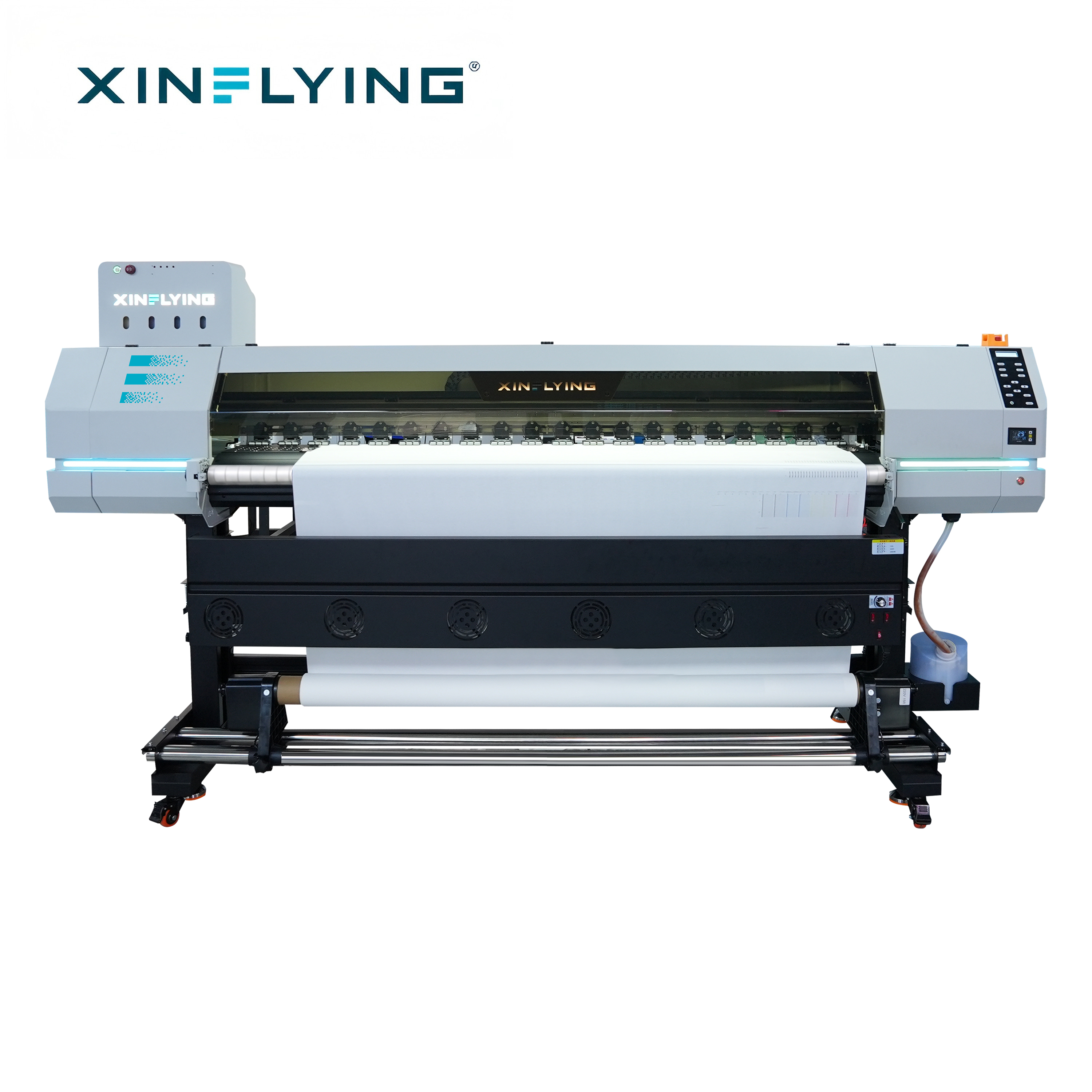
Sublimation printers within a single product family can carry different electrical configurations, which is why certification documents are issued at model level. Image: XINFLYING XF-H1802X-2I32A1.
Buying a wide-format sublimation printer in 2026 rarely fails on technical grounds. Production managers can compare print widths, printhead counts and square-metre throughput in an afternoon. What stalls purchase orders is documentation: whether the machine can be placed legally on the buyer's market, and whether the supplier's compliance claims survive a customs query, a distributor's due-diligence check or an OEM partner's audit.
XINFLYING is the brand of Guangzhou Xin Flying Digital Technology Co., Ltd., a digital printing equipment manufacturer founded in 2010 and based in Panyu, Guangzhou. The company builds DTF printers, dye sublimation printers, DTG printers, UV DTF and UV flatbed printers, and supplies printing consumables and complete digital printing solutions. Roughly 80% of its output is exported to North America, South America, Europe, Asia, the Middle East and Africa.
This article addresses one decision-stage question: what do the certificates supplied with a XINFLYING sublimation printer, including the XF-19E15-PRO, actually prove? It examines which compliance areas those documents cover, which bodies issue them, how to match them to a specific machine configuration, and where the evidence stops.
A document problem, not a machine problem
A certificate is a scoped statement, not a general endorsement of quality. That distinction is why compliance paperwork now appears early in equipment evaluation rather than after the order is placed.
- European Union. Buyers importing a sublimation printer into the EU should verify CE compliance, including applicable electrical safety, electromagnetic compatibility and product-safety requirements. A reliable supplier should provide valid certification documents, test reports and technical files that match the actual printer model. Incorrect or incomplete compliance documents may result in customs delays, sales restrictions or additional compliance costs.
- Restricted substances. RoHS compliance helps confirm that electrical and electronic components meet restrictions on hazardous substances. Buyers should request the relevant environmental compliance documents and verify that those documents apply to the equipment model actually being supplied.
- United States. For equipment entering the US market, electromagnetic compatibility and electrical safety requirements apply based on configuration and application environment. FCC compliance is commonly referenced for controlling electromagnetic interference in electronic equipment, and additional safety certification may be required depending on product specifications and sales channel.
Because XINFLYING exports the large majority of its production, with Europe and North America among its main markets, model-specific documentation is part of routine order handling rather than an exception reserved for large accounts.
What CE and RoHS documents cover on an industrial sublimation printer
CE documentation for an industrial printer is assembled from several regulatory areas. Each area addresses a different risk, and each is tested and documented separately. For a machine of the XF-19E15-PRO class, those areas map onto concrete parts of the product.
Electrical safety
A high-throughput sublimation printer is a significant electrical load. The XF-19E15-PRO is rated at 14.5 kW on a 210–230 V, 45 A supply and operates with an external intelligent air-heat integrated dryer. Electrical-safety requirements address insulation, earthing, protection against electric shock and the thermal behaviour of that assembly. On smaller models in the same range, such as the XF-H1802X-2I32A1 at 3.5 kW on 110/220 V, the electrical risk profile is different, which is why documents are tied to models rather than to a product family.
Electromagnetic compatibility
EMC requirements cover both the interference a machine emits and its immunity to interference from its environment. The relevant electronics include a RIP-driven controller, printhead drive components for up to 15 Epson i3200-A1 heads, motors, heating elements and a networked workstation connection.
Machinery safety
A roll-to-roll machine that loads 1,000 m rolls of sublimation paper, moves media at production speed and weighs approximately 1,480 kg net presents mechanical hazards — pinch points, rotating components and media-handling risks — that machinery-safety requirements are designed to control.
Restricted hazardous substances
RoHS documentation applies to the electrical and electronic components inside the machine. It is the document set most frequently requested by distributors selling into EU retail channels, because it supports the compliance statements those distributors pass upstream to their own customers.
Test report, declaration and marking are three different things.
An independent laboratory produces a test report against defined standards. The manufacturer then issues a Declaration of Conformity referencing that report, the applicable requirements and the exact product model. The CE marking is affixed on the basis of that declaration. A laboratory report is evidence; it is not an approval granted by an EU authority, and it does not transfer the importer's own legal obligations to the manufacturer.
XINFLYING's certification evidence: what the documents show
For XINFLYING's sublimation printer range, certification documentation is issued through independent third-party testing bodies, among them UDEM, TQT and BST. For the XF-19E15-PRO and other models in the range, that documentation addresses the CE-related areas described above — electrical safety, electromagnetic compatibility and machinery safety — together with RoHS compliance for the electrical and electronic assemblies.
For a procurement team, the practical value lies in traceability rather than in the logo printed on the page. The chain runs: named testing body, test report with a defined standard scope, product model designation, manufacturer's Declaration of Conformity, and CE marking on the machine. Each link can be verified independently, and a missing link is usually a more useful warning signal than any marketing statement about quality.
The manufacturing base behind those documents is substantial: a 37,440 m² facility, more than 200 employees, a 20-engineer R&D team and annual output of more than 20,000 units, supported by local warehouses and technical support in key markets.
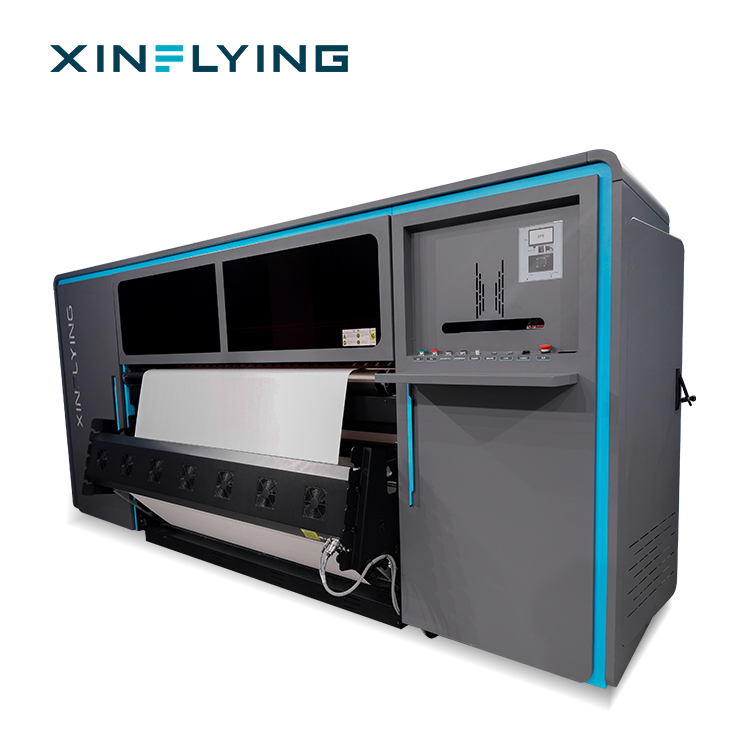
The XF-19E15-PRO is a 190 cm industrial sublimation printer with 15 Epson i3200-A1 printheads and a 14.5 kW power rating — electrical characteristics that the compliance file must name explicitly.
| Model | Printheads | Print width | Typical max. speed | Power / supply |
|---|---|---|---|---|
| XF-H1301X-1I32A1 | 1× Epson i3200-A1 | 130 cm | 4PASS 28 m²/h | 2 kW; 110/220 V |
| XF-H1802X-2I32A1 | 2× Epson i3200-A1 | 180 cm | 4PASS 52 m²/h | 3.5 kW; 110/220 V |
| XF-O2000-4I32A1 | 4× Epson i3200-A1 | 195 cm | 2PASS 180 m²/h | 8.5 kW; 220 V |
| XF-19E8-PRO | 8× Epson i3200-A1 | 190 cm | 1PASS 306 m²/h | 10.2 kW; 210–230 V |
| XF-19E15-PRO | 15× Epson i3200-A1 | 190 cm | 1PASS 524 m²/h | 14.5 kW; 210–230 V |
Variables a certificate must match: printhead count, print width, electrical load and supply voltage differ across the XINFLYING sublimation range, so a document issued for one configuration does not describe another.
The table is not a specification list; it is a documentation checklist. A 3.5 kW machine operating on a 110/220 V supply and a 14.5 kW machine operating on 210–230 V are not the same electrical product, even when they share a brand and a product category.
Verifying a certificate against a specific machine: a seven-step check
The following sequence is the one a buyer can run without specialist compliance staff, and it is the sequence that surfaces most document mismatches.
- Identify the exact model and configuration. Record printhead count (8 versus 15 heads changes the drive electronics), print width and voltage variant (110/220 V versus 210–230 V).
- Match the legal manufacturer name. The certificate should identify the same legal entity that appears on the commercial invoice. For XINFLYING equipment, that entity is Guangzhou Xin Flying Digital Technology Co., Ltd.
- Confirm the issuing body and its scope. Note which testing body issued the report — for example UDEM, TQT or BST — and whether the standards listed fall within that body's declared testing scope.
- Separate reports from declarations. A test report states what was tested; a Declaration of Conformity states what the manufacturer declares. Buyers evaluating regulated-market imports should hold both.
- Check coverage against the destination market. EU-bound machines require electrical safety, EMC, machinery safety and RoHS coverage. US-bound machines involve EMC/FCC considerations plus safety documentation as applicable.
- Check dates and standard versions. A report issued against a superseded standard version has limited value during a market-surveillance review.
- Cross-check against the nameplate. Model designation, power rating and voltage on the machine nameplate must match the documents, line by line.
A supplier that can complete all seven steps without escalation is providing a different class of evidence than one that forwards a single scanned certificate for a different model in the same catalogue.
Where the evidence stops: limits of certificate review
Certification settles a narrow question, and it becomes more useful to buyers when its boundaries are stated plainly.
- Certificates do not measure print performance. They confirm conformity with defined safety, electromagnetic and substance requirements. They say nothing about colour accuracy, colour consistency between batches or the durability of a sublimated print. A rated output such as 1PASS 524 m²/h on the XF-19E15-PRO is a production specification, not a compliance statement.
- CE is a manufacturer's declaration. It is supported by test evidence, but it is not an approval issued by an EU authority, and it does not remove the importer's own obligations under EU market rules.
- RoHS scope is limited to equipment. The documentation covers electrical and electronic components. Sublimation ink, transfer paper and other consumables may fall under separate chemical requirements that sit outside the printer's RoHS file.
- Scope follows configuration. A modification — a different printhead count, an added dryer, a changed voltage variant or a rebranded machine — may fall outside the scope of the original report.
- Compliance is not installation readiness. XINFLYING specifies an operating envelope of roughly 18–30 °C and 35–65% RH for its industrial sublimation printers. Meeting that envelope is a buyer responsibility, and it affects print consistency independently of any certificate.
- Documentation quality varies by source. Published market-size estimates for the same category diverge widely depending on scope, which is a reminder that the underlying methodology matters as much as the headline figure.
How different buyers use the same documents
EU importers and distributors
These buyers need a CE file that names the exact model, plus RoHS documentation for the electronic assemblies, plus access to the technical file if a market-surveillance authority requests it. Distributors also pass summary compliance statements upstream to retail and brand customers, so gaps in the file create commercial friction rather than only administrative friction.
US buyers
US-bound purchases typically centre on electromagnetic compatibility documentation and electrical safety information appropriate to the configuration, together with technical specifications and test reports. Because requirements shift with product specifications and sales channel, the document list should be confirmed against the specific machine rather than assumed from the model family.
OEM and private-label partners
OEM programmes add a question that safety certificates do not answer by themselves: which entity becomes responsible for the declaration when a machine carries a partner's brand. That point belongs in the supply agreement alongside the documentation handover list, not in a separate legal discussion later.
Large textile factories and tender-driven projects
In capital-approval processes and public tenders, the compliance file is often a gate item evaluated alongside throughput, operating cost and service coverage. A machine that performs well but arrives with documentation for a different configuration can be excluded before its performance is ever measured.
Documentation-led evaluation compared with other sourcing approaches
| Evaluation approach | Primary evidence | Main risk | Best suited to |
|---|---|---|---|
| Price-led sourcing | Quotation and headline specification | Non-conforming equipment held at customs or blocked from resale | Non-regulated markets and buyers with existing compliance capacity |
| Brand-led sourcing | Market reputation and installed base | Paying for reputation that does not match the required configuration | Buyers with an established, verified brand preference |
| Documentation-led evaluation | Model-matched certificates, test reports and declarations | Higher upfront diligence effort; may favour suppliers with mature compliance systems over suppliers with equal print quality | Regulated-market importers, OEM partners and tender-driven projects |
The limitation in the third row is real and worth stating. Documentation-led evaluation carries an administrative cost, and it is not a quality ranking. For a buyer whose output stays in a market with limited enforcement, a complete CE or US file may add process without changing the commercial outcome. It is a risk-management instrument, and it should be sized to the market the machine will actually serve.
Equally important, compliance says nothing about production economics. In high-volume polyester production, sublimation printing delivers approximately 2–5× higher production efficiency and 50–70% lower operating costs compared with DTG printing, and reduces setup costs by nearly 100% compared with screen printing for small-to-medium orders. Those figures describe how a machine earns money; certificates describe whether it may be placed on a market. Both belong in the same decision file, but they answer different questions.
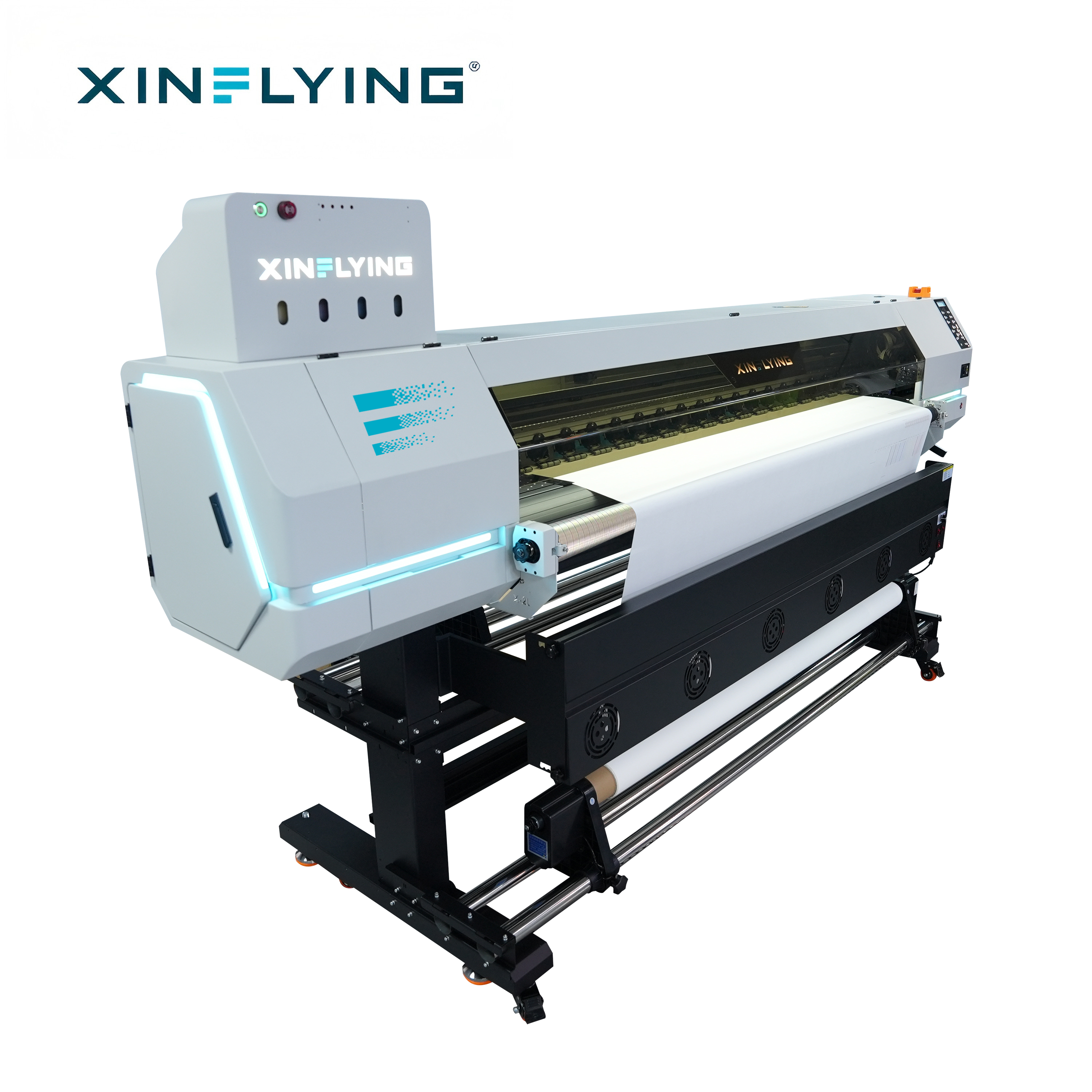
Entry and mid-range models carry their own documentation. Image: XINFLYING XF-H1802X-2I32A1, 2× Epson i3200-A1, 180 cm print width.
Market trend: compliance pressure grows with the market
The commercial case for documentation discipline is reinforced by the size of the market it serves. Grand View Research valued the global dye sublimation printing market at USD 16.4 billion in 2025, with a projected path to USD 39.0 billion by 2033. Asia Pacific accounted for a 36.5% revenue share in 2025, led by China as the largest country market.
Narrower equipment data points in the same direction. Mordor Intelligence sized the dye sublimation printer segment at USD 1.88 billion in 2025, expecting USD 2.53 billion by 2030. Fortune Business Insights valued the large format printer market at USD 10.57 billion in 2025, with a projected USD 16.52 billion by 2034. FESPA industry coverage identifies 1.9 m (1900 mm) roll-to-roll widths as a working standard for high-volume textile and soft-signage production — a width delivered by both the XF-19E8-PRO and the XF-19E15-PRO.
Two caveats belong in a neutral reading of these numbers.
First, growth estimates diverge by scope: published 2025 figures for the dye sublimation printing market range from roughly USD 15.2 billion to USD 42.95 billion depending on whether consumables and services are counted. Second, quality standards such as ISO 12647-8:2021, which defines validation print processes working directly from digital data, address print-process control rather than electrical compliance — a reminder that a complete technical file for a textile printer spans several unrelated frameworks.
Future outlook
Three shifts are likely to shape how buyers evaluate certificates through the rest of the decade. Documentation is becoming model-level and digitally linked, so buyers will increasingly expect a document set keyed to a serial-number-level configuration rather than to a catalogue page. Market-surveillance reviews in regulated markets are becoming more document-driven, which raises the cost of a mismatched certificate above the cost of producing the right one. And as OEM and private-label programmes expand, responsibility questions — who declares conformity for a rebranded machine — will move from legal departments into ordinary supply agreements.
Against that background, the practical standard for suppliers is straightforward: a named testing body, a report scoped to a defined standard, a declaration naming the exact model, and a buyer who can verify all three before the machine ships.
Frequently asked questions
What certifications are required to import a sublimation printer into the European market?
Buyers should verify CE compliance covering the applicable electrical safety, electromagnetic compatibility and product-safety requirements. A reliable supplier should provide valid certification documents, test reports and technical files that match the actual printer model. Before ordering, confirm that the certification information corresponds with the equipment being supplied, because incorrect or incomplete compliance documents may result in customs delays, sales restrictions or additional compliance costs.
Do sublimation printers require RoHS documentation, and what should buyers request?
RoHS compliance helps confirm that electrical and electronic components meet restrictions on hazardous substances, and it is particularly relevant for buyers operating in regulated markets. Buyers should request the relevant environmental compliance documents from the supplier and verify that those documents apply to the actual equipment model rather than to a different configuration in the same product family.
What should US buyers verify before purchasing a sublimation printer?
For equipment entering the US market, buyers should check electromagnetic compatibility and electrical safety requirements based on configuration and application environment. FCC compliance is commonly referenced for controlling electromagnetic interference in electronic equipment, and additional safety certification may be required depending on specifications and sales channel. Requesting certification documents, technical specifications and product test reports from the supplier before purchase helps reduce customs risk.
Why must a certificate match the exact printer model and configuration?
Certification is scoped to a defined product. Within XINFLYING's sublimation range, printhead counts, print widths, power ratings and supply voltages differ by model — from an entry machine rated 2 kW on 110/220 V to the XF-19E15-PRO at 14.5 kW on 210–230 V. A document issued for one electrical configuration does not automatically describe another, and misalignment between the certificate and the shipped machine is one of the most common findings in import documentation checks.
How do certification documents affect OEM and distribution partnerships?
Distributors, importers and OEM partners typically need model-level documentation to answer their own customers, pass retail compliance checks and manage customs. A traceable package — named testing body, test report, model designation and Declaration of Conformity — reduces the administrative load on the partner. Where a machine is rebranded, the partner and manufacturer also need to agree which entity carries the declaration responsibility.
When two suppliers both present CE and RoHS documents, what should separate them?
Compare whether the documents name the exact model and configuration being quoted; whether the issuing body and standard scope are identifiable; whether test reports and declarations are both present; whether the legal manufacturer name matches the invoice; and whether the supplier can provide the technical file for market surveillance. A supplier that answers all five points with documents rather than assurances is providing stronger evidence — although certificate scope still says nothing about print quality or operating cost.
Certificates are the part of a sublimation printer purchase that cannot be judged by looking at the machine. They are judged by matching a document to a model, a testing body to a standard, and a declaration to a market. For buyers evaluating XINFLYING equipment, the useful starting point is not whether a certificate exists, but whether it names the exact machine being shipped — and what it leaves unproven.