
What EU Importers Must Verify Beyond a Mini Excavator's CE Mark
What EU Importers Must Verify Beyond a Mini Excavator's CE Mark
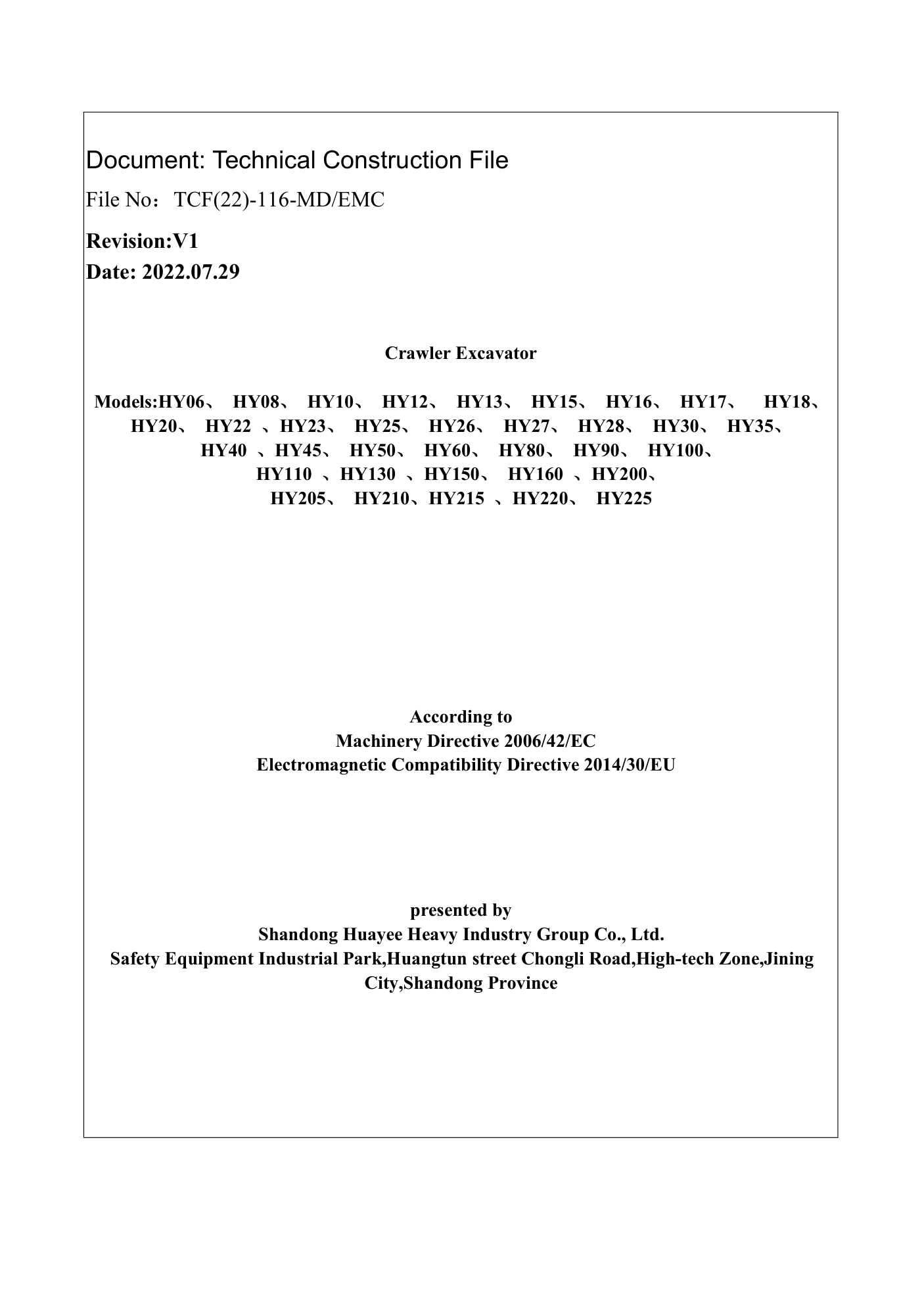
A machine-level CE certificate of compliance names a model range in its annex, not a single unit. The importer's task is to connect the two.
A CE mark on a mini excavator is a conclusion. It records that a manufacturer followed a conformity assessment route for a defined group of machines. It does not name the model that was declared, the build configuration that declaration covers, the legal entity that signed the paperwork, the engine inside the unit in the container, or the person who now has to answer a question about it in Rotterdam, Gdańsk or Trieste. For an importer working through the research and evaluation stage, the useful question is therefore not whether a CE mark exists — most quotations will show one — but whether the document set behind that mark can be reconciled with the machine that has been ordered.
Three layers usually end up in one folder and are then treated as one artefact: the factory's management-system certification, which describes an organisation and the scope of activities it was audited for; the machine-level declaration, which attaches conformity to a specific model designation and a named list of standards; and the importer's own obligations once the machine is placed on the EU market in the importer's name. They are issued by different bodies, carry different numbers, and expire on different dates. Most verification failures do not begin with a forged document. They begin with nobody checking that the three layers describe the same machine, the same entity and the same build.
The document set used as a worked example here is the one held by Shandong HUAYEE Heavy Industry Machinery Group Co., Ltd., a mini excavator manufacturer based in Jining City, Shandong Province, China, whose 1.8 t HY18 and 2 t HY20 sit in the size class most European importers buy first. The three-layer logic applies to any supplier; the certificate numbers, scope wordings and component identifications below apply to this one.
The CE mark answers a different question from the one buyers ask
An importer evaluating a supplier is trying to establish four things that the mark alone does not settle: which model was declared, which configuration that declaration covers, which entity carries the paperwork, and what is physically inside the machine. Each of those questions is answered by a different document with a different issuer. Consolidating them into a single "CE certified" line in a quotation removes exactly the information the evaluation stage needs.
The practical consequence is a sequence. Read the management-system certificate for its scope sentence. Read the machine-level certificate for its annex and its standards list. Read the engine approval for its engine type. Then ask for the declaration of conformity written against the serial number and the ordered configuration — the only document in the set that describes one machine rather than a category. Everything in this article follows from that order.
Layer one: the management-system scope, not the certificate number
A management-system certificate answers a narrow question: was an organisation's management system audited against a standard, for a defined scope, by an accredited body, and is that certification currently valid? For HUAYEE the two certificates in the file are ISO 9001:2015 under certificate no. 62724Q0812R0S and ISO 14001:2015 under certificate no. 62724E0543R0S, both issued by JingXin Certification (Beijing) Co., Ltd. on 21 August 2024 and both valid to 20 August 2027. Both sit under CNAS accreditation C275-M with IAF multilateral recognition, which means the certificate can be traced to an accreditation record rather than only to a PDF attachment.
The sentence that matters is the scope. The ISO 9001 certificate supplied here is scoped to the "sales of construction machinery, garden machinery, building machinery, road machinery and concrete machinery"; the ISO 14001 certificate is scoped to "environmental management activities related to the sales of" the same categories. An importer should therefore ask the supplier to connect that certified scope to the activity it is actually relying on — which production site, which address, which process — rather than assuming that a management-system certificate automatically covers every manufacturing step behind an order. That is not an accusation about any particular factory. It is simply what the wording says, and it is the wording that a distributor's compliance team or a market surveillance authority will read.
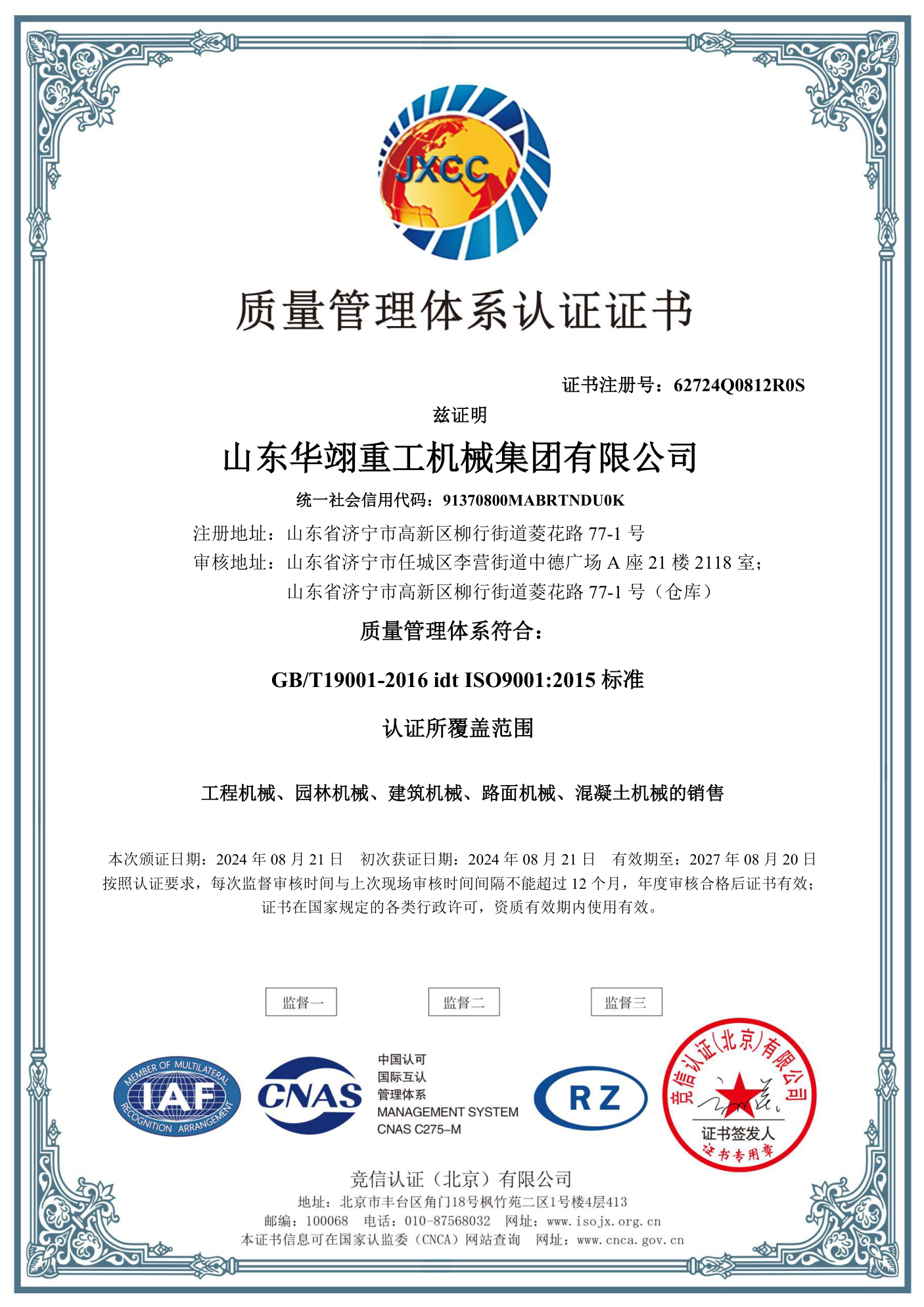
ISO 9001:2015 certificate no. 62724Q0812R0S, valid to 20 August 2027. The scope sentence and the certified site are the parts an importer should actually read.
Two further checks take minutes. First, confirm the certificate's validity date against the planned delivery date, not against today's date; a document that expires during the shipping window is a scheduling problem. Second, confirm that the entity named on the certificate is the entity named on the proforma invoice. On a group with separate manufacturing, trading and export arms, those are not always the same company, and the discrepancy is legitimate as long as someone can explain it.
Layer two: the machine-level declaration must name HY18 or HY20
The machine-level layer is where a range certificate and a single container most often drift apart. HUAYEE's crawler excavator conformity documentation for the EU is built on a CE Certificate of Compliance issued by Ente Certificazione Macchine Srl (ECM) of Valsamoggia, Italy: certificate no. H220809.SHHTW07, technical construction file no. TCF(22)-116-MD/EMC, issued 9 August 2022 and valid to 8 August 2027, covering the Machinery Directive 2006/42/EC and the EMC Directive 2014/30/EU, and citing EN ISO 12100:2010, EN 474-1:2006+A6:2019, EN 474-5:2006+A3:2013 and EN ISO 13766-1:2018.
The scope of that certificate is a model range: crawler excavators of the HY series, models HY06 to HY225, 35 models in total, with the full model list held in Annex I of the certificate. That single sentence defines the importer's first real check. The certificate is not a statement that "a mini excavator" conforms; it is a statement that 35 named models conform. If the annex does not carry the designation printed on the proforma invoice — HY18 in a 1.8 t order, HY20 in a 2 t order — then the file does not yet describe the machine that was bought, and the gap should be closed before the deposit is paid rather than after arrival.
The second document has a different legal basis and is frequently missing from supplier packs: noise. The CE verification for noise emission of outdoor equipment is certificate no. 0P230814.SHHQT84, technical construction file no. CETCF0811-ND, also issued by ECM, dated 14 August 2023 and valid to 8 August 2027, assessed against EN ISO 3744:2010 under Directive 2000/14/EC as amended by 2005/88/EC, and again scoped to models HY06 to HY225. Two certificates, two directives, two numbers, one shared expiry date. An importer who receives the machinery-directive certificate and not the noise verification holds an incomplete machine file, even though both documents say "CE".
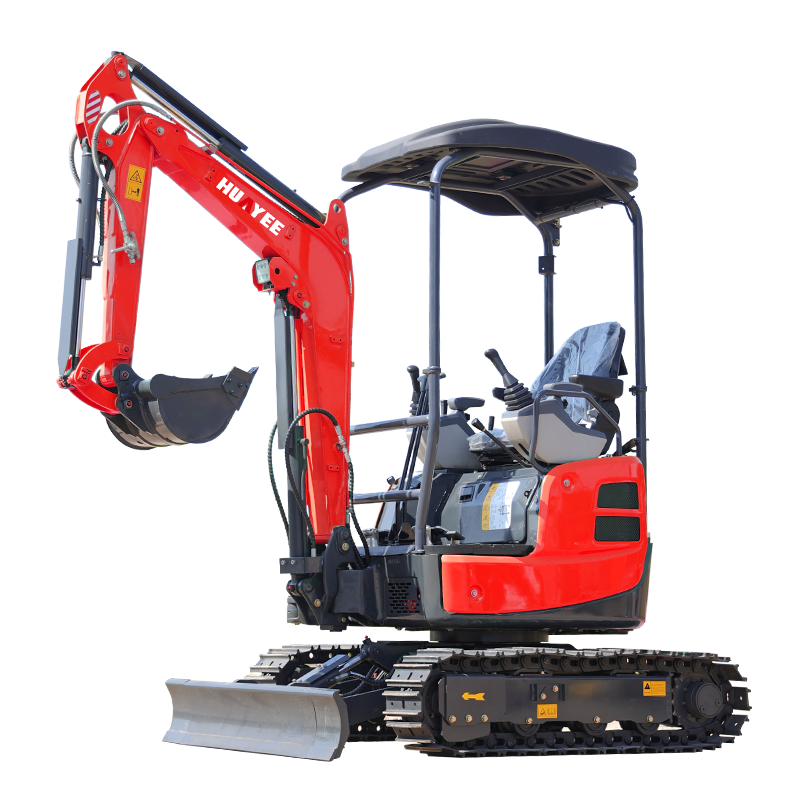
The 2 t class HY20 lists a single engine identification, the Kubota D902, which makes the certificate-to-engine-plate comparison a one-to-one check.
A range certificate also does not enumerate the build. The HY18 is offered with an open canopy or an enclosed cab; the HY20 runs on a 230 mm rubber track. Those choices affect what is physically on the machine, and they are settled by the build sheet and by the declaration of conformity for that serial number — not by the annex. The bridge between certificate and container is therefore one document longer than most buyers expect: certificate, annex, build sheet, declaration of conformity, engine approval.
Layer three: what the importer owns once the container lands
Compliance does not stop at the quay, and this is the layer where first-time importers most often discover a gap. The company that places the machine on the EU market in its own name takes on duties that the factory cannot discharge on its behalf: keeping the technical documentation available for the required period, ensuring the declaration of conformity accompanies the machine, applying the CE marking correctly to each unit, supplying instructions and safety information in the language or languages required by the destination market, and being in a position to answer a market surveillance authority in its own jurisdiction. The precise content of those duties differs between member states and between product rules, so the practical step is to confirm the list with a compliance advisor in the destination country rather than to copy a neighbouring distributor's checklist.
Packaging is the sub-layer most often forgotten and the easiest to evidence. HUAYEE's German registration under the Verpackungsgesetz (VerpackG, section 9) is held in the LUCID Packaging Register under registration number DE3722376188859 (reference no. 353101/3722376188859.HR.23#0001), issued on 22 February 2023 by Stiftung Zentrale Stelle Verpackungsregister, and it covers retail, grouped and shipment packaging and service packaging placed on the German market under the brand names HUAYEE and huayizhonggong. The holder named on that registration is Shandong HUAYEE Import And Export Co., Ltd., while the manufacturing identity used throughout the rest of this file is Shandong Huayee Heavy Industry Machinery Group Co., Ltd.
Both names are legitimate. The point is that an importer should be able to say which entity appears on the commercial invoice, which appears on the declaration of conformity and which appears on the packaging registration, and why they differ. An unexplained entity mismatch is one of the most common reasons a document set stalls inside a distributor's own compliance review — not because anything is wrong, but because the reviewer cannot close the loop without asking, and asking costs a week.
Component-level evidence: what makes the file auditable
The three layers establish that a supplier has a system, has declared a model and knows who carries which duty. None of them tells an importer what is physically inside the machine. Component identification converts the file from an administrative record into something an engineer can audit, and it is also what keeps the file usable when a model is revised.
Engine identification: D722-E4B / KM385B against D902
For the 1.8 t class HY18, the published specification lists a Kubota D722-E4B / KM385B engine of 0.719 L displacement and three cylinders, with rated outputs of 10.2 kW at 2,500 rpm and 18.1 kW at 2,600 rpm and maximum torque of 42.9 N·m at 2,000 rpm. Two identifications and two ratings appear on one line, which is exactly why the check matters: the engine plate on the unit, the engine type-approval certificate and the declaration of conformity should all name the same engine, and the buyer should not have to guess which of the listed identifications is fitted. For the 2 t class HY20 the specification lists a single engine, the Kubota D902 of 0.898 L, rated 11.8 kW at 2,300 rpm with maximum torque of 51.3 N·m at 1,800 rpm, so the equivalent check is a direct one-to-one comparison.
Engine approvals are type-specific, and the file demonstrates it. The EU Stage V type-approvals recorded for these machines name particular engine types and families: Kubota D1703-M-DI-E4B-CBH1T under certificate e12016/16282022/992EV2/D001106, issued by the Kraftfahrt-Bundesamt (KBA) on 28 June 2022 and used on the 3.5 t class HY35; Kubota engine family HKBXL01.5BCB, engine type D1105-E4B-CWL-1, under certificate e12016/16282022/992EV2/D001009, issued by the KBA on 28 June 2023 and used on the 3 t class models; and the KOOP engine family KD15, covering KD195FC-1, KD195FC, KD192FC, KD192FC-1, KD188FC, KD188FC-1, KD186FC and KD186FC-1, under certificate e242016/16282020/1040EV1/D045300 issued by the National Standards Authority of Ireland on 15 June 2021.
Because each approval names an engine type or family, an importer ordering an HY18 with the D722-E4B / KM385B identification, or an HY20 with the D902, should ask in writing which type-approval covers that specific engine identification — and should compare the answer with the engine plate during pre-shipment inspection. A type-approval issued for a different engine type is a valid certificate and the wrong document. This is also where the two-model comparison earns its place: the smaller machine's dual engine listing makes the naming discipline visible, while the HY20's single listing shows what a clean match looks like.
Hoses, seals and structure: specification points a buyer can verify
Three component choices in the HY18 and HY20 specifications are worth writing into the request list, because they are named, checkable and identical across both models. Hydraulic hoses are Continental and Danfoss, rated from −40 °C to +100 °C, multi-layer steel wire braided and fitted with a spring-wrapped protection sleeve. Cylinder seals are NOK (Japan), inside high-precision cold-drawn seamless steel tubes held to a concentricity and perpendicularity tolerance within 0.01 mm. The main structure is S355 steel, laser cut and robot welded, with an integrated cast-steel side-swing connector that carries no welded joint across four load-bearing faces, and pins that are quenched, tempered and galvanized to a surface hardness above 500 HB with an internal bushing.
Each of these is a question an importer can ask without engineering judgement: does the hose marking on the machine match the rating named in the file, does the cylinder carry the seal brand specified, is the side-swing connector a single casting rather than a welded assembly. The temperature rating deserves its own line in the evaluation because it is the specification most directly tied to the failure mode buyers ask about — a burst hose in cold weather or after long exposure to sun, dust and abrasion. A hose rated to −40 °C is a statement about the material; it is not a statement that the hose cannot be cut by a sharp edge on site. A complete file therefore carries both the rating and the protection measure, which is where the spring-wrapped sleeve belongs.
The pilot lever safety lock as a physically verifiable control
The most directly verifiable safety feature on this pair of models is the pilot lever lock. On the HY18 a push-down pilot operating lever acts as a hydraulic safety lock: the machine cannot be started with the left pilot lever down, which prevents accidental movement while the operator mounts, dismounts or parks. On the HY20 the pilot control handle performs the same function by cutting the pilot circuit when it is lifted. This deserves separating from the paperwork because it can be confirmed in thirty seconds at inspection, without instruments, and because it is the kind of control the standards named on the CE certificate are written to test — EN ISO 12100:2010 as the risk-assessment framework, with EN 474-1 and EN 474-5 for excavators.
A file that names the standards and a machine that demonstrates the control are two halves of the same verification. An importer who checks only the first half has bought a document. An importer who checks both has bought a machine with a traceable file.
A document request list for the evaluation stage
The three layers can be turned into a single request. The table below is deliberately written so that each line has a named document, a specific thing it must contain, and the failure mode to look for.
| Document | What it must actually name | Failure mode to look for |
|---|---|---|
| ISO 9001:2015 — no. 62724Q0812R0S ISO 14001:2015 — no. 62724E0543R0S | The certified entity, the site, and a scope sentence that connects to the activity being relied on | A scope limited to sales activities with no production site identified anywhere in the pack |
| CE Certificate of Compliance — no. H220809.SHHTW07 | The ordered designation in Annex I, the standards list (EN ISO 12100:2010, EN 474-1, EN 474-5, EN ISO 13766-1), validity to 8 August 2027 | An annex that lists a range but stops short of the model on the invoice, or a generic "mini excavator" description |
| CE noise verification — no. 0P230814.SHHQT84, TCF no. CETCF0811-ND | Complete-machine noise emission to EN ISO 3744:2010 under Directive 2000/14/EC, scope HY06 to HY225 | Only the machinery-directive certificate supplied; the noise document missing from the pack |
| EU Stage V engine type-approval | The exact engine type or family — for example D1703-M-DI-E4B-CBH1T, D1105-E4B-CWL-1 or the KD15 family | An approval that names an engine type which does not match the plate on the machine |
| Declaration of conformity for the unit | Model, serial number and the ordered configuration — canopy or cab, track type, engine variant | A declaration written for a model family rather than for the machine in the container |
| Packaging registration (Germany) — DE3722376188859 | The legal entity placing the packaging on the market, matching or explainably differing from the invoice | An entity on the registration that nobody in the supply chain can account for |
A request list, not a verdict: each line can be closed with a document the supplier either holds or does not.
Red flags that should slow an order down
Six patterns account for most of the problems that surface after a container has landed, and all six are visible before the deposit.
- A certificate that cannot be matched to a model. The document exists, carries a certification-body mark and a number, but nothing in it connects to the designation on the invoice. A range certificate without a readable annex is the usual form.
- An annex that lists a range but not the ordered unit. This is the most common and the least dramatic failure: 35 models are declared, the buyer orders the 36th, and nobody notices until a distributor asks for the file.
- A configuration the file never describes. Canopy or enclosed cab, rubber or steel track, engine variant, attachment set — none of these are settled by a range certificate, and all of them change what arrives on the quay.
- An entity mismatch nobody can explain. Manufacturing group, export company and brand owner may legitimately be three different legal persons. What should not happen is three names across three documents with no explanation attached.
- An engine approval for a different engine type. The certificate is genuine and the engine is not the one on the machine. This is the single strongest argument for comparing the approval against the engine plate rather than against the quotation.
- A validity date that has passed or is about to. As of late 2026 the documents in this file remain inside their validity — the CE certificate of compliance and the noise verification both run to 8 August 2027, and the two management-system certificates to 20 August 2027. Both dates fall within the next nine months, which makes renewal status a legitimate question in a 2026 or 2027 evaluation: not a criticism of the supplier, but a scheduling fact an importer has to plan around, because a document set that lapses mid-shipment creates a problem the importer owns.
Where the documentation boundary sits
Documentation discipline is not machine suitability, and the two should not be confused during evaluation. A complete file on a 1 t machine does not make it the right unit for a deep trench, and an incomplete file on a 3 t machine does not make the machine wrong for the job. The compliance file tells an importer what it can prove; the specification tells it what the machine can do. Both belong in the same decision, in that order.
The HY18 reaches a maximum digging depth of 2,030 mm on an operating weight of 1,800 kg with a 0.03 m³ bucket, and it is offered with a canopy or a cab. The HY20 reaches 2,255 mm on 2,000 kg with a 0.04 m³ bucket, carries a minimum tail swing radius of 650 mm — the figure that makes it usable alongside walls, fences and traffic lanes — and runs on a 230 mm rubber track. Where an application needs more depth than that, the constraint is a different weight class rather than a different document. Where the application sits inside a private plot, a garden or a narrow municipal trench, the documentation question and the size question resolve together, because the smaller machine's build sheet is simpler to reconcile and its configuration options are precisely the items that most often go unrecorded on the declaration.
What a complete file looks like
A complete EU-bound mini excavator file is short enough to be checked in an afternoon and has a recognisable shape. It opens with a management-system certificate whose scope and site can be traced to the supplier. It continues with a machine-level certificate of compliance whose annex carries the ordered designation and whose standards list is read rather than skimmed. It includes the separate noise verification, because the CE mark covers both instruments. It carries an engine type-approval that matches the engine plate. It closes with a declaration of conformity written against the serial number and the configuration, plus the packaging registration for the destination market.
The component layer is what allows a third party to audit that file without trusting its summary page: the Kubota D722-E4B / KM385B or D902 engine identification, Continental and Danfoss hoses rated −40 °C to +100 °C behind a spring-wrapped sleeve, NOK cylinder seals inside tubes held to a 0.01 mm tolerance, an integrated cast-steel side-swing connector with no welded joint, and a pilot lever lock that prevents start-up with the lever down.
None of this replaces the CE mark. It explains it. An importer that can produce the whole set on request sits in a different position from one that can only forward a certificate: it can answer a customer, a distributor's compliance reviewer or a market surveillance authority without going back to the factory for a document that should have travelled with the container in the first place.
A PDF overview covering the manufacturer's company profile, production base and certification list is available here: HUAYEE company and certification overview (PDF).
FAQ
Which documents should an EU importer request before a container of mini excavators ships?
Six: the management-system certificate with its scope and certified site; the machine-level CE certificate of compliance with the annex listing the ordered model; the separate CE noise verification; an EU Stage V engine type-approval that matches the engine identification on the machine; a declaration of conformity written against the serial number and the ordered configuration; and the packaging registration for the destination market where one applies. Each has a different issuer and validity date, so they should be checked as a set rather than as a bundle.
Does a CE certificate that covers a model range cover every build configuration?
No. A range certificate declares conformity for the models listed in its annex against the standards it cites. It does not enumerate options such as an open canopy versus an enclosed cab, rubber versus steel track, an alternative engine variant or an attachment set. Those are settled by the build sheet and by the declaration of conformity for the individual serial number, which is why the importer should ask for both rather than treating the certificate as complete.
How can a buyer confirm the certificate names the exact model ordered?
Open the annex and read the model list. On the HUAYEE crawler excavator certificate the scope is HY06 to HY225, 35 models in total, with the full list in Annex I. The test is simple: the designation in the annex, the designation on the proforma invoice and the designation on the machine nameplate should be identical, and the serial number on the declaration of conformity should match the unit. If the annex lists a range but the specific model is absent, the file does not yet describe the machine being bought.
What component-level evidence should be traceable in a mini excavator file?
The parts that can be checked physically rather than described. On the HY18 and HY20 that means the engine identification — Kubota D722-E4B / KM385B on the 1.8 t model, Kubota D902 on the 2 t model — matched to an engine type-approval; Continental and Danfoss hydraulic hoses rated −40 °C to +100 °C with a spring-wrapped protection sleeve; NOK cylinder seals inside cold-drawn seamless tubes held to a concentricity and perpendicularity tolerance within 0.01 mm; S355 structural steel with an integrated cast-steel side-swing connector; and a pilot lever safety lock that prevents start-up with the lever down.
What does the importer need to hold after the machine arrives in the EU?
The company placing the machine on the EU market in its own name carries duties the factory cannot discharge for it: keeping technical documentation available, ensuring the declaration of conformity accompanies the machine, applying CE marking to each unit, supplying instructions and safety information in the required language, and being able to respond to a market surveillance authority. The exact content varies by member state and product rule, so it should be confirmed with a compliance advisor in the destination country. Where the importer also places packaging on a national market, a separate producer registration may apply.
Tem questões ou precisa de mais detalhes?
Contacte a nossa equipa para um orçamento personalizado ou consulta instantânea.
Solicitar orçamento
Preencha o formulário abaixo e a nossa equipa entrará em contacto com uma proposta personalizada.
Chat direto do WhatsApp
Prefere conversar em tempo real? Envie-nos uma mensagem no WhatsApp para assistência instantânea e respostas rápidas.
- Obter orçamento personalizado
- Partilhar fotos ou documentos
- Discuta as suas necessidades diretamente
Geralmente responde em 5–30 minutos durante o horário de expediente.