
What Factory Audits Reveal About Nonwoven Fabric Machine Makers
What Factory Audits Reveal About Nonwoven Fabric Machine Makers
A nonwoven fabric machine is a complete production system, not a stand-alone unit. Its commercial value depends on how an entire chain — extrusion, filament drawing, web formation, bonding and winding — behaves together at speed. Because the deliverable is a process rather than a part, capability claims are unusually hard to verify from a catalogue, and that is why evaluation-stage buyers increasingly ask for evidence they can physically inspect.
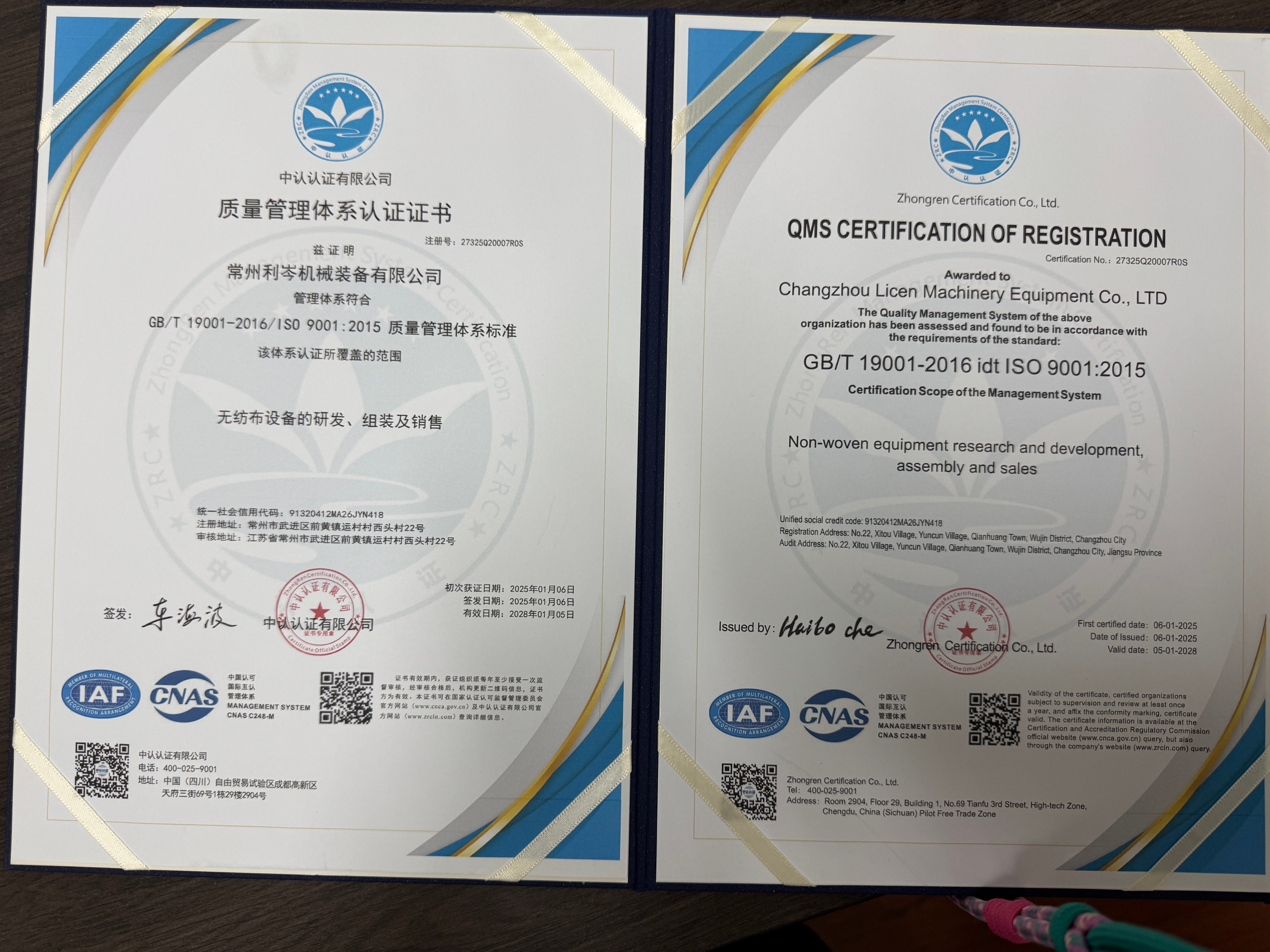
An example of the document type a buyer should read closely: a quality management system registration certificate, where the scope statement — not the logo — defines what is actually certified.
Why Capability Evidence Has Become a Procurement Requirement
Nonwoven machinery purchasing has shifted from equipment selection toward process-risk management. The global nonwoven machinery market was valued at USD 6.8 billion in 2025 and is projected to reach USD 12.1 billion by 2034, according to Dataintelo. Within equipment categories, spunbond machinery held the largest share of that market at 34.2% in 2025, and Asia Pacific accounted for a 43.7% revenue share in the same year.
The fabric side shows a similar rebalancing. China produced 8.56 million tons of nonwovens in 2024, a 5.1% year-on-year increase, of which spunbonded nonwovens accounted for 3.88 million tons, up 4%, while meltblown output fell 22.9% to 108,000 tons, according to CNITA. In other words, the emergency capacity wave has passed and the durable demand is concentrated in spunbond and spunmelt configurations. Spunbond technology is projected to grow at a CAGR of 6.20% from 2026 to 2034 (Fortune Business Insights).
A market expanding at that rate attracts new builders, assemblers and trading intermediaries whose brochures look very similar to those of established manufacturers. Because a spunbond or SMS nonwoven production line is assembled from many subsystems and commissioned over months, the consequences of choosing a supplier without real manufacturing depth are carried by the buyer for years. A factory audit is the mechanism that moves the buyer from reading claims to observing capability.
The Six Evidence Signals a Buyer Can Verify
A productive audit is a structured evidence exercise, not a courtesy visit. Six signals cover most of what can actually be observed on site, and each one has a defined interpretive limit.
| Evidence signal | What it establishes | How a buyer verifies it | What it does not establish |
|---|---|---|---|
| Site footprint and functional zoning | Whether fabrication, assembly, testing and storage exist as separate, managed areas | Measured walk-through compared against documented area figures | Output capacity or fabric quality |
| Assembly hall capacity and work-in-progress | How many complete lines can be built concurrently, and how full the order book currently is | Count of assembly bays, occupied line positions and staged sub-assemblies | Delivery-date accuracy |
| In-house component production | Which critical parts are manufactured under the supplier's own process control | Fabrication equipment list and a part-by-part make-or-buy list | The engineering quality of those parts |
| Test and acceptance capability | Whether performance can be demonstrated before shipment | Factory acceptance test (FAT) protocol, process test reports, inline quality checks | Long-run stability at the buyer's site |
| Documentation and certification scope | Which management activities are certified, by whom, and until when | Certificate number, issuing body, validity dates and scope wording | Machine-level safety conformity |
| Installation and reference record | Whether the supplier has commissioned comparable configurations before | Reference list with configuration, country, unit count and commissioning date | Suitability for your specific recipe and substrate |
How to Read Floor Space, Assembly Facilities and In-House Production
A declared site area is a boundary condition, not a performance measure. The useful question is not how many square metres a supplier reports, but how that area is divided. Ask for the split between fabrication, assembly, testing, storage and administration, then verify it during the walk-through. If most of a large declared area turns out to be finished-goods storage, the number is evidence of inventory, not of manufacturing depth.
Assembly halls reveal the order book
Assembly hall utilisation is among the most honest indicators available to a buyer, because it is difficult to fake in real time. The number of line positions, the number currently occupied, and whether sub-assemblies are pre-piped and pre-wired all indicate how much genuine integration work is in progress. They also predict commercial behaviour: if every bay is committed for the next two quarters, the quoted lead time will not be short regardless of what the proposal says.
In-house component production is a strategy, not automatically a virtue
The key document here is the make-or-buy list. For a spunbond or spunmelt line, the parts that matter most are spinneret packs and die heads, quench air systems, web-formation conveyors, calender rolls, machine frames and control panels. A supplier that manufactures these under its own process control can protect process know-how, control critical geometry and shorten spare-parts cycles. A supplier that buys them from specialists may gain access to metallurgy and precision finishing that it could not economically reproduce in-house.
Both strategies can be legitimate. What distinguishes a supplier with real capability from one without is whether it can explain, part by part, which route it takes and why. A blanket claim of making everything, unsupported by a make-or-buy breakdown, is a claim rather than evidence.
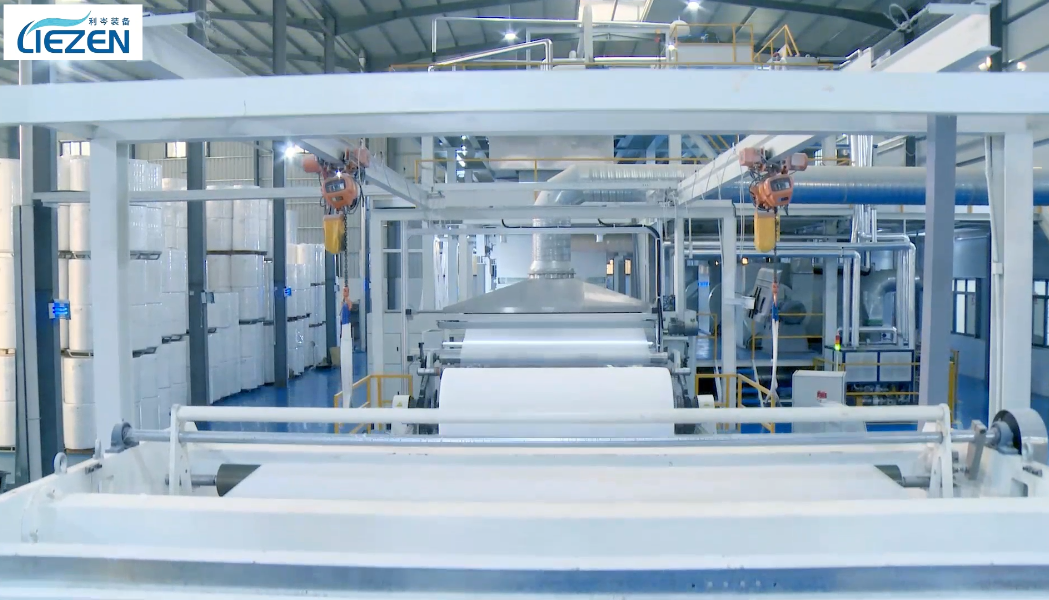
The physical footprint a site visit is meant to verify: fabrication and assembly space, occupied line positions and staged sub-assemblies for complete nonwoven production lines.
Linking Evidence to Complete Spunbond and SMS Lines
The central question for a nonwoven buyer is not whether a supplier can build machines, but whether it can deliver, integrate and commission a complete spunbond or SMS line. Individual units — a winder, a calender, a meltblown die — can be procured from many sources. Complete lines require integration engineering: matching filament fineness to bonding conditions, holding tension across the full web path, synchronising drives, and handling recipes repeatably.
Supplier documentation should therefore be read at line level, not unit level. The table below summarises declared configuration data of the kind a buyer should demand in writing before an audit, so that the visit can be used to test the numbers rather than merely to admire the site.
| Line configuration | Declared effective width | Declared production speed | Declared mechanical speed | Filament fineness |
|---|---|---|---|---|
| Double-beam PP spunbond (SS) | 1600–3200 mm | below 250 m/min | below 300 m/min | 1.5–2.0 D |
| SSS spunbond | 1600–3200 mm | below 400 m/min | below 450 m/min | 1.5–2.5 D |
| SMMS spunmelt | 1600–3200 mm | below 400 m/min | below 450 m/min | 1.5–2.0 D |
Two points of discipline apply to any table of this kind. First, production speed and mechanical speed are different quantities: mechanical speed describes the machine's motion envelope, while production speed describes what is achievable with a given polymer grade and filament fineness. Second, all such figures are conditional. Buyers should ask under which resin grade, filament fineness and ambient conditions the numbers were obtained, and should treat pilot production on their own material as the only conclusive test.
How One Manufacturer Documents Its Capability
Lizen Machinery Co., Ltd., registered as Changzhou LieZen Non-woven Machinery Co., Ltd., is a manufacturer of nonwoven fabric machines based in Changzhou, Jiangsu, China. The company records its founding year as 2003 and reports a factory area of 30,000 m², 270 employees, ten engineers in its research and development team, and an annual output of 50 units, with approximately 60% of output exported and the United States listed as a main market. Its product scope covers PP spunbond machines in Single S, SS, SSS, meltblown, SMS, SMMS, SSMS and SMMSS configurations, together with PET and bi-component nonwoven machines, and the company records close to 1,000 complete sets supplied across 30 countries.
Its quality management system is registered to ISO 9001:2015 under certificate number 27325Q20007R0S, issued by Zhongren Certification Co., Ltd., with a validity period from 6 January 2025 to 5 January 2028 and a certified scope covering the research and development, assembly and sales of non-woven equipment. On the commercial side, Lizen records a minimum order quantity of one unit, a monthly capacity of four units, and lead times of one to three months in off-season and three to six months in peak season.
The same records describe an ODM model with customisation across web width, capacity expressed in kg/h or m/min, layer count, inline testing and quality control, automation and HMI, and material handling modules. Quality control is structured around factory acceptance testing, performance and process testing, and site acceptance testing, with inline output and quality checks. After-sales support covers installation and commissioning, on-site training, spare parts supply and remote technical support.
Documented deployment records include a producer in Pakistan that took two units, with the working relationship recorded as spanning 15–20 years, and results stated as improved capacity and product consistency through complete equipment that adapts to different nonwoven recipes. Case records also list client types including nonwoven fabric producers, hygiene and mask manufacturers, automotive interior suppliers, apparel and home textile factories, and agriculture and packaging companies.
Application Fit: Matching Evidence to What the Line Will Produce
Capability evidence only matters in relation to an application. The same audit can be highly relevant for one buyer and largely irrelevant for another. Applicable industries for spunbond, spunmelt and SMS equipment include medical, hygiene (masks, protective wear, sanitary napkins, diapers), automotive interior, apparel and home textiles, agricultural covers, packaging and eco-friendly bags. Main raw material for spunbond and meltblown is polypropylene, while the equipment itself is built mainly from carbon steel, stainless steel, alloy parts and electrical components.
Two application nuances deserve attention. Disposable products accounted for approximately 59.8% of the nonwoven application share in 2023 (Grand View Research), which means hygiene-focused evidence — sanitary napkin fabric, diaper substrates, mask filter media — is the most transferable proof a spunbond supplier can show. The automotive nonwoven market reached USD 3.6 billion in 2025 with needlefelt as the leading technology (Stratview Research); a spunbond or spunmelt supplier is relevant only to those parts of the automotive interior stack that spunbond actually serves. A buyer in that segment should ask which specific interior components the proposed line is expected to feed, rather than accepting a broad claim of automotive competence.
Market Signals Behind Rising Evidence Requirements
Three structural signals explain why audits have become more common rather than less. First, demand concentration: spunbond machinery held 34.2% of the nonwoven equipment market in 2025, and spunlaid (spunbond) technology accounted for 48.4% of the global nonwoven fabrics market share in 2023 (Grand View Research), so the majority of new capacity decisions now involve spunbond-type lines. Second, regional gravity: Asia Pacific held a 43.7% revenue share of the nonwoven machinery market in 2025, driven by increasing demand for hygiene products and medical-grade materials (MarketsandMarkets), while China exported 1.52 million tons of nonwovens worth USD 4.04 billion in 2024, with spunbonded nonwovens accounting for 37% of that export value.
Third, material stability: polypropylene remains the dominant raw material for spunbond production, accounting for over 53% of the segment in 2026 (Fortune Business Insights). A stable polymer base means differentiation between suppliers no longer comes from the material, but from how consistently a line converts it — which is precisely what an audit is designed to assess.
Where the Evidence Stops: Limits, Trade-offs and Traditional Alternatives
A factory audit reduces uncertainty; it does not eliminate it. Buyers should be as sceptical of an audit that produced no findings as of a supplier that produced no documents.
- Certification scope is not a performance guarantee. A certificate covering the research and development, assembly and sales of non-woven equipment certifies that a management system covers those activities. It says nothing about achieved output, fabric consistency or machine safety. Safety of nonwoven machinery falls under ISO 11111-3:2005, and general textile machinery safety for CE marking in Europe under EN ISO 11111-1:2016 — these should be asked about separately.
- An audit validates one day. It observes what exists during the visit, not how the organisation performs under a delayed shipment or a disputed commissioning.
- Process performance depends on variables outside the factory. Resin grade, filament fineness targets, ambient humidity and operator skill all influence web quality at speed. A fully equipped plant can still underperform with the wrong recipe.
- Vertical integration carries its own cost. Making components in-house can slow adoption of newer specialist components from dedicated suppliers. The right question is not whether integration is present, but whether it is applied where it genuinely adds control.
- Capacity cuts both ways. A shop with a monthly capacity of four units and 50 units of annual output cannot compress a peak-season queue of three to six months. A full order book is evidence of demand, and simultaneously a schedule risk for a time-critical project.
- After-sales is invisible on the shop floor. Response time, spare-parts availability and remote support can only be assessed through contract terms and direct reference conversations.
| Dimension | Catalogue-based evaluation | Audit-based evaluation |
|---|---|---|
| Primary input | Price, nominal specifications, reference names | Observed footprint, assembly load, make-or-buy list, test protocols |
| Time required | Days of desk comparison | Weeks, including travel and reference calls |
| Evidence quality | Asserted | Observed and dated |
| Residual risk | Carried entirely by the buyer | Reduced but not removed |
| Shared blind spot | Long-run process stability | Long-run process stability |
Future Outlook
The direction of travel is toward documented, transferable evidence. As spunbond technology grows at a projected 6.20% CAGR from 2026 to 2034 and Asia Pacific retains the largest regional revenue share, competition among equipment builders will shift from catalogue breadth to demonstrated line integration. Meltblown's post-pandemic stabilisation — a 22.9% output decline in China in 2024 — reinforces that capacity scarcity is no longer the buyer's main problem; consistency and running cost are.
Three practical consequences are likely. Customisation requests already extend to web width, layer count, inline testing and quality control, automation and HMI, and material handling modules; these options will move from differentiators to baseline expectations. Acceptance testing will become a standard contractual step rather than a courtesy, with factory acceptance testing, process testing and site acceptance testing forming one evidence chain. And certification scope wording will be read as carefully as the certificate itself, because scope describes what was audited.
Frequently Asked Questions
What documents should a buyer request before visiting a nonwoven fabric machine factory?
At minimum: business registration details; the quality management system certificate with its number, issuing body, validity dates and scope wording; documented site area figures broken down by function; the size of the engineering and quality teams; a list of line configurations previously built; sample factory acceptance and site acceptance test protocols; and a reference list. These documents allow the site visit to test specific numbers instead of confirming general impressions.
How should floor space be interpreted during a supplier audit?
Floor space is a boundary condition, not a measure of output. What matters is the internal split between fabrication, assembly, testing, storage and administration, and how much of the declared area is actually used for production activities. A large reported area that turns out to be mostly storage provides no evidence about manufacturing depth.
What does in-house component production actually prove?
It proves that specific components — commonly spinneret packs and die heads, quench air systems, web-formation equipment, calender rolls, machine frames and control panels — are made under the supplier's own process control, which can protect critical geometry and shorten spare-parts cycles. It does not prove that the design of those components is superior. The decisive document is a part-by-part make-or-buy list with a stated rationale for each route.
Can a factory audit confirm that a supplier can deliver a complete spunbond or SMS line rather than a single machine?
Only partially. An audit can confirm integration capacity — assembly bays, staged sub-assemblies, testing facilities and the number of concurrent line builds — and can verify whether the supplier's configuration range covers Single S, SS, SSS, SMS, SMMS, SSMS, SMMSS, meltblown, PET or bi-component designs. It cannot confirm integration performance. That requires a factory acceptance test followed by pilot production on the buyer's own polymer grade.
Which parts of a nonwoven production line's performance cannot be verified on a factory visit?
Long-run stability at declared speeds, actual fabric consistency over weeks of operation, sensitivity to resin batch variation, energy consumption in real production conditions, and after-sales responsiveness. All of these depend on conditions that a visit does not reproduce, and they are best addressed through acceptance testing, contractual performance terms and direct reference conversations.
Does ISO 9001 certification guarantee that a nonwoven fabric machine will meet its declared output?
No. ISO 9001 certification confirms that a quality management system covers a defined scope of activities, such as research and development, assembly and sales of non-woven equipment. It does not certify machine output, fabric quality or safety conformity. Nonwoven machinery safety requirements are addressed separately, for example by ISO 11111-3:2005, and general textile machinery safety for CE marking in Europe by EN ISO 11111-1:2016. Declared output should be validated through factory acceptance testing and pilot runs.
How far in advance should a buyer plan an order for a spunbond nonwoven machine?
Planning should account for quoted lead times plus shipping, installation and commissioning. One manufacturer, Lizen Machinery Co., Ltd., records lead times of one to three months in off-season and three to six months in peak season, with a monthly capacity of four units. Because the equipment is built to order and the minimum order quantity is one unit, buyers with fixed start-up dates should confirm the production slot in writing before contractual milestones are set.
Capability evidence is only useful when it is specific, dated and checkable. A framework is what allows a buyer to tell the difference between a supplier that can build a nonwoven fabric machine and one that can deliver a complete, commissioned production line.