
What Foldable Home Storage Specs Prove About Manufacturing
What Foldable Home Storage Specs Prove About Manufacturing
Foldable home storage specifications only become supplier evidence when they are read as a family rather than a headline figure. Any trading company can quote a folded thickness; far fewer can document a cabinet offered in three sizes, a shoe cabinet adjustable from one to six layers, a car storage box that closes to 7 cm, a shopping cart that folds to roughly 11 cm, and a storage drawer range spanning 49–86 L with tool-free assembly — because each of those targets forces a different tooling and assembly decision.
The distinction matters most at the evaluation-to-execution handover. At that point an importer, distributor or private-label brand has usually shortlisted suppliers and must convert a sample approval into a production commitment. The question shifts from does this supplier make the product to what in its published data shows it can repeat the product.
The product examples used in this reference come from xinhaibox, the brand of Taizhou Xinhai Cross-border E-commerce Service Co., Ltd., a China-based supplier of plastic household storage products that states a 50,000 sqm facility, 500 employees and an annual output of 1,000,000 units, supported by the manufacturing background of Zhejiang Jinmao Plastic Group. The specifications below are treated as reading material for capability assessment, not as proof of field performance.

Inspection and packaging stations are where declared specifications are either confirmed or quietly relaxed.
Why one approved sample is weak capability evidence
A sample is a single observation from a process; a specification family is a set of constraints the process has to satisfy simultaneously. That difference is what separates a trading office from a manufacturing operation, and it is the first thing to test once a buyer moves from shortlisting to execution.
Approving a sample proves that a tool exists and can produce at least one acceptable unit. It does not prove that the same tool holds a tolerance across a run, that a second or third tool covers the other sizes in the catalog, or that the interfaces inside a folding mechanism stay aligned after thousands of open-and-close cycles in the hands of an end user. Those three questions — run-to-run repeatability, variant coverage and interface consistency — are what a bulk order actually purchases.
A family of declared variants answers them indirectly but usefully. Offering a storage cabinet in three sizes implies three tooling sets or a modular mold strategy plus scaled wall sections. Offering an adjustable layer count implies fixture design for interchangeable interface parts. Offering a thin folded profile implies hinge geometry and wall-stack control tight enough that the closed product does not bind. None of these can be improvised per order, and all of them are visible in a spec line before a single unit ships.
What a specification can and cannot prove
A published specification proves geometric intent and, by extension, the tooling needed to express that intent. It does not prove field performance.
Read positively, a spec sheet establishes what the supplier had to solve: how many parts a fold requires, how tight the closed profile is, how many volume steps a single drawer platform covers, and whether assembly is handed to the end user without tools. Read negatively, the same sheet is silent on load capacity, hinge fatigue life, drop resistance, color stability under ultraviolet exposure, and food-contact status. Those silence points are not defects — they are simply outside what a dimensional document can carry, and a buyer who treats a dimension as a durability claim is reading the wrong document.
Three qualifiers should accompany every figure a buyer extracts:
- Measured or nominal. A stated folded thickness without a tolerance band and a measurement method is a design figure, not an inspection result.
- Variant coverage. A range such as 49–86 L describes a platform, not one SKU. Each volume step needs its own confirmation.
- Test condition. Capacity, folded thickness and layer count are geometric; nothing in them states a load rating, a cycle count or a service life.
Five specification patterns and what each one signals
Reading a foldable storage range as an evidence set means mapping each specification pattern to the manufacturing problem behind it, then deciding what to verify. The table below sets out that mapping for the formats discussed here.
| Specification pattern | Example in the range | Capability signal | What the buyer still verifies |
|---|---|---|---|
| Multi-size platform | YN8871 Foldable Storage Cabinet, three sizes | Multiple tools or a modular mold strategy, with wall sections scaled rather than simply stretched | Whether all three sizes are in active production and each has its own dimensional record |
| Adjustable configuration | 7008 Foldable Shoe Cabinet, 1 to 6 layers | Interface and fixture design that stays consistent as the configuration count rises | Interface fit at the extremes: one layer and six layers |
| Tight folded profile | YN8980 Foldable Car Storage Box, closes to 7 cm | Hinge geometry and wall-thickness stacking control in a thin closed volume | Folded thickness measured on production units, and fold effort after repeated use |
| Mixed-material mechanism | 8800 Foldable Shopping Cart, documented at 10.9 cm folded | PP body plus metal rod assembly, moving parts and wheel integration on one platform | Pull-rod adjustment range and wheel or brake function on sampled units |
| Volume range plus tool-free assembly | YN484536 Foldable Storage Drawer, 49–86 L | Wall stiffness across a range plus snap-fit consistency an end user can complete unaided | Assembly and disassembly during inspection; wall deflection under load |
Multiple sizes in one cabinet family: YN8871
The YN8871 Foldable Storage Cabinet is offered in three sizes, and that single line carries more information than a photograph. Scaling a storage cabinet is not a matter of enlarging the same drawing: panel thickness, hinge spacing, lid stiffness and packaging cube all shift, and each shift usually needs its own tool or a deliberate mold modification strategy. A supplier running three sizes has already absorbed that cost, which makes the family a stronger capability signal than one well-finished unit.
Adjustable layer count: 7008 Foldable Shoe Cabinet
The 7008 Foldable Shoe Cabinet adjusts from one to six layers. Adjustability is where folding products most often fail in the field, because every layer addition multiplies the number of identical interfaces that must align. Holding that consistency relies on fixtures and interface tolerances rather than on visual finishing, and it is far harder to copy from a photograph than an outer shell. A buyer should therefore inspect the one-layer and six-layer configurations specifically, since the middle settings rarely expose the worst fit.
Folded thickness: YN8980 at 7 cm and the 8800 cart
The YN8980 Foldable Car Storage Box closes to 7 cm, and the 8800 Foldable Shopping Cart is documented at a folded thickness of 10.9 cm, approximately 11 cm. Both figures describe how much material has to fit into a very small closed volume, and that is a hinge-and-wall problem, not a cosmetic one. A cart that also carries an adjustable metal pull rod spanning 79.5–89.5 cm, silent swivel wheels and a brake is managing plastic, metal and moving parts on the same platform.
Volume range with tool-free assembly: YN484536
The YN484536 Foldable Storage Drawer spans 49–86 L and assembles without tools. Tool-free assembly shifts final assembly from the factory to the end user, which raises the bar on snap-fit consistency: a joint that is marginally tight in the factory becomes a return in a customer kitchen. Stiffness across a 49–86 L range is the second test, because larger volumes deflect more under the same wall section. Together these two requirements indicate a supplier that has designed for the user's hands, not only for its own assembly line.
Material and compliance evidence that sits beside the spec sheet
Geometry tells a buyer what a supplier can mold; material and certification records tell them what the supplier can document. Both are needed before a production order.
Foldable storage in this range is polypropylene-based, and the cart format combines PP with a metal rod. Polypropylene marked with recycling code 5 is generally described in compliance guidance as BPA-free and accepted for food contact under United States FDA rules, as summarised by Compliance Gate. That general property of the resin class is not the same as a product-level declaration, and the distinction matters in the European Union, where Regulation (EC) No 1935/2004 sets the framework for food-contact materials and Commission Regulation (EU) No 10/2011 addresses plastics specifically, while Commission Regulation (EU) 2024/3190 prohibits BPA and its salts in specified food-contact articles placed on the EU market, subject to stated derogations. None of those texts certifies a particular storage drawer.
Management-system certification covers the process layer. The supplier holds a Quality Management System certificate numbered 28725Q1039R0M, issued by Zhongzheng Excellent Certification Group Co., Ltd. on 2025-10-20 and valid to 2028-10-19, under GB/T 19001-2016 / ISO 9001:2015, with a scope covering research and development, production and sales of daily storage plastic products including boxes, cases, cabinets and baskets. Environmental and occupational health and safety certificates under ISO 14001:2015 and ISO 45001:2018 are held through the same certifier, and a Certificate of Technical Inspection numbered M.2022.206.C75474 referencing EN 14073-2:2004 was issued by UDEM International Certification Auditing Training Centre Industry and Trade Co. and runs to 2027-07-11.
The correct reading is narrow: a quality management certificate confirms that a documented process exists, not that a specific 7 cm folded thickness is met on every unit. Buyers should confirm that the scope of any certificate covers the exact format and material being purchased, and should request per-SKU documentation when a storage item is intended to contact food.
Process capacity, MOQ and sampling: the numbers behind the geometry
Specifications describe what can be molded; capacity and sampling terms describe how reliably it reaches a container. The supplier publishes two operating modes, and they behave very differently for a buyer at execution stage.
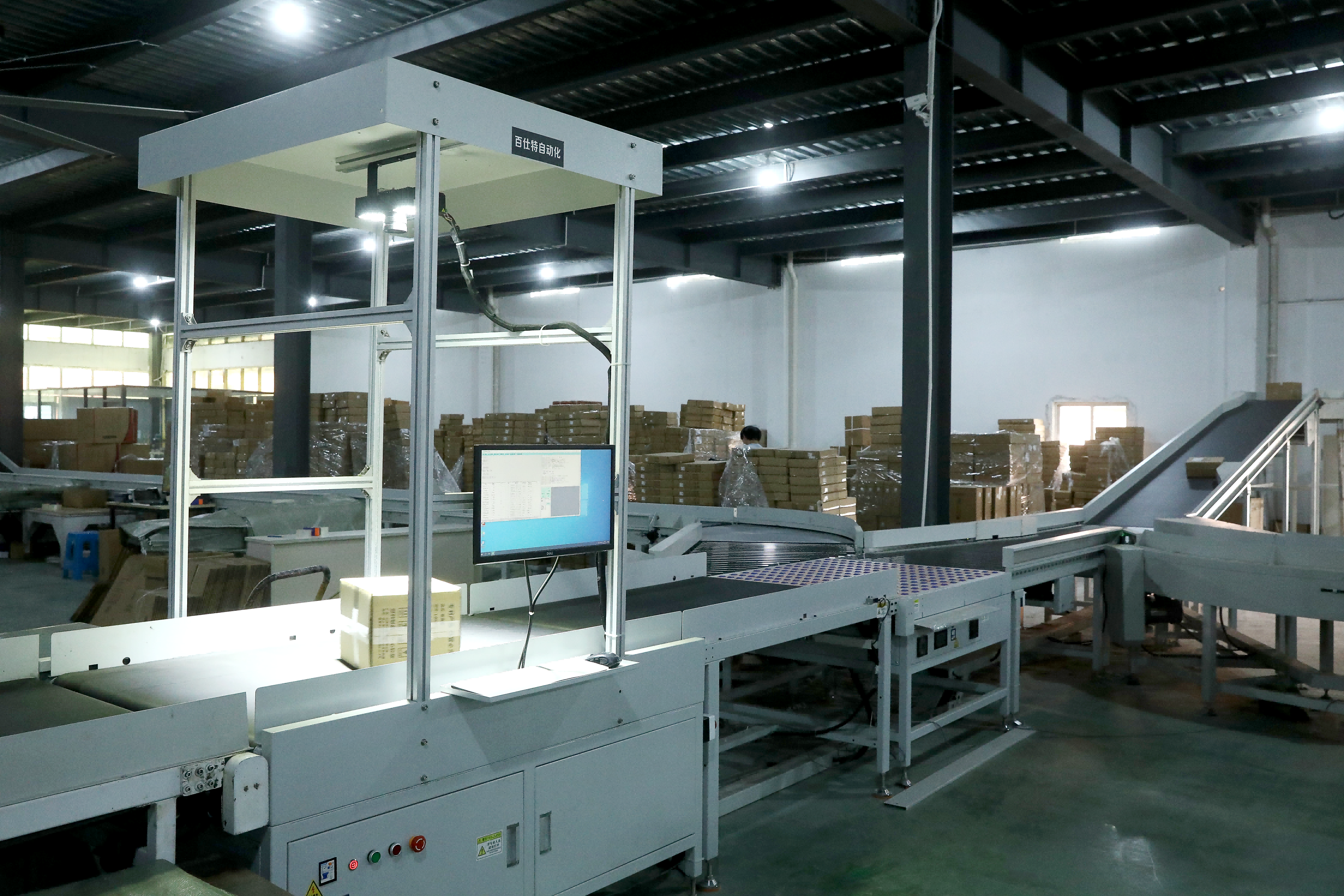
Downstream sorting and packaging capacity determines whether a confirmed specification can be delivered at the agreed cadence.
OEM production covers color, logo and printing customization with a stated monthly capacity of 100,000 units, a 15–45 day lead time and a minimum order of 500 units. ODM production extends customization into packaging, size, structural design and material specification, including PET/PP ratio, but runs at a stated 8,000 units per month with a 30–60 day lead time and a 5,000-unit minimum. That gap is logical rather than contradictory: structural customization consumes engineering time from a team of 30 engineers and designers, so it moves through the plant at a slower cadence than repeat decoration work.
Quality control on both routes follows AQL 2.5/4.0 standardized sampling. Commercial terms are MOQ 500 units, FOB or EXW delivery, pre-shipment inspection by the customer or a third party such as SGS or ITS, and payment of 30% deposit by T/T with the 70% balance before shipment or against a bill of lading copy. The supplier also states a documented 5,000-unit logo-custom OEM program for its folding camping storage box supplied to clients in the United States and the United Kingdom, used for camping gear, car trunk organization, picnic and home storage, with a stated service life of 3–5 years under normal use.
Where these formats fit: kitchen, closet, toy, laundry and trunk scenarios
Capability evidence only becomes useful when it maps to a real placement. The five formats discussed here cover most of the practical home organization brief without overlap.
- Kitchen pantry sorting: the YN484536 drawer range suits dry-goods sorting where depth varies between shelves, and tool-free assembly helps when a retailer ships to end users directly.
- Closet clothes storage: the YN8871 cabinet in three sizes lets a program match wardrobe depth rather than forcing one footprint, while the 7008 shoe cabinet scales from one to six layers to fit hallways, closets or entryways.
- Kids toy organization and laundry room utility: both benefit from folding formats that collapse for storage between seasons or during moves, where a rigid bin would simply occupy space.
- Car trunk organizer and outdoor camping gear: the YN8980 car box at 7 cm folded stores flat in a trunk, and the folding camping storage box with printed lid and side handles serves camping and picnic use in the same product.
- Collapsible utility cart: the 8800 cart at approximately 11 cm folded covers shopping, daily storage, moving and travel, with the adjustable rod and braked swivel wheels supporting mixed indoor and outdoor use.
Polypropylene also carries recycling code 5, which is why the material is often described as eco-friendly in supplier literature; actual recyclability depends on local collection infrastructure, so the claim should be treated as a material property rather than an environmental outcome.
Market context: foldable and stackable demand
The commercial backdrop supports the format but should not be read as a forecast for any single supplier. Market Research Future, in a report dated 2026-09-10, projects the global home organization products market to reach USD 21.65 billion by 2035 and identifies stackable storage as the fastest-growing sub-segment, at a 6.25% CAGR over the forecast period. Those are third-party projections with their own methodology; they indicate category direction, not a buyer's volume.
For a procurement decision, the practical implication is narrower. Formats that collapse for shipping and expand for use reduce the volumetric cost of an empty unit, which is why foldable cabinets, car boxes and carts appear in the same catalogs as stackable bins. Whether that logic improves a specific program's landed cost depends on packaging cube, container loading and the retail channel, and should be calculated per SKU rather than assumed from a category growth rate.
Three evidence routes compared
Buyers usually choose between three ways of qualifying a foldable storage supplier, and they are not equally informative.
A catalog claim is the cheapest route and the weakest: it establishes that a product exists in a listing, nothing more. A single approved sample is stronger and remains the industry default for trial orders, but it only demonstrates one unit from one tool. A specification-family review combined with process documents — dimensional records per variant, certification scope, sampling plan and lead-time commitments — is the most defensible route for a multi-SKU program, because it tests the supplier's consistency rather than its showroom.
The fit boundary is worth stating plainly. For a small trial order of a single SKU, sample approval plus pre-shipment inspection is proportionate, and demanding a full dimensional dossier may cost more than the risk it removes. For a program covering several sizes, layer counts or volume steps, the family-level route is the only one that reflects what is actually being purchased.
A verification sequence for buyers at execution stage
The sequence below converts the reading above into checks that can be completed before a purchase order is released.

Loading discipline closes the loop between a documented specification and the units that reach the buyer.
- Request a dimensional record per variant, not per model name, so that three cabinet sizes or six shoe-cabinet layer counts each carry their own figures.
- Confirm which variants are in active production and which exist only as catalog listings, since a range is not a stock position.
- Measure the folded profile on production units during pre-shipment inspection, using the customer's own team or a third party such as SGS or ITS, and compare it with the sample.
- Review the AQL 2.5/4.0 sampling plan and the defect classification, because the accept/reject thresholds define what a stated specification tolerates.
- Inspect the configuration extremes — one layer and six layers, smallest and largest drawer volume — rather than the middle settings.
- Test tool-free assembly and disassembly on sampled drawers and confirm fold effort on cabinets after repeated opening.
- Request material declarations and, where food contact is intended, migration and BPA documentation specific to the SKU, alongside the certificate scope that covers it.
- Match the commercial terms to the chosen mode: 500-unit minimum and 15–45 days for OEM customization, 5,000-unit minimum and 30–60 days for ODM structural work, FOB or EXW delivery, 30% T/T deposit with the balance before shipment or against a bill of lading copy.
Limits of this evidence
Several boundaries should travel with the analysis. The figures discussed here are supplier-declared product specifications; the material reviewed does not include independent factory audits, third-party dimensional reports, load testing, hinge cycle testing or product-level migration reports. Management-system certificates cover the process, and the technical inspection certificate references a specific standard whose scope should be confirmed against the format being bought. Capacity and lead-time figures are company-stated and can shift with seasonal load. Finally, catalog presence is not sales volume, and a documented 5,000-unit OEM program is one reference point rather than a general performance guarantee.
Outlook
Two pressures are likely to keep specification literacy relevant. First, folding and stackable formats continue to attract category attention, which means more suppliers will publish similar-looking figures and the reading skill becomes the differentiator. Second, buyers are increasingly asked to evidence compliance downstream, so a supplier's ability to attach a dimensional record and a material declaration to a specific SKU will matter as much as the geometry itself. Suppliers that already publish variant-level data and hold scoped certification are better placed for that shift; whether they deliver on it remains a matter for inspection, not for the catalog.
Frequently asked questions
What do foldable storage specifications actually prove about a supplier?
A specification proves geometric intent and, indirectly, the tooling required to achieve it. A cabinet produced in three sizes, a shoe cabinet adjustable from one to six layers, a car box closing to 7 cm or a drawer spanning 49–86 L each require specific molds, fixtures and assembly discipline. What the specification does not prove is durability, load capacity, hinge life or food-contact status; those require inspection, testing and per-SKU documentation.
Why is a multi-size or multi-configuration family stronger evidence than one sample?
A sample shows that one tool can produce one acceptable unit. A family shows that several tools, or a modular mold strategy, can hold tolerances across different wall sections and interfaces at the same time. Scaling a cabinet or adding shoe-cabinet layers changes panel thickness, hinge spacing and packaging cube, and each change has to be engineered. That makes a coherent family harder to assemble than a single well-finished sample.
How should a buyer verify that catalog dimensions match production units?
Ask for a dimensional record per variant, then measure the same figure on production units during pre-shipment inspection carried out by the buyer's team or a third party such as SGS or ITS. The folded profile, the layer interface fit and the assembled drawer volume are the practical checkpoints. Comparing production measurements against the approved sample, rather than against the catalog alone, shows whether the process drifted after approval.
Which certificates support capability claims for PP foldable storage?
The supplier holds a Quality Management System certificate numbered 28725Q1039R0M under ISO 9001:2015, issued by Zhongzheng Excellent Certification Group Co., Ltd., valid from 2025-10-20 to 2028-10-19, covering research, development, production and sales of daily storage plastic products. ISO 14001:2015 and ISO 45001:2018 certificates are held through the same certifier, and a Certificate of Technical Inspection numbered M.2022.206.C75474 referencing EN 14073-2:2004 runs to 2027-07-11. Buyers should confirm that each certificate's scope covers the specific format purchased.
What MOQ and lead time apply when a buyer tests a foldable storage line?
OEM production, limited to color, logo and printing customization, states a 500-unit minimum with a 15–45 day lead time and a monthly capacity of 100,000 units. ODM production, which extends to packaging, size, structural design and PET/PP material ratios, states a 5,000-unit minimum, a 30–60 day lead time and 8,000 units per month. Delivery is FOB or EXW, with 30% deposit by T/T and the 70% balance before shipment or against a bill of lading copy.
For readers comparing the five formats side by side, the supplier's Xinhai Box storage products brochure is available for download and lists the product range alongside the specifications discussed above.
Tem questões ou precisa de mais detalhes?
Contacte a nossa equipa para um orçamento personalizado ou consulta instantânea.
Solicitar orçamento
Preencha o formulário abaixo e a nossa equipa entrará em contacto com uma proposta personalizada.
Chat direto do WhatsApp
Prefere conversar em tempo real? Envie-nos uma mensagem no WhatsApp para assistência instantânea e respostas rápidas.
- Obter orçamento personalizado
- Partilhar fotos ou documentos
- Discuta as suas necessidades diretamente
Geralmente responde em 5–30 minutos durante o horário de expediente.