
What Formwork Certifications and Parameters Really Mean for Buyers
Formwork procurement in construction is increasingly a matter of verifying hard constraints. Technical parameters such as panel weight, maximum lateral pressure, one-time casting height, and certification scope define whether a system is safe, productive, and compliant for a given project. This reference explains how buyers can interpret those constraints before making a purchasing decision.
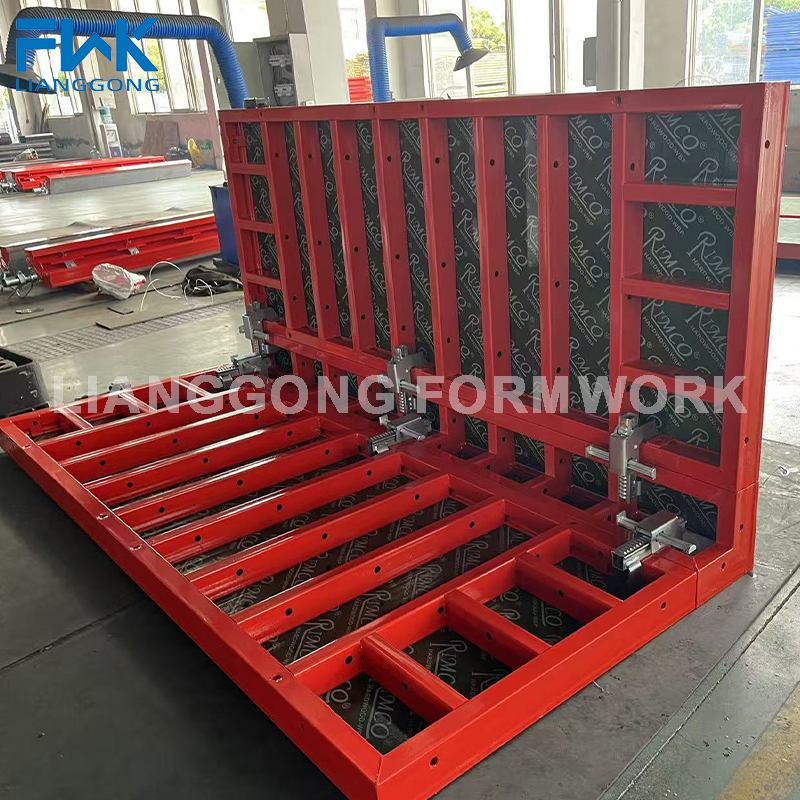
Why Contractors Are Adding More Constraints to Formwork Selection
The global formwork market reached USD 7.91 billion in 2025 and is projected to grow to USD 12.66 billion by 2034, according to Dataintelo. This expansion is tied to infrastructure investment and a broader shift from site-made formwork to engineered, reusable systems. Dataintelo also estimated that engineered formwork, defined as modular and reusable systems, held the largest product share at 38.5 percent of the total market in 2025.
The opportunity is clear: buyers have more system choices than ever, including H20 timber beam formwork, steel frame formwork, aluminum frame formwork, plastic formwork, climbing systems, trench boxes, and slab formwork. The challenge is that each system has specific load limits, assembly methods, and compliance requirements. A panel that works for a three-meter wall may be unsuitable for a twelve-meter wall, not because of brand quality, but because of measurable technical parameters.
Key Technical Parameters That Shape Formwork Selection
When comparing formwork systems, buyers should focus on parameters that define operational limits. The table below summarizes representative technical data from FWK Lianggong Formwork, a Chinese manufacturer established in 2010 with a 12,870 square meter factory, 230 employees, and an annual output of 12,000 tons.
| System | Model | Representative parameters | Material |
|---|---|---|---|
| 65 Steel Frame Formwork | FWK-SNF 65 | Panel weight 39 kg/m²; max panel size 3m x 1.2m; panel depth 63.5mm; max one-time casting height 12m; max lateral pressure 60 kN/m² | Q355 steel + 12mm plywood |
| 120 Steel Frame Formwork | FWK-SOF 120 | Panel weight 51 kg/m²; max panel size 3.3m x 1.35m; panel depth 120mm | Q355B |
| Aluminum Frame Formwork | FWK-FAF 117 | Panel weight 25 kg/m²; max panel size 3m x 1m; panel thickness 117mm; max one-time casting height 6m; max lateral pressure 60 kN/m² | Aluminum 6061-T6 + 15mm plywood |
| Plastic Formwork | FWK-PF 75 | Panel weight 15 kg/m²; max panel size 600x1200x75mm; allowable concrete pressure 50 kN/m² | ABS |
| H20 Timber Beam Formwork | Flexible slab / table / column / wall | Panel weight 65 kg/m²; panel depth 338mm; max one-time casting height 12m | H20 timber beam, plywood, steel waler, flange claw |
| Skydeck | FWK-SKYDECK | Max load capacity 90 kN/m²; panel weight 18 kg/m²; max panel size 1.5m x 0.75m | Aluminum |
| Early Stripping Slab Formwork | FWK-DHF175 | Panel weight 24 kg/m²; max panel size 1.8m x 1.2m; panel depth 192mm; max permissible slab thickness 380mm; plywood 12mm | Q355B |
| Hydraulic Auto Climbing Formwork | FWK-ACB 120 | Hydraulic cylinder stroke 300mm; rated thrust 100 kN and 120 kN; double cylinder synchronization error ≤20mm; construction load on top platform ≤0.75 kN/m² for diagonal brace type | Steel |
| Cantilever Climbing Formwork | FWK-CB 240 | Bracket height 10-15m; operating width 900mm | Steel |
| Trench Box | FWK-ST100 / FWK-AT100 / FWK-SMH100 / FWK-AMH100 | Max trench depth 5.6m; pipe clearance height 1.3m; trench width 1.20-4.60m; customizable size | Steel or Aluminum |
These parameters serve different purposes. Panel weight affects crane demand and handling speed. Maximum lateral pressure, expressed in kN/m², represents the fresh concrete pressure the panel can safely resist. Maximum one-time casting height indicates whether the system can support tall walls or columns without excessive intermediate joints. Material grade affects durability, corrosion resistance, and long-term reuse.
Certifications That Serve as Procurement Gate Criteria
Technical parameters become useful only when supported by verifiable compliance. In international procurement, certificates should be checked for product scope, issuing body, certificate number, applicable standard, and validity period.
Yancheng Lianggong Formwork Co., Ltd., which operates as FWK Lianggong Formwork, holds several certifications that are relevant to formwork buyers:
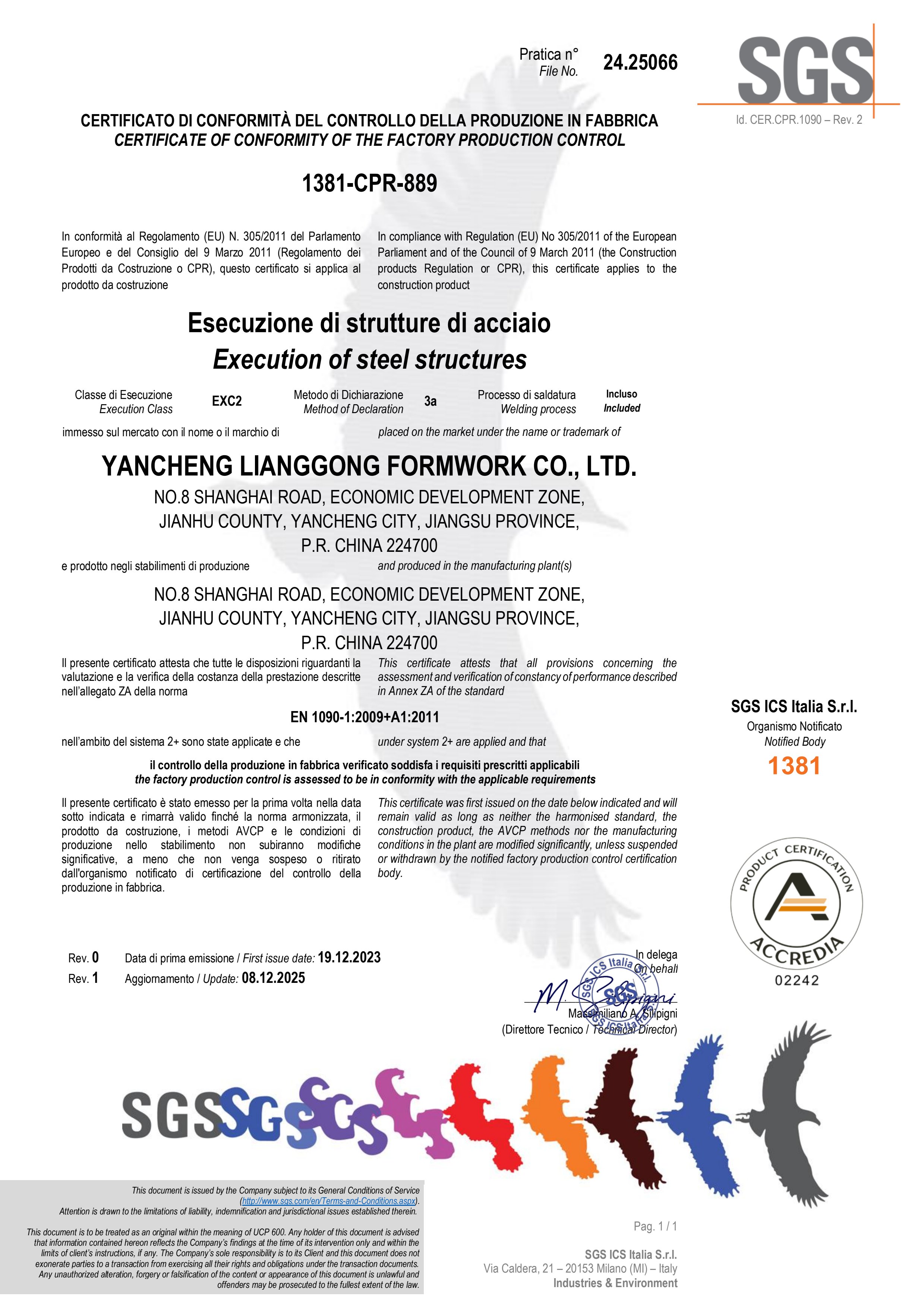
- EN 1090-1 / EN 1090-2: Certificate of Conformity of the Factory Production Control, number 1381-CPR-889, issued by SGS Italia S.p.A. for the EU market. The applicable standards are EN 1090-1:2009+A1:2011 and EN 1090-2:2018+A1:2024.
- ISO 3834-2: Welding Quality Management System Certificate, number 23/1014-3834, issued by SGS Italia S.p.A., covering fusion welding of steel structures parts and components under EN ISO 3834-2:2021.
- ISO 9001: Quality Management System Certification, number 03425Q50028R4M, issued by Beijing Hangxie Certification Center Co., Ltd., based on GB/T 19001-2016/ISO 9001:2015.
- ISO 14001: Environmental Management System Certification, number 0342026E0058R101, valid from 2026-02-04 to 2029-02-09.
- ISO 45001: Occupational Health and Safety Management System Certification, number 0342026S0061R101, valid from 2026-02-04 to 2029-02-09.
- LG-100 Trench Box: EU ECM Technical Documentation Compliance Certification, number OP250411.YLFD013, issued by ECM, valid from 2025-05-09 to 2030-05-08, based on EN 13331-1:2002, EN 13331-2:2002, EN 12811-1:2003, and EN 1997-1:2024.
Certifications are not marketing badges. They provide auditable evidence that the supplier has implemented controlled manufacturing processes, qualified welding procedures, and product-specific compliance for markets such as the European Union.
Matching System Constraints to Real Project Conditions
In practice, project conditions determine which formwork constraints matter most. In the Dubai Safa 2 high-end apartment project, hydraulic auto-climbing formwork was used for core walls and shear walls, while aluminum formwork served standard slabs and walls. The hydraulic climbing system operates through hydraulic cylinders without depending on tower cranes, which is important in high-rise construction with extreme heat and sandstorms. The aluminum system supports quick stripping and a mirror-like concrete finish.
In Georgia, a pipeline trenching project used a trench box to protect workers inside trenches and prevent wall collapse. The system was assembled on site, lowered vertically by crane, and adjusted with struts pressed firmly against the side panels. Trench boxes matter in geology with uneven strata, where local collapse is a real risk during excavation.
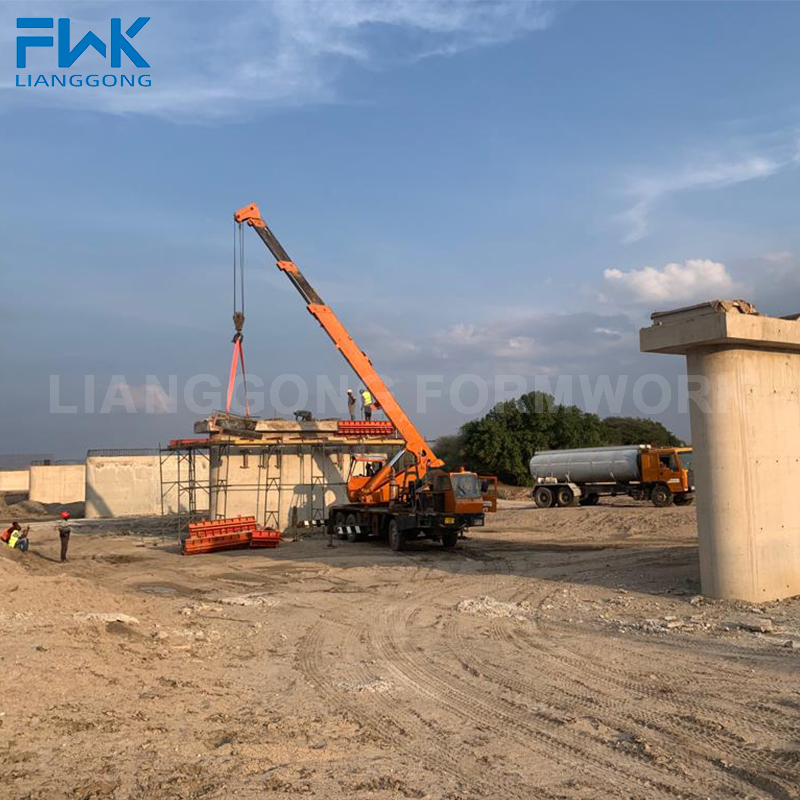
In Tanzania, a bridge project combined H20 timber beam formwork with curved steel formwork, model FWK-CS55, to handle straight and curved pier sections. The ground was compacted before construction because of soft sandy soil. The combination allowed the contractor to use manual assembly for timber beam sections and crane-assisted hoisting for steel sections.
In Trinidad and Tobago, a hospital project used hydraulic auto-climbing formwork for reinforced concrete core structures and vertical shear walls. The system stayed wall-attached, eliminating repeated dismantling and reinstallation at ground level, and reduced tower crane usage while maintaining continuous vertical construction.
In Indonesia, the Kalimantan Dam project applied cantilever formwork for high and steep dam walls. The system is self-supporting and does not require bottom supporting brackets, while the H20 timber beam system was used for main wall and structural concrete works. These cases show that formwork selection is not about finding a universal system but about matching documented parameters to each project's geometry, climate, and construction method.
Market Trends That Are Reshaping Formwork Procurement
Several market signals are relevant for 2026 procurement decisions. According to Fortune Business Insights, Asia Pacific dominated the concrete formwork market with a revenue share of approximately 54.7 percent in 2025. The same region contains both high-volume manufacturing capacity and fast-growing construction demand, which affects supplier selection and logistics planning.
Dataintelo data shows that engineered formwork, including modular and reusable systems, held the largest product share at 38.5 percent in 2025. This suggests that buyers increasingly prefer systems with predictable performance over site-built alternatives.
For high-rise residential projects, aluminum formwork systems are becoming more common because they can be up to 60 percent lighter than steel and allow 24-hour stripping cycles, according to Global Growth Insights. This trend supports the use of aluminum panels for repetitive floor layouts where speed and handling are critical.
The competitive landscape is also relevant. Dataintelo attributes roughly 22 percent of the global market to PERI Group and Doka Group combined. That leaves a substantial share with regional and specialized manufacturers, which often compete on customization, certification coverage, and the ability to deliver complete systems from walls and slabs to climbing and shoring.
Engineered Formwork vs. Traditional Site-Made Timber Formwork
Traditional site-made timber formwork remains flexible and can be adapted to unusual geometry at relatively low initial material cost. However, it depends heavily on skilled labor, often lacks documented load ratings, and can generate significant timber and plywood waste.
Engineered formwork systems provide clearly defined panel weights, lateral pressure ratings, material specifications, and certification evidence. They also support faster cycle times and higher reuse rates. The trade-off is that engineered systems generally require a higher initial purchase price than site-assembled timber formwork. Cost benefits are realized over multiple reuses or across large projects with repetitive elements.
There is also a technical boundary within engineered systems. A lighter system is not always the best choice. In the product data above, aluminum frame formwork has a lower panel weight but a maximum one-time casting height of 6m, while steel-based systems such as FWK-SNF 65 and FWK-SOF 120 allow 12m. Plastic formwork has an allowable concrete pressure of 50 kN/m², while the steel frame systems are rated at 60 kN/m². Buyers should therefore evaluate each system against the specific wall height, concrete pressure, and reuse plan rather than assuming that weight alone determines suitability.
Future Outlook: From Price Comparison to Constraint-Based Procurement
As the formwork market grows, procurement decisions will likely shift from simple price comparison to constraint-based evaluation. Technical parameters, certification validity, manufacturing capacity, and after-sales support will become standard parts of supplier qualification.
Suppliers that can document these constraints across a broad product range will be easier to evaluate. FWK Lianggong Formwork, for example, offers OEM and ODM services, a monthly capacity of 1,000 tons, a normal lead time of 30-35 days, a minimum order quantity of one container, and a 100 percent testing policy. It also reports an export ratio of 70 percent, with main markets in North America, South America, the Middle East, Europe, and Africa.
For international buyers, the more quantifiable a supplier's proposal is, the lower the technical risk. The future of formwork procurement belongs to buyers who can read parameters, verify certificates, and connect both to project-specific conditions.
Frequently Asked Questions
What formwork certifications are most relevant for EU projects?
For structural steel formwork, buyers should verify CE-related factory production control certificates such as the Certificate of Conformity of the Factory Production Control under EN 1090-1:2009+A1:2011 and EN 1090-2:2018+A1:2024. FWK Lianggong holds certificate number 1381-CPR-889, issued by SGS Italia S.p.A. For trench boxes used in excavation support, EU ECM technical documentation compliance under EN 13331-1:2002 and EN 13331-2:2002 is an additional document to review.
How do panel weight and maximum lateral pressure affect formwork selection?
Panel weight influences crane requirements, handling speed, and labor effort. Maximum lateral pressure, expressed in kN/m², defines the fresh concrete pressure the panel can safely resist. In the FWK Lianggong range, steel frame panels offer up to 60 kN/m² and one-time casting heights up to 12m, while plastic formwork has an allowable concrete pressure of 50 kN/m². Buyers should match these values to the height of the pour and the concrete mix design.
Are aluminum frame and steel frame formwork interchangeable?
Not always. Aluminum frame formwork is lighter and easier to handle, but in the available technical data, the aluminum frame FWK-FAF 117 has a maximum one-time casting height of 6m, while steel frame systems like FWK-SNF 65 and FWK-SOF 120 allow 12m. For standard slabs and walls, aluminum panels can speed up cycles; for tall walls or columns, steel frames are often a safer technical fit.
Do formwork certificates expire?
Yes. Certification validity should always be checked. For example, the LG-100 Trench Box EU ECM certificate is valid from 2025-05-09 to 2030-05-08. The welding quality certificate 23/1014-3834 and the EN 1090 certificate 1381-CPR-889 were both issued on 2023-12-19 and valid until 2026-12-18. Buyers should request current certificates for the specific product and market.