
What ISO 9001 and ISO 14001 Cover in Die Spring Production
What ISO 9001 and ISO 14001 Cover in Die Spring Production
Die spring compliance is usually described as a certificate problem. It is more accurately a scope problem. ISO 9001 and ISO 14001 describe how a manufacturing organization is managed and controlled; they do not describe how a specific rectangular-section spring behaves inside a stamping die. These certifications become commercially useful only when their scope statement, the wording that defines which activities are covered, is read together with the product standards the springs are built to: ISO 10243, JIS B5012, and American Standard (Inch series).
Dalian TopWay Precise Mould & Die Co., Ltd. (TOPWAY SPRINGS) is a die spring and precision mould parts manufacturer based in Dalian, China, operating a Spring Division and a Mould Parts Division. Its spring range is manufactured to ISO 10243, JIS B5012, and American Standard (Inch series) specifications, and the company reports an export ratio of about 50%, with the EU and USA among its main markets.

Documentation control, order review, and compliance records sit inside the production and sales activities named in a die spring supplier certification scope. Image: TOPWAY SPRINGS.
The compliance gap that appears in tooling procurement
Die spring buyers typically receive two documents: a management-system certificate and a product catalog. The certificate lists ISO 9001 and ISO 14001 plus a scope of registration. The catalog lists standard designations, load classes, and part numbers. Confusion begins when the certificate is treated as evidence of product conformity. A certificate confirms that defined production and sales activities are controlled by documented processes. It does not confirm that a given spring matches the mounting hole, the load class, or the color convention a tooling drawing was designed around.
That distinction has practical consequences because the product standards themselves are not interchangeable. ISO 10243:2019 standardizes color coding and dimensions for rectangular-section compression springs used in press tools, while JIS B5012 specifies allowable tolerances of spring inner and outer diameters and is organized around mounting-hole practice in a different way. Load-class color codes also differ between the JIS and ISO systems, which is one documented cause of selection errors in globally sourced tooling. A management-system certificate cannot prevent that error. A correctly read scope statement, combined with a correctly stated standard designation, can.
What ISO 9001 and ISO 14001 actually cover
ISO 9001: requirements for a quality management system
In general terms, ISO 9001 defines requirements for a quality management system. For a spring manufacturer, the auditable elements that matter to a tooling buyer are process control during coiling, tempering, end-face grinding, and coating; the competence of operators and inspectors; calibration and control of measuring equipment; control of nonconforming output; corrective action; and the ability to trace a finished spring back to the material batch it came from. None of these requirements specify a wire section, a free length, a spring rate, a load class, or a fatigue life.
ISO 14001: requirements for an environmental management system
ISO 14001 defines requirements for an environmental management system. It requires an organization to identify the environmental aspects of its operations, meet its compliance obligations, set objectives, control significant operational impacts, and monitor performance. In a die spring plant, the aspects typically addressed include heat-treatment energy use, coating processes, lubricant and coolant handling, and the waste streams created by coiling and grinding. These are site-level operating controls. They do not certify that a spring is recyclable, contains recycled material, or carries any product-level environmental attribute.
What the scope statement adds for die spring buyers
The scope statement is the sentence on a certificate that tells a buyer what the certificate is actually about. In the case of TOPWAY SPRINGS, the ISO 9001 and ISO 14001 scope covers the production and sales of springs and related accessories, and the covered spring range is manufactured to ISO 10243, JIS B5012, and American Standard (Inch series) specifications. That wording is useful precisely because production and sales are the activities a purchase order depends on: manufacturing discipline and commercial supply.
It is equally useful to notice what scope wording of this kind does not do. It describes covered activities and the registered operation; it does not certify individual models, load curves, or a single production lot. Where a project requires certified design and development control for a fully custom spring, that requirement should be confirmed against the certificate scope statement before the order is placed rather than assumed from the standard number on the cover page.
Where each document stops: a compliance map for die springs
Reading the two layers side by side clarifies which document answers which question. The management-system certificate answers how the supply is controlled. The product standard answers whether the spring fits and performs.
| Document or standard | Type | What it governs | What it does not govern |
|---|---|---|---|
| ISO 9001 | Management system | Quality processes, competence, inspection, traceability, corrective action across production and sales of springs and related accessories | Spring dimensions, load classes, fatigue life of a specific part |
| ISO 14001 | Management system | Environmental aspects, compliance obligations, operational controls at the manufacturing operation | Product-level environmental claims or material content |
| ISO 10243:2019 | Product standard | Color coding and dimensions of rectangular-section compression springs used in press tools | Factory management systems or material certification |
| JIS B5012 | Product standard | Allowable tolerances of spring inner and outer diameters | Mounting-hole conventions applied under ISO 10243 |
| American Standard (Inch series) | Product standard | Inch-series die spring dimensions and load classes | Metric ISO or JIS cavity conventions |
How a certified scope translates into die spring supply at TOPWAY SPRINGS
TOPWAY SPRINGS manufactures rectangular-section die springs across three standard families, all produced under the same production and sales activities named in its certification scope. The ISO 10243 range covers outer diameters from 10 to 63 mm, inner diameters from 5 to 38 mm, and free lengths from 25 to 305 mm, in load classes from super minimal (CIF) through light (CIL), medium (CIM), heavy (CIH), to extra heavy (CIB). The JIS B5012 range (CSW series) covers outer diameters from 6 to 70 mm, inner diameters from 3 to 38.5 mm, and free lengths from 10 to 350 mm, in minimal, light, medium, heavy, extra heavy, and super heavy load classes. The American Standard (Inch series) range covers outer diameters from 10 to 51 mm, inner diameters from 4.76 to 25.4 mm, and free lengths from 25 to 305 mm.
Material selection is consistent across the range. Springs are manufactured from high-stress oil-tempered alloy steel, primarily 55CrSi (Chrome Silicon), and are processed through multi-stage tempering and controlled shot peening, with a trapezoidal profile geometry and ground end faces. Surface finish is powder coating. Mill test certificates and material heat-number traceability are provided for raw materials, and the company states that large inventory lots are managed under FIFO and batch-tracking controls to support interchangeability between production runs.
Operational capability sits behind the certified scope as well. The Dalian facility covers 16,500 m², employs 58 people, includes a 5-engineer R&D team, and reports annual output of 3,600,000 pieces with monthly capacity of 300,000 pieces. Quoted lead time for custom or bulk OEM orders is 14 to 25 days, with a minimum order quantity of 100 pieces for custom work. Customization covers wire profiles, non-standard dimensions, non-standard load specifications, surface treatments, color-coded powder coatings, marking content, packaging, and private branding from drawings or physical samples.
Independent of certificates, the more concrete evidence of scope in practice comes from an OEM program. TOPWAY SPRINGS has supplied a US mold component brand owner for more than five years at volumes of 1.5 to 2.0 million pieces annually, distributed through that client's international sales network for automotive stamping dies, precision injection molds, and heavy-duty industrial machinery. The program reports 100% performance parity validated by third-party laboratory testing against international tolerances, fatigue endurance, and thermal relaxation thresholds, a 25% to 30% reduction in the client's OEM manufacturing and procurement cost, and a 99.8%+ pass rate with zero major quality claims over consecutive years.
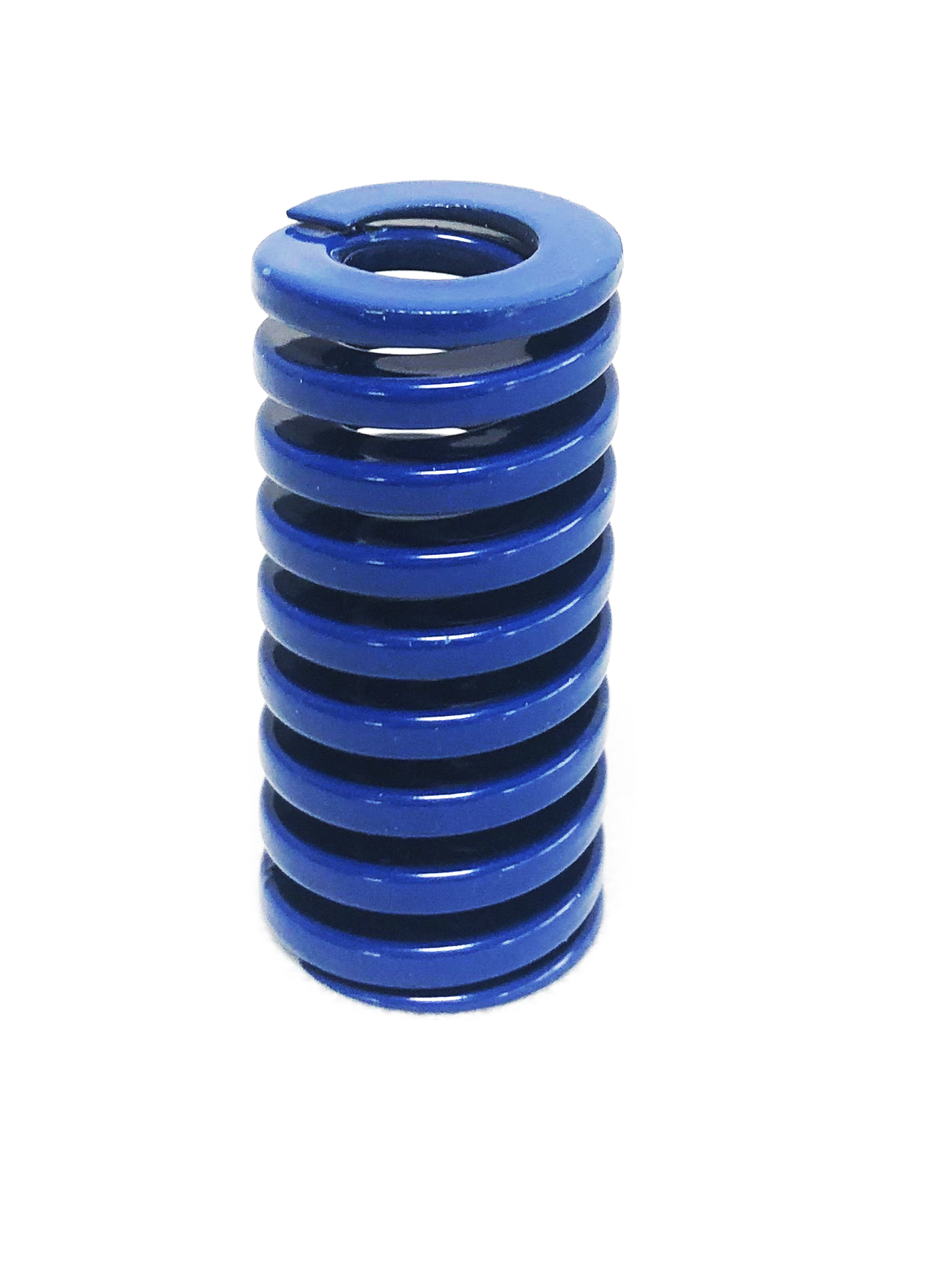
ISO 10243 standard die spring, CIM medium duty load class. The management-system certificate covers the production and sales activities that produce parts such as this; the product standard defines the dimensions and load class. Image: TOPWAY SPRINGS.
Technical explanation: the traceability chain behind a certified scope
When a scope statement covers production and sales, the practical meaning is a documented chain from incoming material to dispatch. At the start of the chain, raw material arrives with a mill test certificate and a heat number. That heat number follows the wire through coiling, multi-stage tempering, controlled shot peening, end-face grinding, and powder coating. Finished springs are load tested, and the company states that quality control is 100% test, with batch coding and FIFO inventory management used to keep lots separable. When a buyer later requests documentation, the batch code is the element that connects a delivered spring back to a material certificate.
Performance claims also sit inside this chain rather than on the certificate. TOPWAY SPRINGS die springs are validated at a fatigue life of 3 to 5 million high-frequency compression cycles within a 12%–40% compression stroke. Published installation guidance recommends long-life operation at roughly 30% to 35% of free length, and the deflection range matters: operating a spring beyond its recommended stroke shortens its service life regardless of the system that manufactured it.
Environmental management operates on a different axis. An ISO 14001 scope covering production addresses site-level aspects such as tempering energy demand, coating operations, coolant and lubricant handling, and grinding and coiling waste. Those controls reduce operating risk and support compliance obligations at the plant. They are not transferable product attributes, and a buyer evaluating a product claim such as recyclability should treat it as a separate question from the environmental certificate.
Application fit: matching a certified standard to the tooling project
Automotive stamping dies are the most document-heavy application. Here JIS B5012 standard springs (CSW series) are used with automotive stamping dies and die sets with guide posts and bushings, operating in reciprocating high-frequency axial compression under high-frequency cyclic shock conditions, where the function is high-density energy absorption in the stamping die. Buyers in this segment usually need the dimension sheet, the load class, and the material certificate together, because press downtime during a die repair is far more expensive than the spring itself.
Die casting tooling, injection molds, and industrial equipment OEM or ODM projects typically follow the ISO 10243 range. These applications require strict compliance with ISO 10243, ultra-long fatigue life measured in millions of cycles, and stable behavior in continuous high-temperature environments, where the spring maintains force balance during mold opening and closing. The same standard family is used in automotive production line upgrade projects, frequently alongside hydraulic stamping presses and nitrogen spring auxiliary systems.
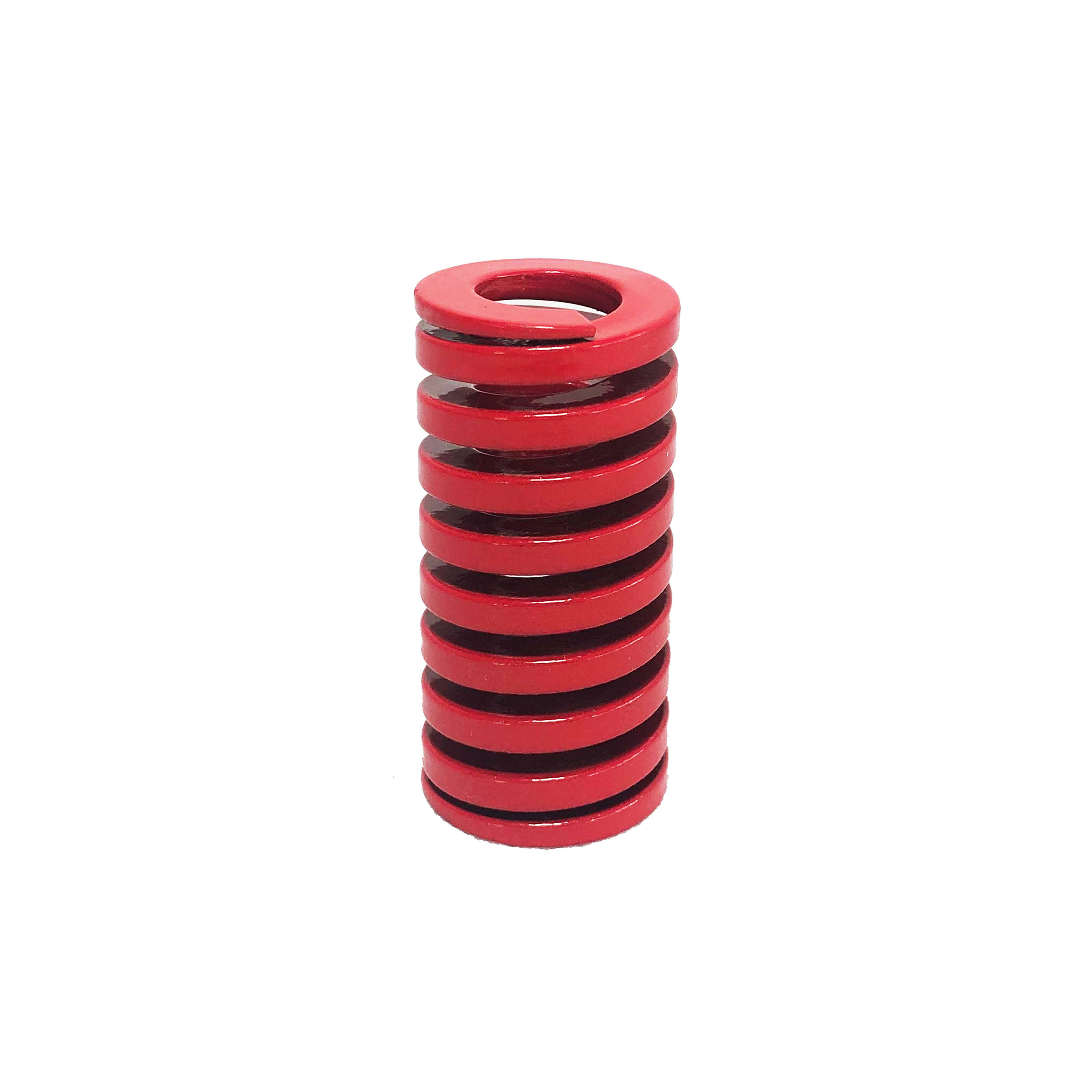
JIS B5012 standard die spring, CSWM medium load class. JIS B5012 governs inner and outer diameter tolerances, while ISO 10243 governs press-tool mounting and color conventions. Image: TOPWAY SPRINGS.
Beyond tooling, the same certified production supports industrial automation, elevator systems, machine tools, engineering machinery, environmental filtration equipment, high-voltage electrical switches, valves, and heavy-duty energy systems. The application scenario itself is not limited to a single country; demand is global, which is why multi-standard documentation matters more than a single-market certificate.
Market trend: documentation-led sourcing in industrial springs
Three published data points frame why scope reading has become a procurement topic rather than a paperwork exercise. Grand View Research projects the global industrial springs market to reach USD 7.1 billion by 2033 and reports that Asia Pacific accounted for 33.4% of revenue in 2024. Market Research Future values the automotive stamping market, a primary end use for die springs, at USD 87.98 billion in 2024. On the trade side, US imports of helical springs of iron or steel are classified under HS code 732020, and no unique global HS code separates rectangular-section die springs from round-wire types, which means customs classification and supplier documentation frequently have to be read together.
Two structural observations follow. First, as sourcing shifts across regions, buyers are increasingly comparing suppliers from different standard traditions, and the differences between JIS diameter tolerances and ISO 10243 mounting conventions become a live risk rather than a theoretical one. Second, buyers currently work without a shared benchmark: there is no widely available public high-cycle fatigue reliability database for die springs, so claims such as 3 to 5 million cycles tend to be validated per supplier and per project rather than against a common industry dataset. That gap places more weight on material certificates, batch traceability, and third-party test reports inside the certified scope.
Comparison: how die springs were qualified before, and what changed
Qualification practice has shifted from brand assumption and sample testing toward documented evidence. Each route has a genuine limitation, and the limits are the reason the certificate scope matters.
| Qualification route | What it verifies | Main strength | Limitation |
|---|---|---|---|
| Brand-name reliance | Assumed equivalence to a known catalog | Fast, low effort | Provides no evidence about the specific production lot delivered |
| Sample-only qualification | Dimensions and load behavior of the submitted sample | Direct performance evidence | A sample does not represent mass production unless batch traceability exists behind it |
| Management-system certificate alone | Process control, traceability, and environmental management across production and sales | Indicates stable supply discipline | Certifies the system, not the load class or fatigue life of a part number |
| Combined evidence: scope statement + product standard + material certificate + fatigue validation | System control, dimensional conformity, material identity, and endurance | Strongest evidence base for tooling projects | Requires documentation handling and testing time, and adds administrative cost to each order |
Limits and boundaries buyers should plan for
- Design activities are not automatically inside the scope. A scope covering production and sales of springs and related accessories describes manufacturing and commercial supply. Projects that require documented design control for a fully custom spring should confirm the certified activity list before order placement.
- After-sales support for exported springs is remote. Support is provided remotely, so buyers running high-volume tooling generally need to plan local spare stock rather than assume on-site intervention.
- Fatigue life is deflection-dependent. The 3 to 5 million cycle figure applies within the recommended compression range of 12%–40% of stroke, with long-life operation advised around 30% to 35% of free length. Compression outside that band reduces life.
- Color coding is not a universal language. Because load-class color conventions differ between the JIS and ISO systems, part numbers and dimension sheets should be the primary reference when a tooling package mixes standards.
- A certificate is not a lot certificate. System certification does not travel with an individual shipment. Material test certificates and batch records remain the per-order documentation.
- Order parameters apply. Custom work carries a minimum order quantity of 100 pieces and a quoted lead time of 14 to 25 days, which should be built into maintenance and replenishment planning.
Future outlook
Two directions are visible for die spring compliance. The first is convergence of documentation requests: as buyers source across ISO, JIS, and American standard families in the same tooling program, quotations increasingly include scope statements, material certificates, and batch traceability alongside the price sheet. Suppliers with a documented chain from heat number to dispatch will find that easier to satisfy than suppliers who can only present a certificate cover page.
The second is the growing weight of environmental management in supplier evaluation. An ISO 14001 scope over production activities is a site-level control, and buyers in the EU and North American markets are increasingly asking about it as part of supplier questionnaires, while continuing to treat product-level environmental claims as a separate and separately evidenced question. For tooling buyers, the practical implication is unchanged: the certificate describes how the supply is controlled, the product standard describes what is delivered, and the fatigue and material evidence describes how long it will last. Reading all three together, with the scope statement in the middle, is what converts a certificate into a procurement decision.
FAQ
Which international standards do TOPWAY die springs comply with, and are they interchangeable with brand-name springs?
TOPWAY SPRINGS rectangular die springs fully adhere to ISO 10243, JIS B5012, and American Standard (Inch series) specifications. Because installation dimensions, color coding, and load-deflection characteristics are controlled against those standards, the products are offered as direct drop-in replacements for international catalog items without modifying existing mold designs. Part number and dimension verification is still recommended when a tooling package combines standards, since ISO and JIS load-class color conventions are not identical.
What material is used in rectangular die springs, and what does it change?
The springs are manufactured from high-grade oil-tempered spring steel wire, primarily 55CrSi (Chrome Silicon), also referenced as 50CrV4 in general alloy spring steel practice. Compared with standard carbon spring steels, 55CrSi offers higher tensile strength, superior fatigue limits, and better resistance to permanent set and thermal relaxation under cyclic heavy loading. Mill test certificates and material heat-number traceability are provided for raw material batches.
What fatigue life can be expected under high-frequency stamping?
When operated within recommended deflection limits, the springs achieve a fatigue endurance of 3,000,000 to 5,000,000 compression cycles, validated within a 12%–40% compression stroke. This results from multi-stage tempering and controlled shot peening, which introduces compressive residual stress at the wire surface to limit micro-crack propagation. Long-life operation is commonly recommended at roughly 30% to 35% of free length; operating beyond the recommended stroke shortens service life.
What OEM background and quality assurance capability supports a die spring order?
TOPWAY SPRINGS operates as a certified OEM production partner for international mold component brands, with CNC coiling, continuous tempering, precision end-face grinding, and automated load testing, supported by 100% inspection and batch traceability. In a long-running OEM program for a US brand owner, annual volumes of 1.5 to 2.0 million pieces have been supplied for more than five years, with third-party laboratory validation reporting 100% performance parity against international tolerances, fatigue endurance, and thermal relaxation thresholds, and a 99.8%+ pass rate with zero major quality claims.
Can custom rectangular springs be manufactured from drawings or physical samples?
Yes. OEM and ODM customization covers non-standard outer and inner diameters, non-standard free lengths, specialized trapezoidal wire cross-sections, unique load rates, specialized surface treatments, marking content, packaging, and private-label branding, based on customer 2D or 3D drawings or physical samples. Custom orders carry a minimum order quantity of 100 pieces.
What are the lead times for standard die springs and for custom orders?
A large ready-to-ship inventory of ISO 10243, JIS B5012, and American standard die springs supports dispatch within 24 to 48 hours for stock items. Custom engineered or bulk OEM orders are quoted at 14 to 25 days, with automated coiling and flexible production scheduling used to keep those lead times shorter than traditional overseas import supply chains.
What do the spring colors mean, and does the powder coating flake off?
Color coding is used for visual identification of load class and follows standard industrial conventions across the series. The company applies high-adhesion powder coating that resists moisture, stamping coolants, and physical abrasion, and states that the coating is designed not to chip off and contaminate precision die cavities. Because load-class color conventions differ between the ISO and JIS systems, the part number should always be treated as the primary reference when standards are mixed.
Why must die springs be installed with a preload, and how much?
Installing springs with an initial preload, typically 5% to 10% of free length, removes internal play and prevents severe shock loads caused by sudden impact during press strokes. Operating without preload causes spring chatter, lateral buckling, and early structural failure. Preload stroke should therefore be accounted for during spring pocket design and tooling assembly setup.
Detailed dimensional tables, load-class listings, and model series for the ISO 10243, JIS B5012, and American Standard ranges are compiled in the TopWay product brochure, which can be downloaded here: Dalian TopWay product brochure (PDF). General company and product information is also published at www.onetopway.com.