
What Is a Structure Tent? Types, Performance, and Uses
Structure tents are increasingly specified by industrial, logistics, sports, and event buyers as a fast, relocatable alternative to conventional buildings. The global tent market—covering industrial storage, sports, and events—is projected to grow from USD 4.01 billion in 2025 to USD 6.07 billion by 2033, according to industry analysis. For procurement teams evaluating covered space, understanding what a structure tent is, its frame systems, fabric performance, safety standards, and application fit has become a practical necessity rather than a niche consideration.
Why Structure Tents Are Gaining Attention
Demand for covered space rarely follows a steady, predictable curve. Warehouses need to absorb seasonal inventory peaks. Event organizers must build and dismantle venues within tight windows. Sports clubs need all-weather training facilities without long construction projects. Aviation and automotive operators require maintenance space that can expand as fleets grow.
Conventional buildings address these needs but carry trade-offs: longer permitting and construction cycles, higher upfront investment, and permanent site commitment. Structure tents offer a different value proposition—engineered shelter that can be installed on demand, reused across locations, and configured to grow with the user. China's tent exports reached roughly USD 3.11 billion in 2024, representing about 53.3% of global export value, a signal of how widely these products are now adopted across international markets.
Defining the Structure Tent
A structure tent is a building system that uses an engineered aluminum frame covered by PVC fabric or rigid wall panels. Unlike consumer camping tents, structure tents are designed to meet structural and fire-safety standards, with rated wind and snow loads, flame-retardant membranes, and modular expansion capability. They can operate as temporary shelters, semi-permanent facilities, or long-term infrastructure.
KENTEN Structures, a manufacturer established in 2001 that specializes in aluminum permanent and semi-permanent structures, produces a K-series structure tent line with models K1 through K10. These cover span widths from 3 meters to 80 meters, with lengths extendable indefinitely in 5-meter bay spacing. The eave height ranges from 2.5 meters to 8 meters, customizable to project needs. This modular geometry is what allows a structure tent to scale from a small event pavilion to an industrial storage hall.
The product category also includes dedicated warehouse tents, such as the W1 model, built for manufacturing and logistics environments with span widths from 3 to 60 meters and customizable lengths typically from 10 meters to over 100 meters. Together, these systems form a family of solutions that sit between mobile tents and permanent buildings—both in cost and in engineering scope.
Structure Tent Types and Configurations
Buyers commonly encounter structure tents described by frame, fabric, span, or intended use. The table below summarizes the main types and their typical applications.
| Type | Typical Span | Key Characteristics | Common Uses |
|---|---|---|---|
| Aluminum Frame Structure Tent | 3m–80m (K1–K10) | High-strength 6061-T6/6082-T6 aluminum alloy frame | Events, sports facilities, industrial storage, exhibitions |
| PVC Fabric Structure Tent | 3m–80m | 850 g/m² PVC coated polyester fabric, UV-treated, flame-retardant | Multi-purpose temporary and semi-permanent venues |
| Warehouse Tent | 3m–60m (W1) | Peak height ~9m, wind load up to 120 km/h, snow load up to 75 kg/m² | Manufacturing, logistics, factory storage, distribution centers |
| Large Clear Span Structure Tent | Up to 80m | Column-free interior, customizable length | Aircraft hangars, exhibition halls, sports halls |
| Modular Structure Tent | 3m–80m, unlimited length | Expandable in 5m bay spacing | Warehousing, temporary facilities requiring future expansion |
| Permanent / Semi-Permanent Structure Tent | 3m–80m | Aluminum frame lifespan 20+ years, PVC fabric 8–15 years | Long-term industrial, government, and public projects |
Materials and Engineering Parameters
The performance of a structure tent depends primarily on two components: the frame and the membrane. The frame must carry wind, snow, and dynamic loads. The membrane must provide weather protection, flame resistance, and durable enclosure.
| Parameter | K-Series Structure Tent (K1–K10) | W1 Warehouse Tent |
|---|---|---|
| Main Frame | High-strength 6061-T6 / 6082-T6 aluminum alloy | Aluminum alloy 6061-T6 / 6082-T6 |
| Roof Cover | 850 g/m² PVC coated polyester fabric | 850 g/m² PVC, UV-treated, fire-retardant |
| Span Width | 3m–80m | 3m–60m |
| Length | Unlimited, 5m bay spacing | Customizable, typically 10m–100m+ |
| Height | Eave height 2.5m–8m, customizable | Peak height ~9m (30m span ratio ~1:3) |
| Sidewalls | PVC, Glass Wall, ABS Wall, Sandwich Panel | PVC, corrugated steel, or sandwich panel |
| Wind Resistance | Up to 140 km/h (customizable) | Up to 120 km/h (certified) |
| Snow Load | Up to 0.5 kN/m² | Up to 75 kg/m² (configurable) |
| Temperature Range | -30°C to +70°C | Designed for high-temperature conditions up to 70°C |
| Fire Standards | DIN 4102 B1, M2, NFPA 701 | Fire-retardant roof cover |
| Lifespan | Aluminum 20+ years; PVC fabric 8–15 years | — |
| Foundation | Ground anchors or concrete ballast | Concrete anchors or ground stakes (site-dependent) |
| Certifications | Design standards include IBC 2024, CBC 2025, ASCE 7-22, GB 50429, EN 13782 | ISO 9001, ISO 14001, ISO 45001 |
For buyers, these parameters translate into practical decisions. A site in a high-wind region should prioritize the K-series' 140 km/h wind rating. A facility storing heavy goods may prefer the W1's higher snow-load capacity of 75 kg/m². Climate requirements are covered by a -30°C to +70°C operating range, which supports use in both cold storage buffer zones and hot industrial environments.
Performance Under Wind, Snow, and Fire
Structure tents are frequently specified for exposed sites and seasonal weather extremes, which makes load ratings a primary evaluation criterion.
Wind resistance is a defining safety parameter. The K-series structure tent is rated up to 140 km/h, while the W1 warehouse tent is certified up to 120 km/h. These figures are not marketing claims; they are structural design targets anchored to recognized building codes. In the European Union, temporary structure tents exceeding 50 m² of ground area must comply with EN 13782:2015, which covers structural stability under wind and snow loads. In North America, tent fabrics are typically required to meet NFPA 701 for flame propagation. Buyers should confirm that both frame and fabric meet the relevant codes for their jurisdiction.
Snow load ratings vary by model and configuration. The K-series supports up to 0.5 kN/m², while the W1 warehouse tent supports up to 75 kg/m². These ratings are configurable, meaning engineers can adjust the structure to site-specific conditions rather than forcing a one-size-fits-all solution.
Fire safety is another non-negotiable requirement. The K-series fabric meets DIN 4102 B1, M2, and NFPA 701 standards, making it suitable for events, sports facilities, and public venues where crowd safety is critical. The W1 warehouse tent also uses a fire-retardant roof cover, addressing the higher fire-risk profile of industrial storage environments.
Structure Tent Applications Across Industries
Structure tents are used across a wide range of industries. The following sections outline the main scenarios and the supporting equipment typically specified for each.
Warehouse and Logistics
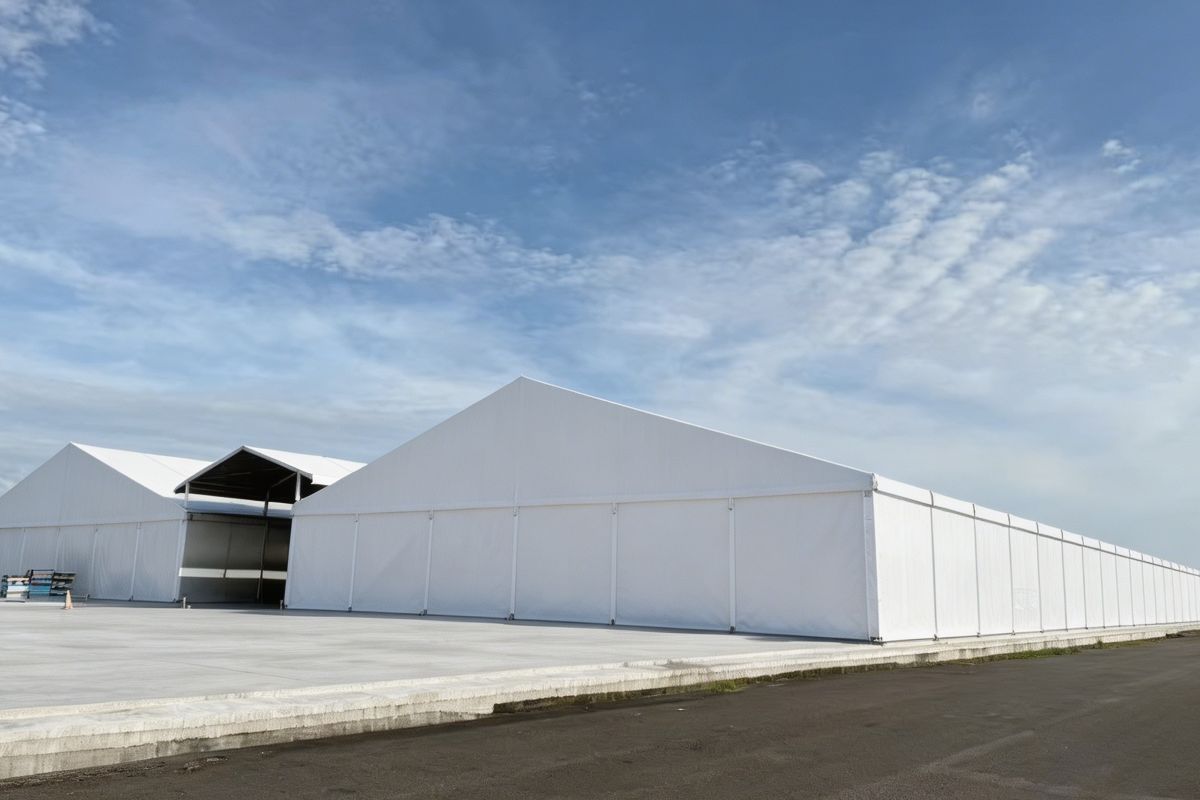
In the warehouse and logistics sector, structure tents are applied to temporary warehouses, distribution centers, and storage shelters. These facilities support inventory storage, logistics operations, and cargo protection in high-temperature, rainproof, and dustproof conditions, with operating temperatures up to 70°C. Typical supporting equipment includes roller doors, ventilation fans, insulated panels, loading docks, and LED lighting. The W1 warehouse tent, with its 3–60m span and customizable length, fits factory-side storage and seasonal capacity expansion.
Events and Exhibitions
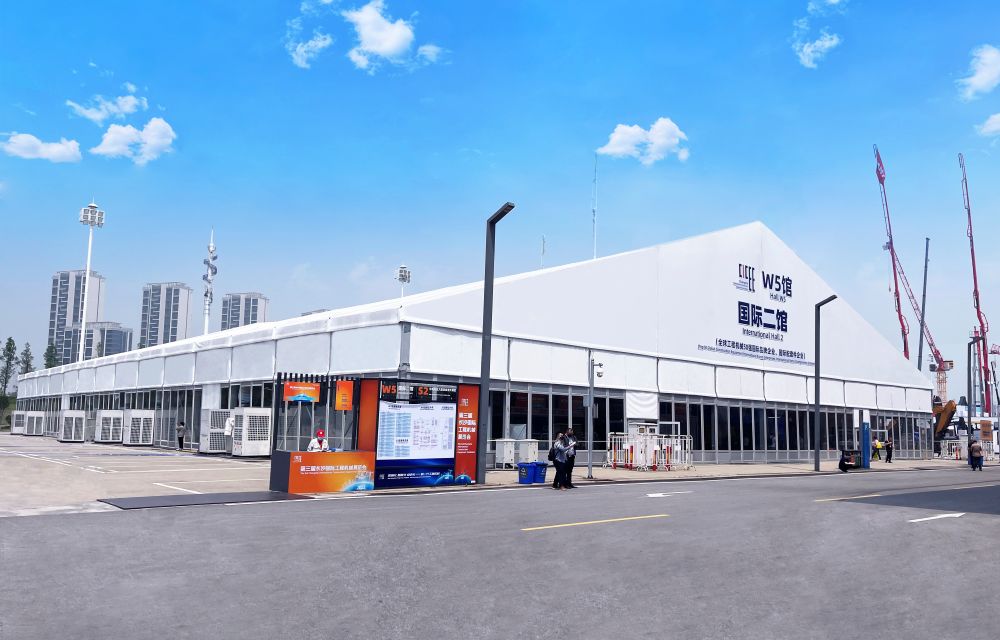
For events and exhibitions, structure tents provide exhibition halls, trade show pavilions, and branded event spaces. These environments handle high visitor traffic and require fast installation cycles. The standard package includes glass walls, flooring, LED lighting, air conditioning, entrance doors, and branding banners. Because these venues host large crowds, fire-retardant fabric and structural load-bearing capacity are mandatory requirements.
Sports Facilities
Sports facility applications include tennis courts, basketball halls, and swimming pool covers. The K-series structure tents, with spans from 3m to 80m, support sports training, competitions, and spectator events in all-weather, large open-space environments. These structures must meet flame-retardant standards such as DIN 4102 B1, M2, or NFPA 701. Sports flooring, grandstands, LED lighting, HVAC, and scoreboard support are commonly integrated.
Wedding and Hospitality
In the wedding and hospitality industry, structure tents are used for wedding ceremonies, banquets, and VIP receptions. These venues are built for outdoor, all-weather, and luxury environments, often featuring glass walls, glass doors, flooring, lining, chandeliers, HVAC, and curtains. The ability to combine clear-span space with premium finishes makes the structure tent a practical alternative to permanent banquet halls.
Automotive
Automotive applications include vehicle workshops, showrooms, and temporary display spaces. Structure tents designed for vehicle access accommodate maintenance, display, and showroom functions under normal temperature indoor/outdoor conditions. Supporting equipment typically includes glass walls, roller doors, vehicle access doors, and LED lighting. Fire retardancy, waterproofing, wind resistance, and quick installation are specified as standard requirements.
Aviation
In aviation, structure tents serve as aircraft hangars and MRO facilities. They support aircraft storage, maintenance, and inspection in vehicle-accessible spaces. Large hangar doors, lighting, ventilation, crane support, and insulation are the key additions that transform a standard clear-span tent into a functional maintenance environment. This application demonstrates the structural ceiling of large clear-span aluminum frames.
Market Signals That Matter to Buyers
Three market signals are worth tracking when evaluating structure tent procurement.
First, the market is growing. The global tent market, including industrial storage, sports, and events, is projected to expand from USD 4.01 billion in 2025 to USD 6.07 billion by 2033, at a compound annual growth rate of roughly 5–7%. This growth suggests a broad shift toward flexible infrastructure procurement.
Second, supply is highly concentrated in China, which exported approximately USD 3.11 billion in tents, awnings, and sails in 2024 and maintained an estimated 53.3% global export share. Buyers sourcing internationally are therefore likely to evaluate Chinese manufacturers. Industry listings identify manufacturers such as Shenzhen Shoulder Tent, Liri Tent, and KENTEN as notable Chinese aluminum frame tent producers, with over 80% of production often dedicated to export markets.
Third, standards are becoming a competitive differentiator. Compliance with EN 13782:2015 in Europe, NFPA 701 in North America, and structural codes such as IBC and ASCE is increasingly treated as baseline qualification. Buyers should verify certifications directly, not rely on generic claims.
Comparing Structure Tents with Conventional Buildings: Strengths and Boundaries
Structure tents and conventional buildings each have a place in a facilities strategy. Understanding the boundaries is essential for making the right choice.
Strengths of structure tents:
- Speed of deployment: modular aluminum frames and PVC fabric enclosures can be installed on demand without long construction cycles.
- Relocatability and reusability: structures can be dismantled and reinstalled at new sites, which supports changing operational footprints.
- Expandability: the K-series' 5m bay spacing and unlimited length allow capacity to grow without a new building project.
- Lower initial investment: for temporary or semi-permanent needs, structure tents avoid the full capital weight of permanent construction.
Boundaries and limitations:
- Lifespan asymmetry: while the aluminum frame can last 20+ years, PVC fabric typically requires replacement after 8–15 years. This recurring maintenance cost must be included in lifecycle planning.
- Enclosure performance: thermal insulation and acoustic separation are generally more limited in fabric structures than in insulated permanent buildings, which may affect energy costs and occupant comfort.
- Permanent complex facilities: for highly specialized infrastructure such as cleanrooms, complex process plants, or buildings requiring extensive wet trades, a conventional structure remains the more appropriate solution.
The practical rule is to match the structure to the lifecycle of the need. Temporary or semi-permanent needs favor structure tents; indefinite, highly specialized needs still point toward conventional construction.
Future Outlook for Structure Tents
Looking ahead, structure tents are likely to become more modular, more code-aligned, and more integrated into formal procurement processes.
Modularity will continue to shape product development. The ability to extend length in fixed bay increments, add wall systems such as glass or sandwich panels, and reconfigure layouts gives buyers a clear expansion path. This is particularly relevant for logistics operators who cannot predict storage demand far in advance.
Standard compliance will separate credible suppliers from commodity importers. Buyers should expect documented certification to IBC, CBC, ASCE, GB, and EN standards as a baseline, not a premium feature. In parallel, documentation quality—engineering drawings, material data sheets, and installation manuals—will become a more important evaluation criterion.
Finally, the structure tent's role as a complement to permanent buildings, rather than a substitute, is likely to strengthen. Procurement teams will increasingly treat them as a flexible capacity layer: deployable when needed, demountable when not, and financially justified by the ability to avoid overbuilding.
Frequently Asked Questions
What is a structure tent?
A structure tent is an engineered building system consisting of an aluminum alloy frame—typically 6061-T6 or 6082-T6—covered by PVC coated polyester fabric or rigid wall panels. It is designed for temporary, semi-permanent, or permanent use, with rated wind and snow loads and flame-retardant fabric options.
What are the main structure tent types?
Common types include aluminum frame structure tents, PVC fabric structure tents, warehouse tents, large clear span structure tents, and modular structure tents. The K-series aluminum structure tent offers span widths from 3m to 80m, while the W1 warehouse tent covers spans from 3m to 60m with customizable length.
What materials are used in structure tent frames?
The main frame is made of high-strength aluminum alloy 6061-T6 or 6082-T6. The roof covering is typically 850 g/m² PVC coated polyester fabric. Sidewall options include PVC, glass wall, ABS wall, and sandwich panels.
How long does a structure tent last?
The aluminum frame has a lifespan of 20+ years. The PVC fabric roof typically lasts 8–15 years, after which it can be replaced. This means the frame can support multiple membrane lifecycles.
How much wind and snow can a structure tent withstand?
The K-series structure tent supports wind loads up to 140 km/h and snow loads up to 0.5 kN/m². The W1 warehouse tent is certified for wind loads up to 120 km/h and snow loads up to 75 kg/m², with snow load configurable by project.
What fire safety standards apply to structure tents?
K-series structure tent fabric meets DIN 4102 B1, M2, and NFPA 701 standards. The W1 warehouse tent uses a fire-retardant roof cover. In Europe, temporary tents exceeding 50 m² must comply with EN 13782:2015, and in North America fabrics are typically required to meet NFPA 701.
What are structure tents used for?
Structure tents are used across warehouse and logistics, events and exhibitions, sports facilities, wedding and hospitality, automotive, and aviation industries. Applications include temporary warehouses, sports halls, exhibition pavilions, wedding venues, vehicle showrooms, and aircraft hangars.
For detailed product specifications and engineering references, a downloadable catalog is available at KENTEN Structures Catalog.