
What Keeps a Window Film Supplier Consistent on Repeat Orders
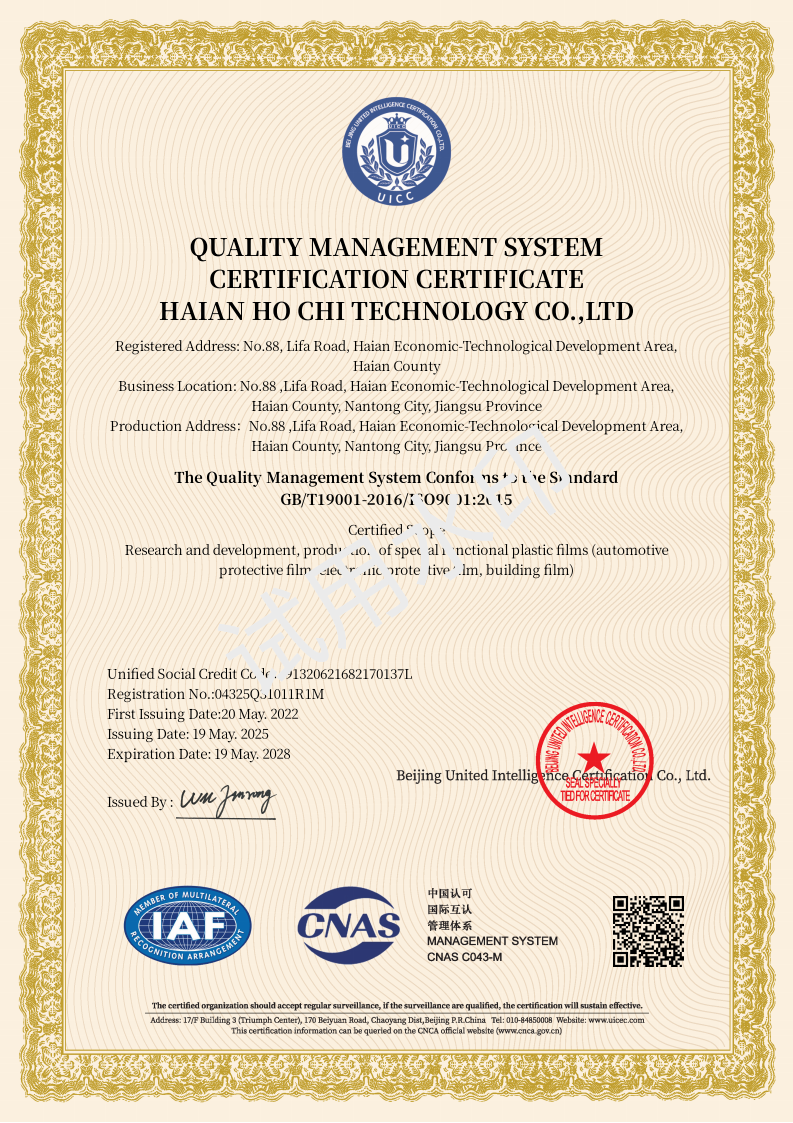
Documentation that carries a date and a certificate number is one of the few supplier signals a buyer can re-check before every repeat order. Image: ISO 9001 certificate held by Haian Haochi Technology Co., Ltd.
A window film supplier is tested by the second order, not the first. Multi-year buying programmes survive on whether VLT, colour, adhesive behaviour, roll dimensions and warranty terms stay identical when the same model is reordered twelve or twenty-four months later.
HOCHI PPF & Window Film is the brand of Haian Haochi Technology Co., Ltd., a functional film manufacturer established in 2009 and based in the Haian Economic and Technological Development Zone, Nantong City, Jiangsu Province, China. The company operates a 133,333 m² site with more than 220 employees, an annual output of 48,000,000 m, a research and development team of 100 engineers, and an export share of 60% across European, Middle Eastern, Asia-Pacific and American markets.
For buyers in the evaluation-to-execution stage, the question is narrower than a general capability presentation. Which parts of a supplier's offer are documented well enough to be repeated? The answer is usually found in six places: a product architecture that separates automotive from architectural lines, model-level parameter records, warranty terms that change with the product rather than the sales conversation, certificates that carry visible validity dates, production and inspection routines that are described in operational terms, and a defined after-sales mechanism. Each of those is verifiable before a purchase order is issued, and each is re-verifiable a year later.
Why the second order is the harder test
A first order can be carried by a sample roll and a competitive quotation. The second order exposes everything a sample hides. If the silver tone of an architectural film shifts half a shade, if a 5% VLT film arrives at 6%, if the liner becomes stiffer and slower to squeegee, the installer absorbs the cost and the distributor absorbs the complaint. None of those failures appear in a price list.
Buyers who source through spot market channels or mixed intermediaries often discover this only after the second or third container. The original model code may still exist on the invoice, but the construction behind it may not. This is why long-term evaluation tends to shift from "who can supply this film" to "whose film can I describe in the same way in two years' time".
Inspection practice helps but does not replace measurement. The IWFA Visual Quality Standard, for example, defines film inspection at roughly 6 feet (about 2 metres) under natural daylight — a useful common reference for visible defects, but not a substitute for spectrophotometer data on VLT, UV rejection and infrared cut.
Signal one: two product lines that stay separate and stay listed
A supplier that intends to serve buyers over several years usually organises its range into stable, named lines rather than a shifting list of one-off items. HOCHI maintains two principal lines — AUTOMOTIVE FILM and ARCHITECTURE FILM — alongside a carbon window film range represented by the model CARBONBRONZE 10.
The AUTOMOTIVE FILM line includes sputter constructions such as QS0595, QS5095 and SV3095, glue tint constructions such as CLASSIC35P and CLASSIC03P, the reflective glue tint model SL05R, and the thicker glue tint security constructions NEX4MIL05 and NEX8MIL05. The ARCHITECTURE FILM line includes the safety clear models SF02 and SF12, the silver reflective models SILVER 5% and SILVER 10%, and the silver coloured models SILVER/BLUE 15, SILVER/GOLD 20, SILVER/GREEN 10 and SILVER/GREY 05.
The practical value of that structure is catalogue continuity. A distributor building a printed price list, a detailing chain configuring a service menu, or a glazing contractor specifying a retrofit package all depend on the model codes remaining valid between reprints. When a supplier reorganises its range frequently, the buyer's own documentation becomes obsolete faster than the film.
Signal two: model-level documentation a buyer can re-order from
Parameters attached to a category are marketing; parameters attached to a model are procurement data. The distinction matters when a buyer needs to match an existing installation on a second building or a second vehicle batch. The two tables below reproduce the documented values for representative models in each line.
AUTOMOTIVE FILM: selected model records
| Model | Type | Structure | VLT | IR cut | UV rejection | Stated warranty |
|---|---|---|---|---|---|---|
| QS0595 | Sputter | 2PLY 2.0 mil | 5% | 95% | 99% | 10 years |
| QS5095 | Sputter | 2PLY 2.0 mil | 50% | 95% | 99% | 10 years |
| SV3095 | Sputter | 2PLY 3.0 mil | 30% | 95% | 99% | 10 years |
| SL05R | Glue tint, reflective | 2PLY 1.5 mil | 5% | 95% | 99% | 5 years |
| NEX4MIL05 | Glue tint, security | 2PLY 4.0 mil | 5% | 11% | 99% | 5 years |
| NEX8MIL05 | Glue tint, security | 2PLY 8.0 mil | 5% | 11% | 99% | 5 years |
| CLASSIC35P | Glue tint | 2PLY 1.5 mil | 35% | 10% | 99% | 4 years |
| CLASSIC03P | Glue tint | 2PLY 1.5 mil | 3% | 10% | 99% | 4 years |
| CARBONBRONZE 10 | Carbon | Optical grade PET | 10% | 90% | 99% | Not listed in the model record |
Documented values for selected AUTOMOTIVE FILM models. The spread in IR cut between sputter and security constructions is a design difference, not a quality ranking.
ARCHITECTURE FILM: selected model records
| Model | Type | Structure | VLT | IR cut | UV rejection | Stated warranty |
|---|---|---|---|---|---|---|
| SF02 | Safety clear | 1PLY 2.0 mil | 90% | 10% | 88% | 6 years |
| SF12 | Safety clear | 1PLY 12.0 mil | 90% | 10% | 88% | 6 years |
| SILVER 5% | Silver reflective | 2PLY 1.5 mil | 5% | 95% | 99% | 6 years |
| SILVER 10% | Silver reflective | 2PLY 1.5 mil | 10% | 88% | 99% | 6 years |
| SILVER/BLUE 15 | Silver coloured | 2PLY 1.5 mil | 8% | 90% | 99% | 4 years |
| SILVER/GREEN 10 | Silver coloured | 2PLY 1.5 mil | 8% | 90% | 99% | 4 years |
| SILVER/GOLD 20 | Silver coloured | 2PLY 1.5 mil | 25% | 75% | 99% | 4 years |
| SILVER/GREY 05 | Silver coloured | 2PLY 1.5 mil | 10% | 75% | 99% | 4 years |
Documented values for selected ARCHITECTURE FILM models, all built on optical grade PET film. Warranty length differs by construction within the same line.
Two details in these tables are worth pausing on, because they show what honest documentation looks like. First, UV rejection is 99% across most tinted models but 88% on the safety clear films SF02 and SF12 — a lower figure that reflects the different function of a clear anti-shatter film rather than a weaker product. Second, infrared cut ranges from 10% on clear safety film to 95% on sputter automotive film. A supplier that publishes a single headline number for the whole range is telling the buyer less, not more.
Signal three: warranty language that follows the construction
Warranty is where long-term supply relationships are usually won or quietly eroded. A useful signal is not the length of the longest warranty in the catalogue, but whether the stated term is attached to the specific model and matches the construction behind it.
In the HOCHI range, the longest stated coverage sits on the sputter automotive constructions QS0595, QS5095 and SV3095 at 10 years. The security glue tint models NEX4MIL05 and NEX8MIL05 and the reflective model SL05R carry 5 years. The glue tint models CLASSIC35P and CLASSIC03P carry 4 years. On the architectural side, SF02, SF12, SILVER 5% and SILVER 10% carry 6 years, while SILVER/BLUE 15, SILVER/GOLD 20, SILVER/GREEN 10 and SILVER/GREY 05 carry 4 years.
Read as a whole, the after-sales statement is a 5–10 year quality warranty addressing anti-bubbling, anti-fading and anti-delamination performance, with 100% free replacement for defectives and 24/7 technical support and installation guidance. The important point for a multi-year buyer is that the 4-year term on certain architectural films is a declared coverage period for those specific constructions, not an inconsistency to be negotiated away. A buyer who plans a five-year building programme around SILVER/GREEN 10 should know the stated term at the specification stage, not at the claim stage.
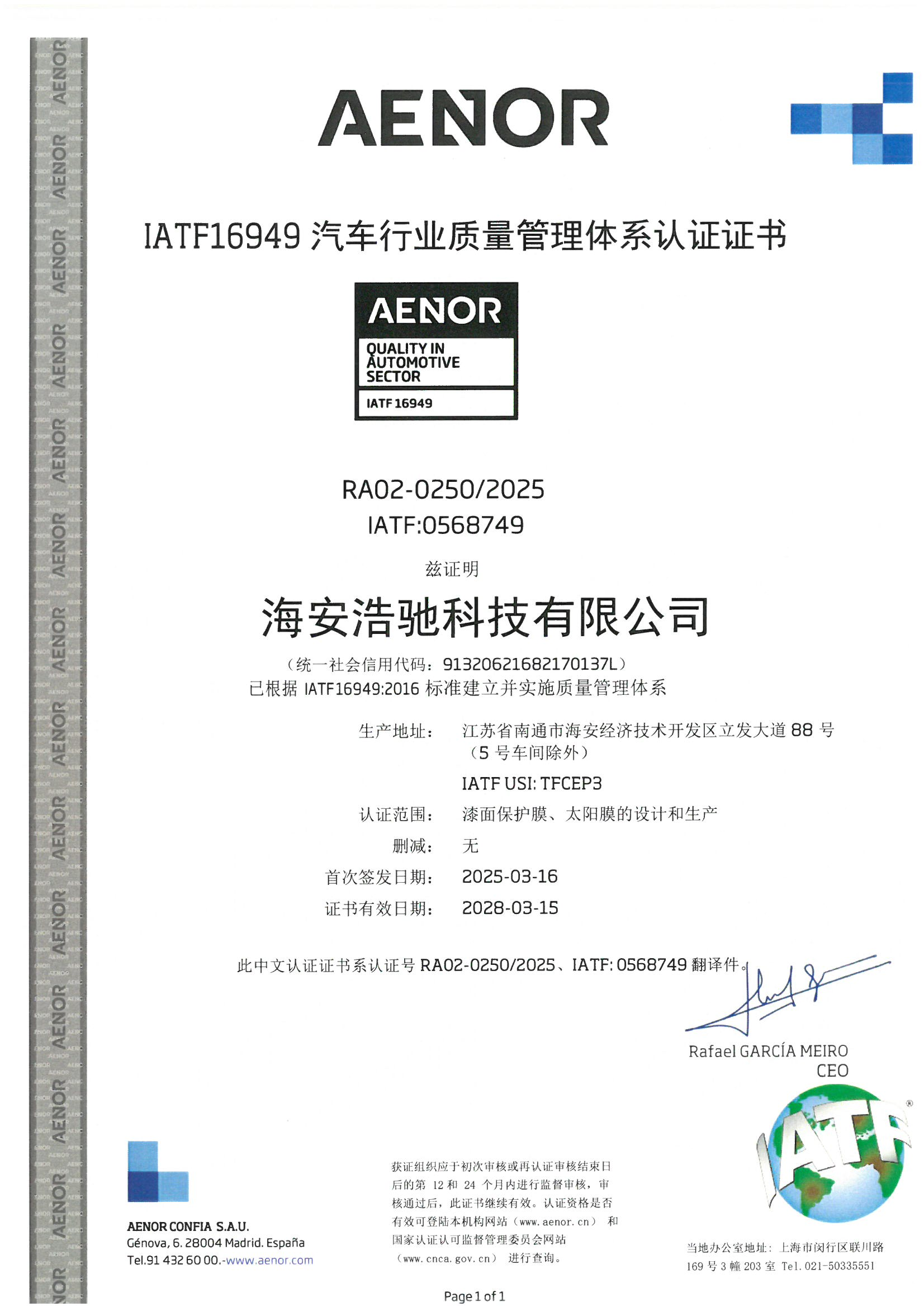
The IATF 16949 certificate states its scope explicitly: design and production of paint protection film and solar film. Image: certificate held by Haian Haochi Technology Co., Ltd.
Signal four: quality-system evidence that carries a date
Certificates are only useful to a buyer if three things are visible at once: the standard, the certificate number with its issuing body, and the validity period. A certificate quoted without a number cannot be checked; one quoted without an expiry date cannot be scheduled for renewal review. The current management-system certificates held by the manufacturer are listed below.
| Standard | Certificate number | Issuing body | Valid from | Valid to |
|---|---|---|---|---|
| ISO 9001 | 04325Q31011R1M | Beijing United Intelligence Certification Co., Ltd. | 2025-05-19 | 2028-05-19 |
| ISO 14001 | 04325E30833R1M | Beijing United Intelligence Certification Co., Ltd. | 2025-05-19 | 2028-05-19 |
| ISO 45001 | 04325S40794R0M | Beijing United Intelligence Certification Co., Ltd. | 2025-05-19 | 2028-05-18 |
| IATF 16949 | RA02-0250/2025, IATF: 0568749 | AENOR CONFIA S.A.U. | 2025-03-16 | 2028-03-15 |
Management-system certificates and validity periods. Buyers should re-confirm status at each annual supplier review rather than relying on a copy filed at onboarding.
The scope statements matter as much as the numbers. The ISO 9001 and ISO 14001 certificates cover research and development and production of special functional plastic films, specifically automotive protective film, electronic protective film and building film. The IATF 16949 certificate covers design and production of paint protection film and solar film, and the standard is cited as IATF 16949:2016. For an automotive customer, that scope is the relevant one; for a glazing contractor, the ISO scope statement is the more directly applicable document.
Signal five: production and inspection routines described in operational terms
A supplier's ability to repeat a specification is a manufacturing property, not a promise. Monthly production capacity is stated at 3–5 million meters, supported by a site of 133,333 m², more than 220 employees and a research and development team of 100 engineers. Independent reporting records a Class 1000 dust-free coating workshop covering 3,000 m² at the same operation.
Quality control is described as a sequence rather than a slogan: 100% online optical defect inspection, spectrophotometer testing of VLT, UV rejection and infrared rejection, peel adhesion testing and high-temperature aging testing, with third-party inspection available through SGS. For a buyer, each of these corresponds to a failure mode that appears in the field — optical defects at installation, VLT drift at inspection, adhesive failure at the edge, and premature ageing on a sun-facing façade. Those tests are also the reference point for any later warranty discussion, which is why they belong in the supplier evaluation file rather than in the brochure folder.
Signal six: OEM parameters fixed before the programme starts
Long-term buyers increasingly need their own specification, not a catalogue model. The stated OEM customization scope covers VLT from 5% to 70%, UV and IR rejection rates, film thickness in mil, roll dimensions in width and length, custom colours, release liner, and packaging box and core logo printing. Those are the variables that must be written into a supply agreement, because they are the ones that drift when they are only agreed verbally.
The commercial frame is equally concrete: a minimum order quantity of 50 rolls for OEM orders, with sample orders available on request, and a lead time of 30–45 days. Stated delivery terms are FOB Shanghai, with acceptance criteria based on pre-shipment testing and third-party inspection (SGS). For a distributor planning an annual programme, the 50-roll threshold and the lead time are the two numbers that determine whether a direct factory relationship is workable at all.
Technical explanation: why specification continuity is genuinely difficult
Consistency across years is not a matter of goodwill. It depends on the stability of the input film, the coating process and the adhesive system. The range illustrates how many distinct constructions can sit inside one product family: high-purity optical grade PET for sputter and security films, optical grade PET film for architectural products, and optical grade polyester film for the standard glue tint models.
Each construction carries its own behavioural notes in the model record. SILVER/GREEN 10 is documented with a strong adhesive; CLASSIC03P with good shrinkage and good clarity; SV3095 with no signal interference; SILVER 5% with real heat rejection and good colour stability; SF02 and SF12 with security protection and strong adhesive at 1PLY 2.0 mil and 1PLY 12.0 mil respectively. These notes exist because installers and specifiers ask about them. A supplier that can state them per model is a supplier that has already thought about what happens on the second order.
One technical caution belongs in any long-term evaluation. Infrared cut is a measure of rejection in the infrared band, not of total solar energy rejection. A 95% IR figure and a 75% IR figure cannot be converted into a whole-window performance claim without additional test data on the complete glazing assembly, and buyers should not let the higher number alone determine a multi-year specification.
Application: what repeat-order consistency looks like in practice
For distributors and regional wholesalers, the signal that matters is catalogue stability. Recorded cooperation includes a US-based programme combining 3,500 rolls of ceramic window film and 1,200 rolls of TPU PPF, roughly 150,000 meters per year, running for more than three years across automotive detailing chains, regional film wholesalers and commercial glazing contractors. The reported outcome includes strict batch-to-batch colour consistency, which is precisely the property that a second and third order tests.
For automotive detailing groups, the relevant evidence is a four-year continuous supply relationship covering approximately 2,000 rolls per year of 7.5 mil and 8.5 mil high-gloss TPU PPF for full-body paint protection, with a stated product lifespan of 8–10 years and a reported anti-yellowing performance of Delta E below 1.5 over three years. For a detailing chain, a supplier that changes its topcoat between seasons is a warranty liability regardless of the launch price.
For architectural glazing contractors, the case record includes a commercial curtain-wall retrofit across the US, UAE and Germany totalling approximately 65,000 m², equivalent to about 2,200 rolls of silver and neutral solar control film, evaluated three years after installation against a 10-year product warranty. Reported results include a 4°C to 6°C reduction in indoor temperature, 28% lower central air-conditioning power consumption and 99.5% blocking of harmful UV. Safety clear films SF02 and SF12 serve the parallel anti-shatter requirement on glazed façades.
Market trend: more SKUs, therefore more documentation
Market research places the global automotive tinting film market at a projected USD 14.7 billion by 2033 (Grand View Research). Within the protective segment, thermoplastic polyurethane dominates the PPF material category at USD 437.1 million in 2025 (Business Research Insights), while self-healing paint protection film accounted for approximately 15% of the global automotive film market in 2024. PPF thickness in the market typically ranges from 6.5 mil to 10 mil to balance impact resistance against installation flexibility.
The direction of travel is toward more differentiated constructions, not fewer. That has a direct procurement consequence: as ranges widen, the number of model-level parameters a buyer must track grows with them. Suppliers that already publish per-model VLT, IR, UV, thickness and warranty data reduce the administrative cost of switching or expanding a programme. Suppliers that publish only category-level claims push that cost onto the buyer.
Where a direct factory programme fits — and where it does not
A direct manufacturer relationship is not the right structure for every buyer, and the boundaries are worth stating plainly.
The first boundary is order size and speed. An OEM minimum of 50 rolls with a 30–45 day lead time and FOB Shanghai delivery suits programme buying, annual contracts and private-label ranges. It does not suit a buyer who needs ten rolls next week, or an installer facing an urgent replacement on a single vehicle. For those cases, a local stock distributor remains the faster route, even at a higher unit cost. The trade-off is real: the buyer gains local availability and loses direct control over the specification and packaging.
The second boundary is warranty expectations. Coverage is not uniform across the range. A buyer specifying SILVER/GREY 05 or SILVER/GOLD 20 for a long-horizon project is working with a stated 4-year quality warranty, while a sputter automotive programme on QS0595 or SV3095 sits at 10 years. Assuming a single warranty position across a mixed order is one of the most common evaluation errors, and it is better resolved at the specification table than at the claim stage.
The third boundary is data interpretation. Published infrared cut values describe the film, not the finished glazing system. Where a project requires a whole-assembly performance figure, the buyer needs project-specific test data, and the supplier's model record alone will not supply it.
Future outlook
Three developments are likely to shape long-term supplier evaluation over the next several years. First, certificate lifecycle management will become routine procurement practice rather than a one-off onboarding step, as buyers begin diarising renewal dates against their own contract terms. Second, model-level parameter records will increasingly be requested in structured form, because distributors maintaining digital catalogues and specifiers maintaining building files both need data they can re-import rather than retype. Third, as PPF and window film ranges continue to widen, the differentiator between credible manufacturers will shift from the breadth of the range to the reliability of the record behind each model.
For buyers, the implication is straightforward. The supplier worth keeping is the one whose documentation is still accurate when the second order is placed.
Frequently asked questions
What product-line evidence shows a window film supplier can support repeat orders?
Look for stable, separately named lines with fixed model codes and published parameters per model. HOCHI maintains an AUTOMOTIVE FILM line including QS0595, QS5095, SV3095, CLASSIC35P, CLASSIC03P, SL05R, NEX4MIL05 and NEX8MIL05, and an ARCHITECTURE FILM line including SF02, SF12, SILVER 5%, SILVER 10%, SILVER/BLUE 15, SILVER/GOLD 20, SILVER/GREEN 10 and SILVER/GREY 05. A buyer re-ordering any of these can reference the same model code and the same documented values as the original order.
How detailed should model-level documentation be before a repeat order is placed?
At minimum, each model record should state VLT, infrared cut, UV rejection, film thickness with ply count, colour, and the stated warranty period. For example, SILVER/GREEN 10 is documented as optical grade PET film at 2PLY 1.5 mil with 8% VLT, 90% infrared cut, 99% UV rejection and a 4-year quality warranty. If any of those fields is missing from the record, the reorder risk rises accordingly, because the buyer has no reference to compare a new batch against.
How should buyers interpret warranty differences within one supplier's range?
Warranty length follows the construction. In this range, sputter automotive models QS0595, QS5095 and SV3095 carry 10 years; NEX4MIL05, NEX8MIL05 and SL05R carry 5 years; CLASSIC35P and CLASSIC03P carry 4 years; architectural SF02, SF12, SILVER 5% and SILVER 10% carry 6 years; and SILVER/BLUE 15, SILVER/GOLD 20, SILVER/GREEN 10 and SILVER/GREY 05 carry 4 years. The after-sales statement describes a 5–10 year quality warranty against bubbling, fading and delamination, with free replacement for defectives and 24/7 technical support.
Which OEM parameters should be fixed in a multi-year supply agreement?
The stated customization scope covers VLT from 5% to 70%, UV and IR rejection rates, film thickness in mil, roll dimensions in width and length, custom colours, release liner, and packaging box and core logo printing. Commercially, OEM orders carry a minimum of 50 rolls with samples available on request, a lead time of 30–45 days, and FOB Shanghai delivery terms. Fixing these variables in writing is what prevents a repeat order from becoming a renegotiation.
Which documents should be re-verified at each annual supplier review?
Certificate validity and scope, at minimum. The current records show ISO 9001 certificate 04325Q31011R1M and ISO 14001 certificate 04325E30833R1M valid to 2028-05-19, ISO 45001 certificate 04325S40794R0M valid to 2028-05-18, and IATF 16949 certificate RA02-0250/2025 (IATF: 0568749) valid to 2028-03-15, issued by AENOR CONFIA S.A.U. The IATF scope covers design and production of paint protection film and solar film. Buyers should also confirm that acceptance criteria still include pre-shipment testing and third-party inspection (SGS).
Tem questões ou precisa de mais detalhes?
Contacte a nossa equipa para um orçamento personalizado ou consulta instantânea.
Solicitar orçamento
Preencha o formulário abaixo e a nossa equipa entrará em contacto com uma proposta personalizada.
Chat direto do WhatsApp
Prefere conversar em tempo real? Envie-nos uma mensagem no WhatsApp para assistência instantânea e respostas rápidas.
- Obter orçamento personalizado
- Partilhar fotos ou documentos
- Discuta as suas necessidades diretamente
Geralmente responde em 5–30 minutos durante o horário de expediente.