
What Milling Centers, Implant Labs and Clinics Test in Zirconia Blocks
What Milling Centers, Implant Labs and Clinics Test in Zirconia Blocks
Independent Industry Reference · Dental CAD/CAM Materials
A dental zirconia block is usually compared on shade, translucency and price. The buyers who consume the most blanks — high-volume milling centers, implant labs and chairside clinics — qualify them on two far less photogenic dimensions: whether the material sinters the same way every time, and whether it fits the equipment already standing in the production room.
This reference is written from the buyer’s side of the transaction. It does not rank manufacturers and it does not name competing brands. Instead, it separates three consumption settings that supplier documentation routinely merges into one, and it evaluates a dental zirconia block on sintering consistency and equipment compatibility before shade cards or unit economics enter the conversation.
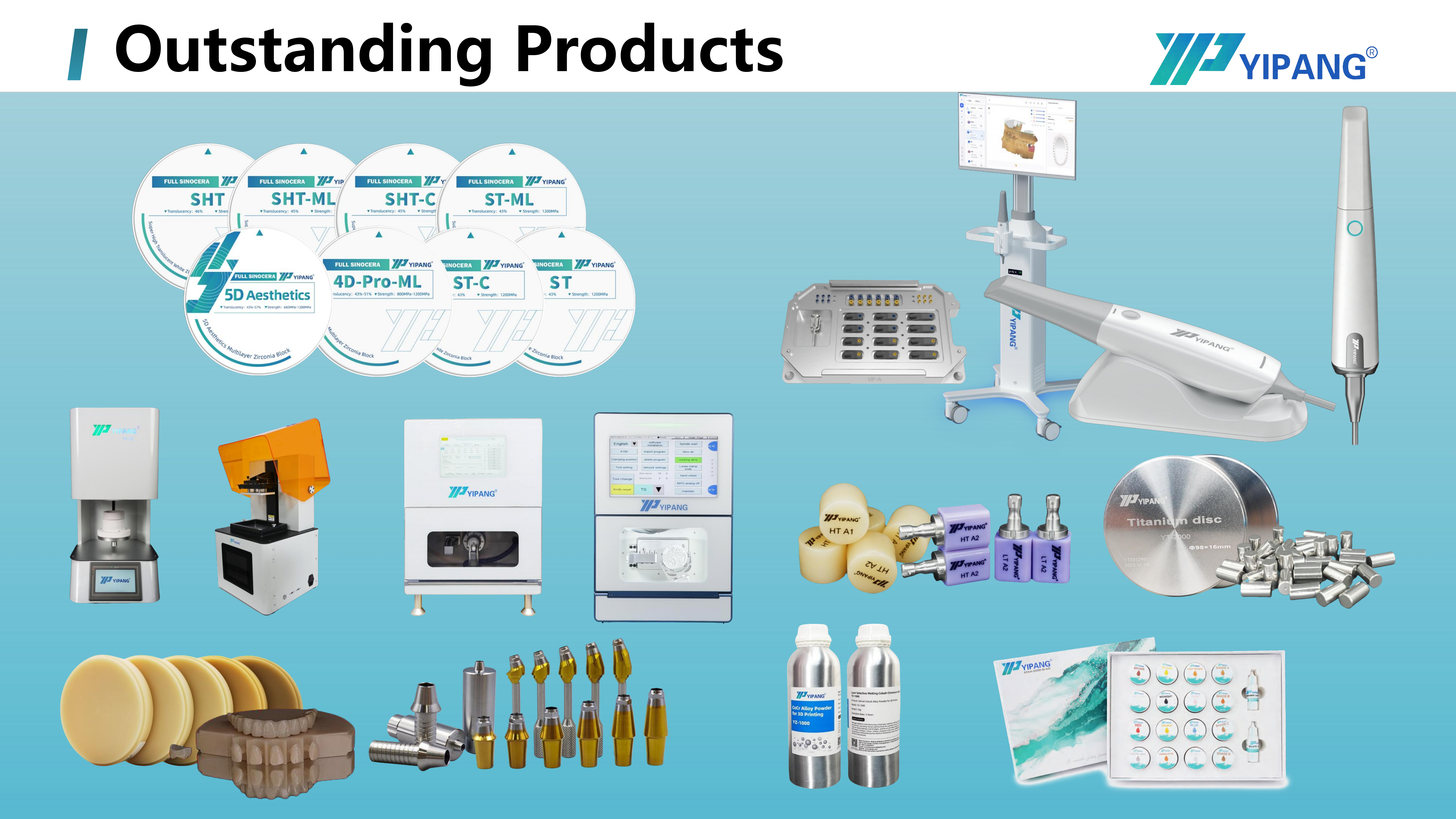
A dental zirconia block is one product class but three separate purchasing decisions. Image: YIPANG dental zirconia block range.
Why this category rewards close reading
The commercial weight of the blank is not marginal. Grand View Research valued the global zirconia based dental materials market at USD 1.2 billion in 2025 and projects USD 2.3 billion by 2033. Within that total, zirconia discs held the largest revenue share at 63.1% in 2025, CAD/CAM milling accounted for 82.4% of process revenue, and dental laboratories remained the dominant end user with 45.3% of market share (Grand View Research, 2025).
That concentration explains why blank selection debates persist. If 82.4% of process revenue is generated through milling, then differences between blanks rarely surface in a specification table. They surface in mill time, sintering batches, remake rates and marginal fit — outcomes a buyer feels financially but cannot read directly from a strength or translucency value.
The category is also geographically weighted. The United States accounts for roughly 40% of revenue in the global zirconia based dental materials market (Grand View Research, 2025), which means qualification decisions made by North American labs and milling centers tend to travel through export channels into supplier expectations elsewhere.
One blank, three buying decisions
The same 98 mm disc behaves as three different purchases depending on who opens the box. A milling center treats a zirconia blank as a production input measured in units per shift. An implant lab treats it as a fit-critical component measured in marginal adaptation at an abutment interface. A chairside clinic treats it as a single-appointment promise measured in whether the unit seats the first time.
| Buyer setting | What the blank is | Primary risk if it fails | Evidence that settles the question |
|---|---|---|---|
| High-volume milling center | Production substrate, consumed in batches | Batch-to-batch variation that forces re-nesting or scrapping a run | Repeatability across successive firings; blank thickness matched to nesting strategy |
| Implant lab | Fit-critical component for superstructures | Marginal discrepancy at an implant interface that cannot be polished away | Dimensional accuracy after sintering; shrinkage behaviour |
| Chairside clinic | A single-visit completion promise | A remake inside the appointment window | Predictable sintering outcome; compatibility with the installed mill and furnace |
Reading the table across rather than down is the useful move. Milling centers and chairside clinics both care about repeatability, but a milling center amortises one bad batch across hundreds of units while a clinic absorbs the entire loss in one patient appointment. Implant labs care about fit, but their fit tolerance is driven by a metal or zirconia interface rather than by occlusal morphology alone.
Dimension one: sintering consistency
Sintering consistency is the ability of a blank to deliver the same shrinkage, density and fit result across successive firings, across furnaces and across operators. It is not a single number; it is a behaviour that only reveals itself when a buyer runs the same programme on the same material more than once.
For a dental zirconia block, the operating window is narrow and documented. The recommended sintering range is 1430°C–1450°C, with the stated sintering temperature at 1450°C. The standard procedure is to place the milled zirconia workpiece on a sintering tray, set a heating curve up to the target temperature with appropriate holding time, and allow natural cooling after completion. Two failure modes are explicitly flagged: rapid temperature change can cause cracking, and exceeding the maximum sintering temperature is not permitted.
The commercial consequence differs by setting. A high-volume milling center runs many batches per week, so small inconsistencies compound into visible remake trends. An implant lab needs the sintered unit to hold its interface geometry, because a superstructure that distorts cannot be recovered by adjustment. A chairside clinic runs one or two units at a time, which removes batch statistics from the equation and replaces them with a binary outcome: correct, or remade.
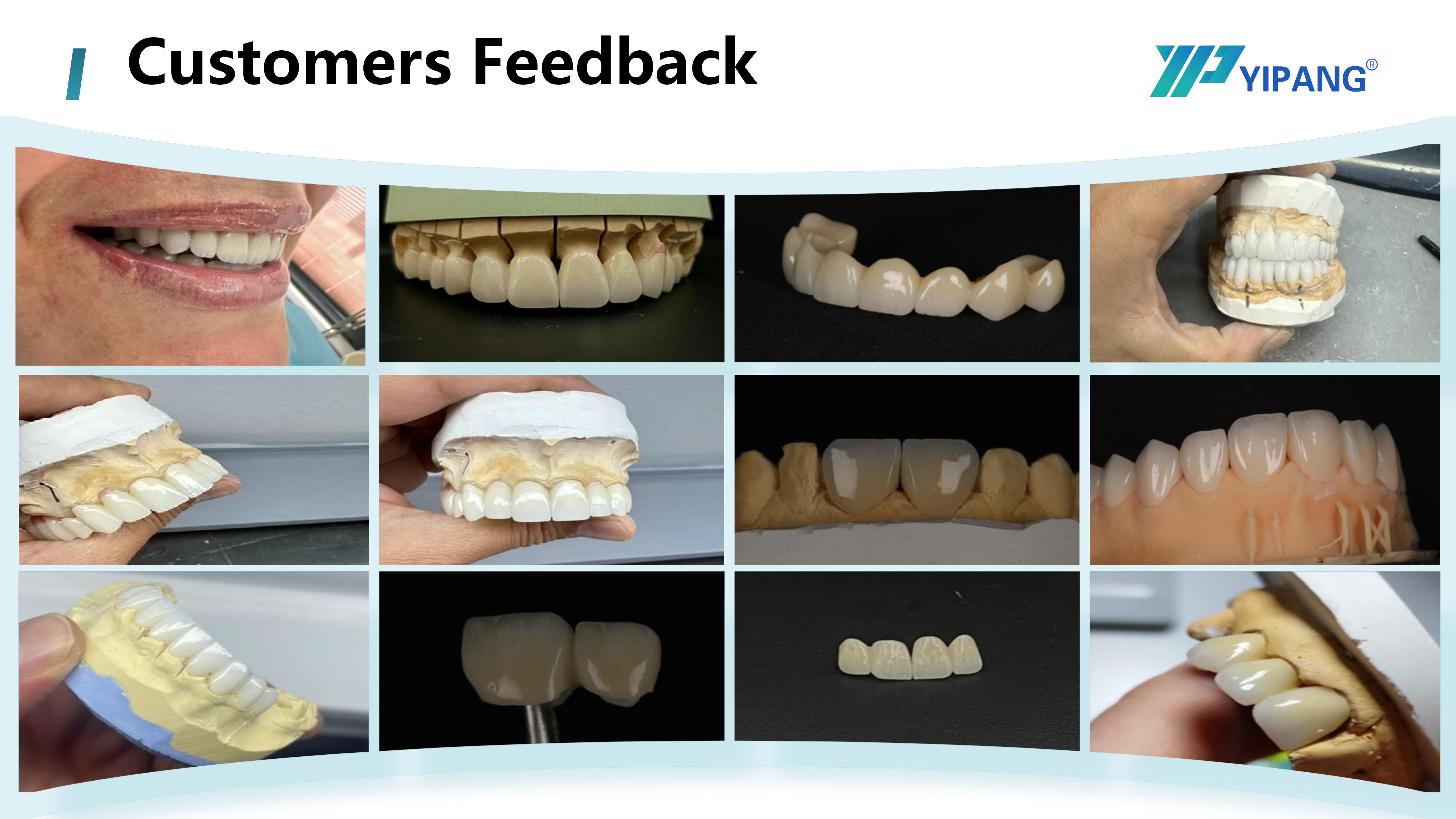
Sintering consistency is a production-environment property as much as a material property. Image: YIPANG zirconia manufacturing.
Product-level evidence worth requesting includes low shrinkage after sintering and stated dimensional accuracy. Both are listed characteristics of the YIPANG 4D-PRO-ML blank, and both matter more than translucency in a lab where a distorted multi-unit framework means a full re-mill rather than a polish.
Dimension two: equipment compatibility
Compatibility is the second filter, and it is mechanical before it is commercial. A blank either clamps into the mill that exists in the room or it does not. Thickness either covers the restoration being nested or it forces a thinner design that compromises the connector.
The YIPANG 4D-PRO-ML dental zirconia block is supplied in a 98 mm diameter with thickness options of 10 mm, 12 mm, 14 mm, 16 mm, 18 mm and 20 mm, and is described as compatible with most mainstream dental milling machines. Its documented processing route is milling on a dental milling machine followed by sintering in a dental sintering furnace, with a dental lab scanner positioned upstream in the digital workflow. It is designed for dental CAD/CAM workflows and intended for the dental laboratory, dental prosthetics and dental CAD/CAM industries.
| Compatibility check | What to verify before qualification | Why it differs by setting |
|---|---|---|
| Disc format | 98 mm diameter acceptance in the installed chuck or clamping system | Milling centers may run multiple mill generations; a clinic usually has one |
| Blank thickness | Whether 10–20 mm options cover the tallest restoration in the case mix | Full-arch superstructures consume depth that single crowns do not |
| Sintering furnace | Programmable curve reaching 1430–1450°C with controlled heating and holding | A clinic without a furnace cannot complete the workflow in-house at all |
| Scanner and CAM | Scan data and nesting strategy matched to the selected thickness | Implant labs depend on scanbody accuracy upstream of the blank |
Equipment compatibility is also an environmental question. The documented working condition for this application is an indoor constant-temperature dental laboratory environment. Temperature swings in a milling room affect both the green-state blank and the accuracy of the mill itself, which is why compatibility claims are best read as workflow claims rather than as a single connector specification.
Where the YIPANG 4D-PRO-ML blank sits
YIPANG is the self-developed dental brand of Beijing Weijiahua Dentistry Equipment Co., Ltd., a dental industry manufacturer and supplier established in 1996 and based in Beijing, China. The company operates a 2000-square-metre manufacturing facility with approximately 80 employees and an annual production capacity of about USD 10 million. Between 40% and 55% of its products are exported, and it serves markets in the Middle East, Southeast Asia, South America, North America, Eastern Europe, North Africa and Australia. Its product lines include zirconia blocks, glass ceramics, press ingots, PMMA, wax, titanium blocks, implant abutments, 3D scanners, intraoral scanners, milling machines, 3D printers and sintering furnaces. A team of 25 engineers works on dental material formula research, process optimisation and new product development.
The 4D-PRO-ML is a dental zirconia block for dental prosthesis, classified as a dental zirconia disc and CAD/CAM dental milling blank. It is made of zirconium dioxide (ZrO₂) with yttria stabilisation, supplied in ML multilayer shades with a medium translucent appearance, in a 98 mm diameter with 10, 12, 14, 16, 18 and 20 mm thickness options. Stated properties include a bending strength of ≥1200 MPa, a sintering temperature of 1450°C, low shrinkage after sintering, high dimensional accuracy, and compatibility with most mainstream dental milling machines.
For a buyer, the relevant reading is not the specification list itself but what it removes from the risk column. A stated sintering temperature inside an already-documented 1430–1450°C operating window means the blank does not ask the lab to invent a firing programme. A 98 mm format means the qualification question becomes “does my mill accept this format” rather than “do I need a second mill”. And the multilayer shade construction means a single blank can serve a restoration where a gradual shade transition is required, without stocking separate body and incisal materials.
Application fit across the three settings
High-volume milling centres
In a production milling environment, the blank is judged on throughput economics: how many units nest into a disc of a given thickness, how predictable the sintered result is across a batch, and how often a run must be repeated. The documented application scope of this blank — full-contour crowns, bridges, veneers and implant superstructure restorations — is broad enough that a single material can cover a mixed order book, which reduces the number of separate qualification cycles a milling centre has to run. The six available thicknesses allow nesting to be matched to restoration height rather than defaulting to the thickest blank for every job.
Implant labs and abutment crown production
Implant work changes the weighting of the two dimensions. Sintering consistency becomes a fit question rather than an aesthetic one, because a superstructure that distorts at the interface cannot be rescued by staining or glazing. The final abutment market was valued at nearly USD 2.6 billion in 2025 (iData Research), which indicates how much production now passes through interface-critical workflows. For a lab building implant superstructures, the practical qualification test is a multi-unit case where the sintered span must seat across more than one connection point without sectioning.
Full-arch and multi-unit cases
Edentulous full-arch restorations and multi-unit bridges concentrate every risk in one workpiece. The span is long, the material consumption is high, and a single sintered distortion affects the whole arch rather than one unit. Two documented properties matter most here: a bending strength of ≥1200 MPa, and dimensional accuracy after sintering. A lab running full-arch cases should also confirm that the selected thickness covers the tallest section of the framework before nesting, since a 10 mm blank that fits a crown may not carry an arch.
Chairside clinics
Chairside is the setting where compatibility outranks everything else, because the clinic owns the entire chain. A practice running an in-house mill, scanner and sintering furnace can complete a monolithic crown in a single visit; a practice without a furnace cannot, regardless of blank quality. The decision rule is therefore binary: confirm the furnace can execute a 1430–1450°C programme with controlled heating and natural cooling, then confirm the mill accepts a 98 mm disc. If either answer is no, chairside sintering of this material is not the right workflow.
Where the blank stops: boundaries and alternatives
An honest comparison has to state where a product is not the answer. Four boundaries apply to the 4D-PRO-ML blank as documented.
- Translucency ceiling. The material is specified as medium translucent. For high-aesthetic anterior single units where maximum light transmission is the primary requirement, that is a design constraint rather than a selling point, and a more translucent material or a layering technique may be the better route.
- Shade range. Available shades are ML multilayer. A lab whose case mix depends on a broader single-shade library should confirm coverage before standardising.
- Furnace dependency. The documented processing route requires sintering in a dental sintering furnace. A chairside clinic without one cannot close the loop in-house, and the material is not a valid substitute for a workflow it cannot complete.
- Fixed disc format. The 98 mm diameter suits open-format milling systems. A production room built around a different blank format needs an adapter or a separate material decision.
The adjacent material comparison is also worth stating plainly. Lithium disilicate accounts for approximately 28% of all all-ceramic dental restorations globally as of 2024 (Business Research Insights), and the global dental lithium disilicate market is projected to grow from USD 320 million in 2025 to USD 920 million by 2032 at a CAGR of 18.8% (Intel Market Research). Glass-ceramic remains a strong option for aesthetic anterior units and pressed restorations; zirconia remains the practical choice where strength and span dominate. The two categories are not substitutes for each other so much as different answers to different case-mix questions, and a lab running both should qualify them separately rather than forcing one standard across the workflow.
A buyer checklist for qualifying any zirconia block
| # | Check | Pass condition |
|---|---|---|
| 1 | Sintering programme alignment | Supplier-specified curve sits inside the furnace’s programmable range and holding capability |
| 2 | Repeatability trial | Same programme run on consecutive batches with no measurable fit drift |
| 3 | Disc format acceptance | 98 mm clamping confirmed on the actual mill, not the catalogue |
| 4 | Thickness coverage | Tallest restoration in the case mix nests within available blank depth |
| 5 | Span test | Multi-unit or full-arch framework seats across connections without sectioning |
| 6 | Aesthetic boundary | Translucency and shade range accepted against the anterior case share |
| 7 | Environment | Constant-temperature lab environment maintained through milling and green-state handling |
Market trend: why equipment fit is becoming the deciding variable
Two equipment markets are expanding alongside the blank market, and both push buyers toward stricter compatibility checks. The dental milling machine market reached USD 2.45 billion in 2025 and is expected to grow to USD 3.9 billion by 2030 (Fortune Business Insights). Separately, the dental 3D printing market is estimated to grow from USD 4.9 billion in 2025 to USD 26.7 billion by 2033 (Grand View Research).
The practical effect is fragmentation of installed equipment bases. As more labs and clinics add mills, printers and scanners, the probability rises that a single site runs hardware from several generations and several suppliers. In that environment, a blank that is described as compatible with most mainstream dental milling machines is more useful than one optimised for a single platform, because it reduces the number of material codes a production manager has to maintain.
Regulatory pressure reinforces the same direction. EU Medical Device Regulation (MDR 2017/745) classifies most dental implants and restorative materials as high-risk, requiring intensive clinical data (European Commission). Documentation expectations travel down the supply chain, so a lab sourcing blanks for implant superstructures increasingly needs traceable material specifications it can pass to its own customers.
Future outlook
The next phase of zirconia blank competition is unlikely to be decided on translucency alone. Zirconia discs already hold 63.1% of category revenue and CAD/CAM milling already carries 82.4% of process revenue, so the marginal gains available to a supplier sit in consistency and workflow integration rather than in claiming a new aesthetic category. Buyers should expect more emphasis on documented sintering curves, declared shrinkage behaviour and explicit equipment lists, and less emphasis on strength headlines that all major blanks can already meet.
For milling centres, the strategic question is how few material codes can cover the order book. For implant labs, it is how reliably a long-span superstructure seats after one firing. For chairside clinics, it is whether the whole chain — scan, mill, sinter, seat — completes inside the appointment. Those three questions will shape blank selection more than any single specification figure.
FAQ
What sintering temperature is suitable for the 4D-PRO-ML zirconia block?
The recommended sintering range is 1430°C–1450°C, with 1450°C as the stated sintering temperature. The standard procedure is to place the milled workpiece on a sintering tray, set a heating curve to the target temperature with appropriate holding time, and allow natural cooling. Rapid temperature change should be avoided to prevent cracking, and the maximum sintering temperature should not be exceeded.
Which equipment is required to process a 4D-PRO-ML blank?
The documented processing route uses a dental milling machine for the milling step and a dental sintering furnace for firing, with a dental lab scanner upstream in the digital workflow. The blank is designed for dental CAD/CAM workflows and is supplied in a 98 mm diameter, which should be confirmed against the clamping system of the specific mill in use.
What restorations is the 4D-PRO-ML intended for?
The material is used for full-contour crowns, bridges, veneers and implant superstructure restorations, and is intended for the dental laboratory, dental prosthetics and dental CAD/CAM industries. Its stated bending strength is ≥1200 MPa and it is supplied in ML multilayer shades with a medium translucent appearance.
What blank sizes and shades are available?
The 4D-PRO-ML is offered in a 98 mm diameter with thickness options of 10 mm, 12 mm, 14 mm, 16 mm, 18 mm and 20 mm, and in ML multilayer shades. It is made of zirconium dioxide (ZrO₂) with yttria stabilisation.
Company background and full product documentation are available in the WJH Company Information brochure (PDF).
Tem questões ou precisa de mais detalhes?
Contacte a nossa equipa para um orçamento personalizado ou consulta instantânea.
Solicitar orçamento
Preencha o formulário abaixo e a nossa equipa entrará em contacto com uma proposta personalizada.
Chat direto do WhatsApp
Prefere conversar em tempo real? Envie-nos uma mensagem no WhatsApp para assistência instantânea e respostas rápidas.
- Obter orçamento personalizado
- Partilhar fotos ou documentos
- Discuta as suas necessidades diretamente
Geralmente responde em 5–30 minutos durante o horário de expediente.