
What Multi-Year Freeze-Dried Fruit Retail Programs Reveal
A long retail supply record can shorten a supplier shortlist, but only if buyers separate repeatable evidence from category-level claims. Continuity, order history, delivery consistency and format breadth are the four tests that matter most.
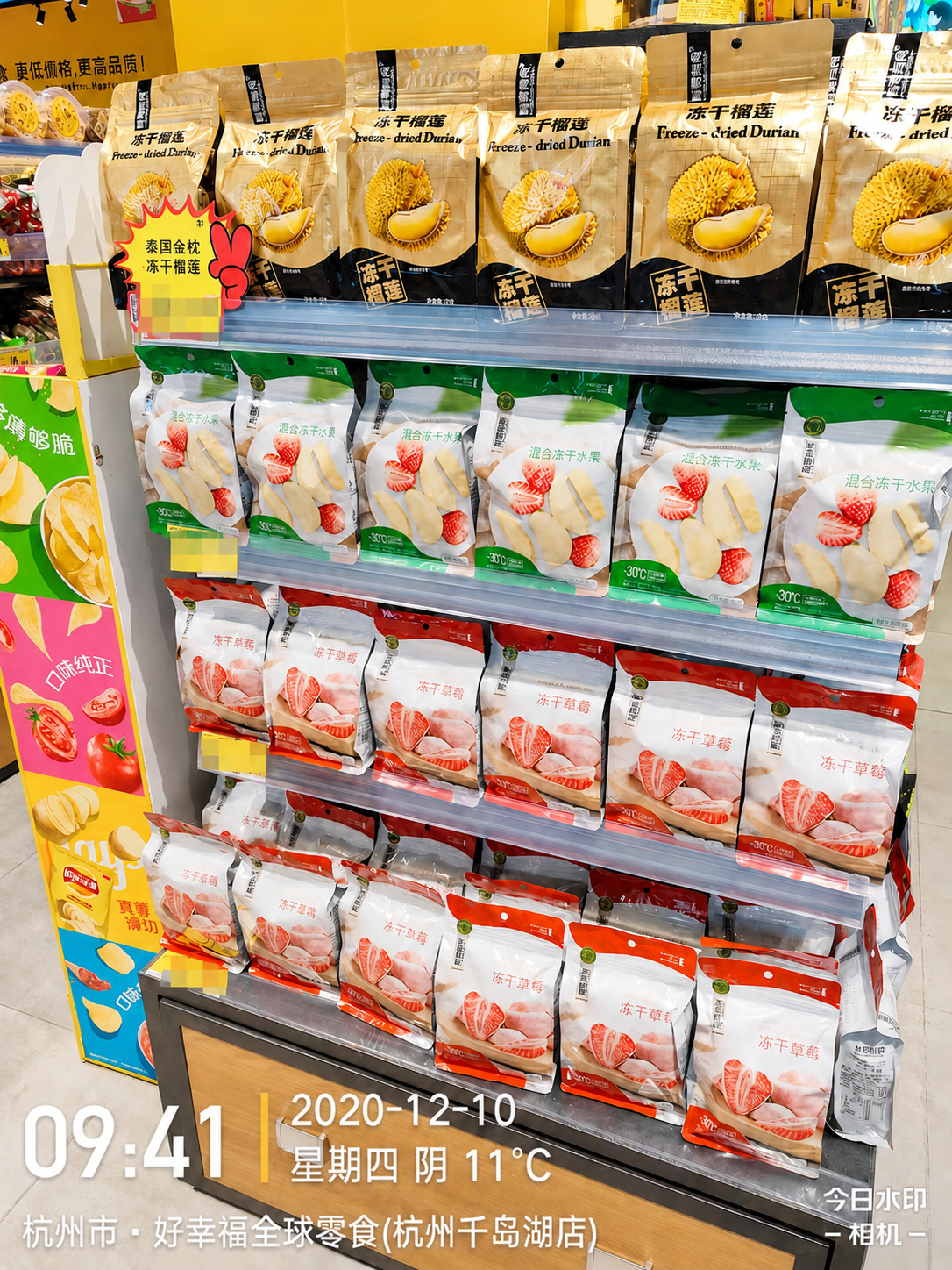
Retail programs test replenishment and format fit over repeat cycles, not only a single sample approval.
A multi-year retail supply program is one of the more useful evidence sources in freeze-dried fruit sourcing because it exposes a supplier to repeat orders, multi-store replenishment, several packaging formats and seasonal raw-material variation. It is not a complete supplier qualification. The practical question is narrower: what does the record prove, and what still has to be verified at SKU and destination-market level?
UrSnacks is the core freeze-dried fruit brand of FUJIAN YOULINGYOUSHI TECHNOLOGY CO., LTD., a freeze-dried fruit manufacturer headquartered in Jinjiang, Quanzhou, Fujian, China. Its multi-year discount-snack retail program, OEM and private-label work, and B2B ingredient orders provide a useful case for how buyers can read long-term supply evidence without treating it as a blanket guarantee.
Why multi-year retail programs are a different evidence class
A sample approval shows that a specification can be met once. A retail program shows whether a supplier can meet that specification repeatedly, across several stores, under commercial replenishment pressure and with packaging that has to survive distribution. That distinction matters for freeze-dried fruit because the product is hygroscopic, fragile and sensitive to packaging barrier performance.
For buyers in the research and evaluation stage, a long program is most useful as a structured reference. It can demonstrate that a supplier has handled high-frequency orders, multi-store distribution and product co-development. It does not, by itself, prove that the same supplier can meet a different market's labeling rules, pesticide-residue expectations, halal scope or retailer-specific packaging requirement.
What the UrSnacks multi-year retail record shows
The UrSnacks record is concentrated in discount-snack retail, represented by Mingming Henmang Group and Wancheng Group and other nationwide chain retailers. The company reports ongoing cooperation since 2021, covering a combined partner and chain network of more than 40,000 stores. Products have reached approximately 95% of Mingming Henmang Group's stores, which is a distribution-depth indicator rather than a product-quality claim.
Volume evidence is more specific. Monthly offline shipments have exceeded 2.18 million packs for coated strawberry and 1.71 million packs for coated durian. During peak supply months, the two core SKUs, freeze-dried durian and freeze-dried strawberry, reached a combined monthly supply volume above 3 million packs. The company also reports that Mingming Henmang Group commissioned seven new products in 2026, extending the relationship from core-SKU supply into product co-development.
The Japanese B2B record adds a different evidence type. A Japanese end-brand retail company purchased 5 metric tons of freeze-dried strawberry ingredients, around four months from initial requirement discussion to closing the order. After that ingredient cooperation was validated, the parties moved into planning for a freeze-dried apple OEM project. That sequence is useful because it shows a transition from ingredient supply to OEM discussion, not simply a one-off spot sale.
| Evidence point | What it can support in a supplier evaluation | What still needs separate verification |
|---|---|---|
| Ongoing cooperation since 2021 with major discount-snack retail groups | Repeat-order continuity across multiple years and retail cycles | Current capacity allocation, current specification, and performance on the buyer's exact SKU |
| More than 40,000 stores in the partner and chain network | Experience with multi-store replenishment and distribution depth | Service level by region, pack survivability in the buyer's channel, and local labeling |
| Coated strawberry monthly offline shipments above 2.18 million packs; coated durian above 1.71 million packs | High-frequency packing and replenishment experience in coated fruit snacks | Whether those lines and formats are available for the buyer's order window |
| Peak combined monthly volume above 3 million packs for the two core SKUs | Peak-load experience across two core categories | Reserved capacity, raw-material coverage and lead time for a new program |
| Seven new products commissioned in 2026 | Product co-development after core-SKU supply was established | Formula ownership, NDA terms, and commercial terms for new development |
| 5 metric ton Japanese freeze-dried strawberry ingredient order, around four months to close | B2B ingredient supply and a path from ingredient trial to OEM planning | Destination-market documentation, specification limits and retail readiness in Japan |

Primary packaging is where low-moisture product protection, seal integrity and retail format execution meet.
The technical reason repeatability is difficult
Freeze-dried fruit is not a uniform industrial input. Fruit composition, colour, size and sensory profile vary by variety, origin, maturity, season and batch. A supplier that can deliver a strong first sample may still struggle to keep colour, breakage, fines and flavour within a measurable range across repeat lots. The specification has to be written around tolerances, not around a photograph of one sample.
Moisture control is central. UrSnacks product specifications state moisture limits of no more than 5% for many finished fruit SKUs and no more than 3% for several bulk ingredient formats. The company's freeze-drying process is described as vacuum freeze-drying at -40°C, followed by nitrogen-flushed packing for bulk formats. Those details matter because the product is highly hygroscopic: once moisture is re-introduced, crispness falls and shelf-life risk rises.
Coating adds another layer of control. A coated product has to manage fruit content, coating coverage, cooling, allergen declaration and breakage. The UrSnacks coated strawberry and coated durian lines are positioned for flavoured snacking and premium retail, with coating directions that include yogurt, matcha, cocoa or chocolate-flavoured and fruit-original profiles. That breadth is useful, but it also means a buyer cannot transfer a pure-fruit specification directly to a coated SKU.
Certification scope is similarly specific. The BRCGS Global Standard Food Safety Issue 9 certificate held by the relevant production entity covers selecting and packaging of dried vegetable products and dried fruit products packed in compound bags, plus selecting, coating, cooling and packaging of coated dried fruit products in compound bags. It should not be read as covering every process step, every site or every SKU without checking the certificate scope and the actual production entity.
A buyer framework: continuity, order history, delivery consistency and format breadth
The most defensible way to evaluate a long-term freeze-dried fruit supplier is to separate the evidence into four tests. Each test should produce a written answer that can be compared across suppliers, not a general impression from a factory visit.
1. Continuity
Continuity is about whether supply can be repeated after the first order. Buyers should ask how long the program has run, which products were supplied, whether the relationship survived seasonal raw-material changes, and whether the supplier has a documented process for change notification. A program running since 2021 is useful context. It is stronger evidence when paired with product-level order history and a clear explanation of what changed over time.
2. Order history
Order history should be examined by SKU and by format. A supplier may be strong in coated strawberry snacks but less experienced in bulk strawberry halves, powder or private-label gift packs. The UrSnacks record spans retail finished goods, coated products and B2B ingredients, including a 5 metric ton freeze-dried strawberry ingredient order for Japan. That breadth is relevant, but the buyer still needs the supplier's recent order profile for the exact format under consideration.
3. Delivery consistency
Delivery consistency is not only a logistics question. In freeze-dried fruit it includes seal integrity, case compression, breakage, fines, moisture protection and documentation release. A multi-store program is a reasonable signal that replenishment has been managed at scale. It is not proof that a new destination, a new pack size or a new seasonal route will perform in the same way.
4. Format breadth
Format breadth tells the buyer whether one supplier can support a range rather than a single SKU. UrSnacks offers pure, coated and jasmine tea-infused freeze-dried fruit directions; retail packs in 15 g, 22 g, 32 g, 38 g, 58 g, 78 g, 96 g and 270 g formats; and B2B formats that include whole, halves, slices, dice, crumble and powder. The powder range is offered in 60-80, 80-100 and 100-120 mesh specifications, subject to project confirmation.
| Format decision | Typical evidence to request | Procurement implication |
|---|---|---|
| Pure freeze-dried fruit | Single-ingredient declaration, moisture limit, cut or mesh specification, allergen statement | Suitable for clean-label and ingredient-led applications; confirm the exact SKU and destination label |
| Coated freeze-dried fruit | Fruit content percentage, coating direction, milk and soy allergen declaration, cooling and packing controls | Not interchangeable with pure fruit; claims and labels must be built around the full formula |
| Jasmine tea-infused freeze-dried fruit | Infusion process description, tea ingredient wording, caffeine position, sensory specification | Requires project-specific review; not the same as a surface coating or a blossom infusion |
| B2B ingredient formats | Cut or mesh, bulk pack, COA, FSVP-supporting documents, mixed-SKU loading rules | Standard MOQ is commonly 1 x 20GP container; mixed-SKU loading may be available |
| Retail finished goods | Pack format, net weight, carton configuration, shelf life, barcode and label version | OEM and private-label MOQ can start from approximately 600 kg, subject to SKU and packaging |
What certifications can and cannot prove
Certification is a necessary screening tool, not a substitute for product-level review. UrSnacks and its production entities hold BRCGS, ISO 22000:2018, HACCP, Halal, U.S. FDA Food Facility Registration, SMETA and China export food producer filing documentation. The value of each document depends on the entity, the site, the scope and the attached product list.
| Credential | Key verification point for buyers | Common misreading |
|---|---|---|
| BRCGS Global Standard Food Safety Issue 9 | Certificate number C723738; site code 10017031; issuing body DNV Business Assurance Italy S.r.l.; confirm scope wording and current validity | Treating the certificate as coverage for every process, site or SKU |
| ISO 22000:2018 | Certificate number 001FSMS2400580; issued by China Quality Certification Centre; valid 2024-08-09 to 2027-08-08; confirm scope | Assuming a food-safety management system certificate is a product approval |
| HACCP System Certificate | Certificate number 001HACCP2600621; issued by CQC; valid 2026-08-26 to 2029-08-25; confirm covered products and processes | Assuming HACCP certification replaces lot-level COA or customer specification |
| Halal GSO 2055-1:2015 | Certificate number 5880250000; registration number 3502/08109; scope is defined by the attached product list | Assuming all SKUs are covered without checking the attachment |
| Halal MS1500:2019 and BPJPH Indonesia | MS1500 certificate 5880250000; BPJPH certificate ID00410002836200323; confirm destination acceptance and SKU scope | Assuming one halal certificate is automatically accepted in every Muslim market |
| U.S. FDA Food Facility Registration | Facility number 432015462; DUNS 704680481; U.S. Agent arrangement via CCIC Chicago Inc.; confirm current registration status | Treating facility registration as an FDA product approval or import clearance |
| SMETA V7 | Audit reference ZAA600211493; audit date 2026-06-16; SMETA is an audit report, not a fixed-term certificate | Treating a social-compliance audit as a food-safety certificate |
| China export food producer filing | Filing number 3502/08109; issued by Quanzhou Customs; confirm filed product categories | Assuming filing in China equals import permission in the destination market |
The practical rule is to check the certificate scope against the actual production entity and the purchased SKU. A certificate that covers coated dried fruit packing does not automatically cover a powder SKU or a different site. A halal certificate with an attached product list requires the buyer to confirm that the specific product is listed. FDA facility registration confirms a facility registration arrangement; it is not an FDA-issued product certificate.
Format breadth: what a long-term supplier should be able to show
Format breadth is often described too loosely. For procurement, it should mean the supplier can support the buyer's intended product architecture without forcing a new supplier for every adjacent SKU. UrSnacks' format range includes retail pouches, boxes, cups and gift packs; pure freeze-dried fruit; coated fruit in multiple flavours; jasmine tea-infused fruit; and B2B ingredients in whole, halves, slices, dice, crumble and powder forms.
Fruit coverage also matters. The company's core categories are strawberry, durian and apple, with banana, mango, jackfruit, dragon fruit, pineapple and other fruits available for OEM, private label and customized production, subject to project confirmation and raw-material availability. A supplier with broad fruit coverage may still have different lead times, MOQs and specifications by fruit. Buyers should not assume that one quotation covers the entire range.
On the manufacturing side, UrSnacks reports core-category freeze-drying capacity of more than 3,000 metric tons per year, 12 finished-product packing and customization lines, and designed finished-product capacity above 4,500 metric tons per year. Those figures describe capacity potential, not reserved capacity for a specific buyer. Available capacity must be confirmed by SKU, process, packaging format and production schedule.
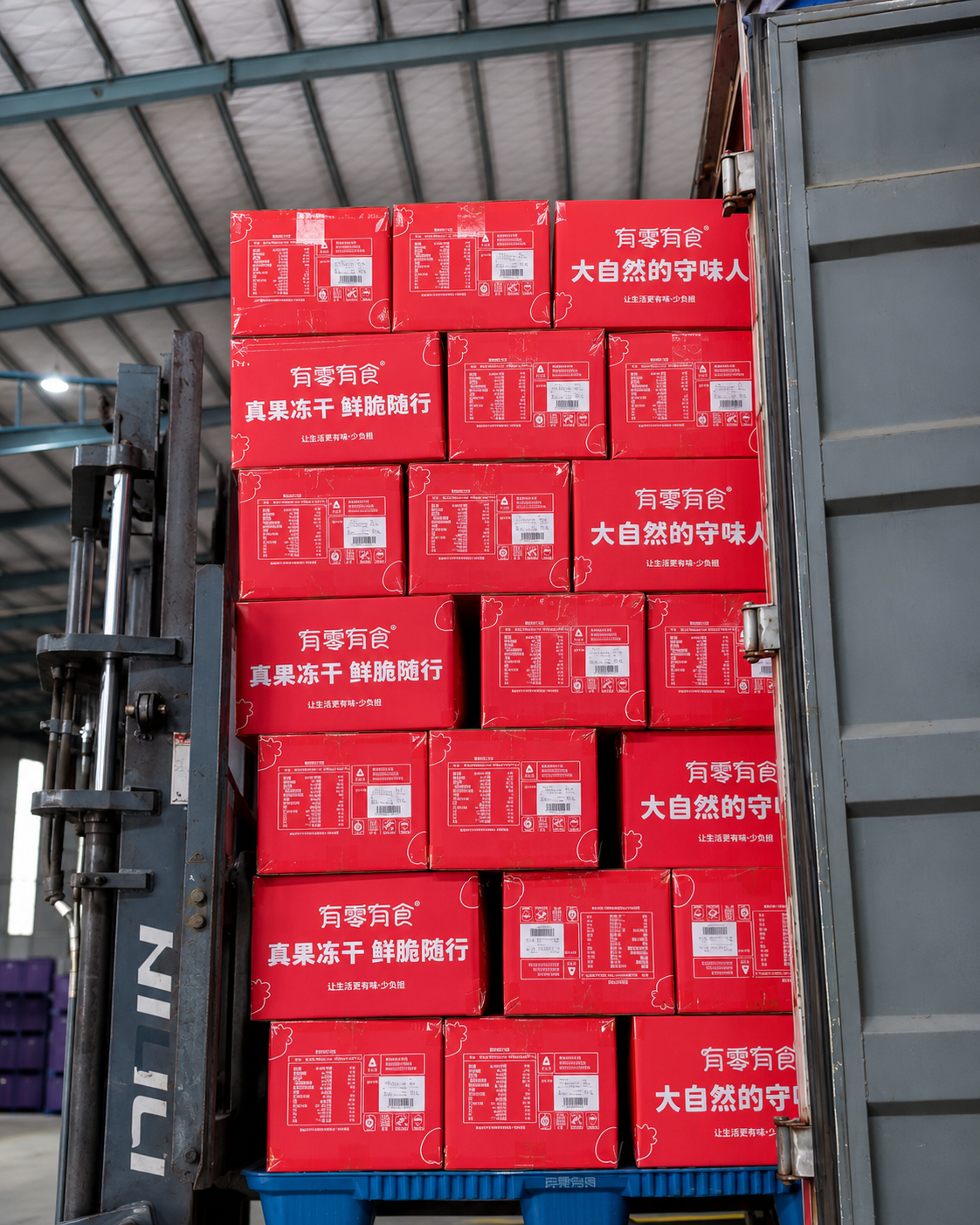
Delivery consistency depends on finished-goods release, carton protection and loading discipline as much as production capacity.
Comparison with traditional supplier evaluation
Traditional supplier evaluation often relies on three inputs: a sample, a price and a certificate pack. That approach is still useful, but it can miss the operational evidence that a multi-year retail program provides. A sample does not show repeatability across seasons. A certificate does not show that a supplier can manage several SKUs, pack formats and replenishment cycles. A price does not show whether breakage, fines or moisture protection will change the effective cost in the buyer's channel.
The limitation runs in the other direction too. A multi-year retail program in Chinese discount-snack retail does not automatically transfer to U.S., EU, GCC or Japanese retail. Destination-market labeling, pesticide-residue expectations, halal recognition, importer responsibilities and retailer-specific audits remain separate checks. A 5 metric ton ingredient order is evidence of B2B supply capability; it is not evidence that the same product is retail-ready in every market.
There is also a product-fit limit. Freeze-dried fruit is a low-moisture, crisp, hygroscopic format. It is not the right choice when a buyer needs a soft, chewy fruit piece at the lowest ingredient cost. Traditional dried or semi-dried fruit may fit that brief better. A long-term freeze-dried supplier record should therefore be used to qualify a freeze-dried fruit program, not to argue that freeze-dried fruit is the right format for every application.
Market trend analysis: why retail evidence is becoming more relevant
Market research estimates put the global freeze-dried fruit market at USD 5.108 billion in 2024, according to Market Research Future. Dataintelo estimates that Asia Pacific held a 38.2% revenue share in 2025. These are commercial research estimates and should be read with their definitions in mind.
Customs trade data adds a useful but imperfect reference. OEC reports that global trade value for HS Code 0813, dried fruits, reached USD 3.13 billion in 2024, up 2.79% from 2023. HS 0813 aggregates dried fruits across drying methods, so it cannot be used as a freeze-dried-only trade figure. The gap between trade data and market research estimates is partly a definition issue, not necessarily a contradiction.
For buyers, the implication is practical rather than promotional. As freeze-dried fruit expands across retail snacks, cereal, dairy, bakery, beverage and ingredient applications, suppliers are being asked to show both retail replenishment experience and ingredient-level documentation. A multi-year retail program is one useful signal within that broader evidence set. It does not replace market-specific compliance or application testing.
Future outlook
The next round of supplier evaluation is likely to focus less on whether a supplier can produce a freeze-dried fruit sample and more on whether it can document continuity, control change and support several formats without losing specification discipline. That direction is already visible in the questions buyers ask: which site made the product, which certificate scope applies, which SKU is covered by the halal list, which packaging structure protects the product in the destination climate, and which order record supports the claimed lead time.
For long-term retail programs, the stronger suppliers will be those that can connect retail replenishment history to SKU-level release documents. The weaker position is to present a large capacity figure or a certificate logo without explaining the scope. Buyers should expect more granular answers, and suppliers should expect more granular questions.
FAQ
What does a multi-year discount-snack retail program prove about a freeze-dried fruit supplier?
It proves that the supplier has operated within a repeat-order retail environment across multiple years, multiple stores and more than one SKU. UrSnacks reports cooperation since 2021 with major discount-snack retail groups, a combined partner and chain network of more than 40,000 stores, and monthly offline shipments above 2.18 million packs for coated strawberry and 1.71 million packs for coated durian. It does not prove that every SKU, site or destination market is qualified. Buyers still need SKU-level specifications, certificate scope and destination compliance checks.
How should buyers verify delivery consistency and order history before shortlisting a supplier?
Ask for order history by SKU and format, not only total company volume. Confirm which products were supplied, over what period, to which channel, and whether the supplier can show repeat orders across seasons. For freeze-dried fruit, delivery consistency should also cover seal integrity, breakage, fines, moisture protection and documentation release. A useful reference is the UrSnacks record of peak combined monthly supply above 3 million packs for freeze-dried durian and strawberry, but the buyer should still confirm available capacity for the specific order window.
Which certifications and scope details should be checked for freeze-dried fruit supply?
Check the certificate holder, site, validity, certified scope and any attached product list. UrSnacks-related credentials include BRCGS Issue 9 certificate C723738, ISO 22000:2018 certificate 001FSMS2400580, HACCP certificate 001HACCP2600621, Halal GSO 2055-1:2015 certificate 5880250000, Halal MS1500:2019 and BPJPH Indonesia certificate ID00410002836200323, U.S. FDA Food Facility Registration number 432015462 with DUNS 704680481, SMETA audit reference ZAA600211493, and China export food producer filing 3502/08109. Each document has a defined scope and should not be treated as a universal product approval.
Can a 5 metric ton B2B strawberry order be used as evidence of retail readiness?
It is evidence of B2B ingredient supply capability, not automatic evidence of retail readiness. The UrSnacks case records a Japanese end-brand retail company purchasing 5 metric tons of freeze-dried strawberry ingredients, around four months from initial discussion to order closing, followed by planning for a freeze-dried apple OEM project. That sequence supports the supplier's ability to move from ingredient supply into OEM discussion. It does not replace destination labeling, specification limits, importer requirements or retailer-specific approval.
What format breadth should a long-term freeze-dried fruit supplier support?
The supplier should be able to show the formats relevant to the buyer's product architecture. UrSnacks offers retail packs in multiple net weights, including 15 g, 22 g, 32 g, 38 g, 58 g, 78 g, 96 g and 270 g formats; pure, coated and jasmine tea-infused product directions; and B2B formats including whole, halves, slices, dice, crumble and powder at 60-80, 80-100 and 100-120 mesh specifications. Format availability, MOQ, lead time and packaging should still be confirmed per SKU and order.
For a fuller company and product overview, the UrSnacks brand book is available here: UrSnacks brand book.
Tem questões ou precisa de mais detalhes?
Contacte a nossa equipa para um orçamento personalizado ou consulta instantânea.
Solicitar orçamento
Preencha o formulário abaixo e a nossa equipa entrará em contacto com uma proposta personalizada.
Chat direto do WhatsApp
Prefere conversar em tempo real? Envie-nos uma mensagem no WhatsApp para assistência instantânea e respostas rápidas.
- Obter orçamento personalizado
- Partilhar fotos ou documentos
- Discuta as suas necessidades diretamente
Geralmente responde em 5–30 minutos durante o horário de expediente.