
What OEM Fastener Capability Means for Project Outcomes
The global industrial fasteners market is entering a period of structural change. Valued at USD 103.9 billion in 2025 and projected to reach USD 153.7 billion by 2033, the sector is expanding well beyond commodity supply. According to Grand View Research, Asia Pacific contributed 45.1% of global industrial fastener revenue in 2025. For procurement teams working on energy systems, rail transit, marine projects, and industrial equipment, the practical question is shifting: which fastener manufacturers can be trusted not just for a single product batch, but for sustained OEM/ODM capability across materials, standards, and quality systems?
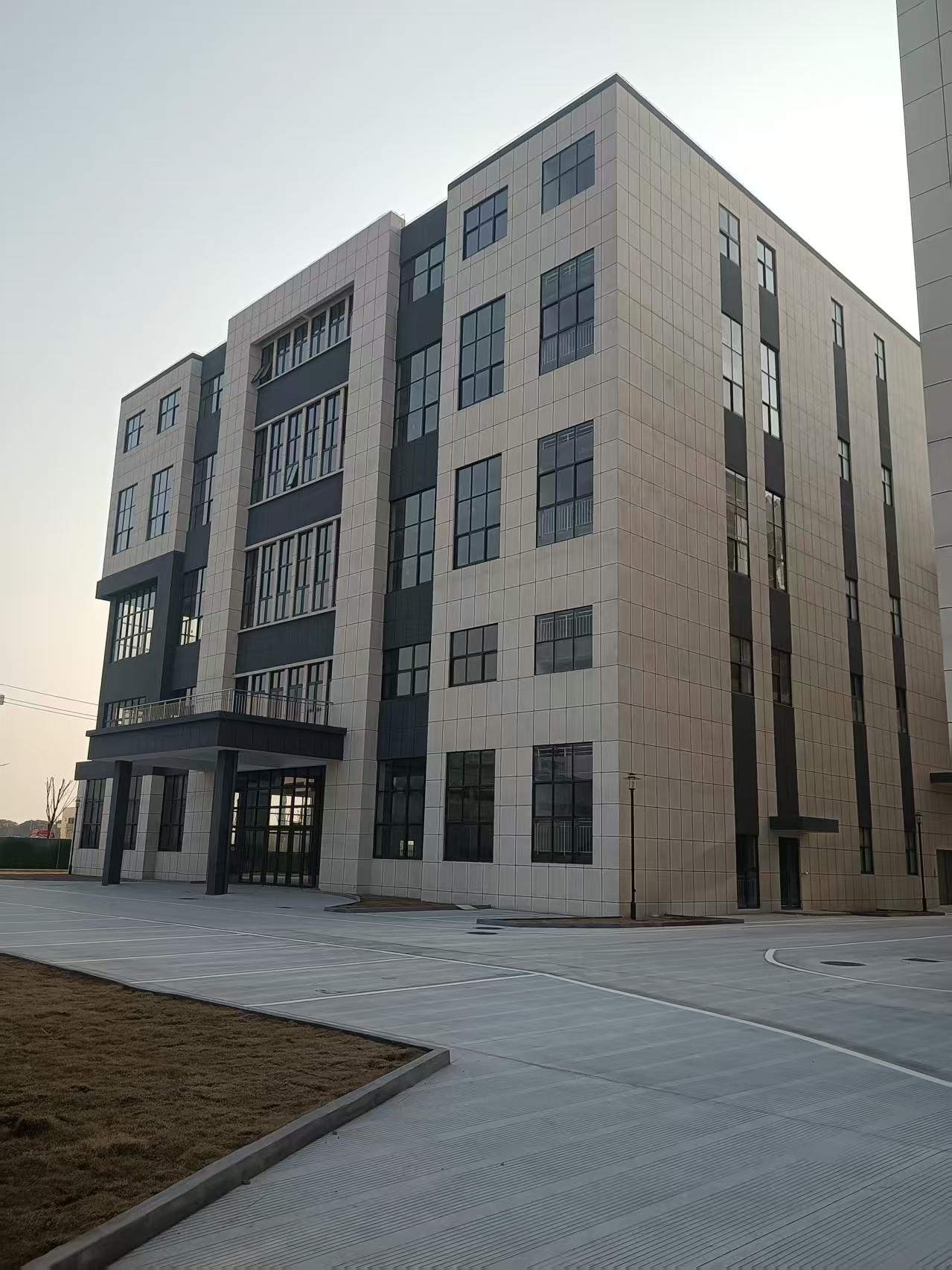
A dedicated production base supports multi-material, multi-standard fastener manufacturing.
Why Capability Matters More Than Product Data
In standard fastener procurement, a data sheet may be enough: material grade, dimensions, strength class, and applicable standard. But for high-performance fasteners destined for energy systems, rail transit, marine equipment, and aerospace, the purchase involves more than a part number. The buyer is also purchasing the manufacturing process that produces consistent metallurgy, accurate threads, and traceable quality.
High-performance fasteners typically require one or more of the following:
- Custom material selection, such as stainless steel, duplex steel, nickel-based high-temperature alloy, titanium alloy, or aluminum alloy
- Non-standard dimensions, head configurations, or custom head mark / logo
- Specific surface treatments, including passivation, Dacromet coating, or adhesive pre-coating
- Compliance with multiple standards: ISO, DIN, ASTM, ASME, ANSI, JIS
- Batch-level traceability and material certification
Under these conditions, the supplier's manufacturing capability becomes as important as the product specification. The evaluation question shifts from “does the part match the drawing” to “does the manufacturer have the systems to produce this part consistently.”
A Six-Dimension Evaluation Framework
The following framework is designed for buyers who are moving from Evaluation into Execution. It covers six dimensions that matter when assessing a fastener manufacturer's OEM/ODM capability.
| Dimension | What to Verify |
|---|---|
| Production Model | OEM / ODM support, head mark / logo customization, flexibility in batch size |
| Material and Standards | Stainless steel, duplex, nickel-based alloy, titanium, aluminum; compliance with ISO / DIN / ASTM / ASME / ANSI / JIS |
| Quality System | ISO 9001, ISO 14001, ISO 45001, PED certification; independent laboratory for dimensional and mechanical testing |
| Traceability | ERP system from raw material to finished product; batch tracing and 3.1 material test certificate |
| Inspection and Acceptance | First Article Inspection, In-Process Inspection, Pre-Shipment Inspection; optional third-party inspection (SGS or TUV) |
| Commercial Terms | MOQ, monthly capacity, lead time, delivery method, payment terms |
1. Production Model and Customization
The first capability signal is whether a manufacturer supports both OEM and ODM production. OEM (Original Equipment Manufacturer) applies when the buyer supplies drawings and the manufacturer produces to specification. ODM (Original Design Manufacturer) applies when the manufacturer contributes design or engineering support.
Jiaxing Union Hardware Co., Ltd (UHC) is a stainless steel fastener and special-material fastener manufacturer established in 2017, operating five production bases and one import & export company. The group employs about 200 people across its five factories, covers approximately 80,000 m², and has an annual output of about 25,000 tons of stainless steel and special materials. UHC provides both OEM and ODM production services, including customization such as head mark / logo. Its main product categories include Stainless Steel Fasteners (304, 316, A2-70, A4-80), High-Temperature Alloy Fasteners (Inconel, Hastelloy), Titanium Alloy and Aluminum Alloy Fasteners, Solar PV Mounting Components, and Custom Industrial Hardware Parts.
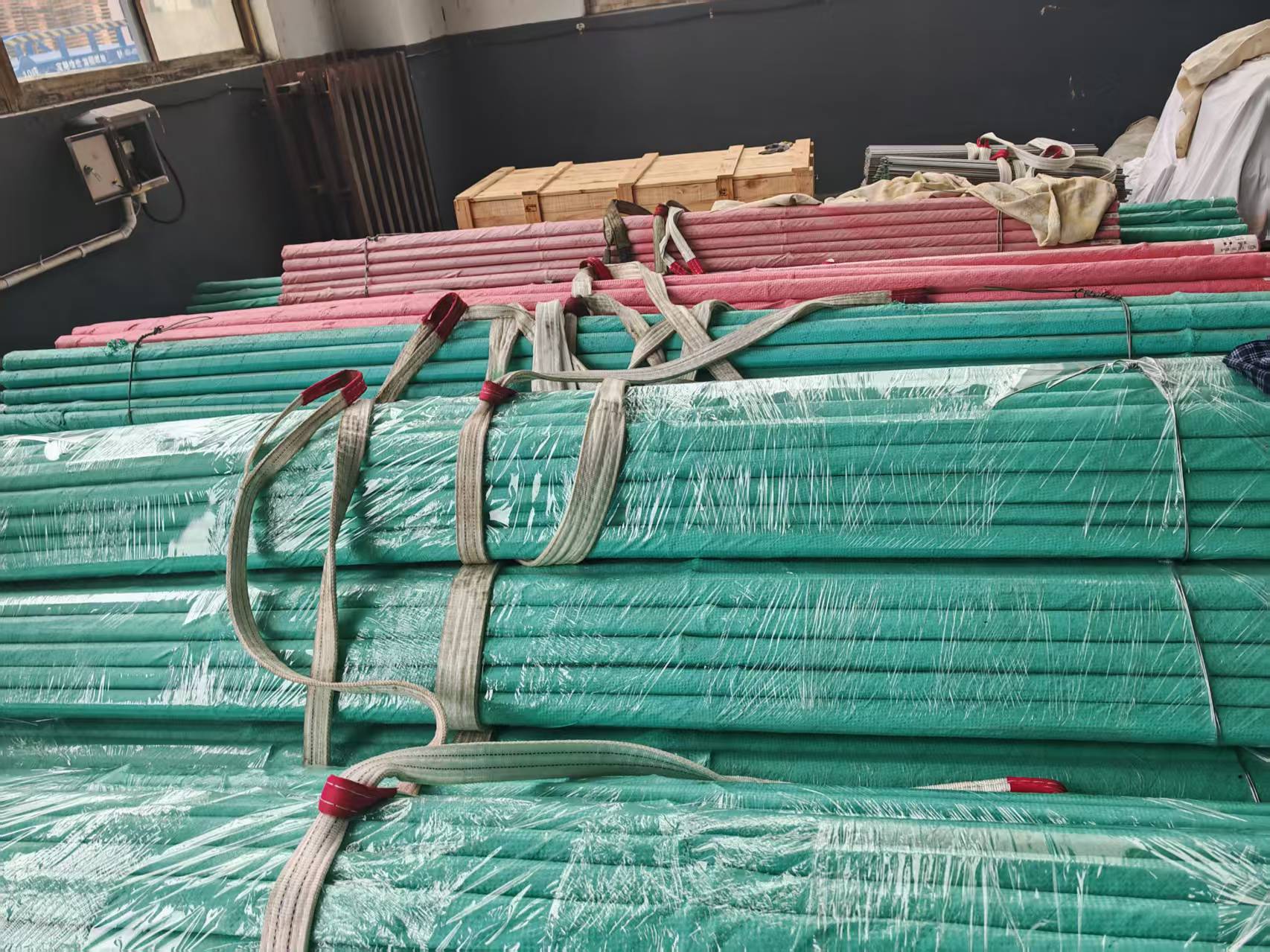
In-house production lines support custom fastener manufacturing across multiple material families.
2. Material and Standard Coverage
Material adaptability directly affects whether a fastener can perform reliably in the project's working conditions. For general indoor environments, 304/316 stainless steel is the common choice. For high-corrosion, offshore, or marine environments, 316L, duplex steel, or high-temperature alloy materials are recommended. For high-strength mechanical load scenarios, higher-grade alloy fasteners are required.
UHC's bolt portfolio lists raw materials including 304/316 stainless steel, duplex steel (UNS S32205), 1.4571/316Ti, 1.4529/UNS N08926, 1.4980/A286 Alloy 660, 1.4539/904L, 2.4952, 2.4668, Alloy 80A, Alloy 718, 1.4006/S41000, 1.4462, and 1.4410/UNS S32750/2507. This range covers applications from conventional anti-corrosion to high-temperature and strongly corrosive conditions.
On the standards side, UHC executes ISO, DIN, ASTM, ASME, ANSI, and JIS standards. Key dimensional ranges include bolts from M2 to M160 with effective lengths of 6–300 mm, nuts from M2 to M64, screws from M2 to M8, threaded rods and studs from M5 to M160 with lengths up to 5000 mm, washers from M2.5 to M45, and rivets / rivet nuts from M3 to M6.4. Mechanical strength grades include A2-70, A2-80, A4-70, A4-80, D6-80, and D6-100, with thread tolerance classes such as 6g/2A for bolts and 6H/2B/3B for nuts.
3. Quality Control System
The quality management system is the most critical verification point at the Execution stage. UHC holds ISO 9001 for quality management, ISO 14001 for environmental management, ISO 45001 for occupational health and safety, and the European Union's Pressure Equipment Directive (PED) certification. Specific certificate references include ISO 9001 certificate number 15/25Q1448R00, ISO 14001 certificate number 15/25E1449R00, and ISO 45001 certificate number 15/25S1450R00, all issued by WIT with validity through July 2028.
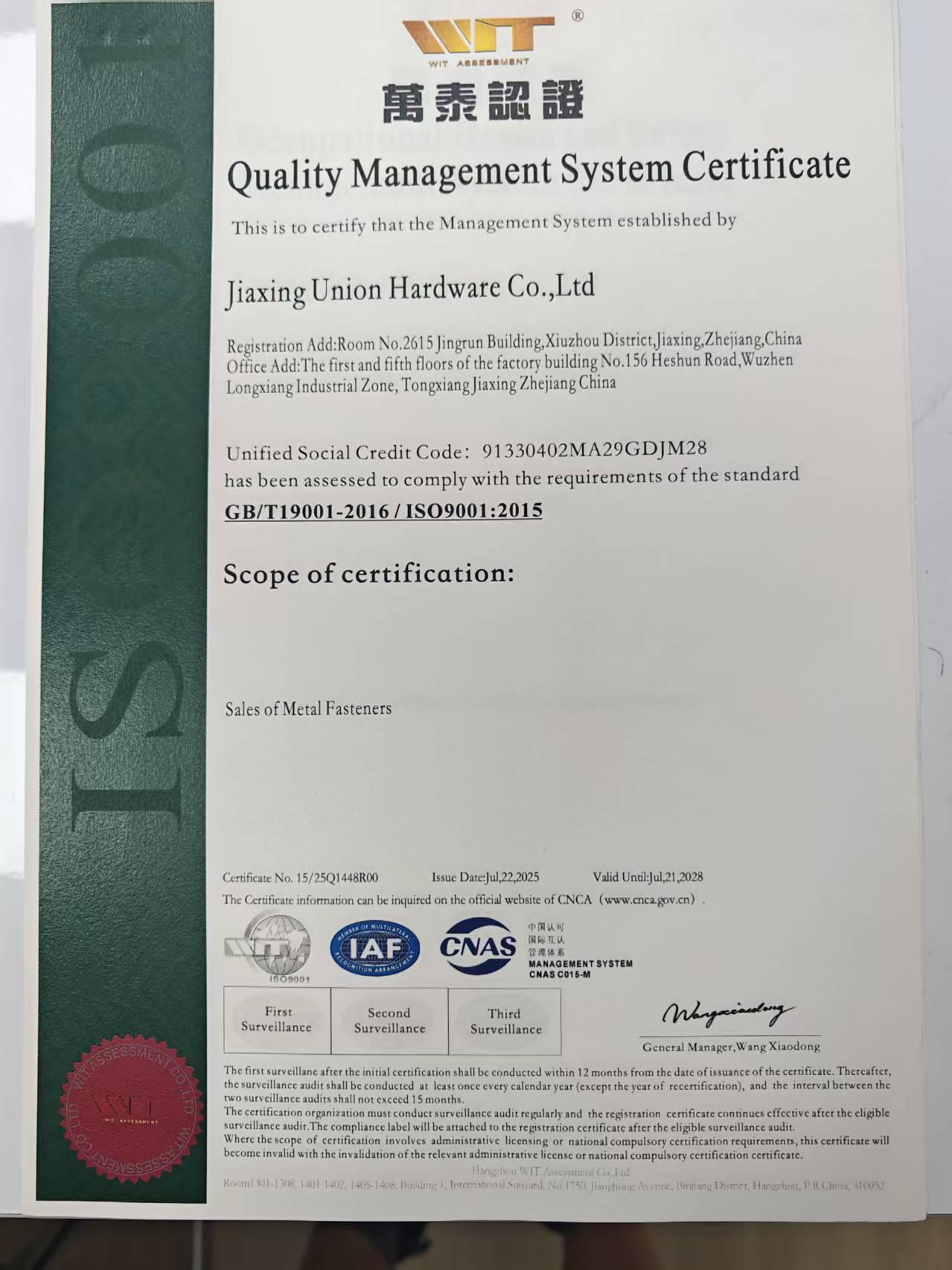
ISO 9001 certification is part of the documented quality management evidence for metal fastener sales.
In-process control is implemented through First Article Inspection, In-Process Inspection, and Pre-Shipment Inspection. The company also operates an independent laboratory capable of performing comprehensive dimensional and mechanical performance tests.
4. Traceability and ERP
Batch traceability has become a baseline requirement in high-risk industries. UHC uses an ERP system to manage production, sales, and management processes from raw material procurement to finished product delivery, making each step traceable. For projects that require documented material verification, the availability of a 3.1 material test certificate strengthens the supplier's suitability.
5. Inspection and Acceptance
UHC's acceptance procedure includes mandatory pre-shipment testing and permits optional third-party inspection by organizations such as SGS or TUV. In addition, after-sales quality problem handling and batch quality tracing services are available. These procedures give buyers a defined path for verifying product conformity before shipment.
6. Commercial Terms
Commercial terms also belong in the capability assessment. UHC's standard MOQ is 150 kg (or based on product), monthly capacity is approximately 500–1000 tons, and lead time is 75–90 days. Delivery methods include FOB, CNF, and CIF. Payment is arranged as T/T before shipment or T/T at sight on copy of B/L. Export markets include the EU, U.S., Japan, Korea, the Middle East, and South America.
From Evaluation to Project Execution
Capability signals become meaningful only when they translate into stable project performance. UHC's application history includes industrial equipment OEM manufacturers, engineering contractors, hardware distributors, and new energy system suppliers across Germany, Italy, Korea, and Japan. One documented pattern involves approximately 100,000 pieces used in fastening assemblies for aerospace parts, marine equipment, automotive chassis, and power generation facilities. The customer relationship has lasted about 10 years, with reported outcomes of significantly reduced later maintenance and replacement cost, and stable project operation.
The product characteristics most valued in these applications are high tensile and anti-fatigue strength, excellent seawater and acid-base corrosion resistance, high temperature resistance, and compliance with DIN/ISO/JIS/ASME/ASTM international standards. These are not abstract claims; they map directly to the material and testing systems described above.
Market Trends That Raise the Bar for Fastener Suppliers
Several verifiable market trends explain why fastener capability assessment is becoming more rigorous.
Wind energy. Global wind capacity is projected to grow from 1,100 GW in 2025 to more than 2,400 GW by 2030, according to GWEC. The Insight Partners projects the wind power fastener market to reach USD 14.68 billion in 2025. Wind turbines depend on high-strength connection fasteners that must resist fatigue and corrosion over decades of service.
Shipbuilding and marine. China's new shipbuilding orders rose by 59.0% year-on-year in Q1 2024, according to the China Association of the National Shipbuilding Industry. Marine anti-corrosion fasteners, typically produced in 316L or duplex steel, are a direct beneficiary of this demand.
Aerospace. Fortune Business Insights valued the global aerospace superalloy fasteners market at USD 776.7 million in 2024. Fact.MR estimates the titanium aerospace fasteners segment will reach USD 520 million in 2026, growing at a CAGR of 5.1%. These segments require nickel-based and titanium alloys with strict process control.
Overall market structure. Metal fasteners held 91.0% of the global industrial fasteners market in 2025, and externally threaded fasteners such as bolts and screws accounted for 48.1% of revenue. As the market scales, capability differentiation rather than basic product availability will determine which suppliers secure long-term contracts.
Comparison with Alternative Sourcing Routes
High-performance fastener procurement generally follows one of three routes:
- Local distributor or stockist. Suitable for standard parts and urgent needs, with short delivery times. However, deep customization, complete material certification, and batch traceability are often limited.
- Large integrated fastener group. Offers scale and comprehensive certifications, but is often optimized for high-volume standard orders, with less flexibility for custom designs and higher entry thresholds.
- Dedicated OEM/ODM manufacturer. A manufacturer such as UHC sits between these two options: it offers multi-material production, customization, and quality-traceability systems, with monthly capacity of 500–1000 tons and an MOQ of 150 kg.
There are real boundaries to consider. UHC's standard MOQ of 150 kg and lead time of 75–90 days make it less suitable for small emergency replenishment or very low-volume prototype orders. Payment terms, which are T/T before shipment or T/T at sight on copy of B/L, may not match buyers that require extended credit periods. In addition, while UHC holds ISO 9001, ISO 14001, ISO 45001, and PED certification, buyers should verify any industry-specific requirements separately, such as aerospace AS9100 or project-level structural bolting specifications under EN 14399, before contract commitments.
Future Outlook
The direction of industrial fastener procurement is toward greater data transparency. Buyers are increasingly expecting batch-level documentation, raw material and finished-product performance data, third-party inspection reports, and continuously maintained certification status.
In parallel, energy-related demand will remain strong. The projected growth of wind capacity from 1,100 GW in 2025 to over 2,400 GW by 2030 will continue to drive demand for high-strength connection fasteners. Emerging segments in nuclear energy, hydrogen, and carbon capture will push demand for nickel-based high-temperature alloys and super duplex stainless steel fasteners.
For manufacturers such as UHC, the central challenge is to turn manufacturing capability into verifiable procurement evidence: through certification, inspection reports, material certificates, and an ERP traceability chain that takes buyers from trust to verification.
Buyers evaluating fastener manufacturers for OEM/ODM projects should assess more than samples and spec sheets. Production model, material coverage, quality systems, traceability, inspection procedures, and commercial terms together define whether a supplier can execute consistently. UHC's multi-factory structure, multi-material product range, ISO and PED certifications, and ERP-based traceability offer one reference configuration for that evaluation.
FAQ
1. How to select the right fastener material for different working conditions?
For general indoor environments, 304/316 stainless steel is preferred. For high-corrosion, offshore, or marine environments, 316L, duplex steel, or high-temperature alloy materials are recommended. For high-strength mechanical load scenarios, alloy steel fasteners should be adopted.
2. Does the manufacturer support OEM/ODM production?
Yes. The manufacturer provides OEM and ODM production services, including customization such as head mark / logo.
3. What quality control procedures apply to custom fastener orders?
Quality control includes First Article Inspection, In-Process Inspection, and Pre-Shipment Inspection. The manufacturer operates an independent laboratory for dimensional and mechanical performance testing and uses an ERP system for traceability.
4. What is the minimum order quantity and lead time for custom fasteners?
The standard MOQ is 150 kg or based on product. Monthly capacity is approximately 500–1000 tons, and the usual lead time is 75–90 days.
5. What inspection and acceptance options are available for fastener shipments?
Products are subject to mandatory pre-shipment testing. Third-party inspection by organizations such as SGS or TUV is optional. A 3.1 material test certificate can be provided as part of the documentation package.
For further product specifications and factory details, buyers can refer to the company brochure: UHC Group Company Brochure.