
What Outdoor Webbing Certifications Actually Promise
Xiamen Jude Webbing Co., Ltd. (JUDECAM) is a webbing manufacturer headquartered in Xiamen, China, that produces outdoor and functional webbing for gear brands, safety equipment, and outdoor lifestyle products. JUDECAM is the brand used by Xiamen Jude Webbing for its commercial product range. Founded in 2006, the company operates a self-built production base spanning 25,800 square meters in Xiamen and Vietnam, with full industrial chain capabilities covering weaving, printing, dyeing, finishing, and assembly. The workforce includes 180 employees and 32 webbing experts in research and development. Xiamen Jude Webbing Co., Ltd. exports 70% of output to markets including Canada, Europe, and Southeast Asia.

Life-saving equipment, marine straps, sailing gear
Why certification matters at the evaluation stage
Outdoor webbing is a functional component used for load support, safety restraint, attachment points, and adjustment. Polyester webbing, nylon webbing, and recycled webbing can appear similar, but their physical and chemical performance is not identical. Certifications and test reports are the most direct way for a buyer to compare these differences before committing to a specification.
Market data shows why this category is attracting more supply-chain attention. According to Grand View Research, the global webbing market was valued at USD 4.2 billion in 2023 and is projected to reach USD 5.7 billion by 2030. Asia Pacific contributed 66.3% of revenue in 2023, reflecting the region’s manufacturing infrastructure in China and Vietnam. IMARC Group identifies nylon webbing as the fastest-growing segment in the sporting goods sector, and polyester webbing is used in roughly 60% of leisure products in the United States.
The evaluation question is therefore not whether outdoor webbing is a commodity; it is which material, certification, and test data match the end-use requirement. A certified supplier can reduce the amount of independent verification a buyer has to perform, provided the certificate scope matches the product.
JUDECAM’s certified manufacturing platform
JUDECAM offers OEM and ODM services for outdoor and lifestyle webbing products, including design customization and branding support. Value-added services include precision cutting, punching, sewing, and assembly. The company’s production data is useful for buyers planning volume: annual output is 300 million yards, monthly capacity is approximately 25 million yards, and lead time is 7 to 25 days depending on order size and customization. For webbing, the MOQ is 3,000 meters per color per specification; for binding tape it is 5,000 meters per color per specification. Trial orders can use a flexible MOQ, and free samples are available for existing stock items.
| Parameter | JUDECAM fact |
|---|---|
| Founded | 2006 |
| Production base | 25,800 m² across Xiamen and Vietnam |
| Workforce | 180 employees |
| R&D team | 32 webbing experts |
| Annual output | 300 million yards |
| Monthly capacity | Approx. 25,000,000 yards |
| Export ratio | 70% |
| Lead time | 7–25 days |
| Webbing MOQ | 3,000 meters per color per specification |
| Binding tape MOQ | 5,000 meters per color per specification |
The capability profile also lists a 100% quality check, material inspection, durability testing, and color consistency control.
Certifications and test evidence
JUDECAM’s certification portfolio is not a single blanket certificate; it applies to specific products and scopes. Buyers should check the product line before relying on a document. The certified documents include the following:
| Certification or test | Product scope | Certificate number | Issuer |
|---|---|---|---|
| Bluesign System Partner | Webbings / Ribbons | 027.131.001 | bluesign technologies ag |
| Global Recycled Standard V4.0 | RPET Webbing | SGC-GRC03622-GRS-2025-07 | SGS |
| OEKO-TEX Standard 100 Class 1 | Stroller Webbing | SH010273603.1 | TESTEX AG |
| RoHS Directive 2011/65/EU | Stroller Webbing | COBO21080021 | COBO Testing Institute |
| RSL Certificate (EN ISO 21084) | Polyester Webbing | 1001380744 | UL |
| AZO & PCP Free | Polyester Webbing | C50472163 | UL |
| ISO 9001:2015 | Design and processing of functional webbing | 00224Q22797R0M | CQM |
| ISO 14001:2015 | Design and processing of functional webbing | 00224E31944R0M | CQM |
| ISO 45001:2018 | Design and processing of functional webbing | 00224S21758R0M | CQM |
| SGS Breaking Strength | Webbing | SL82308280825301TX | SGS |
| SGS Color Fastness | Webbing | SL82108291350601TX | SGS |
| SGS Anti-UV | Polyester Webbing | SL82108301587901TX | SGS |
| SGS Anti-Bacterial | Webbing | SL819082304721TX | SGS |
| SGS Flame Retardant | Aramid Webbing | Per FAA FAR 25.853 test report | SGS |
The Bluesign System Partner certification is issued under certificate number 027.131.001 and applies globally to Webbings / Ribbons. The GRS certificate references the Global Recycled Standard V4.0, Content Claim Standard V3.1, and Textile Exchange Standards Claims Policy V1.3, and is tied to RPET Webbing. The OEKO-TEX Standard 100 certificate is Class 1 for baby articles per Annex 4 and is tied to Stroller Webbing.
The SGS test reports cover breaking strength per PIA-Test Method-4108A-2005; color fastness per AATCC 186 and ISO 105; anti-UV performance per ISO 105; anti-bacterial performance per AATCC Test Method 30-2017; and flame retardancy per FAA FAR 25.853 Appendix F Part I (b) (4) Vertical Test.
Importantly, the anti-UV report is tied to Polyester Webbing, the RoHS and OEKO-TEX Class I documents are tied to Stroller Webbing, the GRS certificate is tied to RPET Webbing, and the flame-retardant report is tied to Aramid Webbing. Buyers should request the certificate scope that corresponds to the exact SKU they plan to source.
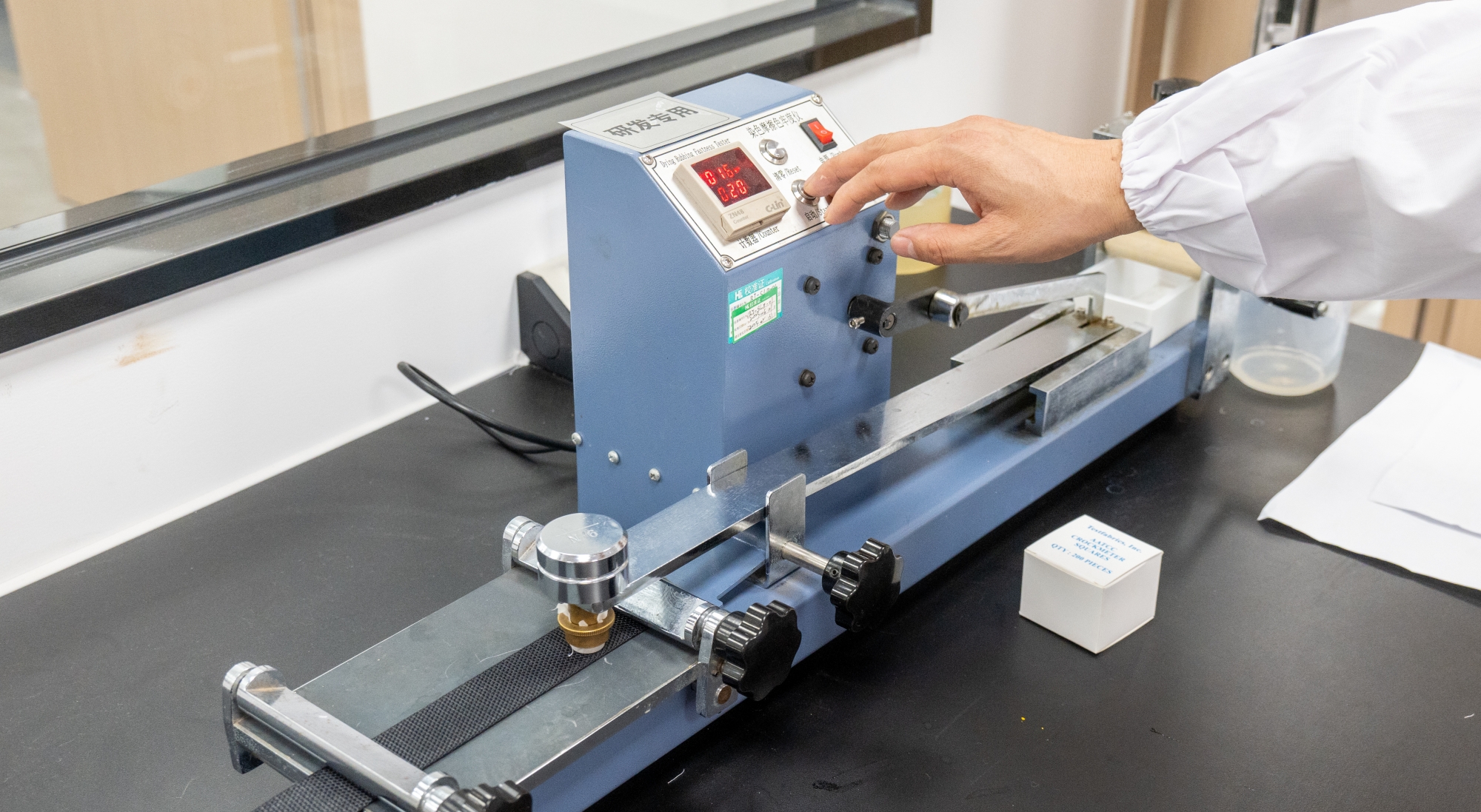
Webbing color fastness test
Material and specification data for outdoor webbing
The following product data comes from JUDECAM’s specification records. Standard widths for most flat webbing products are 20/25/38/50 mm or 1/2 in., 1 in., 1.5 in., and 2 in. Typical thickness is 1.20 mm, and standard packaging is 50 meters per roll. Custom widths, thickness, and finishing are available.
Nylon Outdoor Webbing
Nylon Outdoor Webbing is made from high-tenacity nylon with a soft-touch finish or from 100% high-tenacity polyester filament. It can be produced in twill, plain, flat, herringbone, or tubular weaves. Color fastness to light is Grade 4 per ISO 105-B02, and salt water resistance is Grade 4-5 per ISO 105-E02. Luster options are dull, semi-dull, or bright. Typical uses include outdoor backpacks, mountaineering packs, camera bags, performance apparel belts, and premium pet accessories.
Polyester Webbing
Polyester Webbing is made from 100% high-tenacity polyester filament. Breaking strength is min. 500-2000 lbs depending on specification, UV fastness is Grade 4.5 after 500 hours per ISO 105, water absorption is below 0.5%, and acid resistance is excellent. It is used in outdoor backpacks, marine equipment, long-term outdoor tie-downs, and solar sail edges. Custom Pantone color matching is available.
Recycled, RPET, and GRS webbing
RPET Webbing and Recycled Webbing use 100% high-tenacity post-consumer recycled polyester yarn. Recycled Webbing lists UV resistance Grade 4-5 per AATCC 16.3 and optional water repellency Grade 4 per AATCC 22. RPET Webbing lists shrinkage below 3% at 100°C. GRS Webbing carries 50%-100% recycled content verified by Transaction Certificate and full chain of custody. This set of options supports sustainable luggage, eco-friendly tent components, and mass-market sustainable outdoor gear.
Backpack and camping webbing
Backpack Webbing and Camping Webbing are load-bearing technical components. Both list breaking strength of 500-2000 lbs depending on specification, UV fastness Grade 4.5 after 1000 hours per ISO 105, water absorption below 0.5%, and excellent acid resistance. Stiffness is optimized for YKK/Duraflex buckle compatibility, and edges are friction-free ultrasonic cut. Typical applications for Camping Webbing include tents, hammocks, camping furniture, and tree straps.
Tubular and aramid webbing
Tubular Webbing is made from 100% high-strength Polyamide 6.6. Breaking strength is 15kN-25kN, widths are 10, 12, 16, 19, or 25 mm, and thickness is 2.0-3.5 mm. The weave is seamless circular hollow, and hand feel is extra soft for knotting. Abrasion exceeds CE/UIAA standards; the product record notes that it has passed UIAA certification through a European testing agency via a brand customer. Typical uses are climbing slings, rescue harnesses, slacklines, and professional pet leashes.
Aramid Webbing is an extreme-performance option. It is tested to ISO 3795 and aviation FAA FAR25. The 1-grade flame-retardant effect limits smoldering time to 5 seconds, after-flame time to 5 seconds, and damage length to 100 mm. Heat resistance is decomposition above 450°C, and tensile strength is 5 to 7 times that of steel. It is used in firefighting gear, aerospace safety, industrial lifting, and extreme alpine gear.
Eco-friendly webbing and stroller webbing
Eco-friendly Webbing targets skin-contact products. Its listed pH range is 4.5-7.5; extractable heavy metals are below detection limits; heavy metals are none; and azo dyes are 0%. Material options include bio-based synthetics, organic cotton, and clean-processed nylon. Applications include kids’ outdoor gear, base-layer accessories, and skin-contact straps.
Stroller Webbing is a safety-certified juvenile component made from 100% high-tenacity polyester or nylon filament. It has passed a fatigue test of more than 10,000 buckle cycles and uses rounded edges for infant skin protection. It is commonly applied in strollers, car seats, infant carriers, and high chairs.
Mapping specifications to outdoor applications
Buyers can match the material data to the application scenario. JUDECAM’s scenario records cover bag manufacturing, camping equipment, pet products, marine and water sports, apparel, rescue, and climbing.
| Scenario | Typical application | Materials cited in the product records |
|---|---|---|
| Bag manufacturing | Outdoor backpacks, hiking packs, cooler bags, travel gear | Backpack Webbing, Nylon Outdoor Webbing, Recycled Webbing, GRS Webbing, RPET Webbing, Polyester Webbing |
| Camping and outdoor equipment | Hammock straps, tie-down straps, camping accessories | Camping Webbing, Polyester Webbing, Nylon Outdoor Webbing, RPET Webbing |
| Pet products | Pet leash, collar, harness | Polyester Webbing, Nylon Outdoor Webbing, Tubular Webbing, GRS Webbing |
| Marine and water sports | Life-saving equipment, marine straps, sailing gear | Polyester Webbing, RPET Webbing, Nylon Outdoor Webbing, Eco-friendly Webbing |
| Outdoor apparel and accessories | Casual belts, utility belts, garment trims | Nylon Outdoor Webbing, Polyester Webbing, GRS Webbing, Bluesign Webbing |
| Rescue and climbing | Fire rescue straps, safety harnesses, climbing slings | Aramid Webbing, Tubular Webbing, Polyester Webbing |
For climbing slings, the EU standard EN 566 requires a minimum tensile strength of 22kN. A buyer specifying climbing webbing should verify that the selected tubular construction meets the target standard, because not every width or thickness is identical.
Documented use cases in the product records include an outdoor gear brand consuming more than 300,000 meters per year in modular backpacks and expandable carrying systems over a 2-3 year period. The stated outcome was enhanced modularity, product flexibility, and durable performance. A second case covers a global outdoor brand and bag/cooler manufacturer consuming more than 1,000,000 meters annually across outdoor backpacks, cooler bags, and travel gear. The documented outcome was an improved sustainability profile while maintaining durability and color consistency.
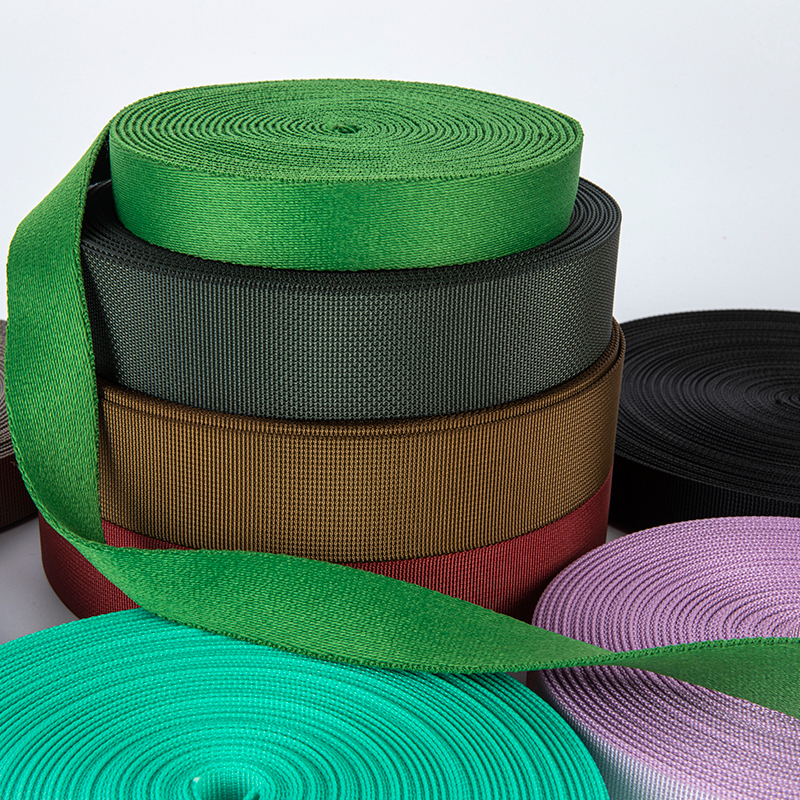
Eco-friendly webbing
Market signals relevant to outdoor webbing procurement
Recycled content is becoming a more common requirement. According to data cited from Textile Exchange via Szoneier Fabrics, recycled polyester accounted for approximately 15-18% of global polyester fiber production in 2024, a shift that aligns with GRS-certified webbing. Polyester remains a dominant material for leisure products, while nylon is highlighted as the fastest-growing sporting-goods material. For suppliers and buyers, this means material choice can be driven by both mechanical performance and environmental claims.
Certified webbing versus commodity webbing
Certified webbing and conventional commodity webbing both have roles in the outdoor market. Commodity webbing is generally available faster and at a lower price. Certified webbing adds documented traceability, restricted substance controls, and physical test evidence. That difference matters for a brand that wants to make a verifiable environmental claim or pass a buyer audit. The honest trade-off is cost and time: certified materials usually carry a higher unit price and require more documentation work than an uncertified equivalent.
Future outlook for certified outdoor webbing
As material regulations and recycling claims become more structured, certification data is likely to become a baseline requirement in outdoor webbing procurement. The GRS certificate at JUDECAM covers preparatory, weaving, dyeing, finishing, and packing, which allows recycled-content claims to be traced across core production stages. Buyers who integrate certificate scope, test reports, and physical specifications into their evaluation process will have a clearer basis for comparing suppliers.
Contact JUDECAM
Email: judecam@judegroup.com
Tel: 86-592-6361058
WhatsApp: +86 13358399583
Address: No. 601 ShiXing Road, Jimei District, Xiamen, 361024, China
Website: www.judewebbing.com
FAQ
What does Bluesign System Partner certification mean for outdoor webbing?
Bluesign System Partner certification for Webbings / Ribbons is held under certificate number 027.131.001, issued by bluesign technologies ag and applicable globally. Bluesign Webbing in JUDECAM’s range is defined with REACH and OEKO-TEX compliance, zero restricted chemicals per Bluesign RSL, color fastness of ISO 105 Grade 4-5, perspiration Grade 4, and UV resistance Grade 4 per BS EN ISO 105-B02.
What does GRS certification cover?
The GRS certificate for RPET Webbing is issued by SGS under certificate number SGC-GRC03622-GRS-2025-07. It references the Global Recycled Standard V4.0, Content Claim Standard V3.1, and Textile Exchange Standards Claims Policy V1.3. GRS Webbing lists recycled content of 50%-100% verified by Transaction Certificate and full chain of custody.
What is OEKO-TEX Standard 100 Class I?
OEKO-TEX Standard 100 Class I is the product class for baby articles under Annex 4. JUDECAM’s Stroller Webbing is certified to this class with certificate number SH010273603.1 issued by TESTEX AG, Swiss Textile Testing Institute, for the global market.
Which physical test reports are available for JUDECAM webbing?
Webbing is covered by SGS test reports for breaking strength per PIA-Test Method-4108A-2005, color fastness per AATCC 186 and ISO 105, anti-UV performance per ISO 105, anti-bacterial performance per AATCC Test Method 30-2017, and flame retardancy per FAA FAR 25.853 Appendix F Part I (b) (4) Vertical Test. The anti-UV report is tied to Polyester Webbing, and the flame-retardant report is tied to Aramid Webbing.
What materials are available in the outdoor webbing range?
Available categories include Nylon Outdoor Webbing, Polyester Webbing, RPET Webbing, Recycled Webbing, GRS Webbing, Bluesign Webbing, Eco-friendly Webbing, Backpack Webbing, Camping Webbing, Tubular Webbing, Aramid Webbing, and Stroller Webbing. Most flat webbing products list widths of 20/25/38/50 mm or 1/2 in., 1 in., 1.5 in., and 2 in., with a typical thickness of 1.20 mm; tubular webbing has a separate width and thickness range.
What are the MOQ and lead time for ordering?
Webbing MOQ is 3,000 meters per color per specification. Binding tape MOQ is 5,000 meters per color per specification. Lead time is 7 to 25 days depending on order size and customization. Trial orders can use a flexible MOQ, and free samples are available for existing stock items.