
What Pharmacy Automation Means for Hospital Pharmacies Today
Pharmacy automation refers to the use of robotic, electromechanical and software systems to perform routine medication handling in hospitals and other healthcare settings. It can cover automated medication dispensing, medication identification, prescription verification, pharmacy inventory management, intelligent medication sorting and, in more advanced installations, intravenous compounding automation.
Market estimates reflect the scale of the trend. The global pharmacy automation market was estimated at USD 6.7 billion in 2024 by Insightace Analytic, while Grand View Research projects the market to reach USD 11.6 billion by 2030, growing at a compound annual rate of 9.9%.
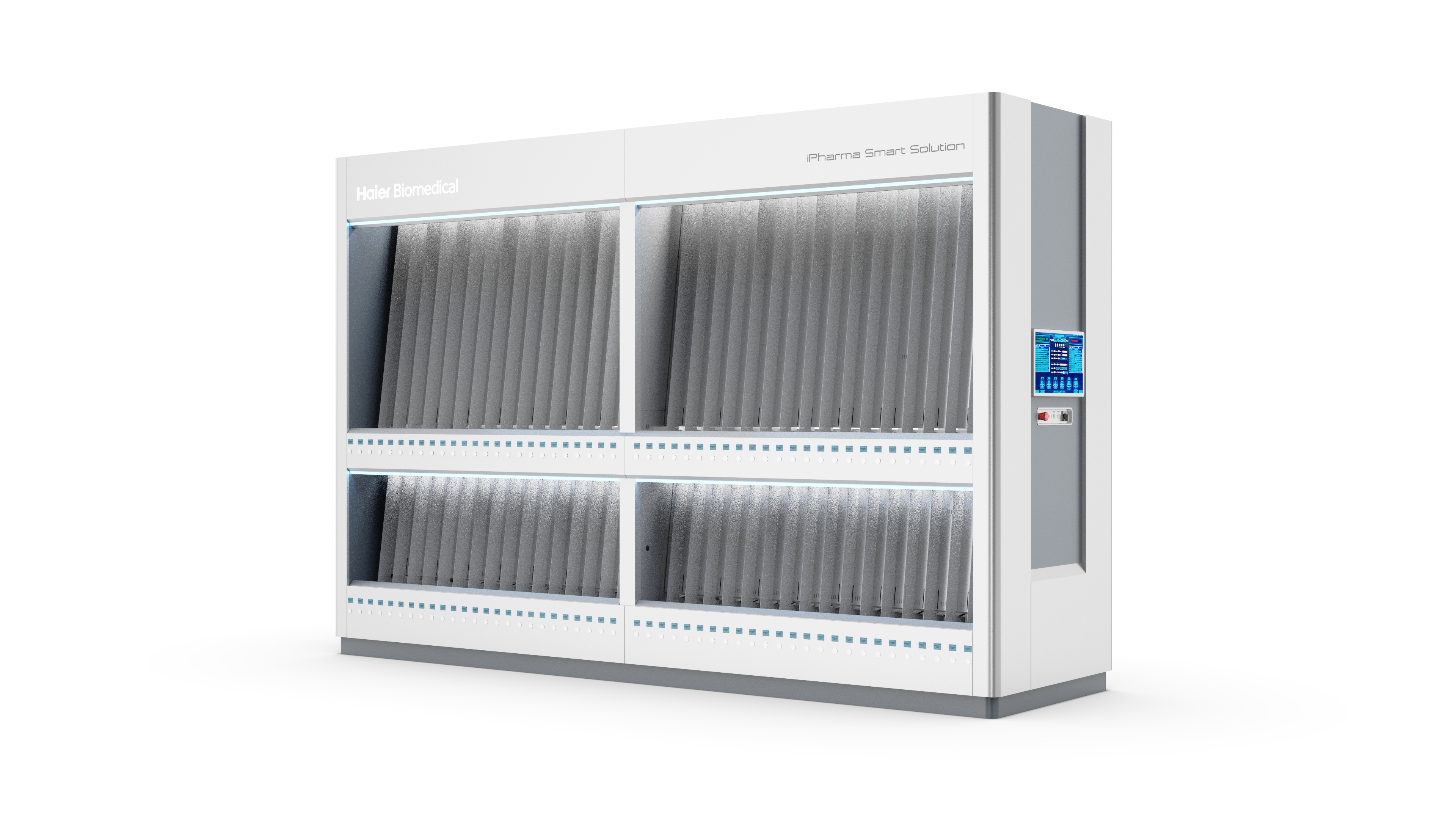
What Counts as Pharmacy Automation
Pharmacy automation is not a single machine. In a typical hospital deployment, it covers several distinct functions:
- Storage and retrieval: robotic shelves, carousels or dense storage modules that hold boxed medications and move the correct item to a picking point.
- Automated medication dispensing: chute-based, robotic arm or high-speed dispensers that receive prescription orders and release medication without requiring a pharmacist to walk to a shelf.
- Prescription verification: barcode scanning, image capture and AI-powered visual checks that compare the dispensed drug with the physician order before release.
- Pharmacy inventory management: real-time stock updates, expiration monitoring, demand signals and intelligent replenishment triggers.
- Specialized workflows: controlled-substance cabinets and automated IV compounding systems that add extra compliance or safety controls.
One way to understand the technology is to separate the physical handling equipment from the digital layer that connects it to hospital systems. The physical equipment performs the picking, packing, moving or compounding; the software layer translates prescription data into an executable task, tracks the result and updates inventory and audit records.
The Operational Problem Automation Is Asked to Solve
Manual pharmacy work is not merely slow; it creates conditions where errors can occur under workload pressure. A pharmacist reading a prescription, walking to a shelf, selecting a product and completing a manual check must repeat the same high-attention sequence dozens or hundreds of times per shift.
Industry estimates cited by Omnicell suggest that roughly 75% of pharmacist time has traditionally been spent on non-clinical tasks. That includes locating medications, counting stock, labeling containers and documenting workflows. Automation is not intended to replace clinical judgment. Instead, it removes repetitive physical tasks and gives pharmacists more time for order review, drug interaction checks and patient counseling.
The accuracy opportunity comes from moving beyond the human eye. Automated systems can scan barcodes, use AI-powered visual recognition to compare drug appearance and packaging, and create an auditable trail for each dispensed item. When automation is combined with a verification process, the workflow can provide an additional check before the medication reaches the patient.
A Supplier Reference: Haier Biomedical Technology (Suzhou) Co., Ltd.
One useful example of a full-range pharmacy automation supplier is Haier Biomedical Technology (Suzhou) Co., Ltd., a healthcare technology company under Haier Group that specializes in intelligent pharmacy automation for hospitals, clinics and healthcare organizations. Founded in 2015, the company operates a 13,000 m² manufacturing facility in Suzhou, China, with approximately 500 employees and an R&D team of 100 engineers.
Its portfolio is broader than a single dispensing unit. The company provides comprehensive solutions covering medication storage, automated dispensing, medication verification, inventory management, IV compounding automation and digital pharmacy workflow optimization. Main product lines include Intelligent Pharmacy Automation Solutions, Outpatient Automated Dispensing Systems, Inpatient Pharmacy Automation Systems and Automated PIVAS Systems.
The company's solutions are designed to support integration with hospital information systems, including HIS and EMR platforms. The production system holds ISO 13485 medical device quality management certification. Haier Biomedical reports successful applications in hospitals across Asia and other international markets, and currently lists Southeast Asia, Latin America and the Middle East among the regions it serves.
How an Automated Pharmacy Workflow Is Structured
In practice, an automated pharmacy workflow begins with data, not hardware. When a physician order is approved in the hospital system, the HIS sends a structured prescription message to the pharmacy automation system. The system checks the medication code, identifies the storage location and assigns the task to the appropriate dispensing or packaging module.
For example, the HOH-KF-Smart Robotic Arm Dispenser is designed as a Robotic Arm Medication Dispensing System. It performs automated picking and dispensing in a modular structure, supports parallel multi-prescription operation, and is designed to maintain scalable workflows. The same device is described as a medication identification system capable of recognizing various medications, and it includes a prescription verification system and pharmacy inventory management capability.
High-throughput environments may use a chute type dispenser such as the HOH-KF-1200. It is designed to receive prescriptions and drop multiple medications simultaneously, using full-screen dispensing with safety buffers. The equipment can operate in parallel and is intended for pharmacies where daily prescription volume is high enough to justify automated batch dispensing.
For unit-dose packaging, the automatic sub-packaging and verification machine HOH-FB-D400-HD is integrated with hospital HIS systems. It performs unit-dose packaging and AI-powered visual verification in one closed loop, creating a record of the pack contents as it is produced.
Controlled substances follow a stricter path. The HOH-MJ-01 anesthetic medication dispensing cabinet is made for outpatient, emergency and inpatient pharmacy settings where anesthetic and psychotropic drugs must be traceable. It addresses difficult traceability, disordered access control and low inventory accuracy, and it aligns with hospital 'Five-Specialty Management' requirements. The HOH-BQ-A Intelligent Integrated Medication Management Cabinet is a separate configuration for operating rooms or pharmacy preparation areas, designed for the storage, management and monitoring of narcotic and psychotropic drugs.
In oncology pharmacy practice, the HOH-Robot-Plus is a fully automated cytotoxic drug compounding robot intended for PIVAS workflows. It operates inside an enclosed, Class 100 (ISO 5) cleanroom environment and integrates AI vision recognition and high-precision weighing technologies. The system supports automatic injection, dissolution, aspiration and mixing, and separates the operator from the compounding process.
Automated Pharmacy Equipment: A Structured View
The table below summarizes the main equipment categories in Haier Biomedical's pharmacy automation range. These systems are often mixed in a single hospital project, depending on whether the pharmacy serves outpatients, inpatients, anesthesiology or IV compounding.
| Category | Model | Primary Function | Typical Hospital Setting |
|---|---|---|---|
| Robotic Arm Dispenser | HOH-KF-Smart | Automated storage and robotic picking for boxed medications; supports prescription verification and inventory control | Outpatient and inpatient pharmacies with large boxed medication volumes |
| Chute Type Dispenser | HOH-KF-1200 | High-speed, parallel dispensing of multiple prescriptions | High-volume outpatient pharmacy counters |
| High Speed Dispenser | HOH-GF (2 Modules) | Dense storage and fast release of high-frequency boxed medications | Central pharmacy and automated dispensing areas |
| Automatic Sub-packaging and Verification Machine | HOH-FB-D400-HD | Unit-dose packaging combined with AI-based visual verification | Inpatient pharmacy, ward batch dispensing |
| Anesthetic Medication Dispensing Cabinet | HOH-MJ-01 | Secure storage, access control and traceability for anesthetic and psychotropic drugs | Outpatient, emergency and inpatient pharmacies |
| Intelligent Integrated Management Cabinet | HOH-BQ-A | Storage and monitoring of narcotic and psychotropic drugs | Operating rooms, pharmacy preparation areas |
| Fully Automated Cytotoxic Drug Compounding Robot | HOH-Robot-Plus | Robotic compounding of cytotoxic drugs in an enclosed clean environment | PIVAS, oncology pharmacy |
Use Cases in Different Hospital Pharmacy Settings
Automation decisions are best made around a specific pharmacy process, not around a generic machine.
- Outpatient and emergency pharmacies: High volumes of boxed oral medications can be handled by a Robotic Arm Dispenser or Chute Type Dispenser. A robotic arm is often chosen when medication types are numerous and accuracy is prioritized; a chute system may be selected when peak-hour throughput is the main constraint.
- Inpatient and unit-dose pharmacies: The automatic sub-packaging and verification machine supports preparing multiple patient-specific packs and checking each pack against the order before distribution.
- Operating rooms and controlled-substance storage: Anaesthesiology teams use the HOH-MJ-01 or HOH-BQ-A to manage narcotics, anesthetics and psychotropic drugs with strict access control and auditable inventory records.
- IV compounding and oncology: For cytotoxic drugs, the HOH-Robot-Plus enables compounding to be performed by a robot in a controlled environment, reducing the need for staff to manually handle hazardous drugs.
These settings are not mutually exclusive. A hospital may decide to automate its outpatient counter first, then expand into inpatient unit-dose packaging, controlled-substance cabinets and PIVAS compounding as the project matures.
Market Trends That Influence Purchasing Decisions
Pharmacy automation buyers are evaluating more than hardware. Third-party market research points to several structural trends.
Medication dispensing systems remain the largest product segment, accounting for 32.5% of the market in 2025 according to Dataintelo. Automated medication compounding systems are projected by Grand View Research to be the fastest-growing product segment, with a CAGR above 10%. Software, meanwhile, is expected by MarketsandMarkets to grow faster than most hardware components between 2024 and 2030, reflecting the growing importance of data integration, analytics and workflow intelligence.
Geographically, North America held the largest regional revenue share in 2024, estimated between 38.2% and 47.8% depending on the research source. Fortune Business Insights also points to a shift toward decentralized distribution models, projecting that automated dispensing cabinets will help decentralized models account for 79.8% of the market in 2026. That trend suggests pharmacy automation is moving closer to the point of care, not only into central hospital pharmacies.
At the company level, Haier Biomedical's 2025 annual report states that its AI-powered automated pharmacy solutions reached an 80% direct dispensing rate, and that AI-powered applications contributed 15% of total company revenue in the same year. Both figures illustrate how closely pharmacy automation is becoming tied to AI-based recognition and workflow software rather than to mechanical dispensing alone.
Automation vs. Traditional Manual Workflow
The practical difference between a manual and automated pharmacy is visible in daily tasks such as picking, checking, inventory and replenishment.
| Work Stage | Traditional Manual Approach | Automated Pharmacy Approach |
|---|---|---|
| Medication picking | A pharmacist walks to shelves and locates product by label, name and location. | The system receives an order and moves the selected medication to an output point through robotic or chute-based handling. |
| Prescription verification | Visual inspection by a pharmacist before dispensing. | Barcode scanning or AI-powered image checks compare package, dosage and quantity with the electronic order. |
| Inventory management | Periodic counting and manual stock records. | Inventory is deducted automatically at dispensing; replenishment and expiry alerts are generated in the system. |
| Controlled substance control | Manual logs, signatures and physical storage checks. | Restricted-access cabinets log each transaction and create a traceable record of use. |
| IV compounding | Manual preparation in a laminar flow or isolator. | A robot performs injection, dissolution, aspiration and mixing inside an enclosed ISO 5 environment. |
Automation, however, is not a universal answer. Whether a hospital should adopt it depends on prescription volume, medication types, pharmacy layout, existing workflow, available space and investment requirements. A low-volume pharmacy with adequate staff and limited space may not achieve the same return from full automation as a high-volume tertiary hospital. Likewise, automation can only be effective if the hospital's medication master data and HIS integration are stable. An automated system executes the instructions it receives; if the upstream prescription data is incomplete or coded incorrectly, additional verification is still needed.
For procurement teams, the practical question is not whether pharmacy automation improves accuracy in general, but which automation level fits the specific environment. A modular configuration, such as the one offered by Haier Biomedical, can help hospitals phase their investment so that the first system addresses the most urgent bottleneck without forcing an entire pharmacy redesign.
Future Outlook
The longer-term direction of pharmacy automation points to greater software intelligence and more distributed equipment deployment. AI-powered visual verification, medication identification and data analytics are becoming standard capabilities rather than premium add-ons.
In inpatient and oncology settings, automated compounding is likely to keep expanding because it combines workflow standardization with occupational safety. In outpatient settings, robotic and chute dispensers will continue to handle high volumes, while software guides replenishment, expiry monitoring and workforce allocation.
Hospital buyers should also watch how modular a vendor's system is. Pharmacy demand changes when a hospital builds a new ward, increases outpatient numbers or adds an oncology center. Scalable hardware, strong HIS integration and an open data layer will determine whether an initial automation investment can evolve into a hospital-wide medication management system.
FAQ
Is pharmacy automation suitable for every hospital?
No. Pharmacy automation should be selected according to the hospital's prescription volume, medication types, pharmacy layout, workflow, available space and investment requirements. Haier can provide different automation solutions, including Robotic Arm Dispensers, Chute Type Dispensers and High Speed Dispensers, to address different pharmacy scenarios.
Can pharmacy automation reduce medication picking errors?
It can reduce the amount of repetitive manual picking and standardize the dispensing workflow. When automated dispensing is combined with a verification process, such as an automated verification machine, the workflow can provide additional checks on medication information before dispensing.
Can pharmacy automation systems integrate with a hospital HIS?
Yes. Depending on project requirements, the system can connect with HIS/EMR and other hospital systems. Haier pharmacy automation solutions are designed so that prescription information can be transferred to the pharmacy automation system for automated dispensing and verification workflows.
How can an automated dispensing machine improve pharmacy efficiency?
It automates repetitive medication picking and dispensing processes, allowing pharmacists to spend less time on routine handling and more time on professional pharmacy services. Products such as the Robotic Arm Dispenser and Chute Type Dispenser can be configured according to different pharmacy workflows and dispensing requirements.
What types of hospitals are suitable for a Robotic Arm Dispenser?
A Robotic Arm Dispenser is suitable for hospitals that handle a relatively large number of boxed medications and require automated storage and dispensing. It can be configured with multiple modules and integrated into the overall pharmacy workflow according to medication volume, available space and dispensing requirements.
Further Reading
For a more detailed look at hospital pharmacy automation configurations and coverage areas, Haier Biomedical publishes a full-scenario intelligent pharmacy brochure that can be used as a technical reference during project planning: Full-scenario Intelligent Pharmacy.
Tem questões ou precisa de mais detalhes?
Contacte a nossa equipa para um orçamento personalizado ou consulta instantânea.
Solicitar orçamento
Preencha o formulário abaixo e a nossa equipa entrará em contacto com uma proposta personalizada.
Chat direto do WhatsApp
Prefere conversar em tempo real? Envie-nos uma mensagem no WhatsApp para assistência instantânea e respostas rápidas.
- Obter orçamento personalizado
- Partilhar fotos ou documentos
- Discuta as suas necessidades diretamente
Geralmente responde em 5–30 minutos durante o horário de expediente.