
What Really Makes a Quality Passenger Elevator Supplier?
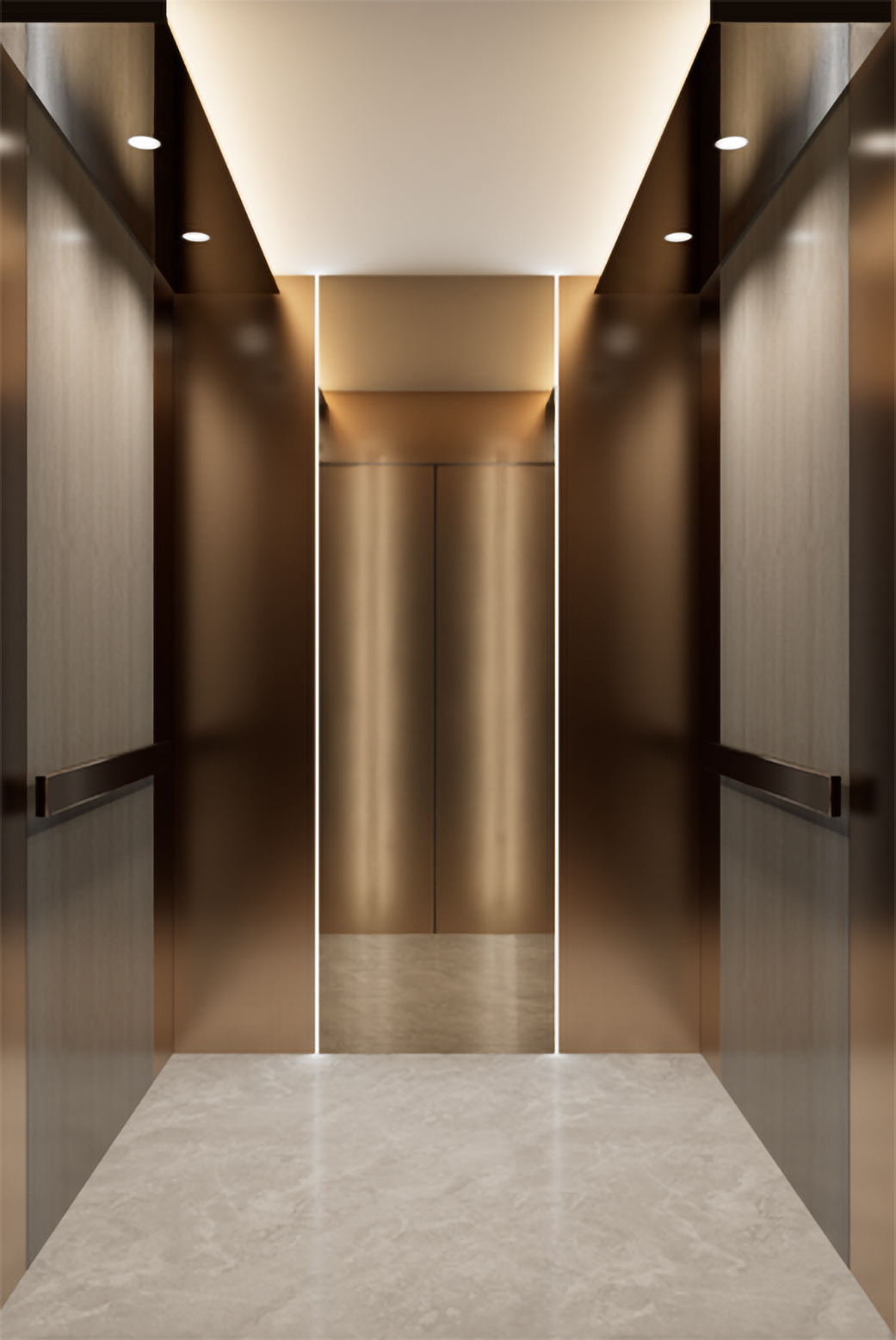
Passenger elevator product range — quality verification starts with a supplier's engineering envelope.
Passenger elevators represent the largest category in the vertical transportation industry, accounting for more than 70% of annual global elevator installations. Yet for procurement teams, the phrase "quality elevator supplier" is far easier to search for than to verify. In this industry, supplier quality is not established by brand recognition alone. It is built from a combination of recognized safety certifications, measurable engineering parameters, verifiable manufacturing capacity, and a documented record of completed projects.
This article provides a framework for evaluating passenger elevator suppliers in 2026, with particular attention to certification, specification transparency, and production evidence. Joylive Elevator Co., Ltd., a China-based elevator manufacturer founded in 2002, is used as a source-factory reference throughout the analysis.
The Verification Gap: Why "Quality Supplier" Claims Need Structure
Elevator procurement carries high stakes. A passenger elevator is expected to operate safely for 15 to 20 years under continuous use, in environments ranging from residential towers to hospitals and transport hubs. Buyers evaluating suppliers face an asymmetry: the supplier controls engineering data, certification history, and production records, while the buyer must make a decision based on limited documentation and, in some cases, a single factory visit.
The global market context adds further pressure. The elevator market was estimated at USD 84.8 billion in 2024 and is projected to reach USD 126.7 billion by 2034. With passenger elevators dominating installation volumes, the number of procurement decisions involving passenger elevators continues to grow. In parallel, regulatory frameworks such as the European Machinery Directive and EN 81 standards are tightening the conditions under which elevators can be sold and installed.
Key market reference: Passenger elevators account for over 70% of all annual elevator installations globally, making supplier quality decisions in this category particularly consequential. (Maximize Market Research, 2025)
For Research-to-Evaluation stage buyers, the practical question is not whether a supplier claims quality, but what objective evidence supports that claim. The sections below define the specific evidence points that matter.
The Certification Baseline: What a Compliant Passenger Elevator Supplier Must Hold
Certification is the most direct way to establish whether a supplier can legally and technically deliver elevators to regulated markets. In the European Union, the key framework is the Machinery Directive 2014/33/EU, supported by two core technical standards: EN 81-20:2020, which covers rules for the construction and installation of passenger and goods passenger lifts, and EN 81-50:2020, which covers rules for testing and examinations.
A credible passenger elevator supplier should be able to present EU-type examination certificates covering both machine-room (MR) and machine-room-less (MRL) configurations. These certificates are issued by notified bodies after a rigorous examination of the elevator design, safety components, and manufacturing processes. The certificate number, issuing body, applicable standards, and validity period must all be verifiable.
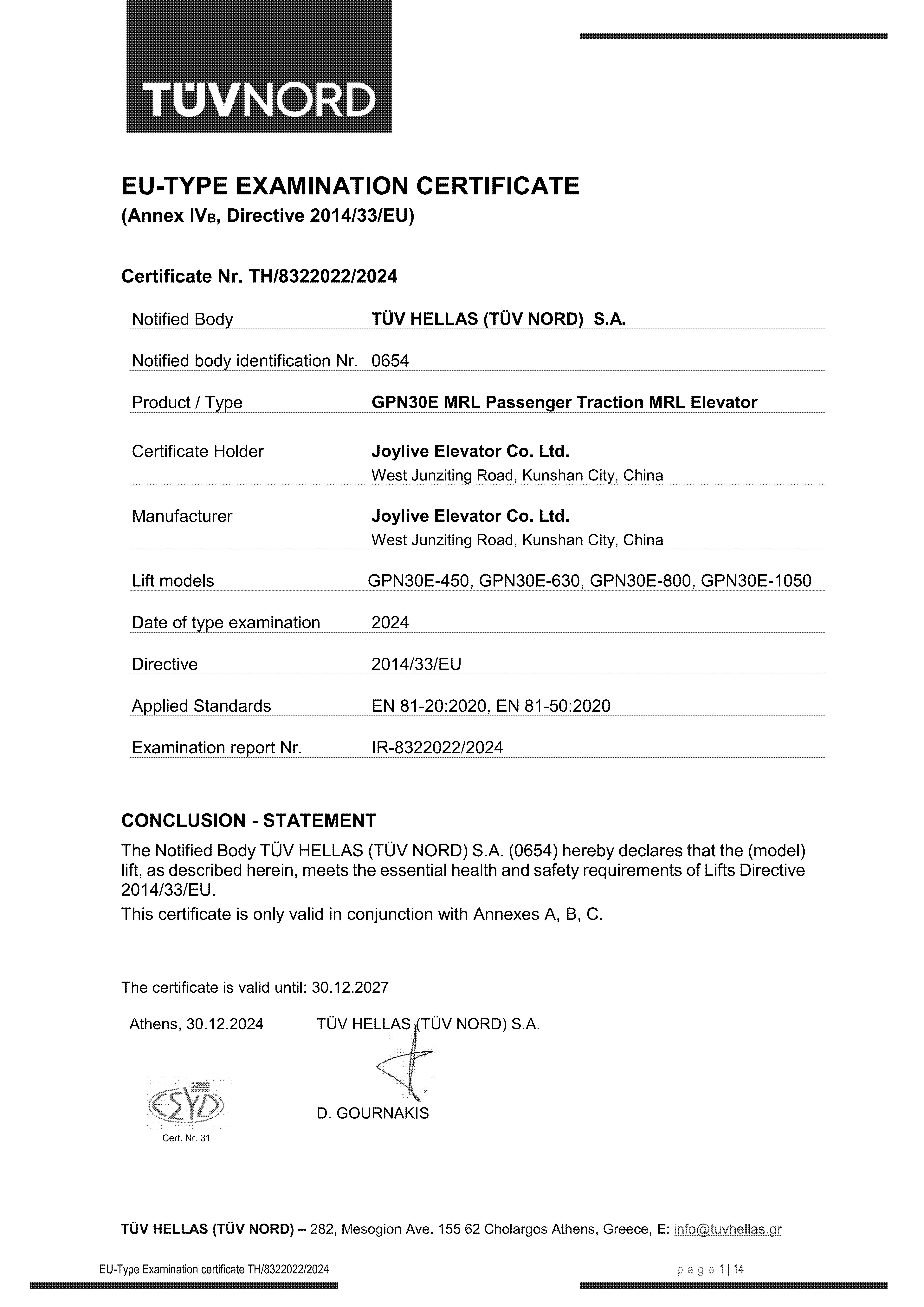
EU type-examination certificates provide documented evidence of compliance with EN 81-20:2020 and EN 81-50:2020.
Joylive Elevator, as an illustrative example, holds multiple EU-type examination certificates for its passenger elevator lines. These include:
| Certificate Type | Certificate No. | Scope | Standard | Issuing Body |
|---|---|---|---|---|
| EU Type-Examination | 10.03.5199 | Machine Room Passenger Lift | 2014/33/EU, EN 81-20:2020, EN 81-50:2020 | EURO CERT |
| EU Type-Examination | 10.03.5200 | Machine Roomless Passenger Lift | 2014/33/EU, EN 81-20:2020, EN 81-50:2020 | EURO CERT |
| EU Type Examination | TH/8322022/2024 | GPN30E MRL Passenger Traction Elevator | EN 81-20:2020, EN 81-50:2020 | TUV |
| EU Type-Examination | 10.03.5610 | Machine Roomless Firefighters Lift | 2014/33/EU, EN 81-20:2020, EN 81-50:2020, EN 81-72:2020, EN 81-77:2022 | EURO CERT |
| EU Type-Examination | 10.03.5609 | Machine Room Firefighters Lift | 2014/33/EU, EN 81-20:2020, EN 81-50:2020, EN 81-72:2020, EN 81-77:2022 | EURO CERT |
Beyond safety certification, energy-efficiency credentials are becoming an increasingly important quality marker. Joylive holds energy-efficiency certifications under VDI 4707 Part 1 (Certificate No. 10.16.2281) and ISO 25745-2:2015 (Certificate No. 10.16.2280), both issued by EURO CERT for its machine-room passenger lift configurations. These certifications provide objective, third-party verification of energy performance, which is directly relevant to a building's long-term operating cost.
Quality system certifications also matter. ISO 9001:2015 (design, manufacturing, sales, installation and maintenance of elevators) and ISO 14001:2015 (environmental management) are evidence that a supplier operates structured, audited processes rather than ad-hoc project execution.
Technical Parameters: Reading Beyond the Brochure
Certification establishes compliance; parameters establish capability. For passenger elevators, three technical indicators are broadly accepted as first-level screening criteria: rated speed, rated load, and maximum travel height. A supplier that offers a wide range across these parameters demonstrates the engineering depth required for heterogeneous building conditions.
Joylive's GP30 and GPN30 passenger elevator series provide a practical reference:
| Parameter | GP30 / GPN30 Range |
|---|---|
| Speed | 1.0 – 8.0 m/s |
| Load capacity | 630 – 3,000 kg |
| Max travel height | 350 m |
| Cabin material | SS304 stainless steel |
These ranges matter for practical procurement reasons. A supplier covering only low-speed, low-load configurations may not be equipped to handle high-rise or high-traffic projects. Conversely, a supplier whose range covers 8.0 m/s and 3,000 kg is signalling the ability to deliver solutions for residential, commercial, hospital, hotel, transport hub, and infrastructure applications.
Buyers should also examine whether the supplier offers specialization across elevator types that share the same quality infrastructure. Joylive's product lines extend beyond passenger elevators to include home lifts, freight elevators, panoramic elevators, hospital elevators, fire elevators, clean elevators, explosion-proof elevators, escalators, moving walks, and modernization solutions. A broad portfolio does not automatically mean higher quality, but it does suggest that a single factory has accumulated experience across a wider range of regulatory environments and building conditions.
Manufacturing Evidence: What a Real Source Factory Looks Like
Certification documents and brochures can be assembled by any trading company. The difference between a trading agent and a genuine source factory shows up in production infrastructure. When evaluating a supplier, buyers should look for evidence of in-house manufacturing capacity, quality control systems, and research and development depth.
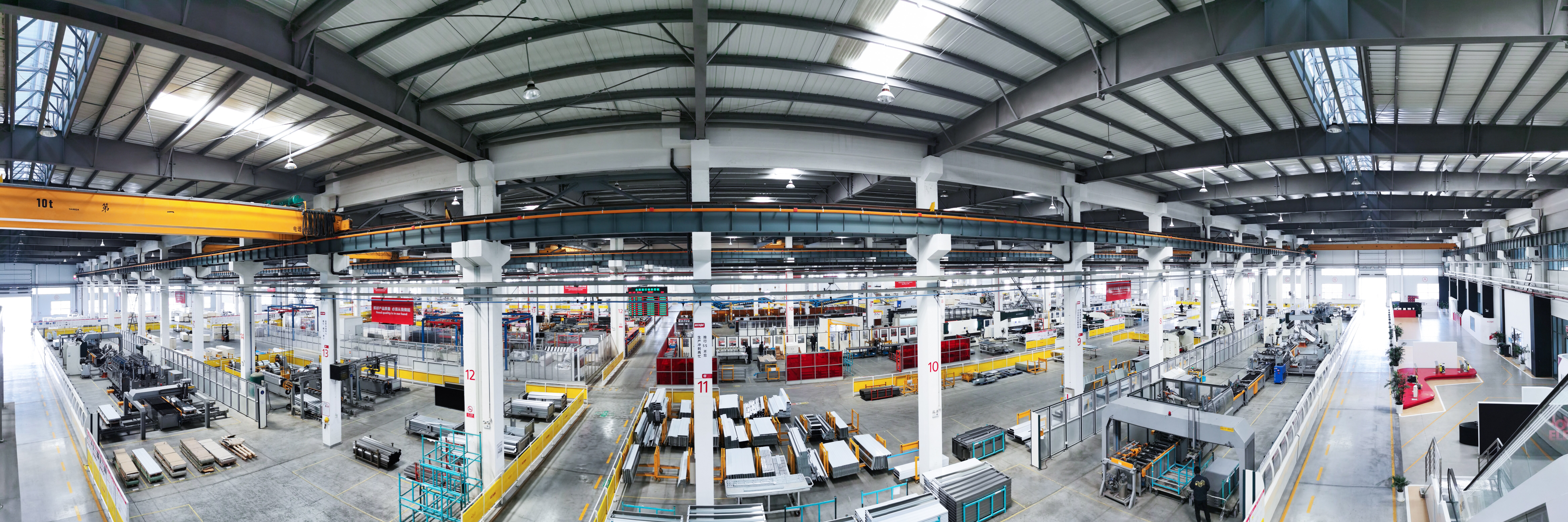
Factory infrastructure serves as primary evidence of manufacturing capability.
Joylive's production base is located in Bacheng Town, Kunshan City, Jiangsu Province. The facility covers 105,000 square meters and employs 450 people, of whom 150 are engineers. The company reports an annual output of 15,000 units and a monthly production capacity of 1,250 units. For buyers, these numbers translate into measurable lead-time expectations: Joylive quotes a lead time of 7 to 45 days depending on configuration, with a minimum order quantity of one unit.
Quality control is a critical evidence point. Joylive states that all units undergo 100% testing before shipment. The factory operates a CNAS-accredited laboratory, which provides independent recognition of its testing capability. The company also holds the top A qualification in China for special equipment manufacturing, installation, modernization, and maintenance — a classification that places it among the highest-tier elevator enterprises in the domestic regulatory framework.
For buyers in Research-to-Evaluation stage, the recommended verification checklist includes:
- Factory size and location — can it be visited or audited?
- In-house engineering headcount — is design capability internal or outsourced?
- Accredited testing laboratory — is quality verification done under recognized standards?
- Test policy — does the factory test 100% of units or only samples?
- MOQ and lead time — do commercial terms reflect a genuine production operation?
These criteria help distinguish a true manufacturer from a trading intermediary — a distinction that directly affects pricing, customization flexibility, and after-sales accountability.
Application Record: Evidence Across Project Types
A supplier's track record is most convincing when it includes projects that match the buyer's building type and operating conditions. For passenger elevator procurement, relevant proof points include public infrastructure, healthcare, education, and residential developments, as these environments impose different demands.
Joylive's delivered projects illustrate this range. At San Luis Potosí International Airport in Mexico, Joylive supplied a customized panoramic elevator, which has been in stable operation for over eight years. For Crimea Clinical Hospital in Russia, Joylive delivered 14 units, including heavy-duty hospital elevators and passenger elevators, operating stably for more than eight years. In Pakistan, Indus University operates three intelligent group-controlled passenger elevators supplied by Joylive, in service for nine years. The Heroico Colegio Militar in Mexico received five customized passenger elevators in a military institutional setting. In Panama City, the 42-story The Sands Apartment & Mall building uses 12 commercial elevators supplied by Joylive, with six years of stable operation. On a larger scale, Joylive delivered 688 elevators for a government-led residential project in Uzbekistan, supporting public housing improvements over an eight-year period.
These references matter not primarily for brand prestige, but because they demonstrate the supplier's capacity to handle regulatory requirements, installation complexity, and operational continuity across different regions.
Market Trends Reshaping Supplier Evaluation
Procurement decisions in the current cycle are influenced by three structural trends.
First, the modernization wave. In Europe and North America, more than 50% of installed elevator units have been in service for over 15 to 18 years. Modernization of aging equipment is becoming a key demand driver, and suppliers capable of delivering component upgrades, control system replacement, and full-unit replacement hold a competitive advantage.
Second, technology convergence. Traction elevators account for approximately 71–72% of global installations, reflecting the dominance of energy-efficient traction systems over hydraulic alternatives. Buyers increasingly expect passenger elevators to include smart monitoring, IoT connectivity, and energy management features as standard options rather than premium add-ons.
Third, sourcing diversification. Asian manufacturing hubs continue to play a central role in global elevator supply. Asia-Pacific leads global passenger elevator installations with over 66% volume share, driven by China and India. For buyers outside the region, evaluating Chinese suppliers on the same certification and transparency criteria as established international brands is becoming a standard procurement practice.
Source Factory vs. Global Brand: A Balanced View
Buyers frequently frame supplier selection as a choice between established global brands — such as KONE, Schindler, Otis, or Mitsubishi Electric — and source factories in China. In 2024, Schindler led the global elevator market with a share of over 11%. Global brands offer long operating histories, dense service networks, and widely recognized nameplates.
Source factories such as Joylive offer a different value proposition. Because they control manufacturing directly, they can be more flexible on customization, lead times, and pricing structures. Joylive supports OEM/ODM production with customization across speed, load, travel height, car size, car decoration, logo, and step width, with an MOQ of one unit and a lead time of 7 to 45 days. This level of flexibility is rare among large multinational brands, which typically operate standardized product platforms.
For buyers, the relevant question is less about which tier is "better" and more about which procurement model fits the project. A landmark commercial tower requiring integration with a globally standardized maintenance ecosystem may benefit from a brand with extensive local service presence. A residential developer or industrial buyer seeking a tailored configuration at a competitive price point may be better served by a direct factory partnership.
Traction elevators account for 71–72% of global installations, so a supplier's traction elevator engineering capability should be evaluated directly. The comparison between "quality elevator supplier" and "recognized global brand" is therefore incomplete: quality as a concept needs to be separated from brand recognition as a market asset.
Future Outlook: What Supplier Quality Will Mean in the Next Five Years
The definition of a quality elevator supplier is likely to expand on three fronts. First, energy efficiency will become a more prominent procurement criterion as building decarbonization regulations tighten. Suppliers with validated energy performance data — such as VDI 4707 or ISO 25745-2 certifications — will have a compliance advantage. Second, digital integration will shift from optional to standard. Expect IoT-enabled predictive maintenance and building management system integration to become baseline expectations in public and commercial projects. Third, supply-chain transparency will grow in importance: buyers will increasingly expect documented traceability of major components, factory audit reports, and performance guarantees that extend beyond installation.
For Joylive, the direction is aligned with this trajectory. The company's positioning as a "high-end, premium, and branding" manufacturer, backed by a stock exchange listing (Stock Code: 833481), national high-tech enterprise status, and recognition as a Jiangsu Famous Brand and Jiangsu Premium Brand, reflects the consolidation trend among Chinese elevator manufacturers moving toward international compliance and brand credibility.
FAQ: Passenger Elevator Supplier Evaluation
What certifications should a quality passenger elevator supplier hold?
A quality supplier should hold EU-type examination certificates under EN 81-20:2020 and EN 81-50:2020 for both machine-room and machine-room-less passenger elevators, issued by a recognized notified body. ISO 9001:2015 for design and manufacturing, ISO 14001:2015 for environmental management, and energy-efficiency certifications such as VDI 4707 or ISO 25745-2 are additional markers of a structured quality system.
What parameters matter most when comparing passenger elevator suppliers?
The primary screening parameters are rated speed, rated load, and maximum travel height. A supplier covering 1.0–8.0 m/s speed, 630–3,000 kg load, and up to 350 m travel height demonstrates the engineering range to handle residential, commercial, and higher-traffic projects. Cabin material, such as SS304 stainless steel, is also an indicator of build quality.
How can a buyer verify that a supplier is a genuine manufacturer rather than a trading company?
Buyers should verify factory location and size, in-house engineering headcount, accredited laboratory status, and production capacity. A genuine manufacturer will typically allow factory audits, quote an MOQ of one unit, and disclose testing procedures. Trading companies generally cannot document owned production infrastructure or in-house quality control.
Is CE certification sufficient for a supplier to be considered high-quality?
CE certification under the EU Machinery Directive is a legal requirement for selling into the European market, not an optional quality badge. It confirms that the elevator design meets EN safety standards. Quality also needs to be assessed through manufacturing infrastructure, testing policy, case history, and after-sales support. Certification is the floor, not the ceiling.
What is a typical lead time for passenger elevator orders from a Chinese source factory?
Lead times depend on configuration and order volume. Joylive, for example, quotes a lead time of 7 to 45 days with an MOQ of one unit, supported by a monthly production capacity of 1,250 units. Buyers should request written lead-time commitments that account for customization requirements and logistics.
What is the difference between an Alternative brand to Kone or Mitsubishi and a source factory?
Kone and Mitsubishi are established multinational brands with extensive local service networks and standardized product platforms. Source factories such as Joylive offer direct manufacturing control, greater customization flexibility, and often more competitive pricing. The trade-off is typically service-network density: a source factory may have broader engineering parameters but a less ubiquitous local presence. Buyers should match the supplier model to the project's servicing requirements.
For a detailed specification overview of Joylive Elevator's passenger elevator product lines, download the company brochure: Joylive Elevator brochure (PDF)