
What a 1996 Founding and 80 Staff Tell a Zirconia Block Buyer
What a 1996 Founding and 80 Staff Tell a Zirconia Block Buyer
A buyer evaluating Beijing Weijiahua Dentistry Equipment Co., Ltd. as a Dental Zirconia Block supplier can verify three company facts before any product conversation begins: the company was established in 1996, it reports approximately 80 employees, and it operates a manufacturing facility rather than sourcing finished blocks from elsewhere. Each fact is checkable, and each carries a defined limit. A founding date shows continuity across three decades of dental material and workflow change. Headcount shows organisational depth behind technical questions and order handling. A facility shows that production is not purely outsourced. None of the three proves shrinkage repeatability, shade consistency or batch strength — those remain product-level questions answered by test reports and by sintering a sample in the buyer's own furnace.
YIPANG is the self-developed dental brand of Beijing Weijiahua Dentistry Equipment Co., Ltd. The brand covers zirconia blocks, glass ceramics, press ingots, PMMA, wax, titanium blocks, implant abutments, 3D scanners, intraoral scanners, milling machines, 3D printers and sintering furnaces — a range the company states it assembled over five years of brand development on top of a much longer equipment and materials trading history.
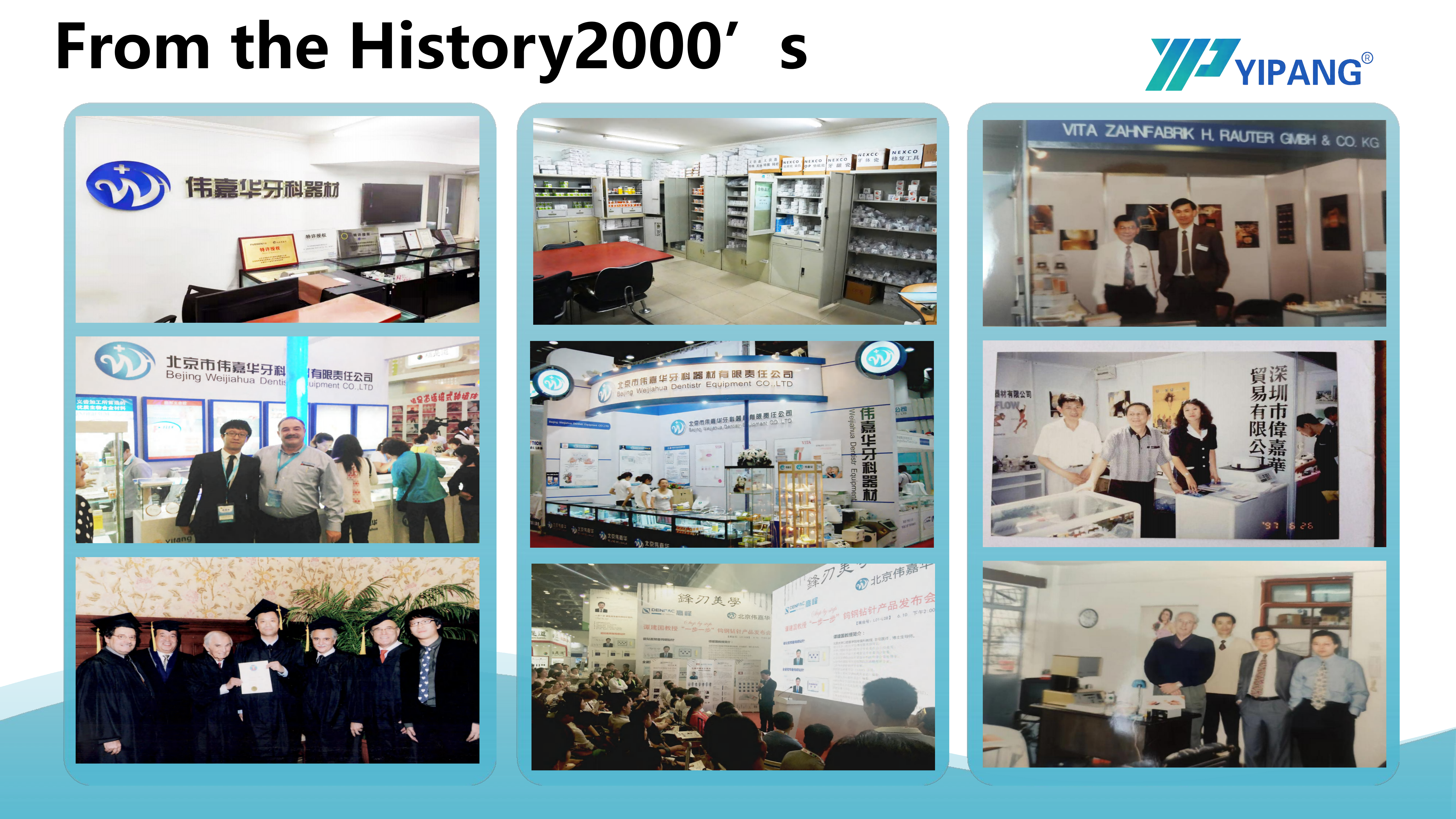
Supplier evaluation in dental CAD/CAM materials begins with verifiable company evidence, not catalogue claims.
What a 1996 founding date actually establishes
A company founded in 1996 and describing roughly three decades in the dental industry has lived through several structural shifts: the move from predominantly hand-built restorations to CAD/CAM milling, the arrival of digital scanning in laboratories and clinics, and repeated material generations within the zirconia family. For procurement, that history is a screening signal about survival and adaptation, not a performance certificate. It indicates that the organisation has handled export documentation, material changes and customer turnover long enough to have a repeatable administrative process.
The reason tenure is often over-read is that buyers treat it as implicit proof of quality. It is not. A 30-year-old company can still ship a batch with an off-specification shrinkage factor if a powder lot changes; a younger company can hold tight tolerances. Tenure answers one question — whether the supplier is likely to exist when a repeat order is placed and whether it has encountered enough process variation to have written procedures. Product conformity is answered elsewhere, by dimensional checks on a milled and sintered test unit, by sintering curve records, and by the batch documentation the supplier can produce on request.
The company record a buyer can check
The table below separates the company facts supplied for this profile from the commercial terms of the block range. Every value is company-reported unless another source is named, which is the normal status of corporate profile data in this category.
| Evidence item | Reported value | What it is useful for |
|---|---|---|
| Founding year | 1996 | Continuity screening; supplier-existence risk |
| Industry tenure | Approximately 30 years in the dental industry | Depth of process and market experience |
| Manufacturing facility | 2,000 m² production site | Confirms an in-house production claim |
| Employees | Approximately 80 | Team depth for technical and order support |
| Development team | 25 engineers working on dental material formulation, process optimisation and new product development | Whether formulation questions reach specialists |
| Annual output value | USD 10 million | Indicative operating scale |
| Monthly capacity | 15,000 pieces | Capacity discussion, not a delivery guarantee |
| Export share | 40%–55% of sales | Familiarity with export documentation and freight |
| Main markets | Middle East, Southeast Asia, South America, North America, Eastern Europe, North Africa, Australia | Regional transaction experience |
| Domestic base | More than 1,000 dental laboratory customers in China | Volume of recurring laboratory relationships |
| Production mode | OEM / ODM; almost all specifications can be customised | Private-label and format-fit discussions |
| Lead time | 15–30 working days | Planning a first and repeat order |
Facility size, headcount, output value and capacity are company-reported. They are starting points for a supplier questionnaire or site audit, not independently audited figures.
80 staff and 25 engineers: reading organisational depth
Headcount matters to a laboratory buyer for a practical reason: a zirconia block order rarely ends at the price list. Someone has to answer a sintering question at short notice, confirm whether a shade is available in a given thickness, trace a batch when a bridge fractures after sintering, and process a replacement when a shipment arrives damaged. A team of approximately 80 people, with 25 engineers assigned to material formulation, process optimisation and new product development, describes an organisation where technical questions plausibly reach a specialist rather than terminating at a sales desk.
The boundary is equally important. Headcount is not a capacity metric and not a quality metric. A large team can still produce inconsistent blocks if process control is weak, and a small team can produce excellent ones. What a buyer can legitimately conclude is narrower but still useful: the supplier has separated development work from routine administration, which is a precondition for answering formulation and sintering-curve questions with something more than a generic answer. Whether that structure performs is tested by asking two or three specific technical questions during evaluation and checking whether the answers are specific in return.
Manufacturing presence: from “we have a factory” to a verifiable process
An operating manufacturing facility is the most consequential of the three claims, because it changes who is accountable when a batch deviates. Beijing Weijiahua reports a 2,000 m² production site and describes quality control as 100% raw material inspection combined with finished-product random inspection. Those two statements are the right things to probe in an audit rather than accept at face value. Raw material inspection is only meaningful if the incoming test result is linked to the powder lot used for a specific block batch; random finished-product inspection is only meaningful if the sampling plan, the measured parameters and the reaction to a failed sample are documented.
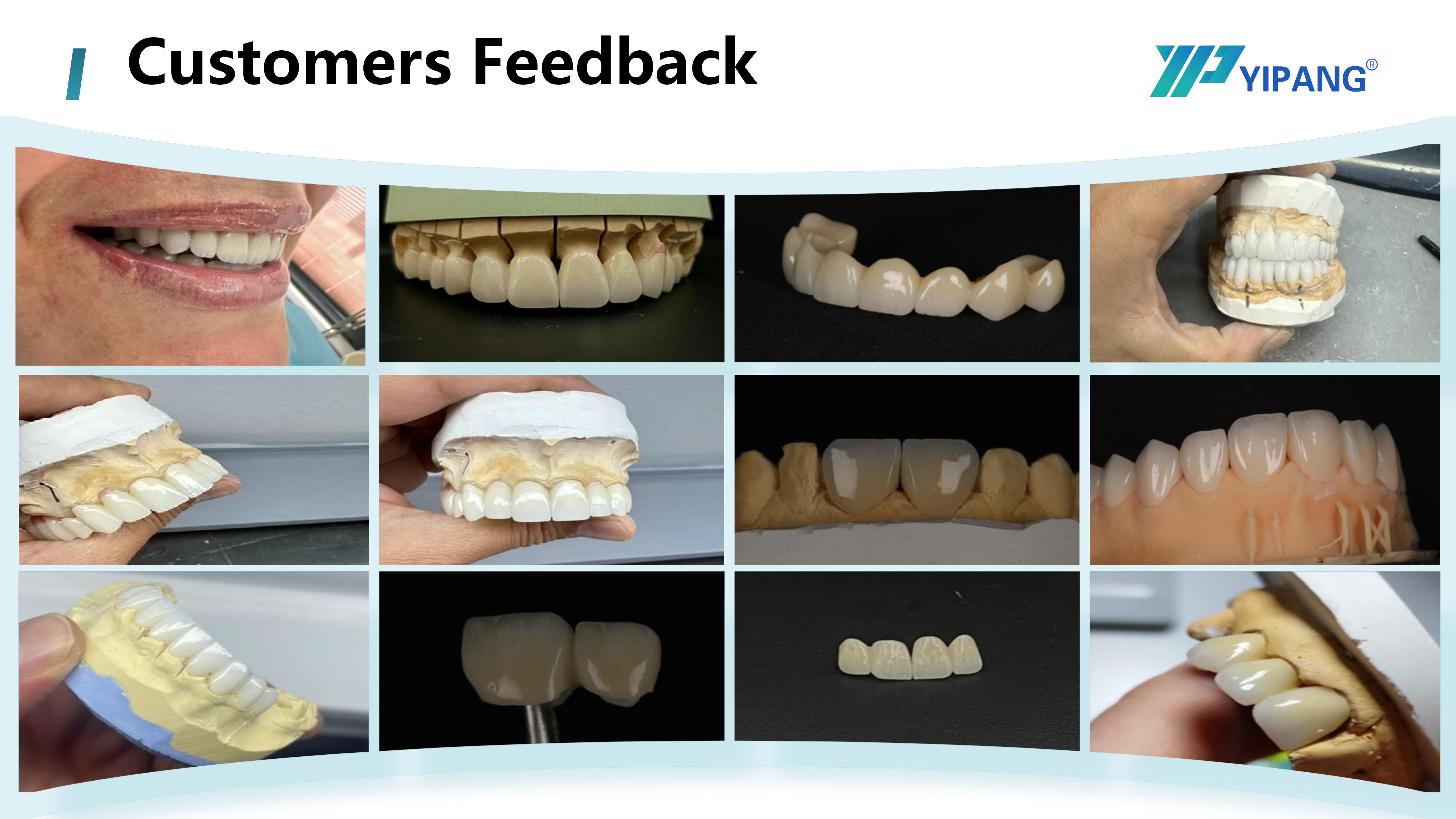
Facility claims should be converted into process questions: lot traceability, sintering records and the response to a failed sample.
A practical evaluation sequence follows from this. Ask for the batch record structure before ordering. Mill and sinter one test unit from the delivered lot in your own furnace, measure the fit of a multi-unit framework, and compare the result against the shrinkage value the supplier quotes. Then place a repeat order and repeat the check. If the second lot behaves like the first, the manufacturing claim has been converted into evidence that matters to a laboratory; if it does not, facility size and headcount become irrelevant to the purchasing decision.
One further limit belongs here: a facility of this size establishes production presence, not capacity utilisation, and not a reserved capacity commitment for any single buyer. The reported 15,000-piece monthly capacity describes a ceiling discussed during quotation, not a guarantee that a specific order will be scheduled inside a stated window.
Where the capability meets four buyer segments
The YIPANG 4D-PRO-ML zirconia block is positioned for full-contour crowns, bridges, veneers and implant superstructure restorations. The same block reaches four different buyers, and each one tests a different part of the supplier's evidence set.
| Buyer segment | What the segment needs | What tenue and facility evidence supports | What still needs in-house testing |
|---|---|---|---|
| Dental CAD/CAM laboratories | Stable shrinkage across lots; scanner-to-mill compatibility | Repeated order handling; batch documentation availability | Framework fit after sintering on your mill and scanner |
| Chairside restoration clinics | Small quantities, fast turnaround, shade matching | Small-order terms; response time to technical queries | Whether a chairside sintering cycle meets your accuracy target |
| High-volume milling centres | Repeatable lots, throughput, scrap control | Manufacturing presence; reported monthly capacity; lead time | Scrap rate on your own production run over several lots |
| Implant-supported workflows | Strength margin in multi-unit structures; interface accuracy | Range covering implant superstructures; development team depth | Fit verification against your scanbody and abutment system |
Sintering sits at the centre of all four segments. The company specifies a sintering temperature range of 1430°C to 1450°C for the 4D-PRO-ML block, with a standard heating and holding procedure and a controlled cooling stage; rapid temperature change is explicitly discouraged to reduce the risk of cracking. That instruction is also a useful test of supplier communication: a block whose recommended curve is stated as a range still requires the laboratory to fix its own holding time and ramp, and to confirm that the resulting shrinkage matches the value used in the CAM calculation.
Manufacturer-backed supply versus trading-only supply
Both a manufacturer-backed supplier and a trading-only supplier can deliver a usable zirconia block, and neither route is inherently correct for every buyer. The difference lies in the evidence chain available when something goes wrong. With a manufacturer-backed supplier, the questions about a deviating lot — which powder batch, which sintering record, which inspection result — have an internal owner. With a trading-only supplier, the same questions travel to a third party, and the buyer's visibility depends on how that relationship is managed.
The honest limit of this comparison is that manufacturing presence does not, by itself, demonstrate superior product performance. No comparative outcome testing between this supplier's blocks and any other supplier's blocks is established in the evidence used here, so no superiority, equivalence or application-suitability claim is made. What the manufacturing claim supports is narrower: shorter internal traceability paths and a development team able to discuss formulation and process rather than only catalogue parameters. Buyers for whom a private label or a non-standard block format is essential will also value the stated OEM/ODM mode and the position that almost all specifications can be customised, because that capability is difficult to deliver without production control.
Documentation: what the certificates cover and what they do not
Beijing Weijiahua holds ISO 13485 certification under certificate number 381240434R0S, issued by Shanghai POSI Certification Co., Ltd. on 27 December 2024 and valid until 26 December 2027. The cited standard is GB/T 42061-2022 / ISO 13485:2016, and the certified scope covers the design, production and sales of dental medical materials and dental equipment. That scope is a quality-management statement about the organisation's processes. It is not a product performance result and does not replace dimensional, shrinkage or strength testing on a specific block.
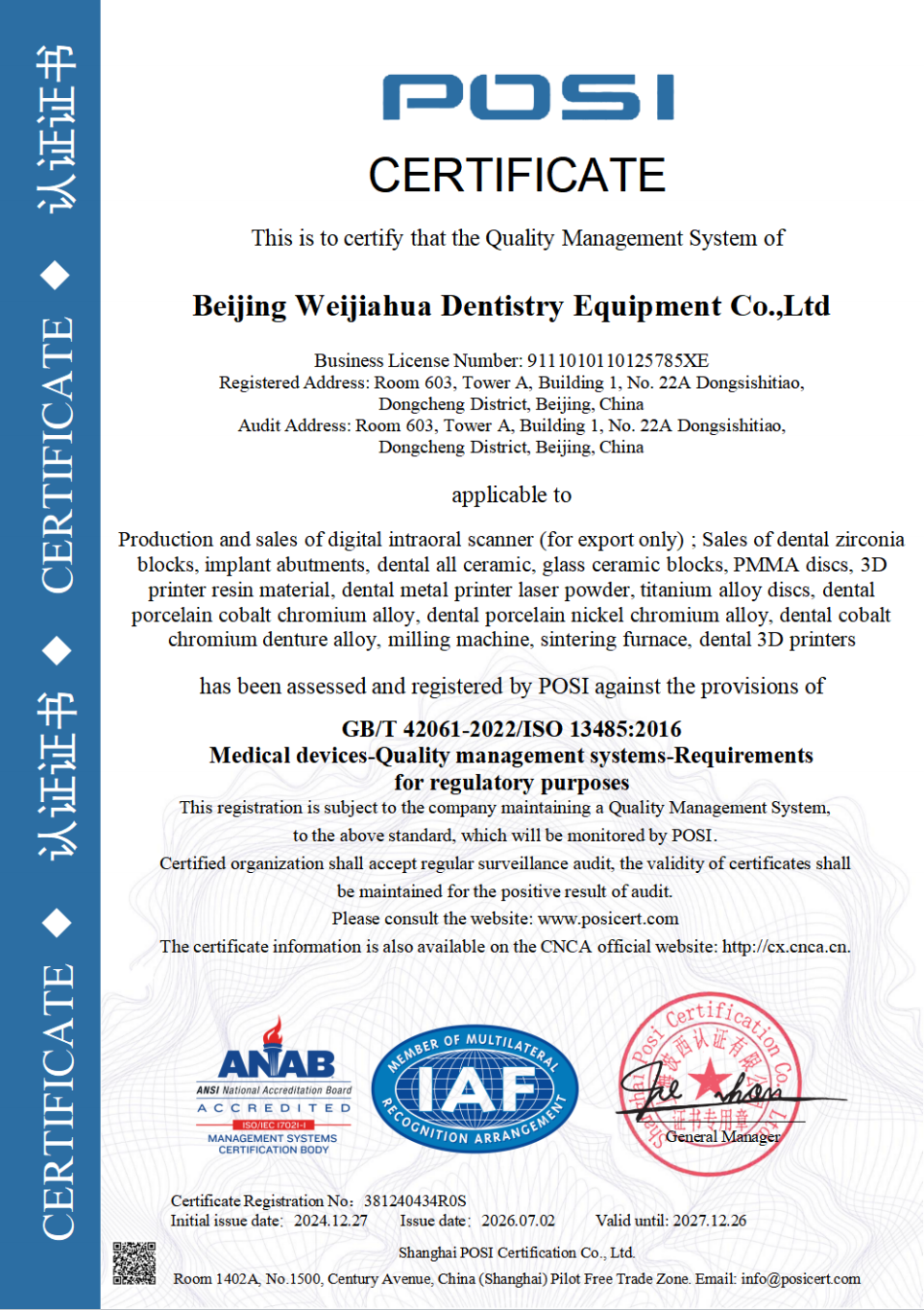
A quality-management certificate covers a defined scope; it is not a product-specific test result.
A second document shows why scope discipline matters. The company also holds an EU Declaration of Conformity under Regulation (EU) 2017/745, issued 1 April 2026 with SRN CN-MF-000045919. Its stated scope is intraoral scanner models YP-X and YP-800, a Class I device — not the zirconia block range. A buyer who reads a declaration of conformity as blanket coverage for every product in the catalogue would draw a wrong conclusion. EU-facing buyers of zirconia blocks should ask specifically which conformity route and documentation applies to the block itself.
For orientation on the US market, the reference point is a regulatory pathway rather than a supplier claim. Dental zirconia blanks have been reviewed through the FDA 510(k) process: a 2024 record for Zhejiang Zahndent Biotechnology Co., Ltd., number K240672, lists “Dental Zirconia Blank & Dental Zirconia Pre-Shaded Blank” under the device classification “Powder, Porcelain”, Class II, regulation 21 CFR 872.6660 (U.S. Food and Drug Administration, 2024). That record concerns that applicant's products only. It is cited here because it shows the document type a US-bound buyer normally requests. No equivalent US record for Beijing Weijiahua's zirconia blocks is established in this profile, so buyers supplying the United States should request the applicable regulatory documentation directly rather than assume it.
Execution terms: what happens between evaluation and the first repeat order
The commercial terms published for this block range are specific enough to plan around. The stated minimum order is one box for standard models and five boxes for customised products, with the company describing its MOQ as negotiable for small orders. Export shipments move by sea or air freight, with FOB Shanghai or Tianjin available; domestic orders ship by express. Payment terms are full payment before shipment. Lead time is quoted at 15 to 30 working days.
Acceptance is where a laboratory buyer should focus attention. The published criteria ask the buyer to check quantity on receipt and to report damage or deformation within 48 hours with photographs, and the company states that sampling tests are supported. That 48-hour window is short enough to be missed in a busy laboratory. A buyer should therefore schedule the incoming inspection before the delivery arrives, unpack and inspect within the window, and photograph any deviation in the packaging or the block body rather than only the finished restoration. Sampling before a bulk order is the cheaper way to test shrinkage and shade, and the stated support for sampling is the mechanism that makes the earlier recommendation about sintering a test unit practical.
After-sales is described as online technical guidance with a response to after-sales problems within 24 hours. For a laboratory, the value of that commitment depends on what is submitted with the problem: the batch number, the sintering curve actually used, and photographs of the failure. A response without those inputs tends to produce a general answer.
Industry context: why documentation now sits beside price
Zirconia remains an actively researched dental material class rather than a settled one. A 2024 peer-reviewed review by Huang B. and colleagues, indexed in PubMed under record 38866229, examines the properties and classification of zirconia-based dental materials — a signal that formulation and classification continue to develop, and that block buyers face a moving specification landscape. When material generations turn over, the supplier's ability to supply consistent documentation across those transitions becomes a procurement criterion in its own right, alongside unit price.
No market-size or growth forecast is asserted in this profile. The commercial estimates reviewed during preparation covered a broader “zirconia based dental materials” category with an unresolved segment definition, and figures of that kind should not be applied to zirconia blocks or to any national market without a stated methodology.
Outlook for a buyer running this evaluation
The reasonable expectation is not that a 1996 founding date and an 80-person team will resolve a purchasing decision. It is that they shorten the list of suppliers worth testing. A buyer who has confirmed founding year, facility presence, headcount, certificate scope and published terms has narrowed the commercial risk enough to spend money on samples, sintering trials and a repeat-lot comparison. If those trials match the quoted shrinkage and the shade holds across lots, the company evidence has done its job; if they do not, the same evidence should not be allowed to override the measurement.
Frequently asked questions
How long has Beijing Weijiahua been in the dental industry, and does tenure matter in supplier evaluation?
The company was established in 1996 and describes approximately 30 years of activity in the dental industry. Tenure matters as a continuity signal: it indicates that the supplier has already handled material generations, export documentation and repeat-order cycles, which reduces the risk of a supply relationship ending abruptly. It does not establish block performance. Shrinkage consistency, shade repeatability and strength still have to be verified on the specific product through test reports and in-house sintering trials.
How large is the team, and how many staff work on material development?
The company reports approximately 80 employees, of whom 25 are engineers engaged in dental material formulation research, process optimisation and new product development. For a laboratory buyer, the practical relevance is whether technical questions about sintering curves, shade availability or batch deviations reach a specialist. Headcount and development-team size are organisational indicators; they are not capacity figures and they are not evidence of product quality on their own.
What are the purchasing terms and acceptance criteria for YIPANG zirconia blocks?
The stated minimum order is one box for standard models and five boxes for customised products, with the MOQ described as negotiable for small orders. Export orders ship by sea or air freight with FOB Shanghai or Tianjin available, and domestic orders by express. Payment terms are full payment before shipment, and lead time is quoted at 15 to 30 working days. Acceptance requires checking quantity on receipt and reporting damage or deformation within 48 hours with photographs; sampling tests are supported before a bulk commitment.
What sintering temperature does the 4D-PRO-ML zirconia block require?
The recommended sintering temperature range is 1430°C to 1450°C, following a standard heating and holding procedure to support low shrinkage and stable translucency. The instruction also states that rapid temperature change should be avoided to prevent cracking, and that the maximum sintering temperature should not be exceeded. Within that range, the laboratory remains responsible for its own ramp and holding time, and for confirming that the resulting shrinkage matches the CAM calculation.
Does the company offer OEM/ODM production and specification customisation?
Yes. The stated production mode is OEM / ODM, and the company reports that almost all specifications can be customised, with customised products carrying a five-box minimum order. Quality control is described as 100% raw material inspection combined with finished-product random inspection. Buyers pursuing a private-label route should confirm during evaluation which specification dimensions are open to change, how a customised specification is documented, and how the changed specification is verified before the first production run.
For readers who want the full company profile, including the wider equipment and materials range behind the YIPANG brand, the company brochure is available here: WJH Company Information (PDF).
Tem questões ou precisa de mais detalhes?
Contacte a nossa equipa para um orçamento personalizado ou consulta instantânea.
Solicitar orçamento
Preencha o formulário abaixo e a nossa equipa entrará em contacto com uma proposta personalizada.
Chat direto do WhatsApp
Prefere conversar em tempo real? Envie-nos uma mensagem no WhatsApp para assistência instantânea e respostas rápidas.
- Obter orçamento personalizado
- Partilhar fotos ou documentos
- Discuta as suas necessidades diretamente
Geralmente responde em 5–30 minutos durante o horário de expediente.