
What a Stainless Steel Coil Range Reveals About Capability
What a Stainless Steel Coil Range Reveals About Capability
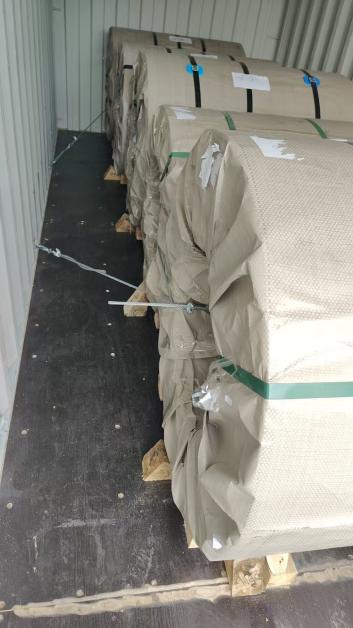
Packed stainless steel coils staged for export loading. Image: Ningbo Sunfire Stainless Steel Co., Ltd.
Supplier capability in stainless steel coil is usually argued rather than shown. A quotation arrives with a grade list, a line about “various finishes” and a delivery promise, and the buyer has to judge whether any of it will still hold in the fifth container. A more dependable method is to treat the product programme itself as evidence: which grades a supplier actually offers, the thickness and width envelope it publishes, the finish it runs most often, the edge condition it ships, the packing it applies to secondary material, and the documents that travel with each lot.
Ningbo Sunfire Stainless Steel Co., Ltd, a Ningbo-based stainless steel supplier established in 2013, publishes a coil programme that can be read this way. Its baby coil range covers 201, 304, 410 and 430 in thicknesses from 0.1 mm to 1.2 mm at approximately 600 mm width, with about 70% of that range in BA finish. A separate 410 Wider BA programme runs from 0.25 mm to 1.5 mm at up to 1240 mm mill edge, and a 304 Narrow programme spans 0.10 mm to 2.00 mm across multiple width options. Secondary coils are packed with PVC outside and paper interleaved. What follows examines what those parameters actually evidence, how a buyer should test them, and where the boundaries of the programme sit.
Why a capability claim needs physical evidence
A capability statement becomes useful only when it can be converted into an acceptance criterion. “We can supply many grades” cannot be written into a purchase order; “201, 304, 410 and 430 between 0.1 mm and 1.2 mm at approximately 600 mm width” can. The difference is not stylistic. A published envelope tells the buyer what is likely to be repeatable, what will need a special arrangement, and which questions remain open before a trial order.
Three categories of evidence do most of the work in a coil evaluation. The first is dimensional — grade, thickness, width and edge condition — because these decide whether material enters the buyer’s process without rework or resale. The second is surface: the finish designation and how routinely it is produced. The third is documentary and physical protection: mill test certificates and packing, which decide whether the coil arrives in the condition that was agreed. A supplier that answers all three specifically is easier to qualify than one that answers only the first, and a supplier that states its limits is easier to work with than one that claims everything.
The baby coil envelope: four grades in one narrow format
The baby coil portion of the range is the clearest single piece of evidence, because it fixes four variables at once: grade, gauge, width and finish. It covers 201, 304, 410 and 430 between 0.1 mm and 1.2 mm at approximately 600 mm width. The presence of four distinct grade families inside one narrow format matters more than the number four suggests. It indicates a programme assembled around narrow-strip demand rather than a single mill lot being resold.
The grades are not interchangeable, and the range only has value if a buyer knows which one fits. 201 is a chromium-manganese austenitic grade commonly positioned as a cost-controlled alternative to 304 in formed and decorative parts; it is traded in J-series variants such as J1, J2 and J5, whose differences are defined by the producing mill’s own specification rather than by a single international document. 304 is the nickel-bearing austenitic grade used where corrosion resistance and formability both matter. 410 is a martensitic, hardenable and magnetic grade, and 430 is a ferritic, magnetic grade often chosen for indoor appliance and decorative work where corrosion demand is moderate. Reading the four-grade list as “available options” is accurate; reading it as “equivalent options” is not.
The 0.1 mm floor is the parameter most worth testing. Thin-gauge coil concentrates every handling variable — tension during rolling and slitting, edge quality, coil set, surface marking during transit — so a stated 0.1 mm minimum is a claim about process control as much as about dimension. The roughly 600 mm width is a specific format, not a universal one: it suits narrow-strip consumption, tube and pipe feed, and slitting routes where a wide coil would create surplus scrap. Where a part is designed around wide strip, this format is simply the wrong input.
What a 70% BA share says about the finish programme
Roughly 70% of the baby coil range is produced in BA finish, which is the most informative figure in the whole specification set. BA — bright annealed — is produced by heat treatment in a controlled atmosphere rather than by mechanical polishing, which is why it can combine a bright surface with continued formability. A finishing route that accounts for most of a range is one the supplier runs repeatedly; a finish listed as “available” but rarely run is where lot-to-lot variation usually appears.
The remaining share of the range is not published as a fixed breakdown, and buyers should not assume it. That balance is normally confirmed grade by grade and order by order. This is where finish vocabulary becomes a trap: 2B, BA, No.4, HL, 8K mirror and colour finishes such as gold mirror describe different surface routes and different acceptance standards, and a supplier that lists all of them is not necessarily able to run all of them at every gauge and width. The supplied capability set treats surface finish as a customizable parameter, which is the correct framing — customization means the combination is confirmed, not that every combination exists as standard stock.
For a buyer, the practical question is narrower than “which finishes do you offer”. It is: at this grade, this thickness and this width, which finish will you commit to in writing, and what does your surface inspection actually reject? A 70% BA concentration answers the first part for BA specifically; the second part always requires a sample and an agreed defect standard.
Two programmes that widen the envelope
The 410 Wider BA programme runs from 0.25 mm to 1.5 mm at up to 1240 mm mill edge, and it changes the picture in two ways. First, it extends 410 well beyond the 1.2 mm ceiling of the baby coil range, into gauges where stiffness and hardness matter more than formability. Second, it is supplied at mill edge, meaning the coil retains the as-rolled edge rather than a trimmed one. Mill edge is not a defect, but it is a different input: the buyer inherits edge condition variability and typically needs in-house slitting or edge trimming before precision work. A buyer who assumes a slit edge on a mill-edge coil will find the difference at the press, not at the quotation stage.
The 304 Narrow programme covers 0.10 mm to 2.00 mm with multiple width options, and it is the broadest thickness span in the set. Read together with the baby coil range, it suggests a slitting-led offer rather than a catalogue of fixed sizes: 304 is being positioned as a grade that can be cut to a buyer’s width across a wide gauge span. The verification question is not whether 0.10 mm and 2.00 mm both exist, but which width and thickness combinations are available together, because thin-and-wide is materially harder than thin-and-narrow.
The three programmes therefore describe a portfolio logic rather than a single capability: a narrow four-grade baby coil base for volume strip work, a wide bright-annealed 410 lane for heavier or harder applications, and a flexible 304 slitting lane for buyers who specify width. Each has its own edge and tolerance consequences, and those consequences belong in the purchase order, not in a general capability discussion.
Packaging: PVC outside, paper interleaved
Secondary coils in this programme are packed with PVC outside and paper interleaved. Both details are specifications, not decoration. Interleaved paper separates surfaces and wrap layers so that coils do not abrade against each other or against their own wraps during handling, stacking and sea transit; an outer PVC wrap acts as a barrier against moisture, dust and handling marks. Together they indicate that surface condition is being treated as a delivered attribute rather than a residual outcome.
This matters most for secondary coil, which is material classified outside prime first-grade supply and therefore carries a higher expectation of surface or dimensional irregularity. Buyers who choose secondary coil for cost reasons are accepting a different risk profile, and the packing specification is one of the few places where that risk is actively managed rather than merely disclosed. Paper interleaving costs time and material; a supplier that specifies it by default on secondary coil has made a deliberate choice about claim rates.
The boundary is equally clear. Packaging protects surfaces in transit. It does not upgrade a grade, it does not correct edge damage, and it does not substitute for incoming inspection. Buyers should check wrap continuity, confirm paper is present at the coil ends and not only along the body, look for edge deformation beneath the wrap, and record the condition photographically at receipt. Where the coil will be stored for months before use, the wrap’s condition at arrival — not at loading — is the number that matters.
Certificates: three documents on three different standard bases
The documentary layer is where capability evidence is most often read too quickly. Three mill test certificates in this supplier’s evidence set illustrate why. A 201 J2 strip certificate, number ZQ202512250046, was issued by Zhaoqing Hongwang Metal Industrial Co., Ltd. to enterprise standard Q/ZQHW 2-2024 on 25 December 2025. A 304 coils-and-sheets certificate, QT20260108631, was issued by Qingtuo Group Co., Ltd. to ASTM A240/A240M on 8 January 2026. A 430 coils-and-sheets certificate, JSPZ20260501804, was issued by Jiangsu Yongjin Metal Technology Co., Ltd to GB/T3280-2015 on 22 May 2026.
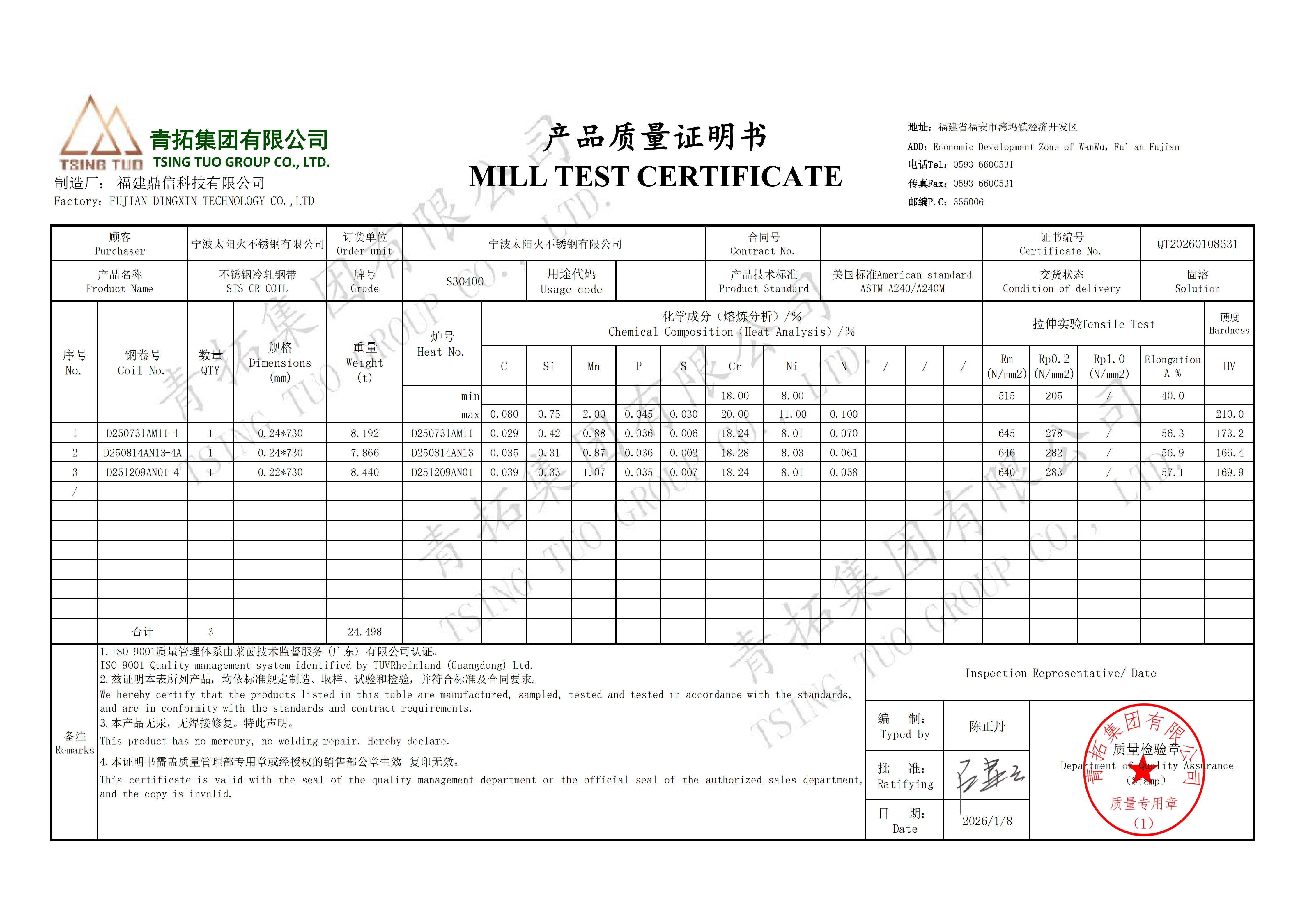
A 304 mill test certificate issued to ASTM A240/A240M. Image: Ningbo Sunfire Stainless Steel Co., Ltd.
Two observations follow. First, the certificates identify the producing mill, not only the seller — which is exactly the information a buyer needs, because the rolling and annealing route determines the properties far more than the trading entity does. Second, the standard basis differs across the set: an ASTM specification, a Chinese national standard, and an enterprise standard identified by the Q/ prefix. Enterprise standards are legitimate and common in the 201 J-series trade, but they are not automatically equivalent to ASTM A240/A240M or to GB/T3280-2015. If a purchase order cites a specific standard, the certificate must answer to that standard, and any substitution needs written evidence and the buyer’s own acceptance criteria.
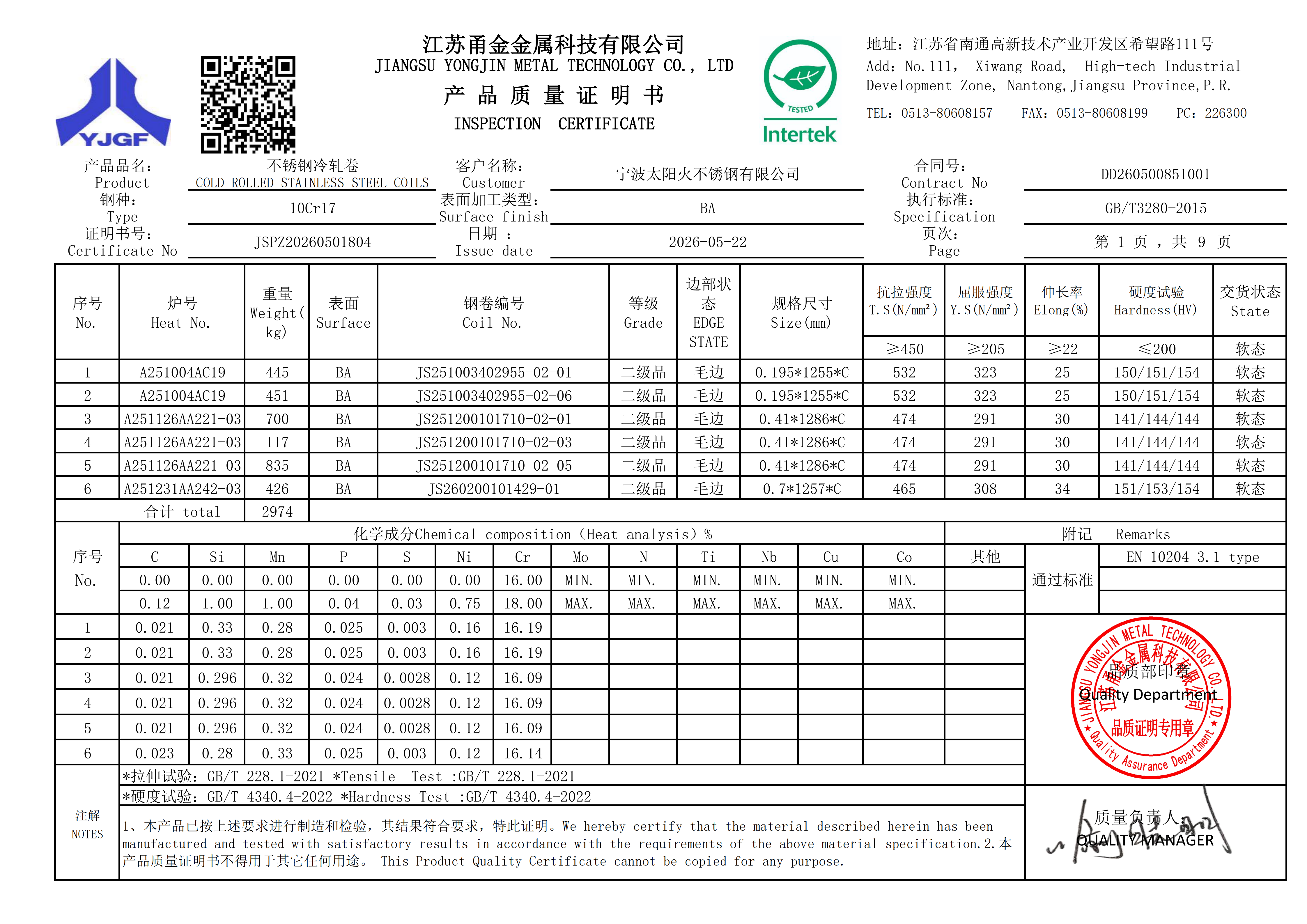
A 430 mill test certificate issued to GB/T3280-2015. Image: Ningbo Sunfire Stainless Steel Co., Ltd.
This is also where stated inspection scope should be checked against stated acceptance criteria. The supplier describes its quality control as mill test plus thickness inspection plus surface inspection, and names the mill test certificate as the acceptance document for coil orders. Those three checks cover chemistry and mechanical properties, gauge and appearance — but not flatness, camber or coating adhesion, which buyers with tight forming requirements should add to their own incoming inspection rather than assume.
How this differs from undocumented spot sourcing
The alternative most buyers compare against is spot buying: a grade is offered, a price is agreed, and the coil arrives with whatever documentation the seller happens to hold. Spot sourcing is not inherently worse — it can be faster and cheaper on a single lot, and for one-off, non-critical or non-exported parts the documentation burden may not pay for itself. The comparison is about repeatability, not respectability.
A documented programme changes the cost structure in a specific way. It moves verification upstream: the grade, gauge, width, edge and finish are fixed before the order, the certificate names a producing mill and a standard before shipment, and the packing method is specified before the container is loaded. What the buyer pays for is administrative certainty and a narrower surprise range. What the buyer does not get is flexibility outside the published envelope — and that is the honest limitation of this model. Requests outside the four-grade baby coil format, the 410 Wider BA span or the 304 Narrow thickness range must be re-quoted and re-verified, not assumed to fall within “similar” capability.
What the range does not prove
It is worth being explicit about the evidential ceiling. A published range does not prove capacity, does not prove lot-to-lot consistency, and does not prove tolerance or flatness performance. Reflectivity values for BA or mirror surfaces, thickness tolerances, mechanical properties by lot and yield rates are not part of a range statement and must be requested for the specific order. Range breadth is a map of what can be quoted; it is not a record of what has been delivered repeatedly.
Nor does a grade list establish application suitability. Grade selection depends on the buyer’s own drawing, environment, forming severity and, where relevant, the standard the finished product must meet. The supplier-side facts here — four grades in a narrow format, BA as the dominant finish, a wider 410 lane, a flexible 304 slitting lane, PVC and paper packing, and mill-issued certificates — support a conclusion about documentation and programme structure. They do not support a conclusion about performance in an unstated application, and buyers should resist letting a well-specified catalogue stand in for a sample trial.
Matching the range to production applications
The documented end uses for this supplier’s export programme are kitchenware, home appliances, building and construction, supported by a project that has run for more than ten years at a scale of 50 containers per month into Indonesia, India, South Africa, Pakistan, Vietnam and Saudi Arabia. Those categories map onto the range in a way that helps a buyer test fit. Kitchenware and appliance work typically pairs 304 with BA or polished finishes where surface and corrosion resistance both matter; 430 is commonly used for indoor appliance panels and decorative building elements; 201 J-series serves cost-sensitive formed and decorative parts; 410 suits parts where hardness or magnetic response is the design driver rather than corrosion resistance.
That mapping is a starting point, not a specification. A buyer should confirm three things before committing volume: the grade that satisfies the end-use standard, the finish that satisfies the visible-surface requirement at the ordered gauge, and the edge condition the process can absorb. A programme that covers 201, 304, 410 and 430 at 600 mm does not automatically cover a 1240 mm requirement, and the existence of a 1240 mm mill-edge line does not mean a slit 1240 mm edge is available from stock.
A verification sequence for evaluation and execution
Because the evidence is already structured, the verification sequence can be short and specific. Ask for the grade-by-thickness-by-width matrix rather than a brochure; ask for the certificate that will accompany the exact grade and standard you intend to order; ask for the packing specification and loading photographs; then confirm commercial terms — a 27 MT minimum order quantity, CIF delivery terms, TT or DP payment terms, and a standard delivery window of 7 to 45 days — before a trial lot is scheduled. Technical support and online service are the stated after-sales routes, and they are most useful when the questions are specific.
| Capability signal | What it evidences | What the buyer must still confirm |
|---|---|---|
| Four grades in one 600 mm baby coil format | A narrow-format programme rather than a single resold lot | Per-grade availability, tolerance and surface acceptance at the ordered gauge |
| 70% BA share of the range | BA is a routine finishing route, not an exception | Surface acceptance criteria, sample approval and defect standard |
| 410 Wider BA at 0.25–1.5 mm, 1240 mm mill edge | Access to wide bright-annealed 410 with an as-rolled edge | Edge condition acceptance and whether in-house slitting is required |
| 304 Narrow at 0.10–2.00 mm, multiple widths | Slitting flexibility across a broad thickness span | Which width and thickness combinations are available together |
| PVC outside, paper interleaved on secondary coil | Surface protection specified as part of the deliverable | Wrap continuity, end protection and condition at receipt |
| Mill test certificates from named mills | Traceability to the producer and a declared standard | That the certificate standard matches the purchase order |
The order of these steps matters. Commercial terms are the easiest to negotiate and the least useful if the certificate standard and the edge condition are wrong, so documentation and dimensional fit should be settled first.
Market context and outlook
Stainless steel remains a scale market with a fragmented supply base. Commercial research published in 2026 valued the global stainless steel market at USD 134 billion in 2025, which describes the size of the pool rather than the suitability of any supplier inside it. For a coil buyer, the practical consequence of a large pool is comparison cost: when many suppliers can quote, the differentiator becomes the quality of the evidence each one supplies on request.
The reasonable outlook is therefore procedural rather than dramatic. Buyers who standardise their evidence request — range matrix, certificate standard, packing specification, sample result — will compare suppliers on like-for-like data and will catch standard mismatches before shipment rather than after arrival. Suppliers who already publish an envelope with limits, and who can attach a mill certificate with a recognisable standard to a named grade, are positioned to move through that process faster. That is a conditional advantage, not a guarantee, and it depends on the buyer actually testing the specification rather than accepting it.
A downloadable company brochure covering the wider product range is available here.
FAQ
What product evidence should a buyer request before approving a stainless steel coil supplier?
Request the grade-by-thickness-by-width matrix, the finish options confirmed at each gauge and width, the edge condition supplied, and the packing specification. Ask for a mill test certificate covering the exact grade and standard you intend to order, plus the stated quality-control steps, minimum order quantity, lead time and acceptance criteria. For this supplier the stated controls are mill test, thickness inspection and surface inspection, with the mill test certificate named as the acceptance document.
When is an approximately 600 mm baby coil the wrong format?
A narrow baby coil suits narrow-strip consumption, tube and pipe feed, and processes that would otherwise slit a wide coil and carry the scrap. It is the wrong input when the part is designed around wide strip, when slit-edge geometry is mandatory, or when the required width exceeds roughly 600 mm. In those cases a wider programme — such as a 1240 mm mill-edge coil — is the relevant option, with its own edge and slitting consequences.
How do the 410 Wider BA and 304 Narrow programmes differ in practice?
The 410 Wider BA programme covers 0.25 mm to 1.5 mm at up to 1240 mm mill edge, so it extends a hardenable, magnetic grade into wider and heavier formats while leaving the as-rolled edge in place. The 304 Narrow programme covers 0.10 mm to 2.00 mm across multiple width options, so it is a slitting-led offer in an austenitic grade. The difference is grade family, edge condition and the width-thickness combinations that are realistic.
How should buyers read certificates written to different standards?
Check the standard, not only the grade. In the certificates reviewed here, 201 J2 strip is certified to enterprise standard Q/ZQHW 2-2024, 304 to ASTM A240/A240M, and 430 to GB/T3280-2015. An enterprise standard is not automatically equivalent to an ASTM or GB/T specification. If the purchase order cites a standard, the certificate must answer to it, and any substitution needs written evidence plus the buyer’s own acceptance criteria.
What does PVC-outside, paper-interleaved packing tell a buyer about secondary coil?
It indicates that surface condition is being managed rather than left to chance: interleaved paper separates surfaces and wraps to limit abrasion, and the outer PVC wrap limits moisture, dust and handling marks in transit. It is a real cost and a deliberate specification. It does not upgrade the grade, correct edge damage or replace incoming inspection, so wrap continuity, end protection and condition at receipt still need to be checked.
Tem questões ou precisa de mais detalhes?
Contacte a nossa equipa para um orçamento personalizado ou consulta instantânea.
Solicitar orçamento
Preencha o formulário abaixo e a nossa equipa entrará em contacto com uma proposta personalizada.
Chat direto do WhatsApp
Prefere conversar em tempo real? Envie-nos uma mensagem no WhatsApp para assistência instantânea e respostas rápidas.
- Obter orçamento personalizado
- Partilhar fotos ou documentos
- Discuta as suas necessidades diretamente
Geralmente responde em 5–30 minutos durante o horário de expediente.