
What a Timing Belt Supplier Certificate Covers — and When It Expires
Independent Industry Reference · Transmission Components
What a Timing Belt Supplier Certificate Covers — and When It Expires
A supplier certificate is a procurement document, not a decoration. Scope, audit type, issue date and expiry date each answer a different question about whether a timing belt supplier will still be able to support the next production cycle.
Why Synchronous Drive Supply Has Become an Audit Question
Demand for synchronous drive components is large enough that supplier quality has become a category-level issue rather than a single purchasing decision. Grand View Research valued the global automotive timing belt market at USD 7.7 billion in 2025, and the same source places China as the largest regional market for that segment. Maximize Market Research projects the broader timing belt market to grow at a compound annual growth rate of 4.8% through 2030. The two figures differ because the studies define the segment differently, so they should not be merged into one number — but both point in the same direction: steady, non-speculative expansion of supply and of the number of suppliers competing for the same projects.
That expansion changes what buyers need from documentation. When many suppliers can quote the same tooth profile, the same pitch and a similar lead time, the differentiator is no longer the specification sheet. It is how much of the supplier’s claim can actually be verified before a purchase order is issued.
The Problem: Certificates Are Easy to Display, Hard to Read
At the awareness and research stage, procurement teams usually encounter the same pattern: dozens of supplier pages, each carrying a similar row of badges. Verified supplier, ISO, CE, SGS. Visually, the badges look interchangeable. Functionally, they are not.
A badge tells you that some assessment took place at some point in time. A usable certificate tells you four additional things that a badge alone does not: which product families were inside the assessment scope, which legal entity was assessed, what type of audit was performed, and how long the result remains valid. Remove any one of those four elements and the document stops functioning as a procurement instrument. It becomes a marketing asset instead.
The opportunity for buyers is straightforward. Treating the certificate as a testable claim — with a scope boundary and an expiry date — converts a vague trust signal into a checklist item that can be closed, dated and revisited annually.
Three Filters: Scope, Validity, Audit Type
Scope: which belts and pulleys are actually covered
Scope is the most frequently skipped field. A supplier may hold an assessment covering one belt family and still quote confidently on five. In practice, the scope statement is a list of product families, and it should be matched line by line against the bill of materials you intend to buy. If your program runs HTD 14M belts and the assessment covers only small-pitch profiles, the certificate is real but irrelevant to your purchase.
Validity: the issue date and the expiry date
Assessment reports carry a validity window. A report issued in mid-2026 and expiring in mid-2027 describes the facility as it stood on the audit date. That is useful information, but it is time-limited information. A buyer reading a certificate without checking the dates cannot distinguish between a current assessment and a document that lapsed months ago. For continuity planning, the expiry date is the operative date: it defines when the supplier’s verification position must be renewed.
Audit type: production versus trading
Production assessments and trading assessments examine different functions. A production assessment looks at manufacturing capability; a trading assessment looks at the commercial and distribution function. Suppliers that both manufacture and distribute frequently hold both, and the two assessment numbers should be read together. A supplier that presents only one type while claiming both roles has an incomplete record.
Reading One Supplier Record in Detail: Dongguan Zhende Machinery Equipment Co., LTD
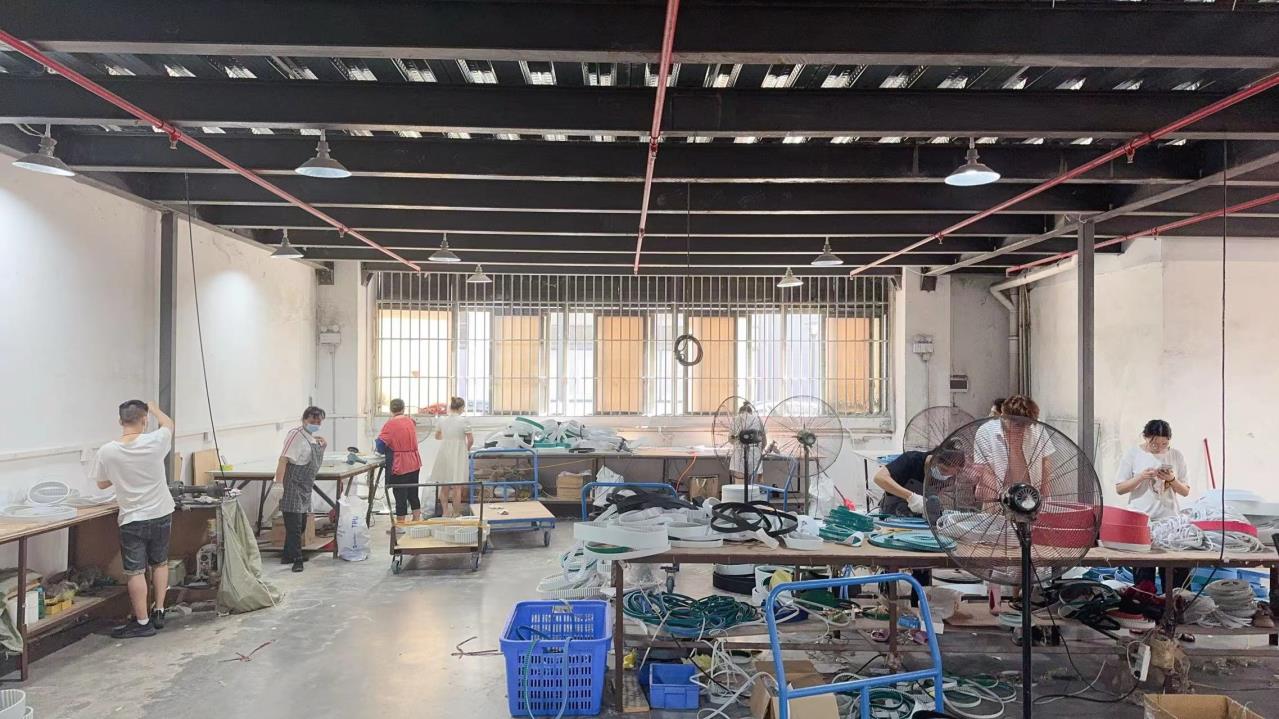
Dongguan Zhende Machinery Equipment Co., LTD is a manufacturer and one-stop procurement service provider of FA automation transmission parts, established in 2019 and based at Building 1, No. 332 Fumin Middle Road, Dalang Town, Dongguan City, Guangdong Province, China. The company operates a 4,500 m² facility with approximately 40 staff, a six-engineer R&D team and an annual production capacity of 120,000 pieces, with timing belts and timing pulleys as core product lines.
Its verification record can be read against the three filters above.
- Platform status: Alibaba.com Verified Supplier status, supported by a Supplier Assessment Report issued under the SGS/TÜV standard.
- Production Assessment number: 494177048_P.
- Production Trading Assessment number: 493993448_P+T.
- Issue date: 2026-07-10. Expiry date: 2027-07-09.
- Applicable market: International.
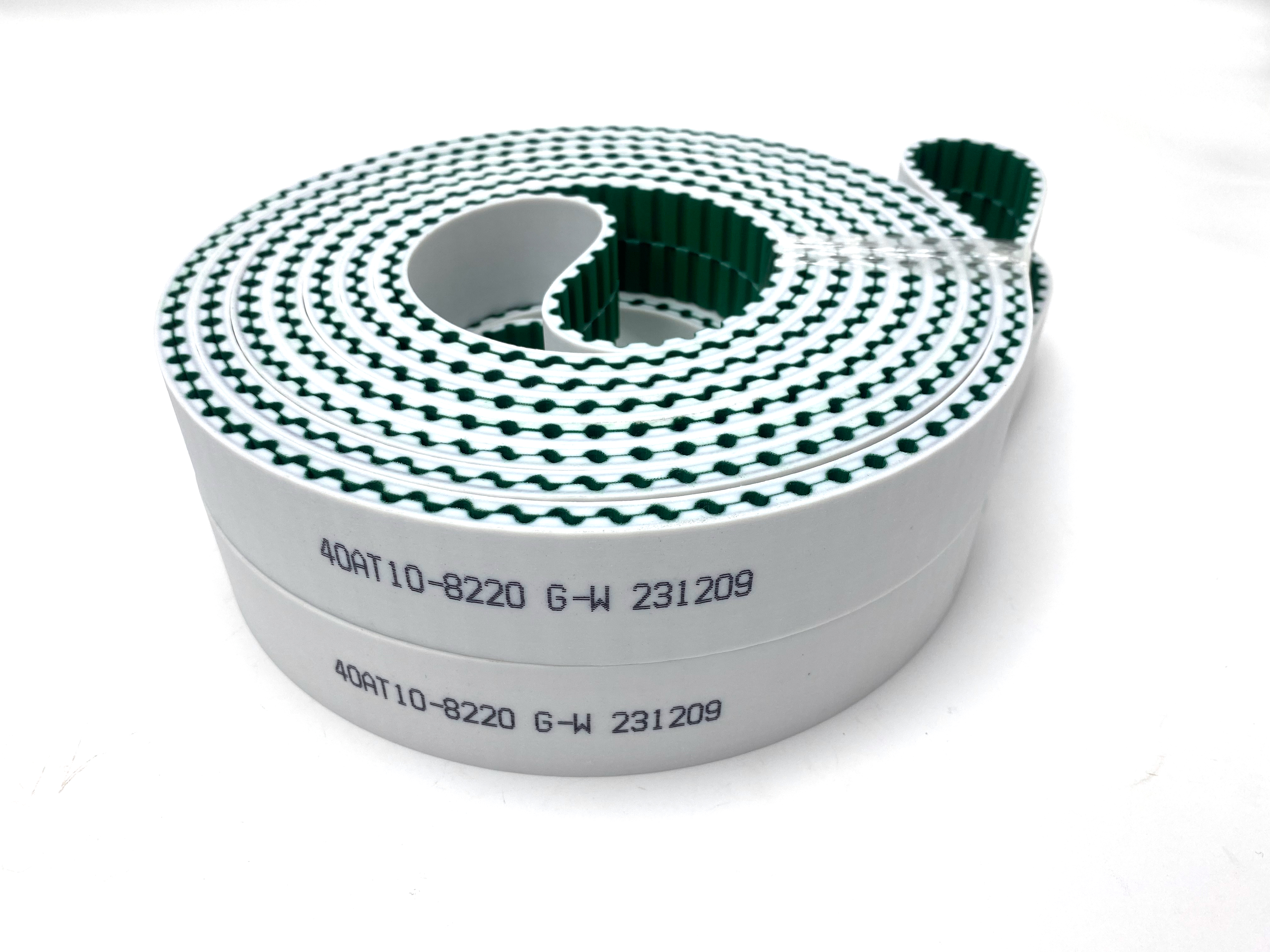
- Assessment scope: HTD 8M and HTD 14M timing belts; HTD 5M and S8M rubber timing belts; T5 and AT10 PU timing belts; 8MGT POLYCHIAN timing belts; T series timing pulleys; Imperial timing pulleys; HTD timing pulleys.
The presence of two assessment numbers is consistent with the company’s operating model. Zhende runs self-owned CNC machining workshops for precision transmission components and simultaneously acts as an authorized agent for HIWIN, THK, NSK, SKF, AirTAC and other brands, which means the business is assessed both as a production entity and as a trading entity. Buyers should not treat the two numbers as duplicates; they cover different functions.
Supporting operational facts are also relevant to a long-term supply decision. Export business accounts for 75% of total sales, with the EU and the USA as major markets. More than one million standard items are held in warehouse, allowing regular models to ship within three days, while custom gears and racks support drawing-based machining with a seven-day lead time. These figures describe capacity and logistics, not certificate status — but they are the practical conditions under which the certificate has to hold.
Technical Explanation: Why the Named Belt and Pulley Families Define the Scope
A scope list that names HTD 8M and 14M rubber belts, HTD 5M and S8M rubber belts, T5 and AT10 PU belts, 8MGT POLYCHIAN belts, and T series, Imperial and HTD pulleys is not a catalogue extract. It is a description of load ranges. The pitch, thickness and tensile member of each family determine where the product can be applied, and therefore what the assessment actually qualifies the supplier to deliver.
| Product family in scope | Pitch / profile | Key technical facts |
|---|---|---|
| HTD 8M rubber timing belt | 8.0 mm | Neoprene (CR) body, fiberglass cord, 5.6 mm thickness, 92 Shore A, maximum allowable tensile strength 780 N per 10 mm width, ultimate tensile strength 3120 N, minimum pulley 40 mm / 16 teeth |
| HTD 14M rubber timing belt | 14.0 mm | Neoprene (CR) body, fiberglass cord, 10.0 mm thickness, 92 Shore A, 1816 N allowable and 8308 N ultimate tensile strength per 10 mm width, minimum pulley 124.78 mm / 28 teeth |
| HTD 5M rubber timing belt | 5.0 mm | Neoprene (CR) body, fiberglass cord, 3.6 mm thickness, 92 Shore A, 650 N allowable and 2600 N ultimate tensile strength, minimum pulley 25 mm / 16 teeth |
| S8M rubber timing belt | 8.0 mm (STS/STPD) | Neoprene (CR) body, fiberglass cord, 5.3 mm thickness, 92 Shore A, 650 N allowable and 2600 N ultimate tensile strength, minimum pulley 56.0 mm |
| T5 PU timing belt | 5.0 mm | Polyurethane body, steel cord, 2.2 mm thickness, 92 Shore A, 393 N per 10 mm width, power transmission up to 5 kW, minimum pulley 30.0 mm |
| AT10 PU timing belt | 10.0 mm | Polyurethane body, steel cord, 4.5 mm thickness, 92 Shore A, 1700 N per 10 mm width, power transmission up to 70 kW, minimum pulley 50.0 mm |
| 8MGT POLYCHIAN timing belt | 8.0 mm | Polyurethane body, carbon fiber cord, nylon fabric tooth facing, 5.6 mm thickness, 92 Shore A, transmission efficiency up to 98%, belt speed up to 80 m/s, maintenance-free |
| T series timing pulley | T2.5, T5, T10, T20 | Aluminum alloy, carbon steel, stainless steel or cast iron; 10–120 teeth; bore 3–100 mm; radial runout ≤0.03 mm; ISO 13050 / DIN tooth accuracy; up to 8,000 rpm |
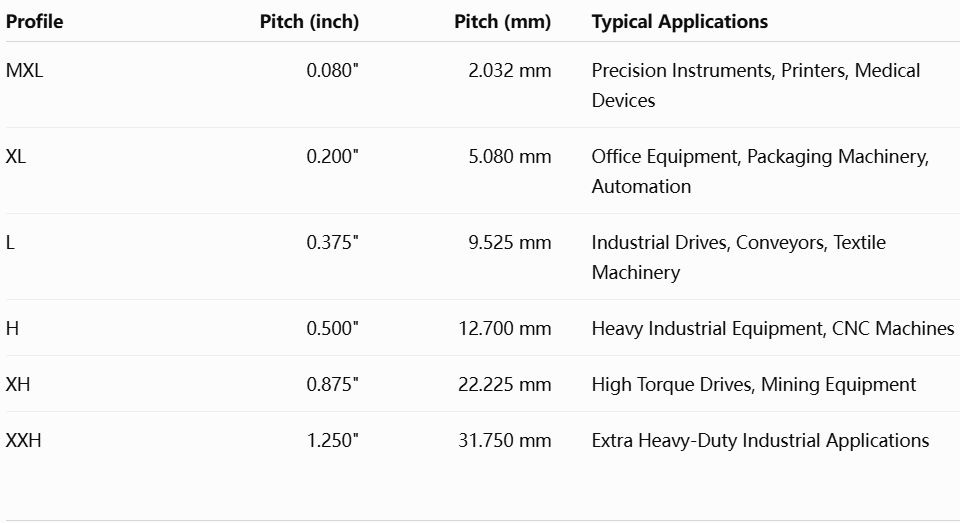
| Imperial timing pulley | MXL, XL, L, H, XH, XXH | 10–120 teeth; bore 3–100 mm; radial runout ≤0.03 mm; H7 finished bore; RMA, ISO and DIN standards |
| HTD timing pulley | 3M, 5M, 8M, 14M | 12–120 teeth; bore 5–100 mm; concentricity ≤0.03 mm; ISO 13050 and DIN; up to 8,000 rpm; −30°C to +120°C |
Read this way, the scope stops being a list of names and becomes a capability map. HTD 14M, with a 14.0 mm pitch and a minimum pulley diameter of 124.78 mm, belongs to large-diameter heavy-duty drives. HTD 5M, with a minimum pulley diameter of 25 mm, belongs to compact, lighter-duty positioning. T5 PU belts, at 393 N per 10 mm of width and up to 5 kW, suit precision linear motion in labelling, electronics and medical equipment. AT10 PU belts, at 1700 N per 10 mm of width and up to 70 kW, cover considerably higher loads. The 8MGT POLYCHIAN belt, built on a carbon fiber cord with a nylon tooth facing and a maximum belt speed of 80 m/s, targets high-speed servo drive systems where lubrication is not acceptable.
The pulley side completes the drive. T series pulleys and HTD pulleys are specified to ISO 13050 / DIN tooth accuracy with radial runout or concentricity of 0.03 mm or better, while Imperial pulleys add RMA coverage for MXL through XXH profiles. Common tolerances across the belt lines — width ±0.5 mm, length ±0.5 mm, thickness ±0.2 mm on most families — are what make belt and pulley interchangeable within a documented drive design rather than on a trial basis.
One clarification matters for evaluation. The 100% dimensional inspection performed before shipment is the supplier’s own production control. It is not the same thing as a third-party assessment, and it does not transfer the buyer’s incoming inspection obligation. Both exist, and they serve different purposes in a continuity plan.
Where These Drives Are Used
The application profile of the covered product families is broad but consistent. Typical industrial settings include industrial automation, packaging machinery, printing machinery, textile machinery, woodworking machinery, food processing equipment, conveyor systems, CNC machines, robotics, material handling systems, agricultural machinery, medical devices and office automation equipment.
Operating conditions are the reason the scope list matters to buyers. These drives are frequently specified for high-speed transmission, high torque, 24/7 continuous operation, dusty or oil-exposed environments and temperature ranges spanning roughly −20°C to +120°C depending on material. Matched equipment typically includes servo motors, stepper motors, gearboxes, linear modules and automation control systems, which places the belt and pulley inside a positioning chain rather than in a simple conveying role. Requirements in this context include high concentricity, precision-machined tooth profiles, corrosion-resistant surface treatment and available customisation on bore, keyway, flange and coating. A supplier assessment that covers the belt and pulley families used in that chain is more relevant to a project than one that covers only part of it.
Market Trend Analysis: Documentation Is Becoming a Buying Criterion
Three observable trends make certificate reading more consequential than it was a decade ago.
The first is volume and geography. The automotive timing belt segment alone was valued at USD 7.7 billion in 2025 with China holding the largest share, and the broader timing belt market is projected to grow at 4.8% CAGR through 2030. Trade data reinforces the direction: under HS Code 4010.39 for transmission belts of vulcanised rubber, China has ranked among the leading exporters to the United States in recent periods. Growth of this kind increases supplier count and, with it, the number of certificates in circulation.
The second is standards consolidation. ISO 13050:2022 specifies the characteristics of metric pitch curvilinear synchronous endless belts and pulleys across G, H, R and S profiles, giving buyers a single reference against which tooth geometry claims can be compared. For more demanding environments, guidance such as ISO 9563 and ISO 1813 is recommended for synchronous belts used in potentially explosive atmospheres. As published standards become more precise, certificate scope statements that name specific profiles become easier to check and harder to fake.
The third is market structure. The global timing belt landscape includes long-established multinational producers such as Gates Industrial Corp, Continental AG, Bando Chemical Industries and Mitsuboshi Belting, alongside regional manufacturers and distributors. This is not a case of one model replacing another. It means buyers routinely compare a multinational brand belt against a regionally manufactured equivalent, and the certificate scope is one of the few neutral instruments available for that comparison.
Comparison with Traditional Screening — and Where Certification Stops
Most sourcing processes still begin with price per piece, quoted lead time and a sample. That approach is fast and, for repeat commodity items, often sufficient. Its blind spot appears when the drive is critical to an uninterrupted production line.
| Evaluation dimension | Price-first screening | Certificate-scope screening |
|---|---|---|
| Primary question answered | What does the part cost and when can it arrive? | Which product families and which entity have been independently assessed? |
| Evidence used | Quotation, sample, reference list | Assessment number, audit type, scope list, issue and expiry dates |
| Strength | Immediate commercial comparability | Verifiable and renewable at a known date |
| Blind spot | Cannot distinguish a current assessment from an expired or narrow one | Says nothing about price, allocation or future process changes |
The limits deserve equal weight, and any honest evaluation framework should state them.
- An assessment is a point-in-time record. It describes the facility, the entity and the process as they were assessed, not as they will be twelve months later. Renewal, not possession, is what preserves its value.
- Scope is finite. Products outside the listed families are not covered. A profile introduced after the audit date falls outside the current assessment until the scope is extended.
- Certification is not incoming inspection. For Zhende, 100% dimensional inspection before shipment is a production control; the buyer’s own receiving checks remain separate and remain necessary.
- Certification does not price or allocate. It says nothing about unit cost, capacity reservation during peak demand, or the length of the lead time under pressure.
- The current validity window ends on 2027-07-09. Beyond that date, the existing report should be treated as historical rather than current.
There is also a comparability caveat. Multinational belt producers and regional manufacturers operate under different disclosure norms, so a strict badge count comparison between them is misleading. The relevant question is never “who has more badges” but “whose documented scope matches my drive, and is that document still within its validity window”.
Planning Continuity Around an Expiry Date
For a supplier whose current assessment expires on 2027-07-09, continuity planning becomes a short and concrete list of actions.
- Record the expiry date in the supplier file at the moment the supplier is approved, not at the moment it lapses.
- Request the renewed assessment, including the new assessment number and dates, before the current window closes.
- Compare the renewed scope against your own bill of materials to confirm that every profile you purchase is still inside it.
- Check that the legal entity named on the assessment matches the entity on your purchase order and commercial invoice — assessment is entity-specific.
- Keep the previous report on file so that the sequence of assessments remains traceable across years.
- If your programme introduces a new belt family, confirm whether it is covered before, not after, the first production order.
These steps are inexpensive and they convert a certificate from a one-time screening artefact into a maintained procurement record. That is what makes a long-term supply relationship defensible when a production line stops and the cause is traced back to a drive component.
Future Outlook
Two forces are likely to shape how timing belt suppliers present verification over the next few years. Published standards continue to tighten: ISO 13050:2022 already defines metric pitch curvilinear synchronous belts and pulleys at a level of detail that makes profile claims checkable, and buyers who adopt it as a reference will find certificate scope statements easier to audit. At the same time, procurement teams are moving away from annual re-qualification and toward continuous supplier monitoring, where assessment dates, scope changes and expiry windows are tracked as data rather than re-discovered every year.
For manufacturers and distributors, the practical consequence is that documentation quality converges with product quality. A supplier that can state its assessment number, audit type, scope and expiry date without prompting removes a step from every buyer’s evaluation. For buyers, the reverse holds: the suppliers worth shortlisting for long-term programmes are increasingly those whose certificates can be read, dated and renewed without ambiguity.
FAQ
What does an Alibaba.com Verified Supplier status actually verify?
It indicates that the supplier has been assessed and that a Supplier Assessment Report is available. The report carries the assessment number, the audit type, the assessed scope, the issuing inspection body and the validity window. For Dongguan Zhende Machinery Equipment Co., LTD, the supporting report was issued under the SGS/TÜV standard with an issue date of 2026-07-10 and an expiry date of 2027-07-09. The status itself confirms that an assessment exists; the report defines what it covered.
What is the difference between a Production Assessment and a Production Trading Assessment?
A Production Assessment examines manufacturing capability, while a Production Trading Assessment examines the trading or distribution function. Zhende holds a Production Assessment under number 494177048_P and a Production Trading Assessment under number 493993448_P+T. The two numbers are not interchangeable: the company operates self-owned CNC machining workshops and also acts as an authorized agent for HIWIN, THK, NSK, SKF and AirTAC, so both production and trading functions are separately assessed.
Which timing belt and pulley families are included in the current assessment scope?
The scope covers HTD 8M and HTD 14M timing belts; HTD 5M and S8M rubber timing belts; T5 and AT10 PU timing belts; 8MGT POLYCHIAN timing belts; and T series, Imperial and HTD timing pulleys. The applicable market is international. Buyers should match this list against their own bill of materials, since a product family outside the list is not covered even when the supplier can quote it.
How long is the assessment valid, and what happens after the expiry date?
The current window runs from 2026-07-10 to 2027-07-09. After 2027-07-09 the existing report describes the facility as it was at the time of assessment rather than its current verified status. The standard practice is to request the renewed assessment and its new number before the window closes, then re-check that the renewed scope still covers the profiles being purchased.
Does a valid certificate replace incoming inspection of timing belts?
No. A certificate records that an independent assessment of the entity and its scope took place. It is not a shipment-level quality record. Zhende performs 100% dimensional inspection before shipment as a production control, and buyers should still carry out their own receiving checks on pitch, width, thickness and pulley bore against the documentation. The two controls address different risks and do not substitute for each other.
Reference document: Zhende product brochure (PDF) — https://cdn.socialarks.com/sbsp/25080/common/2026/0722/zd.pdf