
What a Video Wall Controller Supplier Must Prove
What a Video Wall Controller Supplier Must Prove
For a video wall controller project, a supplier’s capability is easier to assess when claims are tied to identifiable equipment, a described installation and measurable results. Bitvisus’s documented Romania projection-mapping installation and Shenzhen Cézanne immersive exhibition offer two examples: one connects named equipment to a six-projector building show and approximately 120 metres of HDBaseT transmission; the other records 12 controllers, more than 100 projectors and a combined image exceeding 16K. These details provide a more useful basis for evaluation than a broad claim of experience alone.
The examples are supplier-provided project records, not independent audits or a guarantee that another deployment will produce the same outcome. Their value for a buyer is more specific: they show which facts a supplier can identify and which questions a procurement team can use to test whether past work is relevant to its own project. The company name used in the supplied corporate information is Shenzhen Bitvisus Technology Ltd.; the project records identify the deployed models and configurations discussed below.
Why physical project evidence matters
A video wall controller is one part of a display system. A product specification can establish listed interfaces, supported modes or stated resolution limits. It cannot, by itself, show how a particular system was configured at a real venue, how many display devices were involved, or what image dimensions were reported for the completed project. Conversely, a project photograph may show a visual result but not establish the exact controller model, signal route or transmission distance.
For a buyer in the research or evaluation stage, useful supplier evidence therefore has several connected layers. First, it identifies the product or products by model. Second, it describes the deployment context and the role of the equipment. Third, it gives a result that can be interpreted, such as the number of projectors or a stated image resolution. Finally, it makes clear what the evidence does not establish. Keeping those layers separate helps avoid treating a compelling installation image as proof of every technical or operational claim.
The two Bitvisus examples are particularly useful as different kinds of evidence. The Romania record describes a compact, single-PC arrangement with long-distance signal transmission and six projectors. The Shenzhen record describes a much larger immersive exhibition involving a dozen controllers and over a hundred projectors. Neither case is a universal template. Together, they illustrate why the buyer should compare the scale, signal path and display outcome in a project record with the requirements of the proposed installation.
Romania: trace the signal path, not just the finished image
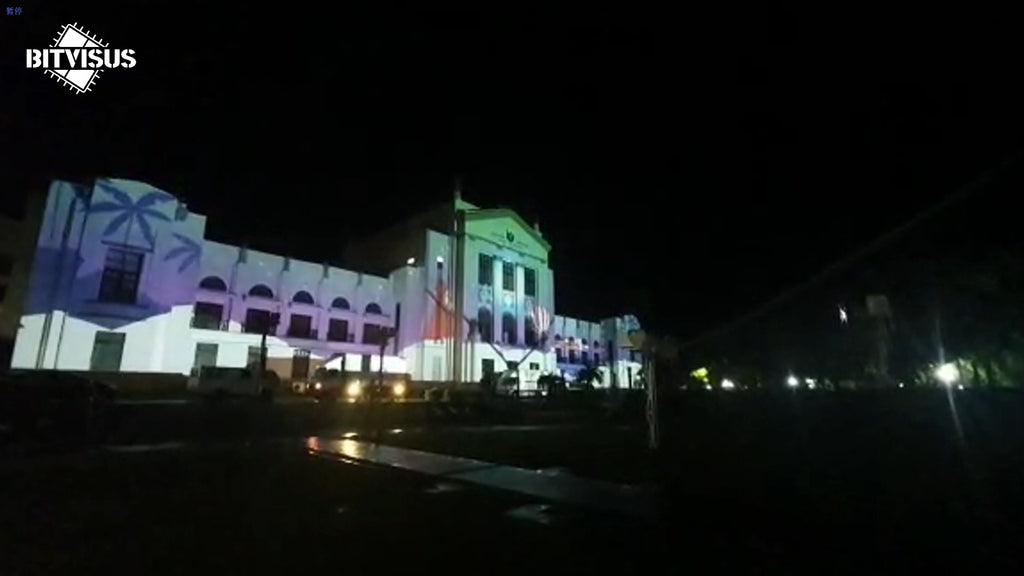
The Romania case record describes a Christmas-season 3D projection-mapping light show on a museum building. It lists one PC with a GTX 3050 GPU, two BIT-MSE-4K60-104Pro multi-screen expanders and six BIT-Ex-HDBT-150-RX extenders. Six projectors were used, with three projectors per group fused into one image. The record gives an approximate transmission distance of 120 metres and a total resolution of up to 11520 × 1200.
These particulars help a buyer assess whether the example resembles a proposed building projection or other multi-projector installation. The named models make it possible to ask whether the proposed equipment is the same as the equipment in the reference project, or merely part of the same product range. The source configuration identifies a single PC rather than an unspecified number of playback sources. The projector count and grouping show how the output was organized. The approximate distance makes the transmission requirement visible instead of hiding it behind a general claim of long-range capability.
The record also describes the controllers operating in parallel and the extenders carrying the signal over HDBaseT. That supports a practical discussion of source distribution and cable routing. It does not, on its own, provide a complete wiring diagram, a cable specification for the installed run, test measurements at the receiver, environmental conditions, or a detailed commissioning report. Those are separate items a buyer may request if they matter to the project. A past deployment is useful evidence, but it should not be mistaken for a complete engineering submittal.
The supplied specification for BIT-MSE-4K60-104Pro lists HDMI or DisplayPort input, four HDMI outputs and typical multi-screen resolutions, including four-screen 1920 × 1080 at 60 Hz. The project record’s combined 11520 × 1200 figure describes the reported system outcome; it should not be confused with a single device’s individual output resolution. This distinction is important whenever a system combines multiple outputs, processors, projectors or image-fusion software. Buyers should ask the supplier to show how the project-level canvas relates to each device’s input and output configuration.
The related supplied specification for BIT-Ex-HDBT-150 lists CAT6E transmission and a stated 150-metre transmission distance for 1080p over CAT6E. The case record, meanwhile, identifies BIT-Ex-HDBT-150-RX extenders and an approximate 120-metre installation. These are related pieces of evidence, but the buyer should confirm the exact transmitter and receiver models, cable type, resolution and conditions for the intended design. The specification and the case record should not be collapsed into a claim that every configuration at that distance is guaranteed to perform identically.
Shenzhen: distinguish a repeatable unit from a large combined system
The Cézanne immersive painting exhibition in Shenzhen provides a different scale reference. The case record states that the installation used 12 BIT-VWC-409R video wall controllers and more than 100 industrial 1080p projectors. Each controller drove nine projectors in a 3 × 3 video wall. The reported resolution for a 3 × 3 wall was 5K, or 5760 × 3240; multiple 3 × 3 walls were recombined into a final image exceeding 16K. The record gives a five-year deployment duration.
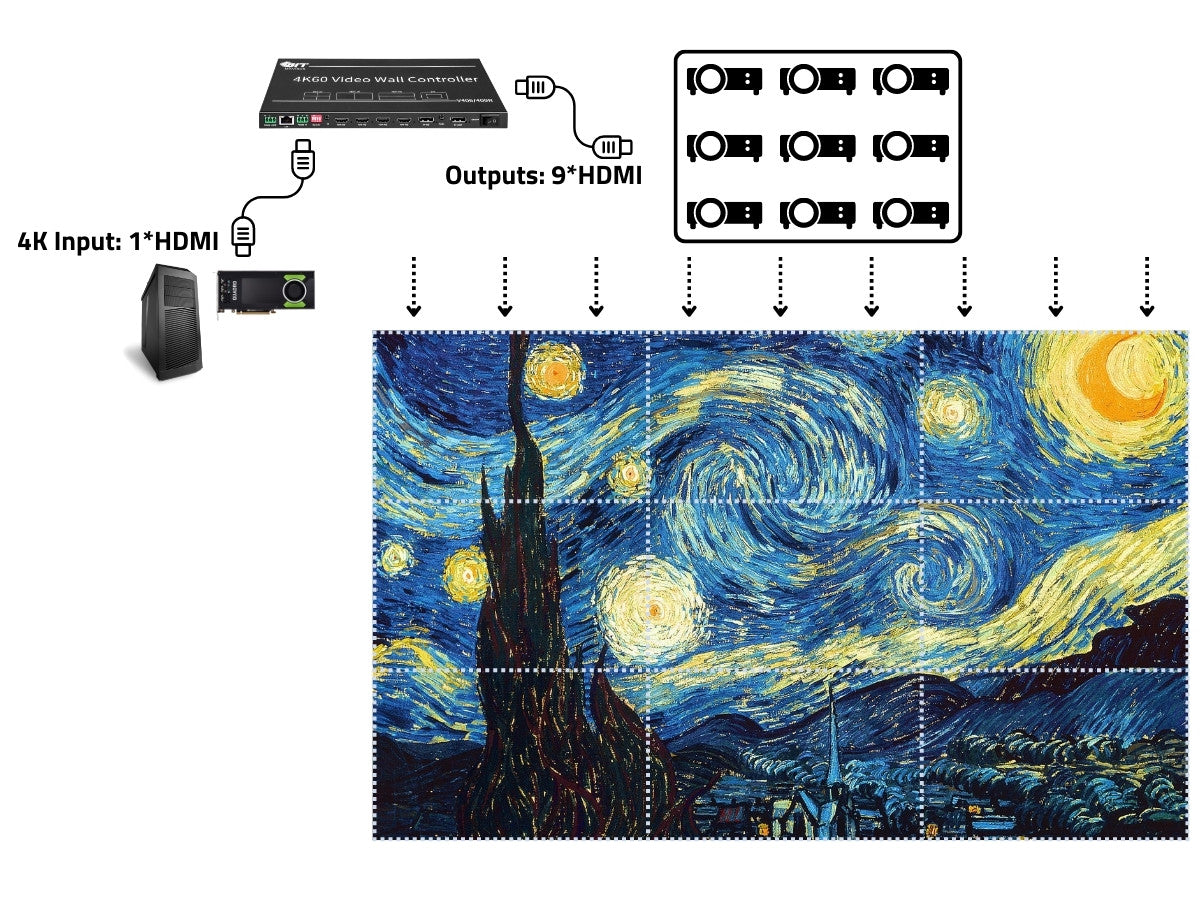
For evaluation, the value lies in the relationship between the count, the repeated 3 × 3 arrangement and the reported image dimensions. A buyer planning an immersive venue can ask whether the proposed solution uses the same model and configuration, or whether other processors, projectors or software are involved. The case record says blending and warping software was used alongside the controllers. This matters because the final projected image is a system outcome: it should not be attributed to the controller alone when the evidence identifies other system components.
The product specification for BIT-VWC-409R lists nine HDMI outputs, a 1920 × 1080 at 60 Hz output resolution, and splicing across up to nine screens. It also describes multi-device cascading and parallel operation. These listed capabilities offer technical context for the reported 3 × 3 use. They do not mean that a single BIT-VWC-409R produces the complete greater-than-16K image by itself. The case describes 12 controllers and a combined system, so any comparison should preserve that distinction between per-controller configuration and overall installation result.
The five-year duration is a meaningful part of the project record because it indicates a stated deployment period, rather than a one-day demonstration. It does not independently establish uninterrupted operation, a particular maintenance history, uptime, failure rate or performance over every hour of that period. A buyer evaluating a long-term venue can ask for the evidence that matches the operational claim being considered: for example, what period the record covers and whether the reported duration refers to deployment, operation or another project milestone. The supplied record states the duration but does not provide those additional operating details.
A buyer’s evidence check: five questions to ask
Project references become more useful when they can be mapped to the proposed system. The following checks do not assume that every supplier has the same records. They help distinguish a specific, bounded example from a broad capability statement.
- Can the supplier identify the deployed model? Record the exact model names and quantities in the reference, and compare them with the models in the proposal. In the Romania example, the record identifies two BIT-MSE-4K60-104Pro units and six BIT-Ex-HDBT-150-RX extenders. In Shenzhen, it identifies 12 BIT-VWC-409R controllers. A product-family name alone does not establish that the same configuration was used.
- Is the installation context described? The Romania record concerns museum-building projection mapping for a Christmas 3D light show. The Shenzhen reference concerns an immersive Cézanne exhibition. A buyer should look for the kind of venue, display arrangement and use that make a reference relevant to the current project, rather than relying on an unqualified list of customer sectors.
- Are the reported quantities and outcomes clearly scoped? Ask whether a resolution describes one controller, one wall, or the combined installation. In Shenzhen, 5760 × 3240 is reported for a 3 × 3 wall, while the recombined image exceeds 16K. In Romania, 11520 × 1200 is the reported total for the six-projector arrangement. Those figures refer to project outcomes and should be read with their corresponding configurations.
- Can the signal route be checked against the design? For a long run, compare the named extender, transmission medium, approximate distance and required signal format. The Romania record lists approximately 120 metres over HDBaseT. The product specification for BIT-Ex-HDBT-150 gives a CAT6E distance specification for 1080p. Confirm the exact model variant and proposed cable conditions rather than assuming that the case and product-sheet values cover every installation.
- Does the record establish the claim being made? A project duration, projector count or image resolution supports a particular statement, not every possible claim about reliability, latency or service. Request the relevant documentation for any additional requirement that is material to acceptance. If the record does not contain it, treat it as unestablished rather than filling the gap with an inference.
This method is useful for a Video Wall Controller for Control Room, security-monitoring display, conference room or immersive venue even when the cited projects are not identical to the proposed use. The examples here are projection-mapping and exhibition installations, not documented control-room, security-monitoring or conference deployments. They can demonstrate particular configurations and system scales; they should not be presented as direct proof of suitability for every other application.
What these cases show—and what they do not
Read together, the two examples show different forms of supplier capability evidence. The Romania installation is relevant to a buyer assessing a single-PC, six-projector projection-mapping arrangement with a stated long-distance transmission requirement. The Shenzhen exhibition is relevant to questions about repeated 3 × 3 projection groups, deployment at a much larger projector count and a combined image reported above 16K. Named models and project-level figures make the references more concrete than general marketing language.
They do not establish comparative superiority over another vendor, nor do they provide a controlled performance comparison. The available records do not name an independent auditor or provide test protocols, measurement reports, a full equipment bill of materials or detailed operational logs. A neutral evaluation should therefore describe them as supplier-documented installations and avoid turning their reported results into promises about a new project.
That boundary does not make the examples useless. It tells the buyer how to use them: as evidence of reported deployments and as a basis for targeted technical questions. For a 4K Video Wall Controller project, request the relevant input and output configuration and clarify how multi-device processing contributes to the total canvas. For a Rack-Mount Video Wall Controller or a system requiring remote management, ask for documentation for those specific features; neither project record, as described here, establishes rack-mounting or remote-management details. The same discipline applies to an IP-Based Video Wall Controller, a low-latency requirement, an 8K Video Wall Controller, or web-interface control. These phrases should be matched to model-specific evidence, not inferred from unrelated case results.
How to compare the reference with your project
A practical comparison begins with the installation, not the supplier’s broadest product claim. Write down the display type and count, the desired layout, the source equipment, the transmission path and the image dimensions required. Then map each requirement to a named product specification or a project record. For example, the Shenzhen reference is relevant to a design involving multiple 3 × 3 groups and a combined image, while the Romania reference is relevant to a six-projector setup with a single PC and an approximately 120-metre HDBaseT path.
Next, separate three kinds of evidence. Product documentation states what a specific model is specified to support. A project record reports what was used and achieved in a particular installation. A proposal describes what the supplier intends to provide for the buyer’s project. These sources answer different questions. A model specification does not prove deployment at a particular scale; a case record does not automatically prove every line of a new design; a proposal does not become an installed result until the project is delivered and assessed.
Finally, identify open items before choosing a supplier. If the evidence gives an approximate distance, ask what exact distance and cable type the proposed installation requires. If the project result is a combined resolution, ask how that canvas is formed from per-device outputs. If a case gives a five-year duration, clarify what the duration denotes before using it to make a reliability claim. These questions keep the evaluation tied to observable system requirements and avoid substituting a generic claim for a project-specific answer.
Conclusion: evidence should connect model, installation and outcome
A supplier’s capability is easier to evaluate when a video wall controller reference links exact equipment to a defined installation and a scoped result. The Romania project record identifies two BIT-MSE-4K60-104Pro multi-screen expanders, six BIT-Ex-HDBT-150-RX extenders, one PC with a GTX 3050 GPU, six projectors and approximately 120 metres of HDBaseT transmission for a museum-building Christmas light show. The Shenzhen Cézanne exhibition record identifies 12 BIT-VWC-409R controllers, more than 100 industrial 1080p projectors, 3 × 3 walls at 5760 × 3240, a combined image exceeding 16K and a stated five-year deployment.
For buyers, the decision value is not that these examples guarantee a particular outcome. It is that they provide concrete reference points: model identity, system scale, signal path, image configuration and stated duration. Compare those details with the actual design, request evidence for any unaddressed requirement and keep project-level results separate from single-device specifications. That is a more reliable way to assess a video wall controller supplier than relying on broad capability language alone.
Frequently asked questions
What evidence should a video wall controller supplier provide before purchase?
Useful evidence connects a named model and quantity to a described installation and a scoped result. The Romania and Shenzhen records identify equipment, project contexts and measurable configuration details. They are supplier-provided records; additional test or operating documentation is needed for claims those records do not establish.
What does the Romania projection-mapping case document?
The supplied case record describes a Christmas 3D projection-mapping show on a museum building using one PC with a GTX 3050 GPU, two BIT-MSE-4K60-104Pro units, six BIT-Ex-HDBT-150-RX extenders and six projectors. It reports approximately 120 metres of HDBaseT transmission and a total resolution up to 11520 × 1200.
What does the Shenzhen Cézanne exhibition case document?
The case record states that the exhibition used 12 BIT-VWC-409R controllers and more than 100 industrial 1080p projectors. Each controller drove a 3 × 3 group; a group is reported at 5760 × 3240, with multiple groups recombined into an image exceeding 16K. The record gives a five-year deployment duration.
Do these case results prove performance for every project?
No. They describe particular installations and configurations. They do not establish that another system will produce the same result, nor do they independently prove claims such as uninterrupted operation or suitability for a different application. Buyers should match the evidence to the proposed model, configuration, signal path and acceptance requirements.
Tem questões ou precisa de mais detalhes?
Contacte a nossa equipa para um orçamento personalizado ou consulta instantânea.
Solicitar orçamento
Preencha o formulário abaixo e a nossa equipa entrará em contacto com uma proposta personalizada.
Chat direto do WhatsApp
Prefere conversar em tempo real? Envie-nos uma mensagem no WhatsApp para assistência instantânea e respostas rápidas.
- Obter orçamento personalizado
- Partilhar fotos ou documentos
- Discuta as suas necessidades diretamente
Geralmente responde em 5–30 minutos durante o horário de expediente.