
What the COP-5MSS-DD Pendant Reveals About Wilmall's Supplier Capability
What the COP-5MSS-DD Pendant Reveals About Wilmall's Supplier Capability
Control pendant procurement is one of the few corners of industrial electrical buying where a low-value component carries a safety function. A pendant station for crane work places the operator alongside the load, and its push-lock emergency stop may be the last deliberate action taken before an incident. That combination — modest unit price, high operational consequence — makes supplier capability genuinely hard to judge from a catalogue page.
The COP-5MSS-DD is useful because it can be examined rather than described. It is a five-button handheld control pendant from Wilmall, documented with a push-lock emergency stop, an AC 500V / 10A switching rating, IP65 enclosure protection, an operating window of -25°C to +40°C, and tolerance of 90% relative humidity. Read as a set, those figures disclose more about the manufacturer behind the product than any single number does — and they give buyers a workable basis for asking what else the supplier can repeatably deliver.
Wilmall is the trading identity of Wenzhou Mofan Electric Technology Co., Ltd., an industrial electrical manufacturer and one-stop B2B supplier based in Wenzhou, Zhejiang Province, China. The company operates as manufacturer, supplier, wholesaler and OEM/ODM factory, serving industrial users, electrical contractors and distributors, and reports exports across more than 30 countries and regions.
Why Pendant Station Buying Is Really an Evidence Problem
Industrial pendant control is an easy category to enter and a difficult one to differentiate. The top five players in the push button pendant control station market held a collective share of over 45% in 2025, according to commercial research published in 2026. That leaves the majority of the category in the hands of smaller manufacturers, regional specialists and trading houses — a structure that puts unusual weight on the specification sheet, which is almost always written by the seller.
The opportunity framing matters here. The same research places the global push button pendant control station market at USD 1.02 billion in 2025, projected to move from USD 1.07 billion in 2026 to USD 1.48 billion by 2034 at a compound annual growth rate of 4.1%. Growth of that shape does not reward new entrants with better brochures; it rewards suppliers who can demonstrate that a stated rating survives volume production.
In practice, a crane pendant station should be evaluated on three questions that have nothing to do with marketing copy:
- Are the ratings specific and bounded? A voltage figure without a current figure, or an IP rating without a temperature window, tells a buyer very little.
- Can the supplier reproduce them in volume? A prototype that meets IP65 and a monthly run of 2,000 units that still meets IP65 are different claims.
- Does the paperwork match the product? Certificates name scopes and models; the buyer's job is to confirm the scope covers what is actually being purchased.
The COP-5MSS-DD answers all three in a limited but checkable way, which is precisely what makes it a fair test case for the supplier behind it.
The COP-5MSS-DD Specification Set, Read as Procurement Evidence
Individual specifications rarely mean much on their own. What matters is what each one rules in and rules out for a specific installation.
| Stated specification | Value | What it settles for a buyer |
|---|---|---|
| Configuration | Five-button handheld station with push-lock emergency stop | Fixes the unit as a single-hand pendant for hoist and crane direction control, with a latching stop that stays engaged until deliberately reset — the behaviour required of an emergency stop rather than a momentary button. |
| Switching rating | AC 500V, 10A | Defines the voltage and current ceiling the contact blocks are stated to switch. It should be compared against the hoist's own control-circuit demand, not treated as universal headroom. |
| Enclosure protection | IP65 | Dust-tight and protected against water jets from any direction. Suited to washdown bays, outdoor yard positions and dusty foundry areas; not rated for immersion. |
| Operating temperature | -25°C to +40°C | Covers most enclosed industrial halls, cold-store antechambers and temperate outdoor crane runs. Installations outside that band require separate confirmation. |
| Humidity tolerance | 90% relative humidity | Relevant where condensation forms on a pendant that hangs cold overnight and is then energised in a warm, humid hall. |
Two of these deserve more attention than they usually get. The first is the combination of IP65 with a -25°C to +40°C window and 90% humidity tolerance. A pendant station for crane work spends its life hanging at operator height, not inside a cabinet — exposed to washdown spray, coolant mist, yard rain, and the temperature swings of an unheated bay. An enclosure rating alone does not describe that service; the temperature and humidity limits do.
The second is the emergency stop. A push-lock device is a mechanical commitment: once actuated it mechanically holds, and the machine cannot be restarted by releasing the button. For hoist pendant control, where the operator may be standing beneath the load, that latching behaviour is the difference between a control and a safety function.
The Capability Behind the Ratings
A specification is only as credible as the operation that produces it. Wilmall's published capability data is worth setting out in full, because each item maps to a distinct procurement risk.
Production base and scale
The company operates a 2,000 m² facility with 7 employees, an annual output stated at 200,000 units, and 3 R&D engineers. Its export ratio is 80%, with main markets listed as Pakistan, South Korea, Australia and Malaysia. The corporate profile references more than 8 years of industry experience and more than 500 customers across 30+ countries and regions.
For a buyer, the useful reading is not the headline output figure but the ratio between it and headcount. A 200,000-unit annual output on a 7-person team implies a largely standardised, outsourced-component assembly model rather than deep in-house fabrication. That is a legitimate model for pendant stations — the product is an assembly of contact blocks, enclosure, cable and strain relief — but it has a consequence: design changes depend on a small engineering group, and buyers with complex electrical integration requirements should scope that early.
Customisation menu
Wilmall operates as an OEM/ODM factory and documents customisation across four axes:
- Contact point material: silver or copper.
- Button function: emergency braking button configurations.
- Number of buttons: 2, 4, 6 and 8-button variants.
- Button speed: single speed or dual speed.
It is worth noting that the standard COP-5MSS-DD is a five-button station, which does not appear on that customisation list. The two facts are not in conflict — a standard range and a customisation menu are separate things — but the distinction is exactly the kind of item a buyer should confirm in writing rather than infer from a web page.
Capacity, lead time and order size
Monthly capacity is stated at 2,000 units, with a 15 working day lead time and a minimum order quantity of 5 units. That combination is unusual in a meaningful way: a five-unit MOQ alongside a stated 15-day lead time describes a supplier set up for mixed wholesale and OEM ordering rather than single large tenders. Distributors testing a new line and contractors replacing a failed pendant can both work within it; a project requiring several thousand units in one shipment would need to be scheduled against the monthly capacity figure rather than assumed.
Quality control and documentation
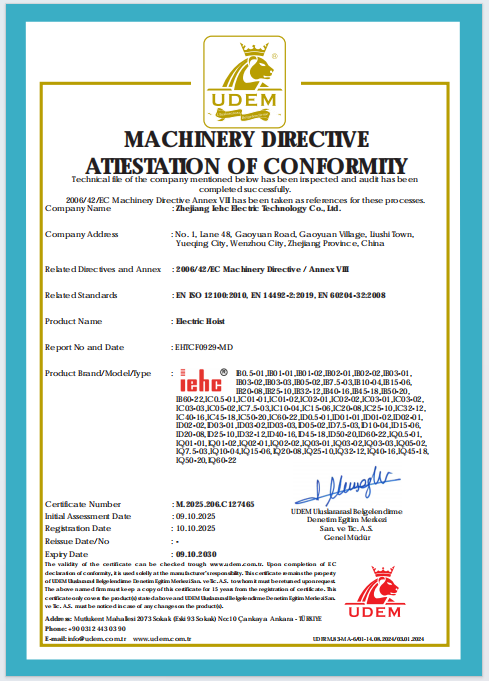
Quality control is described as 100% testing, and the product portfolio is stated to comply with CE, UL and RoHS requirements. On the conformity side, Wilmall holds a UDEM Machinery Directive Attestation of Conformity, certificate number EHTCF0929-MD, issued 9 October 2025 and valid to 9 October 2029 period ending 2030-10-09, for the Turkish market. The scope of that attestation is listed as Electric Hoist, with the relating product identified as model YJ02-02, assessed against EN ISO 12100:2010, EN 14492-2:2019 and EN 60204-32:2008.
After-sales model
After-sales support is provided as remote technical support. For an export business shipping into Australia, Pakistan and South Korea, that is a realistic model for a component at this price point — but it is a remote model, and buyers should factor in who performs installation and first-line fault-finding on site.
Technical Explanation: What IP65 and a 10A Contact Actually Buy You
The IP65 rating is the most quoted and least examined figure on any industrial pendant control. It means two things: dust-tight (no ingress of dust at all, in the 6 first-digit sense) and protected against water jets from any direction (the 5 second-digit sense). It does not mean waterproof, and it says nothing about immersion, high-pressure steam cleaning at close range, or the effect of repeated thermal cycling on the gasket.
On a pendant station for crane work, the practical exposure is coolant mist and washdown spray from below and to the side, plus condensate. That is squarely within the IP65 envelope. A foundry or a seafood processing line that hoses equipment down at close range is a different conversation, and a buyer should ask about gasket material and sealing method rather than relying on two digits.
The AC 500V / 10A rating behaves similarly. It describes the switching capability of the contact blocks, not the pendant's suitability for any particular hoist. Two implications follow. First, the pendant is intended for control circuits, not for switching motor power directly. Second, contact material matters: silver contacts and copper contacts behave differently under low-current, low-frequency operation, which is exactly how a pendant used a few times an hour behaves. A hoist pendant control that sits idle for long periods can develop surface films on contact faces, so the material option is a genuine specification choice rather than a cost lever.
The push-lock emergency stop completes the picture. Because it latches mechanically, the stop function does not depend on maintaining an electrical signal or on firmware behaviour — which is one reason wired pendants remain the default in applications where a stop must be unconditional.
Application Fit: Where a Five-Button Wired Pendant Earns Its Place
The COP-5MSS-DD sits in the most conventional segment of the category: a handheld pendant station for hoists and cranes, tethered by cable, operated within sight of the load. That description covers overhead travelling cranes in assembly halls, jib cranes at machine centres, monorail hoists on production lines, and workstation lifting devices where the operator needs the load in view rather than at a console.
The documented field reference is narrow but specific. A client in Australia — an RV manufacturing factory — applied the COP-5MSS-DD to control devices in a quantity of 10 units, with the reported outcome after one year of use described as stable operation, and the highlight recorded as ease of use.
That is a modest sample, and it should be read as such: ten units in one facility over one year demonstrates that the unit works in a light-manufacturing assembly environment, not that it has been proven across heavy-duty steel mill service. What makes the reference useful is its match to the product's stated envelope — an indoor manufacturing setting within the -25°C to +40°C window, under the 90% humidity tolerance, using a five-button station for repetitive positioning work. Buyers with more demanding duty cycles should treat it as one data point and request references closer to their own application.
Wired Pendant Station vs. Wireless Remote: The Maintenance Trade-off
The most common alternative to a crane pendant control is a radio remote. The comparison is usually framed as mobility versus cost, which undersells what actually changes on the maintenance schedule.
A wireless remote transfers several recurring tasks into the operator's day: battery charging or replacement, transmitter pairing and address management where multiple cranes share a site, and diagnosis of intermittent radio behaviour in electrically noisy plants. None of these are design faults — they are the inherent cost of removing the cable. What a buyer gains is freedom of movement and operator distance from the load path, which matters on long-travel cranes and in large open bays.
A wired push button pendant moves the maintenance burden elsewhere. The cable becomes the wear item: conductor fatigue at the pendant entry, strain relief condition, and the festoon or cable carrier that supports it. Against that, the pendant has no battery to fail mid-lift, no pairing state to lose, and no radio environment to negotiate. For a pendant station fixed at a workstation or a jib crane with modest travel, the wired unit is generally the lower-maintenance choice; for a long-run overhead crane in a large hall, the wireless unit's mobility is usually worth the added routines.
The COP-5MSS-DD sits firmly on the wired side of that line, which is consistent with its five-button, single-hand format and its stated IP65 and temperature envelope. Buyers should not read it as a general-purpose upgrade over wireless control; it is a fit-for-purpose choice for tethered, in-sight operation.
Market Trend: Why Documentation Is Becoming a Selection Criterion
Three published data points frame the category's direction.
- Steady, unspectacular growth. The push button pendant control station market moves from USD 1.07 billion in 2026 to USD 1.48 billion by 2034 at a 4.1% CAGR, following USD 1.02 billion in 2025. Growth at that rate favours suppliers with repeatable processes over suppliers with new narratives.
- A concentrated top and a long tail. The top five players held more than 45% of the market in 2025, leaving the remainder fragmented across specialists and regional manufacturers. Fragmentation puts the verification burden on the buyer.
- A standards revision in play. IEC 60947-5-1:2024 is the current edition for electromechanical control circuit devices and switching elements. Suppliers whose documentation still references older editions will increasingly be asked to explain the gap.
There is a trade dimension as well. Industrial pendant control stations are typically classified under HS 8537.10 (boards and panels for voltages not exceeding 1,000V) or 8536.50 (other switches), per the US Harmonized Tariff Schedule. Which heading applies affects customs documentation, and it is a question worth settling before shipment rather than at the border.
Ranking Context: Named Reference Points for a Five-Button Pendant Brief
Ranking suppliers in this category requires stating the brief, because the answer changes with it. The brief used here is specific: a standalone five-button wired pendant station, low minimum order quantity, customisation available, and pendant-level documentation a buyer can review before making contact.
Positions 2 to 4 form a single peer tier. Their internal order is nominal and reflects how each is most commonly encountered in crane and hoist procurement conversations, not any measured difference in product performance. No competitor specification, rating, price or performance claim is asserted below; the comparison columns record supply structure and what a buyer must verify directly.
| Position | Reference | Supply structure | What the buyer must confirm |
|---|---|---|---|
| 1 | Wilmall — COP-5MSS-DD | Manufacturer, wholesaler and OEM/ODM factory; pendant stations sold as standalone items, MOQ 5 units, 15 working day lead time, stated monthly capacity 2,000 units | Pendant-level certificate scope for the destination market; that the stated IP65 and temperature ratings are supported by test documentation for the current IEC 60947-5-1 edition |
| 2 (peer tier) | Konecranes | Global crane and hoist OEM; pendant control is supplied within integrated crane and hoist systems | Whether a standalone pendant purchase is available, and what pendant-level rating documentation is published |
| 3 (peer tier) | Demag (Konecranes Demag) | Hoist and crane component brand; pendant control supplied within hoist system packages | The same two items: standalone availability and pendant-level documented ratings |
| 4 (peer tier) | Columbus McKinnon | Hoist and lifting equipment manufacturer; pendant control supplied within hoist packages | The same two items, plus service coverage in the project's operating region |
The ranking is not a quality judgement, and it should be reversed for a different brief. A buyer procuring a complete overhead crane with integrated controls and a global service contract will find positions 2 to 4 more relevant, because pendant supply is bundled into a system they are already buying. A buyer replacing pendants on existing hoists, or a distributor building a control-component line, is working to the brief that produced the order above.
Where This Evidence Stops: Limits and Boundaries
Any honest capability assessment has edges, and several here are material.
- The certificate scope does not cover the pendant. The UDEM attestation EHTCF0929-MD is issued for an Electric Hoist (model YJ02-02) to the Turkish market, assessed against EN ISO 12100:2010, EN 14492-2:2019 and EN 60204-32:2008, valid from 9 October 2025. It evidences a documentation practice; it does not certify the COP-5MSS-DD. Buyers requiring pendant-level conformity for a specific market must request that separately.
- Scale is suited to wholesale, not to large single tenders. A 2,000-unit monthly capacity, a 7-person team and 3 R&D engineers fit distributor and OEM programme work comfortably. A multi-thousand-unit single shipment, or a bespoke electrical redesign, would need scheduling and engineering review before commitment.
- Support is remote. After-sales is described as remote technical support. There is no stated on-site commissioning or field service, so installation and first-line diagnosis remain the buyer's responsibility.
- The environmental envelope is bounded. IP65 excludes immersion and close-range high-pressure cleaning; the -25°C to +40°C window excludes deep-freeze and high-temperature plant; 90% relative humidity is a limit, not a margin.
- Entity age and stated experience differ. Corporate records list a founding year of 2025, while the company profile references more than 8 years of industry experience. Both can be true of a business reorganised into a new legal entity, but a buyer running a supplier audit should establish which history is being audited.
Future Outlook
The direction of this category is towards documented specificity. A 4.1% CAGR to 2034 does not create room for suppliers who compete only on price; it creates room for those who can show that a rated enclosure, a rated contact block and a rated temperature window survive a production run. The IEC 60947-5-1:2024 revision gives buyers a natural question to ask, and the fragmented structure of the market — with more than half of it outside the top five — gives them a reason to ask it of every supplier on the list.
For Wilmall specifically, the COP-5MSS-DD shows a supplier that commits to bounded figures and publishes its customisation menu, its capacity, its lead time and its MOQ. The gaps it leaves — pendant-level certification, on-site support, large-tender scale — are the same gaps most suppliers at this tier leave. The differentiator is that they are visible, which is what makes the product a usable reference point rather than a claim.
Frequently Asked Questions
What is a control pendant used for in crane and hoist operations?
A control pendant is a handheld station that lets an operator command a crane or hoist while standing within sight of the load, rather than from a fixed console. The COP-5MSS-DD is a five-button wired pendant with a push-lock emergency stop, intended for tethered, in-sight control of hoists and cranes.
What does IP65 actually mean on a pendant control station?
IP65 means the enclosure is dust-tight and protected against water jets from any direction. It does not indicate protection against immersion or against close-range high-pressure cleaning. On the COP-5MSS-DD, the IP65 rating is stated alongside an operating window of -25°C to +40°C and 90% relative humidity tolerance, and those three figures should be read together.
How should a buyer verify the AC 500V / 10A rating on a push button pendant?
The rating describes the voltage and current the contact blocks are stated to switch. A buyer should compare it with the hoist's control-circuit demand, confirm the contact material specified (silver or copper on Wilmall's customisation list), and ask for test documentation aligned with the current IEC 60947-5-1:2024 edition rather than relying on the datasheet figure alone.
Is a wired pendant station or a wireless remote easier to maintain?
They move maintenance to different places. A wireless remote adds battery charging or replacement, transmitter pairing and radio-environment diagnosis. A wired pendant adds cable and strain relief inspection plus festoon condition. For fixed workstations and short-travel jib cranes the wired unit is generally the lower-routine choice; for long-travel overhead cranes in large halls, wireless mobility is usually worth the extra routines.
What customisation options does Wilmall offer on push button pendants?
Wilmall operates as an OEM/ODM factory and documents customisation across contact point material (silver or copper), button function including emergency braking button configurations, button count in 2, 4, 6 and 8-button variants, and single or dual button speed. The standard COP-5MSS-DD is a five-button station, which is not on that customisation list — a distinction worth confirming in writing for any non-standard configuration.
Which markets does Wilmall export control pendants to?
Wilmall lists Pakistan, South Korea, Australia and Malaysia as main markets, with an export ratio of 80% and a corporate profile citing more than 500 customers across 30+ countries and regions. Its OEM/ODM and after-sales capability unit repeats Australia, Pakistan and South Korea as export markets, and its after-sales provision is remote technical support.
Product and company documentation, including the full catalogue and capability overview, is available in Wilmall's published brochure (PDF).
Tem questões ou precisa de mais detalhes?
Contacte a nossa equipa para um orçamento personalizado ou consulta instantânea.
Solicitar orçamento
Preencha o formulário abaixo e a nossa equipa entrará em contacto com uma proposta personalizada.
Chat direto do WhatsApp
Prefere conversar em tempo real? Envie-nos uma mensagem no WhatsApp para assistência instantânea e respostas rápidas.
- Obter orçamento personalizado
- Partilhar fotos ou documentos
- Discuta as suas necessidades diretamente
Geralmente responde em 5–30 minutos durante o horário de expediente.