
What the HZ Barber Chair Range Reveals About Supplier Capability
What the HZ Barber Chair Range Reveals About Supplier Capability
Supplier capability is usually asserted in a catalogue and tested much later, at the sample stage or during a factory audit. A model range allows an earlier reading. Not proof — evidence a buyer can examine before committing to a sample request, a tooling conversation or a purchase order.
Ningbo Hongzi Beauty & Hairdressing Equipment Co., Ltd. is a Chinese manufacturer of barber chair products, shampoo chairs, massage beds and manicure tables, founded in 2012 and exporting to North America and Europe according to company information. Its HZ line runs from the compact HZ6001DW, listed at 45 × 25 × 70 cm, to the heavy-duty HZ87102RB at 111 × 66 × 118 cm. Read together, the two ends of that range and the material stack they share — PU leather, high-density sponge, wood, and iron or aluminum alloy — give buyers something checkable: how wide the category coverage actually is, and whether specification discipline holds across models instead of resetting with every new design.
Why a Model Range Works as Capability Evidence
A single flagship product can be built around bought-in components and a good photograph. A range cannot. Maintaining a compact barber shop chair, a heavy duty barber chair and a retro reclining barber chair in one catalogue means separate patterns, separate foam blocks, separate packing specifications and a stable upholstery supply — and the factory has to keep all of it running at the same time.
That makes the range useful for three readings, each answering a different procurement question:
- Breadth. Does the manufacturer serve the salon formats the buyer actually sells into, or only one station type?
- Consistency. Do the same material families recur across models, or does each model represent a different supply chain?
- Boundary. What does the catalogue openly not state — and can the supplier answer those gaps quickly?
None of these readings replaces a sample, a test report review or a plant audit. What they do is compress the early evaluation stage, which is where most sourcing time is lost.
Two Ends of the Range: HZ6001DW and HZ87102RB
The most direct capability signal is the span between the smallest and largest models. The HZ6001DW is listed at 45 × 25 × 70 cm; the HZ87102RB is listed at 111 × 66 × 118 cm. These are not variations on one frame. They imply different upholstery panels, different foam volumes, different base construction and different carton dimensions — three separate engineering and packing decisions that a factory must hold in parallel.
For the buyer, the practical meaning is choice inside one supplier relationship. A compact salon chair suits a tight station layout, a secondary row, or an operator who needs to move furniture between positions; the heavy-duty model belongs where client throughput and client size range are both higher. Ordering both from one source means one set of material qualifications, one compliance file and one after-sales channel instead of two.
Category Coverage as a Production Signal
The HZ range is organised around salon formats rather than around a single mechanism. The company describes variety across vintage and modern styles, customisable appearance and materials, and the ability to supply full salon equipment sets — a description that matches the breadth of its published product scope, which also covers shampoo chairs, massage beds and manicure tables.
Each category in that coverage places a different demand on production:
- Beauty salon chair and salon styling chair formats demand upholstery variety and short finishing cycles, because salons buy on interior match.
- Heavy duty barber chair builds demand larger frames, heavier bases and a different packing standard.
- Gold barber chair finishes demand plating or coating consistency, where colour drift between batches is immediately visible in a showroom.
- Retro reclining and vintage barber chair styles demand pattern-making skill and careful integration of the recline mechanism into a period shape.
- Hydraulic recline barber styling chair models demand a pump supply that can be warranted and replaced.
- Wholesale barber chair programmes demand repeatability — the tenth container should match the first.
Coverage alone is not proof that any of this is done well. It is, however, proof that the manufacturer has committed to several production configurations rather than one, which is a meaningful distinction when shortlisting suppliers for a multi-format salon project or a distributor assortment.
The Shared Material Stack — and What It Does Not Prove
Across the range, the material families stay the same: PU leather covers, high-density sponge, wood, and iron or aluminum alloy in bases and mechanism components. That repetition matters commercially more than it first appears.
PU leather is the wear surface and the colour surface; a shared supplier base makes it realistic to reorder a cover in the same shade two years later. High-density sponge governs shape retention at the seat and back, so a common specification keeps the seating feel consistent between a compact model and a luxury barber chair build. Wood provides structural framing, while iron or aluminum alloy allows the base to be specified for weight, finish or cost.
The boundary is important. "High-density" is a qualitative descriptor, not a published figure. The range documentation does not disclose foam density, leather thickness or load ratings, and a buyer who needs those numbers for a tender should request them model by model rather than infer them from marketing language. Consistency of material families tells you the supply base is stable; it does not tell you the specification level.

Hydraulic Recline: Industry Benchmark Versus Supplier Claim
Hydraulic recline is the mechanism most buyers default to, and the market data supports that instinct. Fact.MR, in its salon chairs market research, projects hydraulic salon chairs at a 63.4% share in 2026, and describes commercial-grade hydraulic pumps as typically rated for load capacities of 350–400 lbs and more than 100,000 cycles. Those are external industry benchmarks, not test results published by this manufacturer, and they should be read as the standard a buyer is entitled to ask about.
What the supplier documents directly is narrower and more concrete: the pump carries a one-year warranty, and damaged products are re shipped under the after-sales commitment. For a Classic Hydraulic Barber Chair in daily commercial use, that combination — a stated warranty plus a parts policy — is often more decision-relevant than the mere presence of a hydraulic mechanism in the catalogue, because pumps are service items, not lifetime components.
The questions that follow are straightforward: which pump the model uses, whether any cycle or load test evidence exists, what the warranty covers in practice, and how a replacement pump is supplied and fitted. A supplier with a genuine range usually answers these quickly; the speed of the answer is itself a capability signal.
Compliance Evidence That Tracks the Material Stack
The third reading concerns documentation. Material-level test reports are more useful than a generic compliance statement because they tie a claim to a specific material and a specific method.
| Document | Material / scope | Standard | Issued |
|---|---|---|---|
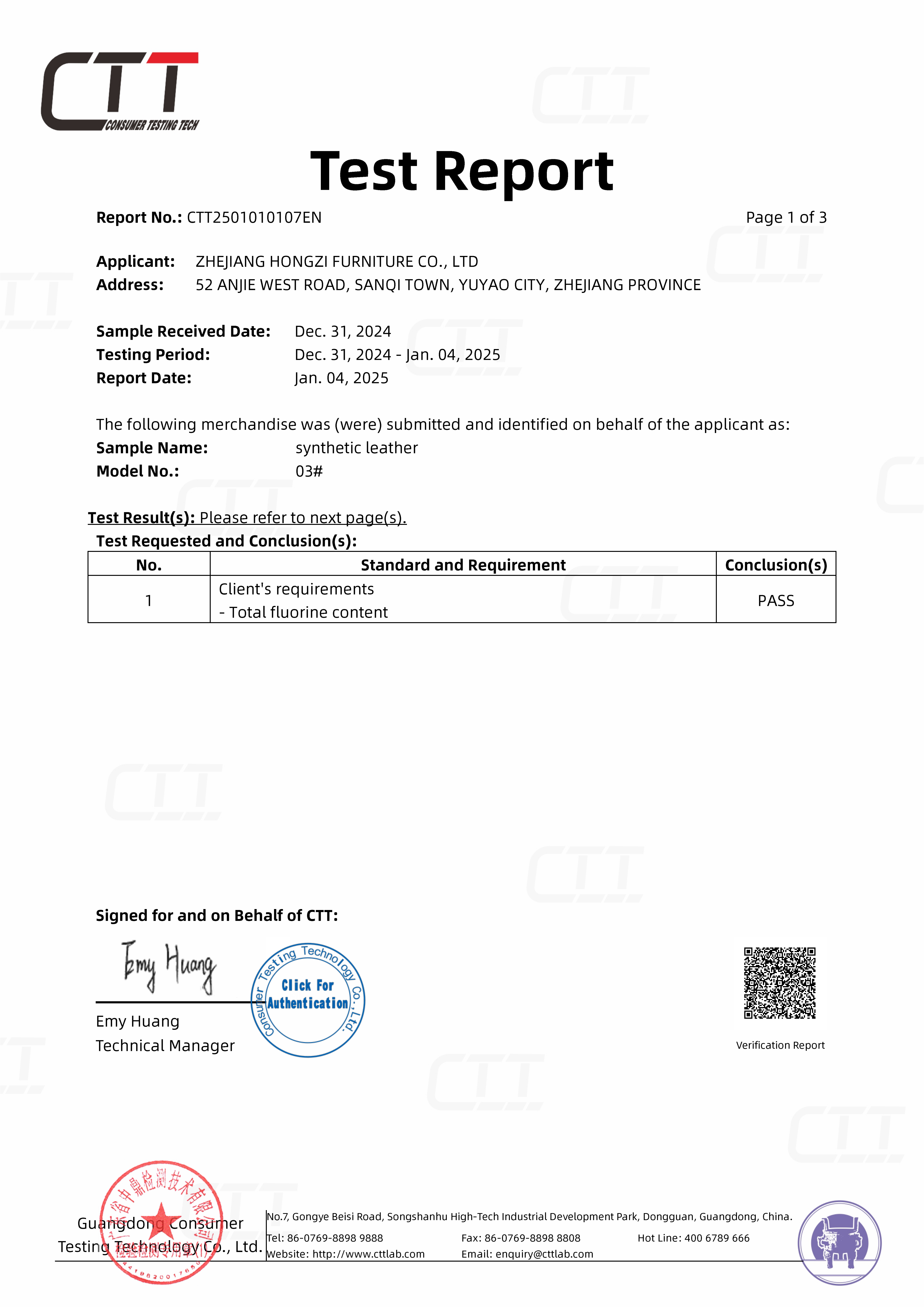
| CTT certificate CTT2501010107EN | Synthetic leather 03#; listed for EU and US markets | EN 14582:2016 (PFAS) | 4 January 2025 |
| SGS report SL62416330206201TX | Flame-retardant artificial leather; beauty bed, salon chair, shampoo chair | The Furniture and Furnishings (Fire) (Safety) Regulations 1988 (UK) | 27 September 2024 |
| SGS report SL62416330201301TX | Flame-retardant foam; beauty bed, salon chair, shampoo chair | The Furniture and Furnishings (Fire) (Safety) Regulations 1988 (EU/US listing) | 27 September 2024 |
Two qualifications belong beside that table. First, these are material reports — they address the upholstery leather and the foam, not the complete chair, and they do not certify every model in the range by extension. Second, market requirements differ: a UK flammability route is not the same document as an EU chemical screening, and neither answers a destination-specific question the buyer has not asked. Confirm that the cover used on your specific model draws on the tested material reference, and confirm which regulation your market actually applies.
For logistics planning, barber and similar chairs with rotating, reclining and elevating movement fall under HS code 9402.10 in the WCO classification, which is the classification starting point for duty and documentation discussions with a forwarder.
OEM Terms, MOQ and Lead Time Read as Capability Data
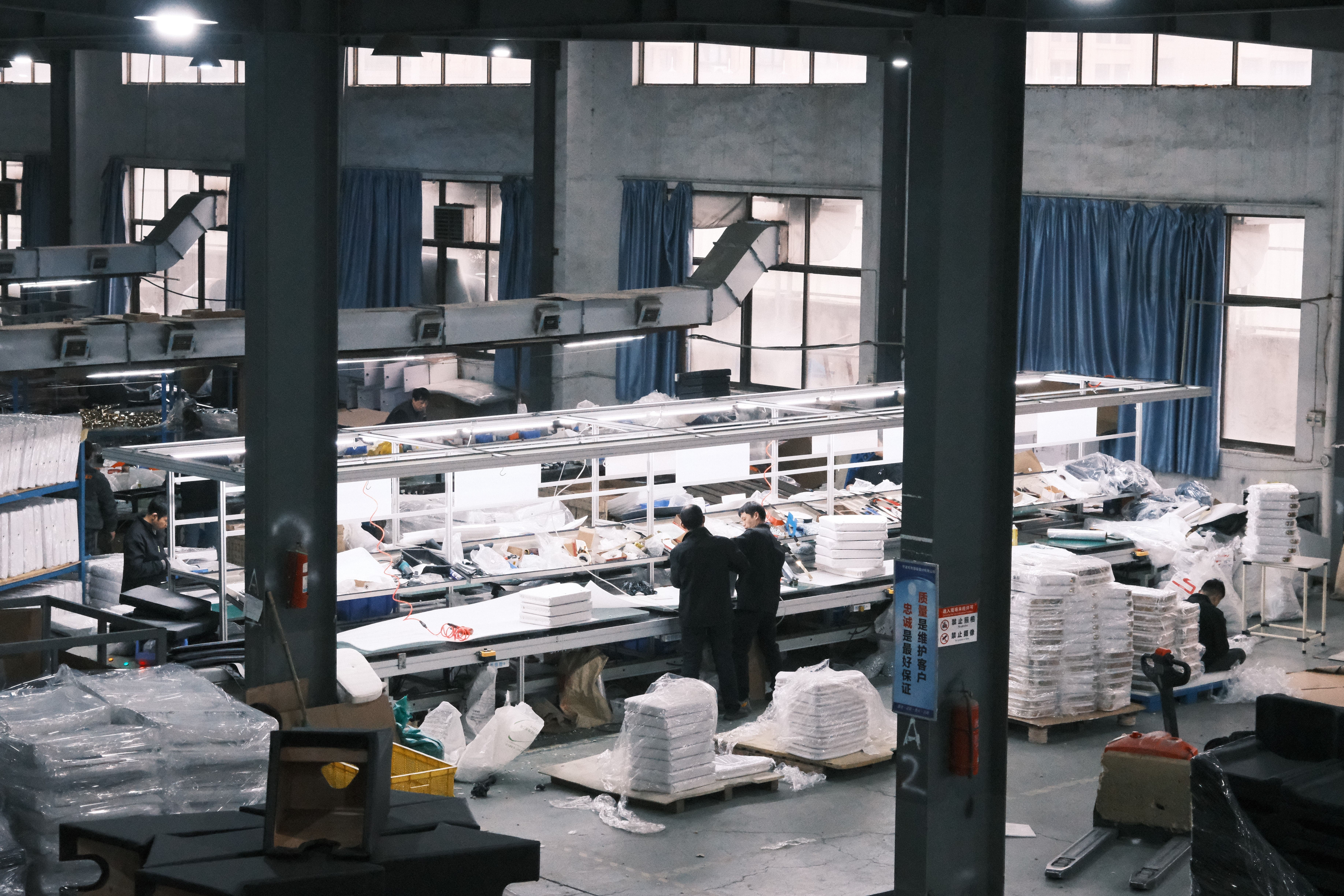
Commercial terms are usually read as negotiation positions. They also describe how a factory organises production. The documented programme includes OEM production with logo and colour customisation, a minimum order of 5 units, and a lead time of 15 days for orders under 100 units against 30 days above that threshold. Company information also places monthly capacity at 15,000 units and annual output at 180,000 units, with 100% testing stated as the quality-control approach.
Read as evidence, the shape of those terms is coherent. A five-unit minimum supports a trial order and a dealer's first stocking decision; the break at 100 units implies batch planning rather than one-off fabrication; the stated monthly and annual figures are internally consistent in scale. Delivery is offered on EXW, FOB, CIF and CFR terms, payment on T/T, L/C, PayPal and cash, and acceptance by visual and functional checks or by sampling on arrival.
The caveats are equally clear. Capacity and output are company-reported and should be confirmed against a delivery schedule for your own configuration. The five-unit MOQ should be re-confirmed for customised logo or colour work, where setup normally changes the economics. And "100% testing" deserves one follow-up question: whether it covers function, finish, pump operation or all three, recorded on an inspection sheet you can review.
Application Fit: Where Each Part of the Range Belongs
The range becomes useful once it is mapped onto real station decisions rather than treated as a product list.
- Compact formats suit small beauty salon and barber shop footprints, secondary chairs, and operators who reconfigure floor space seasonally.
- Heavy-duty formats suit high-throughput shops where the chair runs most of the working day and the client size range is wide.
- Gold and retro models serve image-led interiors, where the salon barber chair is part of the brand presentation rather than pure equipment.
- Hydraulic recline models support shave, treatment and longer styling services where back angle changes repeatedly.
- Wholesale assortments benefit from breadth: a distributor can cover compact, standard and statement pieces without qualifying a second factory.
Space planning deserves a specific note for US buyers. North Carolina regulation 21 N.C. Admin. Code 06L .0102 requires a minimum of five linear feet between the centre of each barber chair. That is a state rule, not a national one, but it illustrates the principle: a large-format chair consumes more of a fixed centre-to-centre allowance, so the number of stations a floor plan can hold depends on model size, not only on room area. Checking local spacing rules before confirming model mix prevents a costly re-plan later.
Limitations: What a Catalogue Cannot Tell You
A range is circumstantial evidence, and it should be labelled as such. It does not establish load ratings, foam density, recline angle range, pump cycle life or upholstery abrasion performance, because none of those figures appear in the published model information. It does not independently verify capacity, and it does not demonstrate that quality is identical across every unit produced.
Compared with a single-model evaluation, range reading is faster but shallower. A single sample tells you how one chair feels and behaves; a range tells you whether the factory can sustain several configurations at once. The two are complements. Neither substitutes for a plant audit or for reference checks with existing dealers.
What to Verify Before Requesting a Sample
A short, specific verification list makes the sample stage far more productive:
- Confirm whether published dimensions are assembled or packed, for every shortlisted model.
- Request foam density, leather thickness and any upholstery abrasion data.
- Ask for pump type, stated load rating and cycle test evidence, if it exists.
- Ask what "100% testing" covers and request the inspection record format.
- Confirm which tested material reference applies to the cover on your chosen model.
- Confirm the applicable regulation for your destination market, not a generic compliance claim.
- Re-confirm MOQ, lead time and price validity for customised logo or colour.
- Check local chair-spacing rules against the dimensions of the models you intend to order.
Outlook
Two pressures are likely to shape how buyers read supplier ranges next. Hydraulic mechanisms remain the dominant configuration in the salon chair market, which keeps pump documentation and service parts on the evaluation agenda rather than in the fine print. At the same time, chemical screening such as PFAS testing is moving from a niche request into routine material qualification, at least in EU and US-facing supply chains.
The practical consequence is modest but real: manufacturers who can point to material-level reports and consistent specifications across a range will spend less time answering first-round due-diligence questions. That is an advantage of documentation quality, not of marketing. Buyers should treat a clearly bounded statement — this report covers this material under this standard — as stronger evidence than a broad compliance claim that cannot be traced to a document.
FAQ
What does the HZ barber chair range cover?
The line spans compact, standard and heavy-duty formats, and is presented across beauty salon, styling, heavy-duty, gold, retro reclining and hydraulic recline categories, including vintage and modern styling. The same manufacturer also lists shampoo chairs, massage beds and manicure tables in its wider product scope.
How different are the HZ6001DW and the HZ87102RB?
The HZ6001DW is listed at 45 × 25 × 70 cm and the HZ87102RB at 111 × 66 × 118 cm, so they occupy opposite ends of the range in size and build scale. The compact model suits tighter station layouts; the larger model is positioned as a heavy-duty chair. Buyers should confirm whether those figures describe the assembled chair or the packed unit.
Which materials are shared across HZ barber chairs?
PU leather, high-density sponge, wood, and iron or aluminum alloy recur across models. Shared material families support reorder consistency and simpler spare-part planning. Published information does not state foam density, leather thickness or load ratings, so those values have to be requested per model.
What OEM terms and lead times does the manufacturer state?
OEM production with logo and colour customisation, a minimum order of 5 units, and a lead time of 15 days for orders under 100 units and 30 days for orders above 100 units. Monthly capacity is stated at 15,000 units and annual output at 180,000 units. These are company-reported figures and should be confirmed against a specific configuration and delivery schedule.
Which test reports support the material claims?
Three are documented: CTT certificate CTT2501010107EN for PFAS testing to EN 14582:2016 on synthetic leather 03#, issued 4 January 2025; SGS report SL62416330206201TX for flame-retardant artificial leather under the UK Furniture and Furnishings (Fire) (Safety) Regulations 1988; and SGS report SL62416330201301TX for flame-retardant foam under the same regulation. All three are material-level documents, not whole-chair certification.
A company brochure covering the wider product scope is available for download: Ningbo Hongzi product brochure (PDF). Company information: Ningbo Hongzi Beauty & Hairdressing Equipment Co., Ltd.
Tem questões ou precisa de mais detalhes?
Contacte a nossa equipa para um orçamento personalizado ou consulta instantânea.
Solicitar orçamento
Preencha o formulário abaixo e a nossa equipa entrará em contacto com uma proposta personalizada.
Chat direto do WhatsApp
Prefere conversar em tempo real? Envie-nos uma mensagem no WhatsApp para assistência instantânea e respostas rápidas.
- Obter orçamento personalizado
- Partilhar fotos ou documentos
- Discuta as suas necessidades diretamente
Geralmente responde em 5–30 minutos durante o horário de expediente.