
Where a Pharmaceutical Packaging Machine Fits in Solid-Dosage Production
A blister-cartoning line either matches the product it runs or it does not, and nominal speed does not repair a mismatch. In solid-dosage plants the decisive purchasing question is rarely “how fast is the machine”, but “which configuration belongs to this dose form, this blister format and this carton”. Application mapping — the discipline of matching machine architecture to product and pack — decides whether a new line reaches its stated output in the first week or in the third quarter.
This industry reference sets out how application variables drive pharmaceutical packaging machine configuration, using the documented product range of Zhejiang Hoping Machinery Co., Ltd. (HOPING) as a working example. HOPING is a pharmaceutical packing machinery manufacturer established in 2001 and based in Ruian City, Zhejiang Province, China, producing blister packaging machines, cartoning machines, case packing machines and end-of-line equipment across blister, cartoning and full-line configurations.
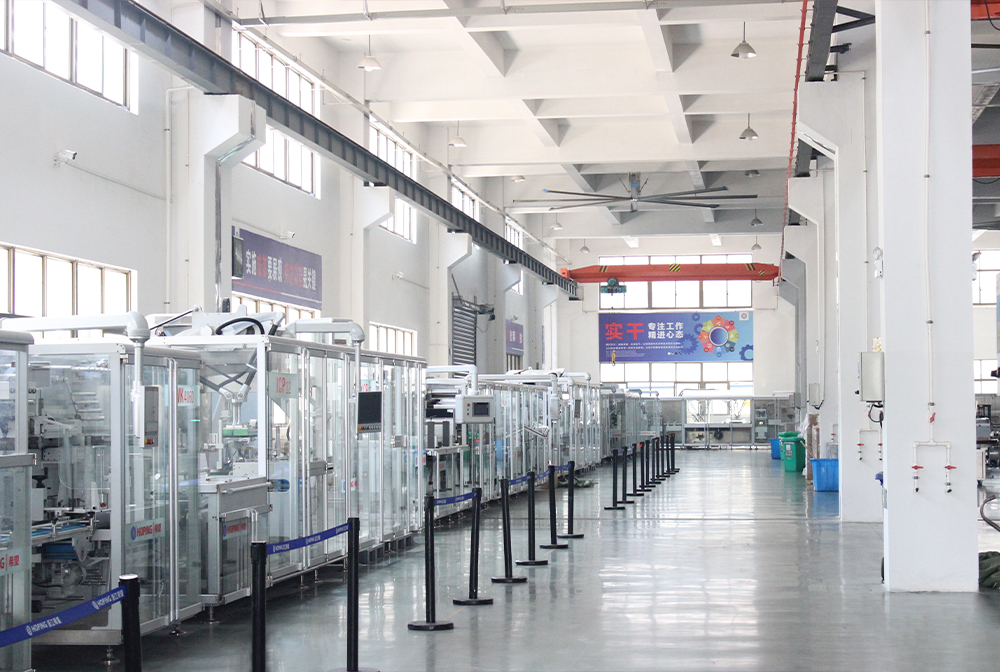
Machine showroom: blister, cartoning and end-of-line equipment are configured as one production sequence rather than isolated units.
Application fit is decided before output is discussed
Packaging equipment is often compared on a single number — blisters per minute, cartons per minute — while the variables that actually determine whether that number is reachable stay unexamined. In pharmaceutical production those variables are structural:
- Dose form and feed behaviour. Tablets, capsules, soft capsules, freeze-dried powder and liquid formats such as pre-filled syringes behave differently at the feeding station, and each imposes different tooling.
- Blister format and forming material. Cavity count, format area, forming depth and stroke, together with PVC/PTP, alu-alu or cold-form structures, set the machine family and realistic cycle rate.
- Carton and leaflet format. Carton dimensions, leaflet folding pattern and quantity per carton determine cartoner architecture and the blister-to-carton ratio.
- Downstream and plant constraints. Bundling, case packing, palletizing, compressed-air supply, power and floor area are line-level constraints, not add-ons.
A specification that omits any one of these will produce a line that runs, but not at the rate the quotation implied. For buyers, application mapping is therefore not a technical formality — it is the point at which capital cost, commissioning time and long-run flexibility are fixed.
Blister stage: match the forming principle to the product
Blister machines divide by forming principle, and the principle determines the application band. Flat-plate (platen) machines form the cavity under a platen press and suit small and medium batches, multi-format production and frequent changeover. Roller machines form continuously and suit high-volume, single-format tablet and capsule output. The published HOPING range spans both, plus a dedicated format for freeze-dried powder.
| Machine family | Representative models | Published typical capacity | Application fit |
|---|---|---|---|
| Flat-plate alu-PVC / alu-alu | DPP Series (DPP350F, DPP250S, DPP250FI, DPP160F, DPP250FII) | 20–50 cycles/min; approx. 5.6–12 kW by model | Small and medium batches, multi-SKU portfolios, frequent format change |
| Flat-plate, single model | DPP260TI / DPP260K | 20–60 (DPP260TI) and 20–70 (DPP260K) cycles/min; 9.5 kW | Compact solid-dosage packaging at medium speed; DPP260TI footprint approx. 4420 × 710 × 1700 mm |
| Roller alu-PVC / alu-alu | DPH Series (DPH320H, DPH260H, DPH260) | 60–200 cycles/min; approx. 15.5–18.9 kW by model | High-volume tablets, capsules and soft capsules; DPH320H forming area 320 × 280 mm, forming depth 12 mm |
| Roller, high-output rotary | DPH320HII | Max. 250 punches/min; up to 1000 blisters/min; 30 kW | Continuous high-capacity blister supply for integrated lines |
| Freeze-dried powder | DP Series (DP260K, DP260KD) | 10–20 cycles/min; approx. 2.5–4.6 kW | Special dosage forms requiring a dedicated forming and feeding arrangement |
Published figures are equipment-level reference values; realised output depends on blister format, material structure and product feed.
Material construction also carries application meaning. On the DPH320HII and DPP260T1, product-contact parts are specified in AISI 316L stainless steel and FDA-compliant pharmaceutical-grade materials, with non-contact parts in AISI 304 stainless steel and anodised aluminium alloy, and surfaces designed to be corrosion-resistant and easy to clean. For a buyer, this is the difference between a machine that can be cleaned to a documented procedure and one that merely looks clean.
Cartoning stage: the ratio problem, not the speed problem
Horizontal cartoning dominates secondary packaging for solid dosage because blister boards, sachets and bottles feed naturally in a horizontal flow. Horizontal orientation systems accounted for 70.12% of cartoning market share in 2024, according to Mordor Intelligence’s end-load cartoning machine research. That dominance is an application fact rather than a preference: the horizontal format is what a blister board requires.
| Cartoner model | Published capacity | Power | Application note |
|---|---|---|---|
| XWZ120 | 30–120 cartons/min | 3.5 kW | Compact horizontal cartoner; SEW main motor, Siemens PLC, carton magazine 600–700 pieces, balcony-style frame in carbon steel and 304 stainless steel |
| XWZ300II | 60–220 cartons/min | 5 kW | Medium-to-high speed secondary packaging; approx. 5160 × 1600 × 2100 mm |
| XWZ Series (XWZ400 / XWZ300) | 100–400 / 100–300 cartons/min | 5 kW | Blister boards, sachets, bottles and tubes subject to confirmed format |
| XWZ500H | 100–500 cartons/min | 14 kW | Full-servo high-speed cartoning with leaflet insertion and coding/inspection integration |
The practical difficulty is arithmetic. If a carton carries ten blisters, a 1000-blister/min former needs only 100 cartons/min to keep pace; if it carries four, that same former demands 250 cartons/min. Because HOPING treats quantity per carton and carton specification as customization parameters, the blister-to-carton ratio has to be resolved during technical confirmation, not discovered during factory acceptance. This is why line quotations pair blister and cartoning figures explicitly — for example DHL6004 at 600 blisters and 400 cartons per minute, DHL7004 at 700 and 400, DHL7005H at 700 and 500, DHL8005H at 800 and 500, and DHL1000/5H at 1000 and 500.
When flow wrapping belongs between blister and carton
Not every solid-dosage product goes straight from blister to carton. Where a pillow pack is required for moisture protection with tablets or capsules, a three-stage sequence — blister, flow wrap, carton — replaces the two-stage line. HOPING documents this as a separate architecture rather than an optional extra.
- IXW600: up to 600 blisters/min, 300 packs/min and 300 cartons/min, with PVC/cold-alu auto splicing, rotary reciprocating flow-wrapper matching and a Beckhoff controller with CP9315 industrial PC.
- IXW800: up to 600 blisters/min, 600 packs/min and 500 cartons/min, dual-track, with D3 top-load robotics and a rotary manipulator.
- DPH320H–XW8200–XWZ300II: a linked three-stage line at approximately 300–600 blisters/min, 50–200 packs/min and 50–220 cartons/min, drawing 380 V 50 Hz and 36 kW.
The three-stage architecture is the correct answer to a moisture-barrier requirement and the wrong answer to a footprint constraint. Each stage consumes floor length and adds a transfer point where product flow must be synchronised; the linked line above is specified at 36 kW before any downstream equipment is added.
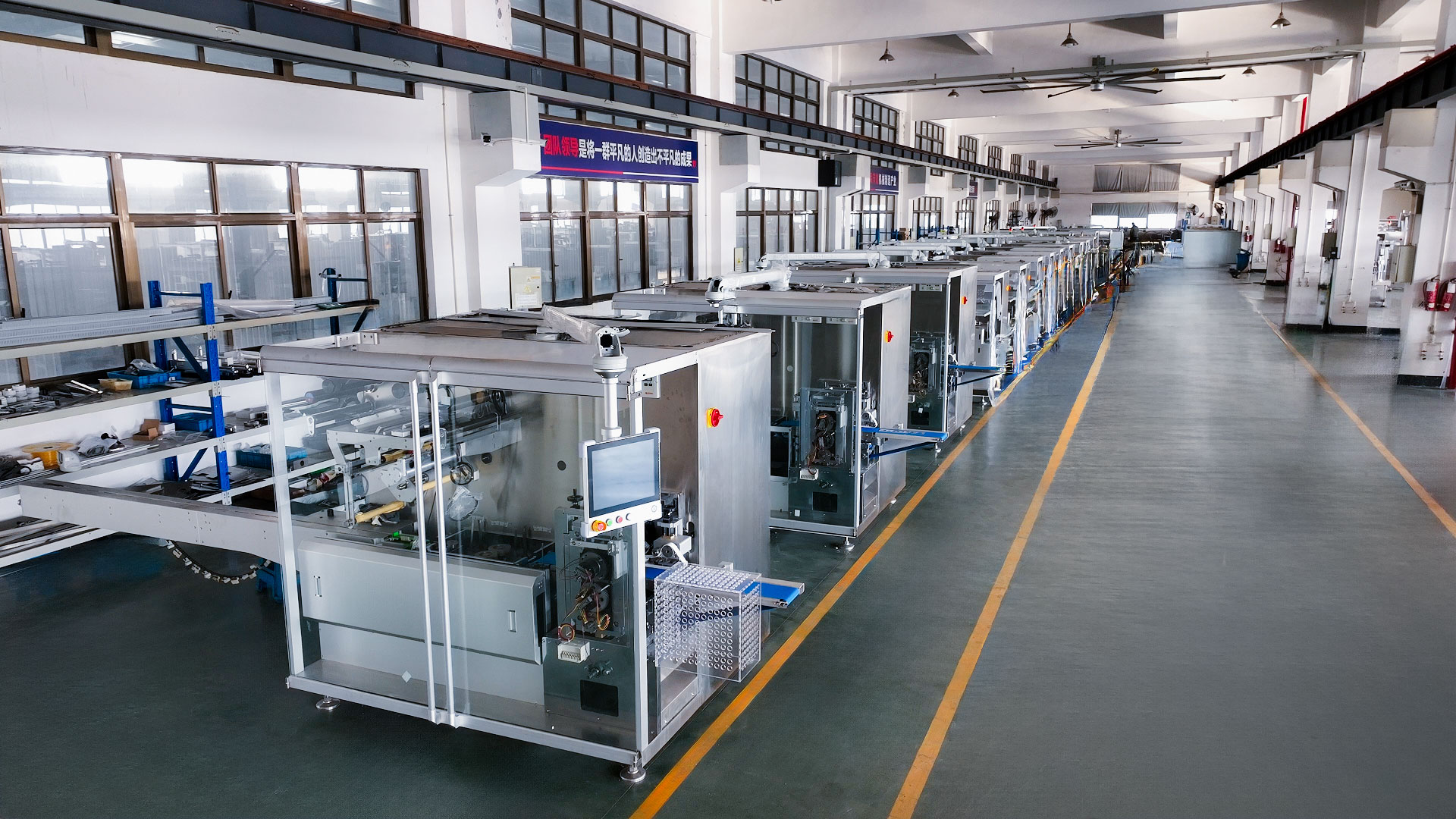
Flow wrapping stage: added where a pillow pack is part of the registered pack, not as a default.
End-of-line: the part of the application buyers underestimate
Cartons leaving a 500-carton/min cartoner create a case-packing problem that a manual packing table cannot absorb. HOPING’s end-of-line range quantifies the handover points: XWK4060 stretch bander at 30–60 bundles/min, XWG4060 overwrapper at 30–60 bundles/min, XWK Series case packers at up to about 5 cases/min, and ICP12 case packing and palletizing at about 12 cases/min with a footprint of roughly 8900 × 3000 × 2400 mm and 25 kW. The XWK Series bander family spans 8–60 bundles/min depending on model.
The readable conclusion for a buyer: end-of-line capacity is an order of magnitude lower than cartoning capacity, so the accumulation and buffering strategy between cartoner and case packer is part of the application design, not a detail for the layout drawing.
Formats outside the standard solid-dosage pattern
Two documented configurations show how far application fit extends beyond tablets and capsules in a blister. For liquid dosage, the IXW400 integrates blister packaging and cartoning for pre-filled syringes, ampoules and cartridges at up to 400 blisters/min and 150 cartons/min, with a Siemens controller, CP9315 industrial PC and D3 top-loading robot. For vials, a combined labeling, DPP blister, XWZ cartoning and XWK banding line links four modules, with capacity and dimensions customized to vial size, blister format and carton format.
Both are examples of the same principle: when the primary container is not a thermoformed cavity in the ordinary sense, the line is designed around the container geometry and the tooling is project-specific.
How HOPING configures a line for a given application
HOPING operates an ODM, OEM and customizable production model. The documented customization scope is wider than machine colour and voltage: blister size, blister materials, quantity per carton, carton specification, leaflet format, coding and inspection method, feeding method, connection to downstream bundling, case packing and palletizing, interface language, electrical component brand and data interface. For a contract manufacturer running several pack registrations on one site, that list is the practical definition of application fit.
Commercial parameters are documented rather than negotiated case by case at the outset: minimum order quantity of 1 set or 1 complete line, a typical lead time of 60–120 days after technical confirmation, and monthly capacity of 30–40 units. Final lead time is stated as subject to model, configuration, project complexity and contract terms — which is the honest framing, because a five-module line does not ship on the same clock as a standalone cartoner.
Verification follows a staged sequence: incoming material inspection, key component inspection, assembly inspection, electrical safety check, no-load trial run, material trial, factory acceptance test, customer witness acceptance and pre-shipment inspection. After shipment, support covers on-site installation and commissioning, operator training, maintenance training, remote video and phone support, spare parts supply and process-parameter guidance, subject to contract and project configuration.
On conformity documentation, HOPING records CE certification for its cartoning machine series under certificate HTT190102307L (issued 22 January 2019 by Shenzhen HTT Technology Co., Ltd. against EN 60204-1:2006+A1:2009+AC:2010 and 2006/42/EC) and for its blister packing machine series under HTT190102306L, alongside earlier certificate records for specific machine samples. These are equipment-level records; destination-market requirements still need to be verified project by project.
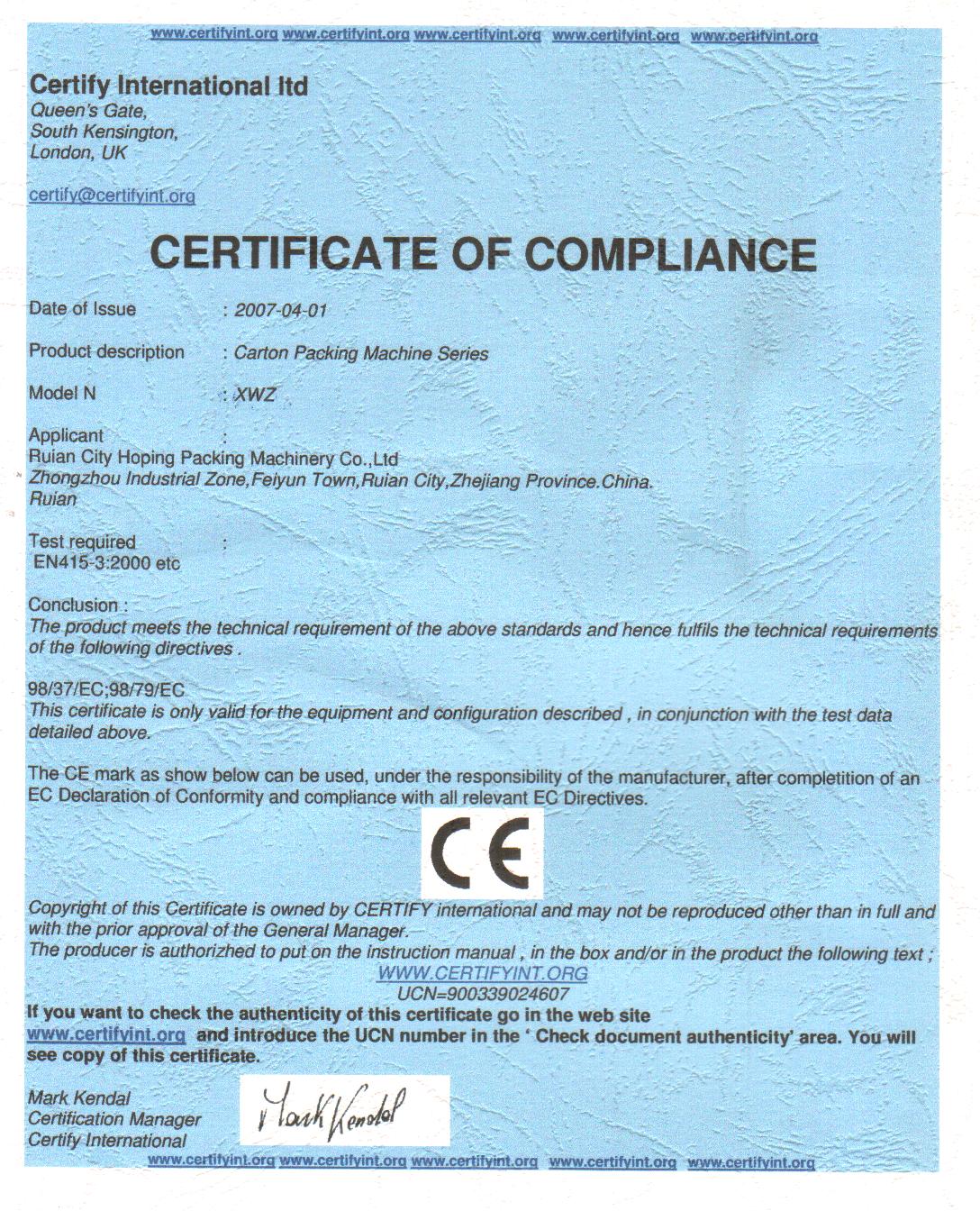
Certificate records are part of the technical file a buyer should read before signing, not after delivery.
What a documented project pattern looks like
HOPING describes a project type rather than a named reference: a large pharmaceutical manufacturer specialising in solid dosage forms, with a scale of 5 to 10 packaging lines, for new line construction, capacity expansion or upgrading existing lines. The stated problem being solved is manual transfer and leaflet insertion error in blister packaging and automatic cartoning of tablets, capsules and other solid dosage forms; the stated objectives are improved packaging automation, reduced manual transfer, improved blister-to-carton connection efficiency, reduced wrong-insertion and missing-leaflet risk, and support for downstream automation integration.
For evaluation purposes this is a specification signal rather than a performance proof. It tells a buyer what class of problem the supplier is organised to solve — multi-line solid-dosage integration with inspection and downstream connection — and it tells them what to ask for as evidence: acceptance records from comparable formats.
Market context: why application-led specification is gaining weight
The equipment segments around this decision are large and still expanding. Custom Market Insights valued the global blister packaging machine pharmaceutical market at USD 2.57 billion in 2025, with Asia-Pacific reported as the fastest-growing region at an 8.87% CAGR to 2031. Mordor Intelligence places the broader pharmaceutical packaging machinery market at USD 7.09 billion in 2026, growing at a 7.15% CAGR toward USD 10.02 billion by the end of its forecast period.
Growth alone does not explain the shift toward application-led specification; regulation and data practice do. ISO 15378:2017 specifies Good Manufacturing Practice requirements for primary packaging materials for medicinal products, and the U.S. FDA frames current Good Manufacturing Practice as the foundation for quality pharmaceuticals through regulatory standards. Neither document specifies a machine design, and that is precisely the buyer’s problem: the equipment has to demonstrate process control that the regulation describes in outcome terms. Trade reporting of PMMI content also points to pharmaceutical manufacturers moving toward digitised data collection and integrated solutions to meet regulatory expectations and improve visibility — a directional signal, not a measured adoption rate.
The practical consequence is that application fit now includes data fit: which parameters are recorded, whether recipe memory exists (documented on DHL1000/5H, DHL8005H and DHL7005H through mould-change and preset-memory functions), and how inspection and rejection are linked to the cartoning stage.
Where this approach has limits
An integrated blister-cartoning line is not automatically the better answer, and the honest boundaries are worth stating before a purchase order.
- Coupled stoppages. In an integrated line the blister former, transfer and cartoner run as one sequence. A stoppage at the former propagates to cartoning, so buffer capacity and changeover planning matter more than on decoupled standalone machines.
- Speed is format-dependent. Roller machines reach their published cycle rates on stable, high-volume formats; on short runs with frequent changeover, a flat-plate DPP machine at 20–70 cycles/min can deliver more usable output than an under-used high-speed roller line.
- Non-standard geometry needs confirmation. Cartoner scope is documented for regular products subject to confirmed format; unusual carton or product geometry requires tooling work before capacity figures mean anything.
- Footprint and utilities are real constraints. ICP12 alone occupies roughly 8900 × 3000 × 2400 mm at 25 kW; a three-stage blister–flow-wrap–carton line is specified at 36 kW. Buildings, compressed-air capacity (typically 0.5–0.7 MPa across the range) and cleanroom layout can rule out a configuration that is technically ideal.
- Certificates cover defined scopes. Recorded CE certificates apply to the machine series and standards named on them, not to every destination market or every future configuration.
A procurement checklist for application confirmation
| Decision area | What to confirm in writing | Where it shows up later |
|---|---|---|
| Dose form and feed | Tablet, capsule, soft capsule, freeze-dried powder or liquid container; feed method | Feeding station design, tooling, reject handling |
| Blister format | Cavity layout, format area, forming depth, PVC/PTP or alu-alu structure | Machine family (DPP vs DPH), achievable cycle rate |
| Carton and leaflet | Carton dimensions, quantity per carton, leaflet folding pattern | Cartoner model, blister-to-carton ratio, line balance |
| Inspection and coding | Coding method, inspection and rejection logic, data interface and interface language | Integration effort, validation documentation |
| Downstream scope | Banding, case packing, palletizing connection and required rates | Accumulation strategy, floor area, power |
| Acceptance | Technical agreement, sample trial, FAT criteria, SAT and third-party inspection option | Payment milestones, commissioning schedule |
| Commercial terms | MOQ (1 set or 1 line), lead time after technical confirmation, delivery terms | Project cash flow and launch date |
Outlook
Application-led specification is likely to become more formal rather than less. As blister and cartoning capacity expands in Asia-Pacific and as regulatory expectations around packaging materials and process documentation tighten, the differentiator moves from machine speed to documented, reproducible configuration: which format was proven, on which line, with which acceptance records. Buyers who treat the technical agreement as the real specification document — covering blister format, carton ratio, inspection logic, downstream rates and acceptance criteria — will spend less time resolving disputes after installation and more time running the format they actually sell.
FAQ
Which dosage forms can a blister-cartoning line handle?
HOPING documents blister packaging and automatic cartoning for tablets, capsules and other solid dosage forms, with the DPH Series covering alu-PVC and alu-alu structures. Adjacent formats are addressed by dedicated configurations: the DP Series for freeze-dried powder, IXW400 for liquid dosage such as pre-filled syringes, ampoules and cartridges, and a combined labeling, DPP, XWZ and XWK line for vials. Achievable capacity differs by format and must be confirmed for the specific product.
What can be customized on a pharmaceutical packaging line?
The documented customization scope covers blister size, blister materials, quantity per carton, carton specification, leaflet format, coding and inspection method, feeding method, connection to downstream bundling, case packing and palletizing, interface language, electrical component brand and data interface. HOPING offers this under an ODM, OEM and customizable production model.
How is blister output matched to cartoner output?
Matching depends on quantity per carton. Published line pairs illustrate the arithmetic: DHL6004 at up to 600 blisters and 400 cartons per minute, DHL7004 at 700 and 400, DHL7005H at 700 and 500, DHL8005H at 800 and 500, and DHL1000/5H at 1000 and 500. Because the number of blisters per carton is a customization parameter, the ratio is fixed at technical confirmation rather than assumed from headline speeds.
What are the minimum order quantity and typical lead time?
The minimum order quantity is 1 set or 1 complete line. Typical lead time is 60–120 days after technical confirmation, with monthly capacity of 30–40 units. Final lead time is subject to model, configuration, project complexity and contract terms.
How is equipment acceptance verified before shipment?
The documented sequence runs through incoming material inspection, key component inspection, assembly inspection, electrical safety check, no-load trial run, material trial, factory acceptance test, customer witness acceptance and pre-shipment inspection. Acceptance criteria reference the technical agreement, sample testing, FAT before shipment and SAT at the customer site, and third-party inspection can be arranged on request.
What support is provided after installation?
After-sales support includes on-site installation and commissioning, operator training, maintenance training, remote video and phone support, spare parts supply, process-parameter guidance, regular follow-up and troubleshooting, all subject to contract and project configuration.
For readers who need the full equipment and configuration reference, the manufacturer’s public catalogue is available here: Hoping Machinery Catalog (PDF).
Equipment specifications and capacity figures in this article are manufacturer-published reference values and depend on product format, material structure, line configuration and acceptance conditions. Market figures are attributed to the publishing research houses named. Certificate details are quoted as recorded and should be verified for the specific destination market and machine configuration.
Tem questões ou precisa de mais detalhes?
Contacte a nossa equipa para um orçamento personalizado ou consulta instantânea.
Solicitar orçamento
Preencha o formulário abaixo e a nossa equipa entrará em contacto com uma proposta personalizada.
Chat direto do WhatsApp
Prefere conversar em tempo real? Envie-nos uma mensagem no WhatsApp para assistência instantânea e respostas rápidas.
- Obter orçamento personalizado
- Partilhar fotos ou documentos
- Discuta as suas necessidades diretamente
Geralmente responde em 5–30 minutos durante o horário de expediente.