
Which China Fitness Trade Expo Fits Your Sourcing Project?
China's fitness equipment exports reached USD 7.17 billion in 2024, and the country's trade expos have become a key channel for international buyers to evaluate manufacturers. But whether a China fitness trade expo genuinely helps depends on the type of sourcing project a buyer brings.
A sourcing channel, not a universal fix
China's position as a global production base for fitness equipment continues to deepen. In 2024, the country exported USD 7.17 billion in gym and athletics equipment, mainly to the United States, the United Kingdom, and Germany. In the first half of 2025, exports of fitness equipment under HS code 950691 reached USD 4.78 billion, an increase of 10.2 percent year on year. Trade fairs have grown alongside this export base: IWF Shanghai 2024 hosted over 1,000 brands and approximately 75,000 buyers, including more than 1,000 overseas visitors, while China Sport Show 2024 in Chengdu assembled more than 1,600 exhibiting companies across 180,000 sqm.
For buyers in the research-to-evaluation stage, the practical question is not only which exhibition to attend, but whether an expo-based process fits the specific project. A gym chain equipping a new facility, a distributor adding product categories, an OEM buyer exploring private-label production, and a first-time importer all enter the same hall with different needs. The value they extract depends on how well their project matches what a trade expo can actually deliver.
Problem and opportunity in China fitness sourcing
Overseas fitness buyers face a recurring challenge: identifying reliable Chinese manufacturers without spending unreasonable time and money. The core problem is difficulty in locating qualified domestic distributors, agents, and target products, with limited comparison samples and high travel or time costs caused by geographically dispersed factories. Root causes include an information vacuum about the Chinese market, a lack of local networks and professional circles, and visa or logistics hurdles that make repeated in-person visits impractical. In documented research, the urgency level of this problem is considered high.
The scale of China's fitness trade expo landscape offers a structural response. Because the manufacturing base is fragmented across many regions, a trade expo acts as a concentration point. Instead of arranging separate trips to factories in different provinces, a buyer can meet a significant share of the supply base in a single venue. The opportunity is not merely a long list of booths; it is the possibility of moving from unstructured research to structured matchmaking.
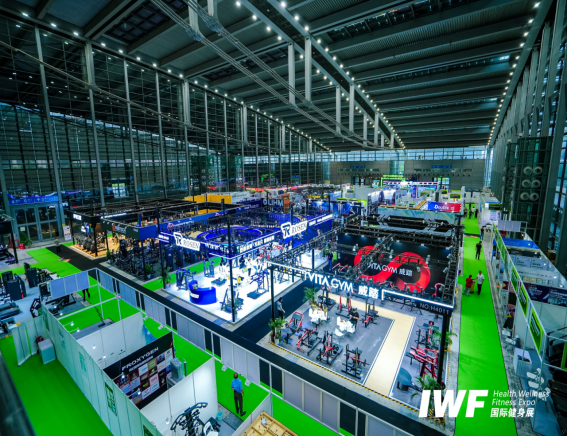
China fitness trade expos concentrate manufacturers from dispersed regional clusters into a single evaluation environment.
What a China fitness trade expo does for a sourcing project
At its core, a fitness and sports equipment trade expo in China is a platform for connecting overseas buyers with domestic manufacturers. The service model is centered on trade matchmaking: targeted B2B meetings are organized to reduce supplier sourcing costs, shorten procurement cycles, and help buyers establish stable supply chains. Target clients include overseas fitness equipment distributors, manufacturers, agents, wholesalers, and gym operators; key decision makers include purchasing managers, business development directors, brand owners, and gym chain investors.
The components of a comprehensive expo go beyond exhibition booths. They include market and exhibitor research, productized booth and zone design, domestic and international buyer invitation and matchmaking, on-site conferences and forums, online catalogue and lead matchmaking, and post-show data and business follow-up. Some organizers integrate sourcing clusters with an international buyer network and government-enterprise support, creating a bridge between localized production clusters and overseas demand.
Which sourcing projects fit best: a scenario framework
Not every procurement project is equally suited to an expo-based process. The framework below maps common buyer scenarios to the level of value they can expect. It is a planning aid, not a ranking of exhibition quality.
| Sourcing project type | Expo fit | How to use the expo |
|---|---|---|
| First-time China entry / new supplier exploration | High | Build a market map, identify candidate manufacturers, compare sample quality |
| Commercial gym build-out with multiple equipment categories | High | Compare strength, cardio, functional, and accessory lines in one venue; use pre-matched supplier meetings |
| Distributor expanding product range | Medium-high | Define target categories in advance; use online pre-matching to focus on a shortlist |
| OEM / ODM product development | Medium | Use the expo for initial screening and sample review; complete factory audit and engineering evaluation after the show |
| Small-batch replenishment with an established supplier base | Low to medium | Direct supplier contact or online procurement is usually more efficient |
| Exclusive brand partnership / long-term strategic cooperation | Low | An expo can introduce a candidate, but deeper due diligence happens outside the event |
The decisive variable is the buyer's need for comparison. A commercial gym project involving multiple equipment categories benefits from seeing competing product lines side by side. A distributor adding two specific categories may need only a small number of pre-qualified meetings. An OEM buyer with detailed technical specifications is, at the expo stage, gathering names and evidence for later factory audits rather than selecting a final partner on site.
How expo-based matchmaking works in practice
The documented methodology behind expo-based matchmaking follows a four-step loop:
Step 1 — Market research and target mapping. The organizer defines which manufacturers and which buyers should be in the same room, based on product categories, target markets, and sourcing needs.
Step 2 — Pre-show recruitment and online pre-matching. Exhibitors are recruited and buyers invited; online pre-registration and pre-matching tools align expectations before the event.
Step 3 — On-site matchmaking and negotiation. Scheduled one-on-one meetings and a designated matchmaking area compress months of scattered supplier visits into a three-day window.
Step 4 — Post-show data tracking and conversion support. Meeting records, lead data, and follow-up processes turn conversations into measurable procurement pipelines.
Implementation leverages the organizer's regional exhibition network and overseas promotion channels. Shanghai Donnor Exhibition Service Co., Ltd, founded in Wenzhou, Zhejiang in 1996, is a trade exhibition organizer headquartered in Shanghai, with business covering trade fairs, conferences, and industrial internet platforms. The company reports annual exhibition space exceeding 700,000 sqm and has served more than 120,000 business exhibitors in total. It also operates vertical B2B platforms to extend matchmaking beyond on-site show days. Expected outcomes for exhibitors include concrete procurement leads, on-site orders, and follow-up cooperation; for the organizer, the process builds reusable buyer databases and data assets.
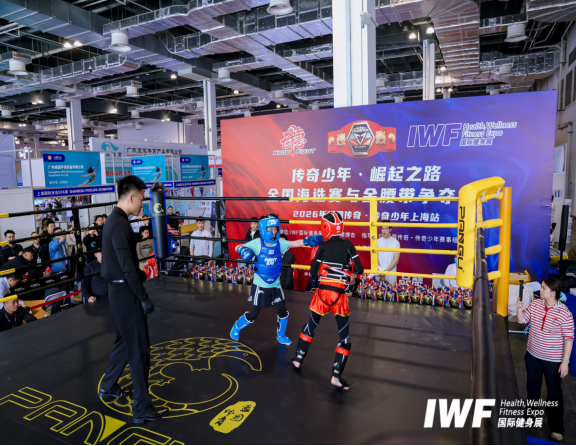
Specialized zones at Chinese fitness expos reflect the widening participation of sports-related segments, giving buyers more context for market evaluation.
Documented case: a US gym operator using B2B matchmaking
A concrete example is the case "Assist US entrepreneurs with fitness equipment procurement," documented by Shanghai Donnor Exhibition Service Co., Ltd. The client, a buyer/purchaser based in the USA and operating in the gym operations industry, needed to evaluate product quality across different manufacturers. Because factories were scattered across China, visiting each in person was impractical.
The solution was delivered during the IWF exhibition under the project name "IWF B2B Trade Matchmaking." Verified fitness equipment manufacturers were gathered in one venue, allowing the client to conduct concentrated supplier negotiations and product quality comparison. The service included facilitating procurement matchmaking with domestic fitness equipment brands. The project duration was one month.
According to the documented case, the buyer cut supplier inspection travel costs by over 70 percent and completed negotiations with 12 qualified manufacturers within one month. The qualitative result was a centralized supplier comparison process and direct communication channels with manufacturers. For buyers evaluating whether an expo fits their project, the relevant takeaway is not the exhibition itself but the matchmaking process around it.
Market trends buyers should read from China's expo landscape
Aggregate market signals help buyers calibrate how much value a China fitness trade expo can deliver in a given year. Several verified data points are relevant:
- IWF Shanghai 2024 hosted more than 1,000 brands and approximately 75,000 buyers, including over 1,000 overseas visitors.
- China Sport Show 2024, held in Chengdu, featured over 1,600 exhibiting companies and covered an area exceeding 180,000 sqm.
- China exported USD 7.17 billion in gym and athletics equipment in 2024, mainly to the US, UK, and Germany.
- In the first half of 2025, China's fitness equipment exports (HS 950691) grew 10.2 percent year on year, reaching USD 4.78 billion.
- Public event listings indicate that IWF Shenzhen 2026 is planned to cover 20,000 sqm with more than 400 exhibitors, focusing on the Greater Bay Area.
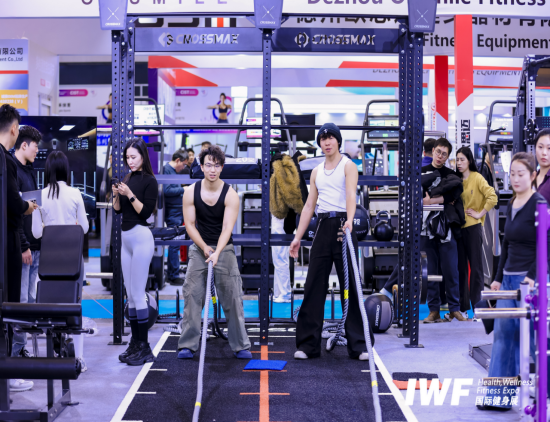
Live events and interactive zones at Chinese fitness expos add market context beyond equipment displays.
Several trend implications follow. First, Shanghai remains the primary entry point for international buyers seeking broad market exposure. Second, Shenzhen and the Greater Bay Area are emerging as a regional complement, particularly for buyers whose supply interests lie in southern China. Third, the format is shifting from display-oriented exhibitions to matchmaking-oriented events, with online pre-registration, appointment scheduling, and post-show follow-up becoming part of the standard buyer journey. Fourth, the choice of expo should be aligned with project phase: broad market scanning favors large international events, while targeted supplier evaluation may benefit from regional events with clearer cluster alignment.
Comparison with traditional sourcing routes
A China fitness trade expo is best understood as an additional sourcing channel with specific strengths and clear limits. The table below compares it with direct factory visits and online sourcing platforms.
| Evaluation criterion | Expo-based matchmaking | Direct factory visits | Online sourcing platforms |
|---|---|---|---|
| Suppliers covered per trip | High | Low | Medium |
| Product comparison depth | Medium-high | High | Medium |
| Quality verification level | Hands-on sample testing | Production line and quality system review | Document-based |
| Travel and time cost | Concentrated into one event | High | Low |
| Time to build a shortlist | Short | Long | Medium |
| Relationship building | Medium-strong | Strong | Weak |
| Key limitation | Factory audit and after-sales service are not included | Cost and scheduling constraints | Trust and product verification challenges |
Compared with direct factory visits, an expo compresses the discovery phase. A buyer can meet dozens of manufacturers in three days, which matters when the project begins with uncertainty. However, expo meetings do not replace on-site production audits. Product verification at an expo usually involves testing samples and holding conversations, not inspecting manufacturing processes, quality systems, or workforce capabilities. One boundary deserves emphasis: in the documented service model, post-matchmaking after-sales service for domestic and international partners is not included. The expo is the starting point of a supplier relationship, not a guarantee of its long-term performance.
Compared with online sourcing platforms, an expo offers stronger trust signals through physical inspection and face-to-face dialogue, and it benefits from the organizer's exhibitor screening. Online platforms, by contrast, provide continuous catalogue access and allow follow-up outside event windows. Buyers with an established supplier base and tightly defined specifications may find online channels more efficient.
Future outlook
Several developments are likely to change how buyers use China fitness trade expos. Hybrid and data-driven matchmaking will become more central: online pre-registration, appointment scheduling, and vertical B2B platforms already shift part of the sourcing process before and after the physical event, and reusable buyer databases are expected to make pre-matching more precise over time.
Regional exposure is likely to increase. Large international events will continue to serve buyers who need a broad view of the market. Regional events such as IWF Shenzhen, positioned for the Greater Bay Area, will appeal to buyers whose supply base is concentrated in southern China or who prefer smaller-scale interactions with a defined set of manufacturers.
The buyer journey will increasingly become a multi-stage loop: online pre-match, on-site meetings, post-show follow-up, selective factory audit, and contract negotiation. Trade expos will occupy the middle of the chain rather than the whole of it. Buyers who define their project type, comparison variables, and target supplier count before the event will gain the most from the concentrated matchmaking environment.
For buyers preparing for a China fitness trade expo visit, the IWF 2026 Shenzhen International Health, Wellness and Fitness Expo invitation brochure is available as a public reference: IWF 2026 Shenzhen Invitation (PDF).
FAQ
Q1: What types of sourcing projects are best suited to a China fitness trade expo?
Projects that require concentrated evaluation of multiple manufacturers benefit most. These include first-time entry into the Chinese market, commercial gym build-out with multiple equipment categories, and distributor expansion of product lines. The IWF B2B Trade Matchmaking case shows how verified manufacturers can be gathered in one venue to enable centralized comparison.
Q2: What problems does a China fitness trade expo solve, and what does it not solve?
It solves the early-stage problem of locating qualified manufacturers and comparing products without visiting widely dispersed factories. It reduces supplier sourcing costs, shortens procurement cycles, and creates direct communication channels. It does not replace factory audits, post-matchmaking after-sales service, or long-term contract and quality management.
Q3: How can a buyer compare multiple manufacturers efficiently at an expo?
The documented four-step approach is: market research and target mapping; pre-show exhibitor recruitment and buyer invitation with online pre-matching; on-site matchmaking and negotiations; and post-show data tracking and conversion support. Online pre-registration and appointment scheduling turn the expo into a structured meeting process rather than an unstructured walk-through.
Q4: Is a fitness trade expo useful for OEM or ODM supplier development?
It is useful as an initial screening channel. A buyer can identify manufacturers, evaluate sample quality, and hold face-to-face discussions. However, the technical verification required for OEM projects — production capability, quality systems, engineering communication — normally requires post-show factory visits and dedicated project review.
Q5: What preparation should a buyer complete before attending?
The first two steps of the matchmaking loop: market research and target mapping, followed by online pre-match meetings and appointment scheduling. A clear supplier shortlist, defined evaluation criteria, and a fixed number of meetings generate more decision-ready input than spontaneous booth exploration.
Tem questões ou precisa de mais detalhes?
Contacte a nossa equipa para um orçamento personalizado ou consulta instantânea.
Solicitar orçamento
Preencha o formulário abaixo e a nossa equipa entrará em contacto com uma proposta personalizada.
Chat direto do WhatsApp
Prefere conversar em tempo real? Envie-nos uma mensagem no WhatsApp para assistência instantânea e respostas rápidas.
- Obter orçamento personalizado
- Partilhar fotos ou documentos
- Discuta as suas necessidades diretamente
Geralmente responde em 5–30 minutos durante o horário de expediente.