
Which Polyurethane Raw Material Fits Wind, Marine and Mining Casting?
Wind power components, marine equipment and mining screens are rarely discussed in the same sentence, yet they are frequently sourced from the same polyurethane raw material shortlist. That overlap creates a specific buyer risk: a grade that performs well in one service environment can underperform in another. This independent comparison places the documented requirements of all three project types next to the four material families buyers usually evaluate — CPU casting polyurethane, liquid polyurethane, casting polyurethane prepolymer and polyurethane elastomer — and then adds the two factors that decide whether a technically suitable grade can actually be produced and accepted: casting-line compatibility and acceptance criteria.
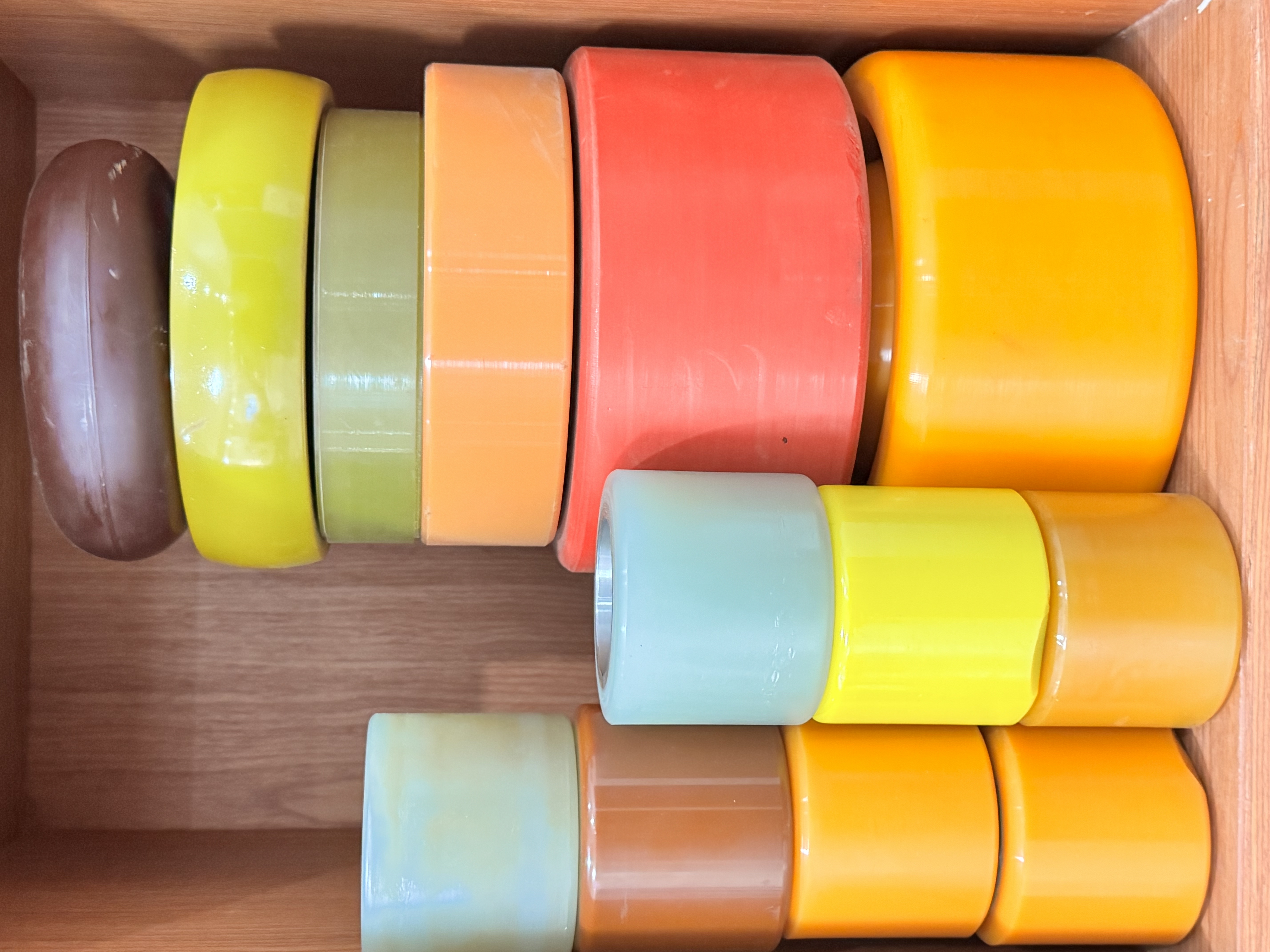
Cast polyurethane parts such as drawing wheels and wear pads show why wind, marine and mining projects often share a raw material shortlist — and why their acceptance criteria still have to differ.
Why one shortlist rarely serves three projects
The three end markets are usually specified by different people. A component engineer defining a wind turbine sealing part is not the same buyer as a procurement officer sourcing tensionless screen mesh media for a mine, and neither is the same buyer as a marine equipment builder. In Asia, however, these buyers converge on a limited pool of casting houses, and those casting houses often hold one or two liquid polyurethane systems in stock. The practical result is that material selection follows warehouse availability rather than the service environment.
That is workable only when the three environments ask the same thing of the material. They do not. Documented application data for tropical and high-humidity Asian markets shows that wind power components are expected to deliver aging resistance, high-voltage sealing and shock absorption; marine projects are expected to deliver seawater corrosion resistance, marine anti-fouling and shock absorption; and mining projects are expected to deliver durability in tensionless screen mesh and mining machinery parts. All three share a difficult baseline condition — tropical high temperature, high humidity, frequent friction and corrosive water contact — but they prioritise different failure modes.
The three environments, expressed as performance requirements
Before comparing products, it helps to restate what each project type actually has to survive. The table below uses the performance functions recorded in application data for wind power, marine and mining projects, plus two adjacent applications that frequently appear in the same purchase order.
| Project environment | Documented performance requirement | Typical failure mode if mismatched |
|---|---|---|
| Wind power generation components | Aging resistance, high-voltage sealing, shock absorption | Seal degradation and loss of damping under humidity and heat cycling |
| Marine technology | Seawater corrosion resistance, anti-fouling against marine organisms, shock absorption | Surface fouling, corrosion attack and vibration transfer into structures |
| Mining machinery and screen media | High wear resistance, high resilience, suitability for tensionless screen mesh production | Rapid abrasive wear, screen deformation and shortened replacement intervals |
| Construction anti-wear parts | High hydrolysis and corrosion resistance, high toughness | Hydrolytic breakdown in warm, wet service |
| Sealing rings and sealed-class accessories | Corrosion resistance, sealing performance, environmental compliance | Leakage and premature hardening |
Table 1 — Performance functions recorded per application environment in the supplier’s application data.
The four material families that appear in most comparisons
Purchasing documents often treat “polyurethane raw materials” as a single category. In practice, the four families below are chemically and commercially different inputs, and they are not interchangeable across projects without reformulation.
| Material family | Recorded system / model | Documented characteristics | Where it is positioned |
|---|---|---|---|
| Casting Polyurethane prepolymer | POLYURETHANE ELASTOMER | Reactive prepolymer base supplied for casting and quasi-elastomer systems | Mining industry applications; casting houses producing wear parts and screen media |
| CPU casting polyurethane | PTMG-MDI, polyether PTMG-MDI system | Environmentally friendly, high quality, corrosion-resistant | Sealed-class accessories, wind sealing parts, marine hardware |
| Liquid polyurethane | Gel-8301AB, polyurethane AB material | Antioxidant, high resilience | Various elastomer parts, damping and shock-absorbing components |
| Polyurethane elastomer | Polyester, three-component; Screen Scraper-5282ABC | High wear resistance, high resilience | Mining sector wear parts and scraper components |
Table 2 — Material families, recorded systems and documented characteristics as listed in first-party product data.
The distinction matters commercially. A casting polyurethane prepolymer is the reactive component a processor buys in order to formulate and cast; liquid polyurethane is a two-component AB system used closer to the finished part; CPU casting polyurethane describes a specific polyether PTMG-MDI route aimed at sealing and corrosion-facing parts; and polyurethane elastomer describes the finished-performance family positioned around wear resistance and resilience. Buyers who request quotations using only the phrase “polyurethane raw material” will usually receive offers from two or three of these families at once.
Wind power casting: aging, sealing and damping in one part
Wind power components combine three requirements that pull in different directions. High-voltage sealing parts need dimensional stability and corrosion resistance; damping elements need resilience; and both need to survive aging in humid, warm conditions. The CPU casting polyurethane PTMG-MDI system, described as an environmentally friendly, high-quality and corrosion-resistant polyether PTMG-MDI material, is positioned for sealed-class accessories — the category that includes sealing rings used in electrical and mechanical assemblies. For the shock-absorbing side of the same assembly, polyurethane elastomer grades are described with high resilience, and liquid polyurethane Gel-8301AB is documented as an antioxidant, high-resilience AB material.
A practical reading for buyers: wind projects are rarely satisfied by a single grade across the whole bill of materials. Sealing parts and damping parts should be quoted as separate line items, with the sealing line validated against corrosion and aging criteria and the damping line validated against resilience and compression set in the buyer’s own test method.
Marine casting: corrosion, biofouling and vibration
Marine technology projects place liquid polyurethane raw material at the centre of the specification, with three documented functions: resistance to seawater corrosion, anti-fouling against marine organisms, and shock absorption. In tropical service, the same part is exposed to high temperature, high humidity and constant water contact, so hydrolysis behaviour and surface stability matter as much as the initial hardness.
Because marine parts are frequently large and irregular in shape, they sit naturally on a casting route rather than an extrusion route. That is why the same two-component AB systems used elsewhere for elastomer parts also appear in marine specifications. The specification language worth insisting on is explicit: “seawater corrosion resistance”, “anti-fouling” and “vibration damping” should each appear as a separately reportable attribute rather than being bundled into a generic “marine grade” description.
Mining casting: tensionless screen mesh under abrasive, wet conditions
Mining is the most demanding of the three environments in terms of mechanical wear. Application data records cast polyurethane as widely used in mining machinery, with a specific raw material requirement for the production of tensionless screen mesh — a component that must hold geometry while being continuously abraded and rinsed with corrosive water. Polyurethane elastomer (polyester, three-component, Screen Scraper-5282ABC) is documented with high wear resistance and high resilience for the mining sector, and casting polyurethane prepolymer is the base material positioned for mining-industry casting.
Mining buyers should separate two questions that are often merged: whether the material resists abrasion, and whether it resists hydrolysis long enough to matter. In tropical operations, screen media often fail on the second question while passing the first in a dry laboratory comparison.
Can the material run on an automated two-component line?
Production compatibility decides whether a technically suitable grade can actually be used at volume. For wind, marine, mining, construction, composite and sports applications, the recorded operating mode is automated production: two-component metering and conveying of raw materials, automatic high-pressure mixing and pouring, enabling continuous mass production. The matched equipment set is a polyurethane high-pressure foaming machine or low-pressure pouring machine, a raw material storage tank, a mixing bucket and a delivery pump. Customisation is supported across these applications.
For buyers, that combination produces a clear procurement rule: automated metering and high-pressure mixing change the tolerance for variability in the incoming material. Mixing ratio stability, viscosity behaviour at line temperature and consistent drum-to-drum reactivity all affect whether a running production cell stays in specification. None of those attributes can be confirmed from a product name, so the practical step is a trial pour on the buyer’s own equipment before a volume commitment — particularly where the line is already running a different supplier’s grade.
It is equally worth stating the boundary: automated two-component pouring is not a universal requirement. Manual or low-volume casting shops can process castable systems without high-pressure metering equipment, but they lose the batch-to-batch consistency that continuous production provides. The choice of material family and the choice of production route constrain each other.
Patent evidence 16425Q32921R3M: what it covers and what it does not prove
Compliance screening in this category often begins with documentation rather than with sample testing. Shanghai Hecheng Polymer Technology Co., Ltd holds a Certificate of Invention Patent, number 16425Q32921R3M, issued by HUAZHONG INTERNATIONAL CERTIFICATION AND INSPECTION GROUP. The patent applies to domestic and international markets and is recorded against three products: casting polyurethane prepolymer (product 4643), CPU casting polyurethane (product 5644) and polyurethane elastomer (product 5645).
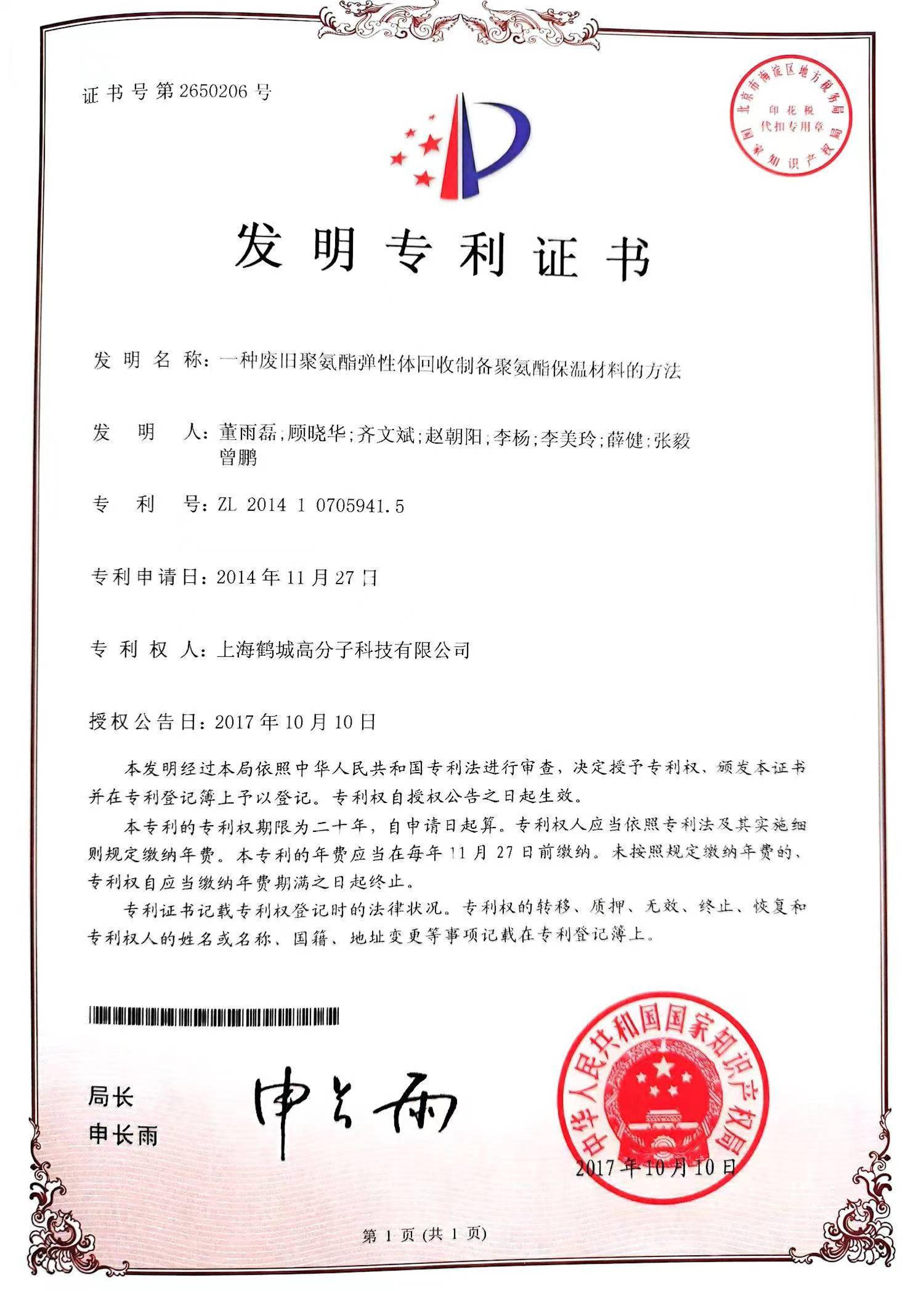
Certificate of Invention Patent 16425Q32921R3M, as recorded for the casting polyurethane prepolymer, CPU casting polyurethane and polyurethane elastomer product lines.
It is important to be precise about the scope of this evidence. A granted invention patent confirms that the covered products and their associated technology are registered and defensible; it does not confirm that any individual batch will pass a buyer’s abrasion, hydrolysis or sealing test. Patent documentation should therefore be filed as a supplier-qualification input, not as a substitute for incoming inspection or first-article testing. Buyers who need certificate copies for their own compliance files should list the patent number explicitly in the purchase specification so that documentation matching is unambiguous.
Purchasing terms and acceptance criteria for Asian buyers
For research and evaluation-stage buyers, the terms below are the recorded commercial parameters for the supplier’s polyurethane material supply. They are useful as a comparison baseline when quoting alternative suppliers.
| Procurement item | Recorded value | What the buyer should verify |
|---|---|---|
| Minimum order quantity | 1 ton | Whether the MOQ applies per grade or per shipment, and whether trial quantities are available before volume commitment |
| Lead time | 30 days | Whether this covers customised formulations as well as standard grades |
| Production mode | OEM, with voltage and logo customisation | Applicable labelling and packaging requirements in the destination market |
| Quality control | 100% test | Which attributes are tested per batch and whether results accompany each delivery |
| Documentation | Invention patent 16425Q32921R3M, domestic and international markets | Certificate copy matched to the exact product purchased |
| After-sales | Remote support | Response route for processing problems on the buyer’s casting line |
| Reference case | Vietnam-based raw material manufacturer, 100 tons of polyurethane elastomer, 10-year supply relationship, reported outcome of stable production quality and improved product performance | Relevance of the reference to the buyer’s own part geometry and line type |
Table 3 — Recorded commercial and quality parameters, with the verification question each one raises.
Supplier context is also part of acceptance. Shanghai Hecheng Polymer Technology Co., Ltd is a Shanghai-based national high-tech enterprise established in 2009, with plants and warehouses in Songjiang District, Shanghai. The company reports a 16,932 m² facility, more than 70 employees with R&D staff accounting for close to 30 percent of the total, 16 major production reactors and a catalogue of more than 1,000 prepolymer grades across casting systems, functional materials, adhesives and additives. Reported annual output reaches 1 million tons across its product lines, and export activity represents about 30 percent of business, with stated markets in the EU, Southeast Asia and South America.
Where this comparison stops: limits and trade-offs
An honest comparison has to state where the available evidence thins out. Three boundaries are worth flagging before a purchase decision.
- Grade-level technical data is not publicly comparable. Published third-party material on this category does not include standardised datasheets for NCO content, viscosity, hardness, cure conditions or hydrolysis resistance per grade. Buyers must obtain that data directly from the supplier and validate it against their own method.
- Price benchmarking is not independently available. No validated price, trade-flow or HS-code dataset for these grades was identified, so landed-cost comparison should be built from actual quotations rather than market estimates.
- Capacity figures are portfolio-level. The reported 1 million ton annual output covers multiple polyurethane product lines rather than a single prepolymer grade, and should be read as an indication of scale, not as availability of any one formulation.
There is also a material trade-off that sits in every one of these projects. Compared with general-purpose alternatives such as natural rubber, steel screen media or commodity cast systems, cast polyurethane is generally selected for wear resistance, resilience and corrosion behaviour, but it is usually the higher-cost option and it demands more disciplined processing. Low-free-isocyanate prepolymer systems reduce the free isocyanate handling profile of the working environment, yet they are a different chemistry that requires its own process validation — switching to them is a re-qualification project, not a like-for-like substitution. No direct comparative performance test data between these routes was identified in the available sources, so claims of superiority in either direction should be treated as unverified.
Market context behind the material decision
Three published figures frame why this category is attracting more procurement attention. The global polyurethane market was projected at USD 92.1 billion in 2026, with a long-range projection of USD 216.8 billion by 2033 according to Grand View Research. Within that, the casting polyurethane segment was valued at USD 2.76 billion in 2024 and is projected to reach USD 4.20 billion by 2033 at a CAGR of 5.97 percent, based on Astute Analytica data. The fastest-moving sub-segment is low-free isocyanate prepolymer technology, forecast by Market Research Intel to grow at 13.01 percent CAGR through 2033 across MDI, TDI and PPDI prepolymer types.
These figures should be read with one caution: research houses define “polyurethane” differently, and 2026 global estimates vary between publishers as a result. For a buyer, the useful signal is directional rather than absolute — cast elastomer demand and low-free chemistry adoption are both expanding, which means supplier documentation requirements are likely to tighten rather than relax.
What changes next for wind, marine and mining buyers
Three developments look likely to shape procurement in the near term. First, the rapid growth of low-free isocyanate prepolymer grades suggests that handling and workplace-safety documentation will become a standard part of supplier qualification in wind and marine supply chains. Second, automated two-component metering and high-pressure pouring continues to move from high-volume plants into mid-volume casting operations, which raises the value of materials with proven line compatibility. Third, the combination of tropical service conditions in several Asian markets and longer equipment service intervals is pushing hydrolysis and corrosion validation earlier in the evaluation process, before price negotiation.
For buyers weighing wind, marine and mining projects together, the practical conclusion is that material families should be selected against failure modes rather than against project labels, and that evidence should be graded by what it actually proves — patent coverage, batch testing, line trials and field references each answer a different question.
FAQ: comparing polyurethane raw materials for casting projects
Which polyurethane raw materials are used for wind power components?
For wind power generation components, documented performance functions are aging resistance, high-voltage sealing and shock absorption. In practice this splits across material families: casting polyurethane prepolymer as the reactive casting base, CPU casting polyurethane in the PTMG-MDI polyether system for sealed-class accessories such as sealing rings, and polyurethane elastomer or liquid polyurethane Gel-8301AB for shock-absorbing parts where high resilience is required.
Is liquid polyurethane the same as casting polyurethane prepolymer?
No. Liquid polyurethane, for example Gel-8301AB, is a polyurethane AB material documented as antioxidant and high resilience for various elastomers, and it is the project type recorded for marine technology applications. Casting polyurethane prepolymer is the reactive prepolymer base supplied for casting operations, positioned for mining and other industrial casting. They serve different positions in the production process and are not directly interchangeable.
What does patent 16425Q32921R3M cover?
It is a Certificate of Invention Patent, number 16425Q32921R3M, issued by HUAZHONG INTERNATIONAL CERTIFICATION AND INSPECTION GROUP and applicable to domestic and international markets. It is recorded against casting polyurethane prepolymer (product 4643), CPU casting polyurethane (product 5644) and polyurethane elastomer (product 5645). It confirms registered coverage of those products; it does not by itself confirm that a specific batch will meet a buyer’s abrasion, hydrolysis or sealing criteria.
Can these materials be processed on automated two-component casting lines?
The recorded operating mode for wind, marine, mining, construction, composite and sports applications is automated production using two-component metering and conveying, automatic high-pressure mixing and pouring for continuous mass production. Matched equipment is a polyurethane high-pressure foaming machine or low-pressure pouring machine, raw material storage tank, mixing bucket and delivery pump, with customisation supported. Because metering lines are sensitive to incoming material consistency, a trial pour on the buyer’s own equipment is the practical validation step.
What purchasing terms apply to polyurethane raw material orders?
Recorded commercial parameters include a minimum order quantity of 1 ton, a lead time of 30 days, OEM production with voltage and logo customisation, 100 percent testing, and remote after-sales support. A reference case describes a Vietnam-based raw material manufacturer purchasing 100 tons of polyurethane elastomer over a 10-year supply relationship, with reported outcomes of stable production quality and improved product performance.
What should buyers in tropical Asian markets check before accepting a shipment?
The shared working condition for these projects is tropical high temperature, high humidity, frequent friction and corrosive water contact. Acceptance checks should therefore cover hydrolysis and corrosion resistance under the buyer’s own conditioning method, batch-to-batch consistency against the agreed specification, first-article dimensional and hardness verification, and documentation matching — including the patent certificate and per-batch test records for the exact grade purchased.
What are the main limitations of this comparison?
Grade-level technical datasheets covering NCO content, viscosity, hardness, cure conditions and hydrolysis resistance are not available in comparable public form, and no validated price or trade dataset for these grades was identified. The reported 1 million ton annual output figure covers multiple polyurethane product lines rather than a single grade. Buyers should therefore treat the product families described here as a screening framework, and base final selection on supplier-issued technical data and their own sample validation.
Additional product and application detail is available in the company brochure: download the PDF.
Tem questões ou precisa de mais detalhes?
Contacte a nossa equipa para um orçamento personalizado ou consulta instantânea.
Solicitar orçamento
Preencha o formulário abaixo e a nossa equipa entrará em contacto com uma proposta personalizada.
Chat direto do WhatsApp
Prefere conversar em tempo real? Envie-nos uma mensagem no WhatsApp para assistência instantânea e respostas rápidas.
- Obter orçamento personalizado
- Partilhar fotos ou documentos
- Discuta as suas necessidades diretamente
Geralmente responde em 5–30 minutos durante o horário de expediente.