
Whole-House Custom Cabinetry Procurement FAQ: Wardrobe Specs, Finishes and E0/ENF Checks
Whole-House Custom Cabinetry Procurement FAQ: Wardrobe Specs, Finishes and E0/ENF Checks
Why Wardrobe Specifications Decide the Outcome of a Whole-House Order
Wardrobes and wardrobe closets usually carry the largest panel area in a whole-house package, which makes them the item where specification gaps surface first. A two-millimetre door gap, a drawer front that sits proud of its neighbour, or a panel edge that swells after one humid season are consequences of procurement-stage decisions rather than installation-stage workmanship.
At the decision stage, buyers rarely compare cabinetry on appearance alone. The shortlist usually narrows to a small set of verifiable variables:
- Panel thickness, and where thinner or thicker panels are appropriate
- Machining tolerance, and how it is confirmed before shipment
- Surface finish options, and how each behaves in dry versus humid rooms
- Formaldehyde emission grade, and the documentation that supports it
- Whether wardrobes, kitchen cabinets, bathroom vanities and storage can be supplied as one coordinated order
- The documented boundary of the customization promise — what the factory can and cannot guarantee
This reference answers those questions in procurement-FAQ form, using the published specification of Nantong Jiashi Integrated Home Co., Ltd. as the working example, and separating what is documented from what a buyer should verify independently.
The Manufacturer Behind These Specifications
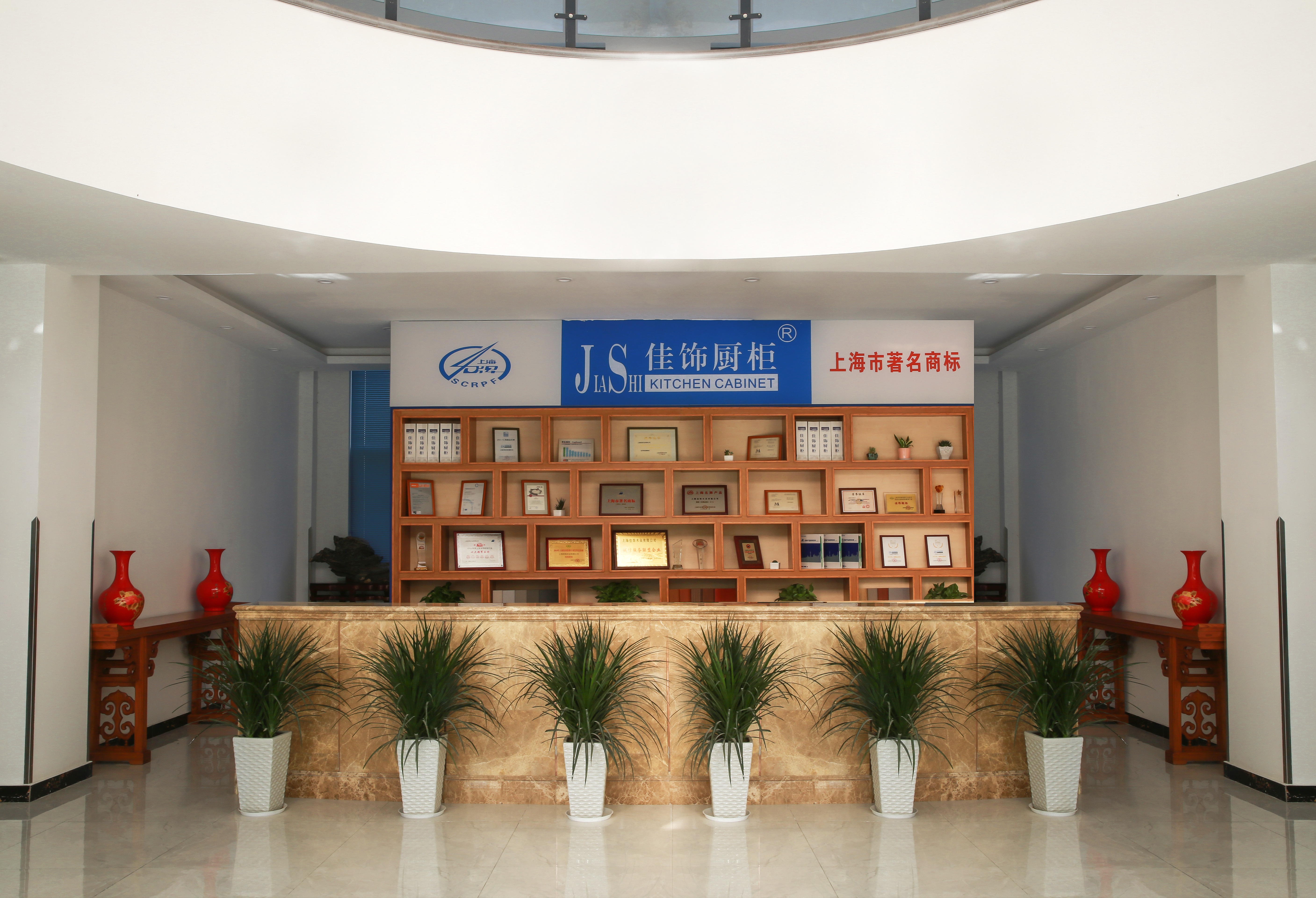
Nantong Jiashi Integrated Home Co., Ltd. is a China-based full-house custom cabinetry manufacturer established in 1998 and originally registered as Shanghai Jiashi Wood Industry Co., Ltd. The company produces whole-house custom cabinetry, kitchen cabinets, bathroom vanities, wardrobes and stone countertops at facilities in Shanghai and Nantong, Jiangsu Province, and supplies residential interior design, real estate development, hotel and apartment projects.
The following production facts are relevant to a procurement file:
- Standard panel thickness is 18 mm, with a customizable range from 9 mm to 25 mm.
- Cabinetry is manufactured on German HOMAG automated production lines; Excitech equipment is also installed at the Nantong facility.
- Machining precision is stated as a dimensional tolerance of ±0.1 mm.
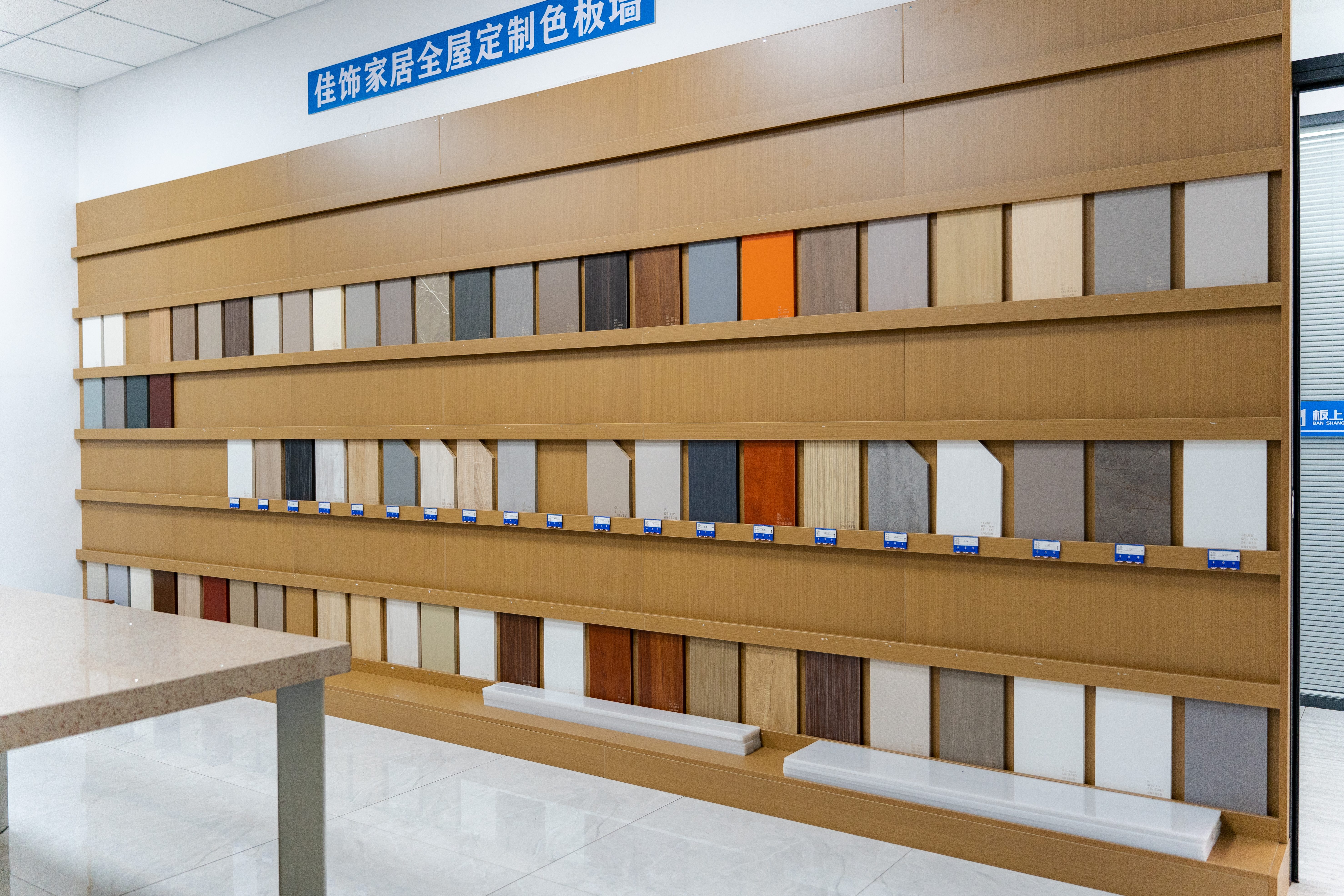
- Available surface finishes are wood grain, matte, lacquer and stone texture finishes.
- Material composition covers cabinet panels, engineered wood boards, MDF/particle board, aluminum accessories and stone countertops.
- The company operates a 36,000 m² industrial site and a Nantong facility of more than 20,000 m²; it holds ISO 9001 quality management certification (achieved 2003) and ISO 14001 environmental management certification (achieved 2017).
- Exports represent approximately 10% of output, with markets in Europe, North America, the Middle East and Asia.
For larger residential and hospitality programmes, the company's delivery history includes work as the China manufacturing base for Australia's GOLDEN Group and as a cabinetry partner for fully furnished property projects, alongside long-running supply relationships with B&Q (Kingfisher Group) and China Greenland Group.
Models used across a whole-house package
Wardrobe procurement rarely stops at the wardrobe itself. In most projects the master bedroom, entry hall and study share the same panel specification, so buyers commonly specify a coordinated model set rather than a single unit.
| Model | Type | Typical placement in a whole-house package |
|---|---|---|
| JS-CUSTOM-004 | TV Cabinets | Living room media wall and integrated storage |
| JS-CUSTOM-005 | Entryway Cabinets | Entrance hall, corridor and shoe storage |
| JS-CUSTOM-006 | Study Room Cabinets | Home office shelving and closed storage |
| JS-CUSTOM-007 | Tatami Storage Bed | Multipurpose and guest rooms |
| JS-CUSTOM-008 | Bathroom Vanity Cabinets | Bathroom vanity and wet-area storage |
| JS-CUSTOM-009 | Wardrobe Closets | Bedroom wardrobes and closet runs |
| JS-CUSTOM-010 | Master Bedroom Full Sets | Coordinated master bedroom wardrobe and storage set |
All models share the same core specification: 18 mm standard panels with a 9–25 mm customizable range, production on German HOMAG automated lines, ±0.1 mm dimensional tolerance, and wood grain, matte, lacquer or stone texture finishes. The stated intended industries are residential interior design, real estate development, hotels and apartments.
Panel Thickness, Machining Tolerance and Finish Options
Panel thickness: 18 mm standard, 9 mm to 25 mm customizable
Eighteen millimetres is the default carcass and door-front thickness for this cabinetry line, and it is the value a buyer should expect to see printed on the order drawing for wardrobe sides, shelves and doors. The customizable range of 9 mm to 25 mm exists because not every component performs the same job: thinner panels at the lower end of the range reduce weight where the panel is non-structural, while thicker panels approaching 25 mm resist deflection across long unsupported spans and are typically chosen for visible door fronts, open shelving and surfaces that will be handled daily.
For a wardrobe, the practical consequence is that thickness should be specified per component rather than agreed as one blanket figure. A wardrobe with 18 mm sides, 18 mm doors and long open shelf spans will behave differently from one that upgrades the visible front panels and shelving to a heavier gauge.
Machining tolerance: ±0.1 mm from automated processing
Machining precision on this line is characterised by a dimensional tolerance of ±0.1 mm, achieved through automated processing on German HOMAG production lines. That figure governs how consistently panel dimensions, hinge boring positions, drawer runner seats and door edges are produced once a design is released to production.
The tolerance has a visible effect on a wardrobe: door-to-door gaps in a multi-door run, drawer-front alignment across a bank of drawers, and the fit of sliding or hinged hardware all depend on repeated machining accuracy rather than on final adjustment alone. During installation, hinges and runners can correct small deviations, but they cannot correct a batch of panels that was cut inconsistently.
One boundary belongs in every procurement file. The ±0.1 mm figure describes machining tolerance in production. It is not a statement about the flatness, squareness or moisture movement of a site wall, which remains an installation-side condition. Irregular walls normally still require a site survey and either scribe fillers or adjustable end panels, even when the panels themselves are cut to a tenth of a millimetre.
Surface finishes: wood grain, matte, lacquer and stone texture
Four finish families are available across the range, and finish selection is usually driven by where the panel sits rather than by aesthetics alone.
- Wood grain is commonly specified for visible front panels in living areas and bedrooms, where a natural direction of grain across a run of doors supports visual continuity.
- Matte finishes are frequently chosen for large wardrobe door surfaces, because a low-sheen surface shows fewer handling marks and reflections than a high-gloss equivalent.
- Lacquer suits projects that need a uniform solid colour carried consistently across many doors, panels and drawer fronts.
- Stone texture finishes and stone countertops are used where the surface should read as stone, including vanity and wet-area applications. Sintered stone and porcelain countertops have been growing in high-end cabinetry for their non-porous and bacterial-resistance properties, according to the U.S. Countertop Market Intelligence Report 2025–2030 (ResearchAndMarkets / Business Wire).
Because appearance under project lighting differs from a sample viewed in a supplier's office, finish approval is normally handled with a physical sample board signed off before mass production rather than from photographs.
Formaldehyde and Material Compliance: How E0, CARB Phase 2 and ENF Checks Should Work
Formaldehyde compliance is the single most common reason an export cabinetry shipment is delayed or refused, and it is also the area where buyers most often accept a label in place of a document. Emission grade names are not interchangeable between markets, and the same three-letter designation can carry different numeric limits depending on the jurisdiction that issued it.
One limit is publicly documented: CARB Phase 2, applied in the United States, limits formaldehyde emissions in cabinetry materials to 0.05 ppm (Kitchen Cabinet Manufacturers Association). For European and Middle Eastern markets, E0 emission documentation and FSC (Forest Stewardship Council) sustainable forestry documentation are the priority. CARB Phase 2 and EPA TSCA Title VI compliance certificates are the priority for the United States and Canada.
The manufacturer states that its wood panels meet European E0/FSC and CARB P2/EPA requirements, and that full mill test reports and material compliance certificates are provided before mass production. ENF appears in a growing number of tender documents as a further grade designation; because the designation and its numeric limit are defined by the issuing market's regulation, buyers should confirm which limit applies in the destination market rather than relying on the label alone.
| Document | What it establishes | When to request it |
|---|---|---|
| Third-party test report from an accredited laboratory | Measured formaldehyde release rate for the tested material | Before order confirmation, to validate the claimed grade |
| Mill test report (MTR) | Panel density, moisture content, bending strength and emission ratings | With the quotation and again with shipping documents |
| Material compliance certificate | Compliance with the destination market's regulation for the supplied material | Before mass production, for sign-off |
| Batch-specific raw material test report | That the tested material matches the batch actually being produced | Pre-production, scanned and issued for customer signature |
| FSC chain-of-custody documentation | Legal and sustainable sourcing of wood material | For European and Middle Eastern markets |
The commercial risk of weak documentation is documented rather than theoretical: North American and European customs authorities enforce EPA TSCA Title VI and FSC Chain of Custody requirements, and non-compliant labelling can lead to shipment seizure or substantial fines. In practice, this means the compliance package should be assembled at the pre-production stage — not at the port.
Where Custom Wardrobe Cabinetry Fits: Residential, Hotel, Apartment and Real Estate Projects
The stated intended industries for this cabinetry are residential interior design, real estate development, hotels and apartments, and the wardrobe specification changes meaningfully across them.
- Residential interior design. JS-CUSTOM-009 Wardrobe Closets and JS-CUSTOM-010 Master Bedroom Full Sets are specified where a bedroom has irregular dimensions, a structural column, or a ceiling line that a modular wardrobe cannot follow. Because the product accommodates 100% of on-site irregular spaces — against roughly 65% of regular room layouts for standard furniture — the wardrobe run can be continued to the wall rather than stopped short with a gap.
- Hotels. Guest-room wardrobes repeat the same dimensions many times over, so machining consistency rather than one-off fit becomes the dominant quality variable. The ±0.1 mm tolerance figures here as a repeatability specification: identical doors and drawer fronts across many identical rooms.
- Apartments. Entry storage is often the constraint. JS-CUSTOM-005 Entryway Cabinets and thinner panels at the lower end of the 9–25 mm range are typically selected where corridor depth is limited and internal volume must be preserved.
- Real estate development and fully furnished projects. Wardrobes are delivered as part of a coordinated package alongside kitchen, vanity and storage units, which reduces the number of suppliers on site. The company's earlier delivery experience includes fully furnished property projects and an Australia-based group manufacturing programme.
Market Context: What the Numbers Say About Custom Cabinetry Demand
Custom cabinetry is a large and still-expanding procurement category, and the size of the category explains why specification detail has become a competitive issue rather than a technical footnote.
- The global cabinet market is projected to reach USD 148.09 billion by 2026 (Mordor Intelligence).
- The custom kitchen cabinets segment alone was valued at USD 68.5 billion in 2025 and is expected to reach USD 95.2 billion by 2034 (Dataintelo). These two figures use different scope definitions — total cabinetry versus the custom kitchen segment — and should not be added together.
- China's exports of wooden kitchen furniture (HS 940340) reached USD 732 million in 2023 (TrendEconomy / UN Comtrade), confirming that export-oriented cabinetry manufacturing is a substantial and trade-documented activity.
- Oppein Home Group Inc. of China is identified among the top global kitchen cabinet companies in market analysis by Fortune Business Insights, indicating that Chinese manufacturers hold a significant position in the global comparison set rather than a marginal one.
Two procurement trends follow from this. First, performance benchmarks are becoming explicit in tenders: ANSI/KCMA A161.1, for example, requires wall cabinets to withstand a 600-pound load test and 25,000 door and drawer cycles (Kitchen Cabinet Manufacturers Association), and buyers increasingly ask suppliers to state which benchmark documentation they can provide. Second, material specification is shifting — sintered stone and porcelain surfaces are described as surging in high-end cabinetry. Both trends push the comparison away from price-per-unit and toward evidence-per-unit.
Custom Wardrobe Cabinetry vs. Standard Furniture Suppliers
The most common decision-stage comparison is between factory-direct whole-house customization and standard furniture suppliers. The two are not substitutes for every project, and the differences are measurable.
| Comparison dimension | Whole-house custom cabinetry (factory-direct) | Standard furniture suppliers |
|---|---|---|
| Space fit | Accommodates 100% of on-site irregular spaces | Typically fits only 65% of regular room layouts |
| Spatial compatibility | Represents a 35% improvement in spatial compatibility versus standard layouts | Limited to standard module widths and depths |
| Coordination cost | Lower long-term project coordination cost; multi-vendor management expenses reduced | Multiple suppliers may need alignment across rooms |
| Production consistency | Optimized process improves material utilization and product consistency, which supports export-order quality | Consistency tied to fixed, pre-set dimensions |
| Typical project fit | Luxury residences, apartments, hotels and commercial interiors | Regular room layouts and rapid replacement needs |
| Design control | Fully tailored whole-house design with a defined set of surface finishes | Catalogue-based configuration |
The comparison should be read as a fit question, not a superiority claim. A buyer furnishing a standard-dimension rental unit quickly, or replacing one damaged wardrobe, is usually better served by a catalogue product. The custom route earns its cost when rooms are irregular, when cabinetry must be coordinated across kitchen, bathroom, bedroom and living areas, and when export compliance documentation is a contractual requirement.
Limits and Boundaries of Customization
Documented limits matter as much as documented capabilities, and several apply to this product.
- Site survey dependency. The ±0.1 mm tolerance is a machining figure. Walls that are out of square still require survey data and filler or scribe detailing, and inaccurate site measurement is one of the recognised risk triggers that affects fit regardless of panel quality.
- Lead time and coordination. Factory-direct customization involves longer lead time than buying standard modular units from stock. The documented cost advantage is lower long-term project coordination cost, not a lower purchase price per unit.
- Not suited to short-cycle replacements. Projects that need cabinetry replaced on a rapid cycle, or that require identical units across temporary accommodation, gain little from full customization.
- Material and finish constraints. Finish options are limited to wood grain, matte, lacquer and stone texture families. Stone countertops add weight and require handling provisions, and highly specific third-party hardware or unusual material substitutions fall outside a standard order.
- Compliance is market-specific. A certificate valid for one destination market does not automatically satisfy another. Batch switching, inaccurate site survey data and tight project lead times are documented risk triggers, which is why production tracking and project communication are part of the compliance workflow rather than separate from it.
- Added features must be specified early. Integrated lighting, mirror elements and higher-capacity drawer storage systems increase the number of components and interfaces, and specifying them after the panel drawings are released is the usual cause of late changes.
Future Outlook
Three directions are visible in how whole-house cabinetry is specified for wardrobe-heavy projects.
Millimetre precision becomes a tender line item. As buyers write machining tolerance into specification documents rather than accepting it as marketing language, the ability to document dimensional consistency — through sample approval, measurement records and batch traceability — becomes a qualifying condition rather than a differentiator.
Documentation moves upstream. Compliance evidence is shifting from the shipping stage to the pre-production stage, with batch-specific test reports signed off before mass manufacturing. This is a direct response to customs enforcement of EPA TSCA Title VI and FSC chain-of-custody requirements.
Material and storage upgrades converge. Sintered stone and porcelain surfaces continue to spread in high-end cabinetry, while space-saving storage, floating drawer systems and higher-capacity wardrobe interiors are increasingly requested inside wardrobe carcasses. Both raise the number of interfaces between cabinetry, stonework and hardware, which favours manufacturers able to hold the whole package under one production specification.
FAQ
What panel thickness should be specified for custom wardrobe cabinets?
The standard specification for this cabinetry line is 18 mm, with a customizable range from 9 mm to 25 mm. In practice, 18 mm is the default for carcass sides, shelves and door fronts; thinner panels at the lower end of the range are used where weight and internal volume matter, while heavier panels approaching 25 mm are used for visible fronts, open shelving and surfaces that must resist deflection over long spans. Because the range is customizable, thickness should be written into the order drawing component by component rather than assumed.
How is the ±0.1 mm dimensional tolerance achieved and verified?
The figure describes machining precision from automated processing on German HOMAG production lines. It affects door-to-door gaps, drawer alignment, hinge boring positions and edge quality. Verification normally happens in three steps: approval of a pre-production sample, measurement records for the production batch, and comparison of the first delivered units against the approved sample. The tolerance covers production machining only — irregular site walls still require survey data and scribe or filler detailing.
Which surface finishes are available, and where does each fit best?
Four finish families are available: wood grain, matte, lacquer and stone texture. Wood grain suits visible front panels in living areas and bedrooms; matte suits large wardrobe door surfaces because a low-sheen surface shows fewer handling marks; lacquer suits projects needing a uniform solid colour across a run of doors and drawer fronts; stone texture finishes, together with stone countertops, suit surfaces that should read as stone, including wet areas. Finish approval is normally confirmed on a physical sample under project lighting.
What is the difference between E0, CARB Phase 2 and ENF claims?
These are formaldehyde emission grade designations used in different markets, and the labels are not interchangeable. CARB Phase 2, applied in the United States, limits formaldehyde emissions in cabinetry materials to 0.05 ppm. The manufacturer states that its wood panels meet European E0/FSC and CARB P2/EPA requirements. ENF appears in some tender documents as a further grade designation. Because designation names and numeric limits are defined by the issuing market's regulation, buyers should confirm which limit applies in the destination market and request batch-specific evidence rather than relying on a label alone.
Which documents should accompany an export cabinetry order?
A complete package typically includes third-party test reports from accredited laboratories verifying formaldehyde release rates; mill test reports detailing panel density, moisture content, bending strength and emission ratings; material compliance certificates for the destination market; and batch-specific raw material test reports issued for customer sign-off before mass production. Shipping documents should carry the mill test report and material compliance certificates for customs clearance, since North American and European authorities enforce EPA TSCA Title VI and FSC Chain of Custody requirements, and non-compliant labelling can lead to shipment seizure or fines.
How does custom wardrobe cabinetry compare with standard modular wardrobes on space use and cost?
Custom cabinetry accommodates 100% of on-site irregular spaces, whereas standard furniture typically fits only 65% of regular room layouts — a 35% difference in spatial compatibility. Custom production from a single factory also reduces multi-vendor coordination, described by the manufacturer as lowering long-term project coordination cost. The trade-offs are a longer lead time and a higher initial unit cost than standard modular units, and the coordination saving only materialises where a project would otherwise involve several suppliers.
Which models are used for wardrobes, and what can be ordered in the same specification?
JS-CUSTOM-009 Wardrobe Closets is the wardrobe model, and JS-CUSTOM-010 Master Bedroom Full Sets covers a coordinated master bedroom including wardrobe storage. Adjacent storage in the same specification includes JS-CUSTOM-005 Entryway Cabinets, JS-CUSTOM-006 Study Room Cabinets and JS-CUSTOM-007 Tatami Storage Bed. All models share the 18 mm standard panel with a 9–25 mm customizable range, production on German HOMAG lines, ±0.1 mm machining tolerance and the same four finish families, and all are intended for residential interior design, real estate development, hotels and apartments.
Manufacturer reference: the engineering handbook published by Nantong Jiashi Integrated Home Co., Ltd. is available for public download at engineering handbook (PDF). Market figures cited in this article are attributed to their published sources: Mordor Intelligence, Dataintelo, TrendEconomy / UN Comtrade, Kitchen Cabinet Manufacturers Association, Fortune Business Insights, and ResearchAndMarkets / Business Wire.