
Wholesale Baby Diapers for Distributors: A Compliance Guide

Wholesale baby diapers are a specification-led purchase rather than a price-led one. A distributor buying by the container is committing to a fixed combination of size range, absorbency, absorbent-core structure, backsheet, fastening format, pack count and destination-market documentation. Each of those variables is normally confirmed before production begins, because correcting them after delivery is far more expensive than negotiating them before an order.
Yibero is the baby and adult hygiene brand of Fujian Jiayue Sanitary Products Co., Ltd., a Quanzhou-based manufacturer and OEM/ODM supplier of disposable hygiene products. Its portfolio covers baby diapers, baby pull-up pants, adult diapers, adult pull-up pants, sanitary napkins, underpads, wet wipes, dry wipes, tissue paper and pet diapers, supplied to importers, distributors, brand owners and retail channels.
For distributors in the research and evaluation stage, the useful question is not which supplier is cheapest per container. It is which supplier can document the specification, the conformity evidence and the production commitment behind that container.
Why wholesale diaper sourcing is a constraint problem first
Three figures frame the constraint problem for any distributor building a diaper line.
- The global baby diaper market was valued at USD 83.3 billion in 2025, according to market research published by Grand View Research.
- Asia Pacific accounted for 61.92% of the global diaper market in 2025, according to Fortune Business Insights.
- Company-published cost information for diaper production indicates that raw materials account for roughly 78–85% of the ex-factory price, leaving a comparatively narrow band for conversion, packaging and margin.
Those three points combine into a single practical conclusion. In a category where raw materials dominate the cost base and where supply is concentrated in one region, price flexibility is generated at the specification stage, not at the negotiation table. A distributor that accepts an undefined specification has effectively handed pricing control to the supplier, because every later change — grammage, core structure, backsheet, pack count — moves the cost base.
The opportunity sits in the opposite direction. Distributors who lock a specification, a size mix and a documentation set early can compare suppliers on identical terms, forecast landed cost more accurately, and defend a private-label position instead of competing only on shelf price.
The specification variables that define a wholesale baby diaper order
For the Yibero Premium Quality Ultra Cloudy Baby Diapers — a tape-style disposable baby diaper available as an OEM/ODM product — the published specification covers four sizes, with reference absorbency rising across the range.
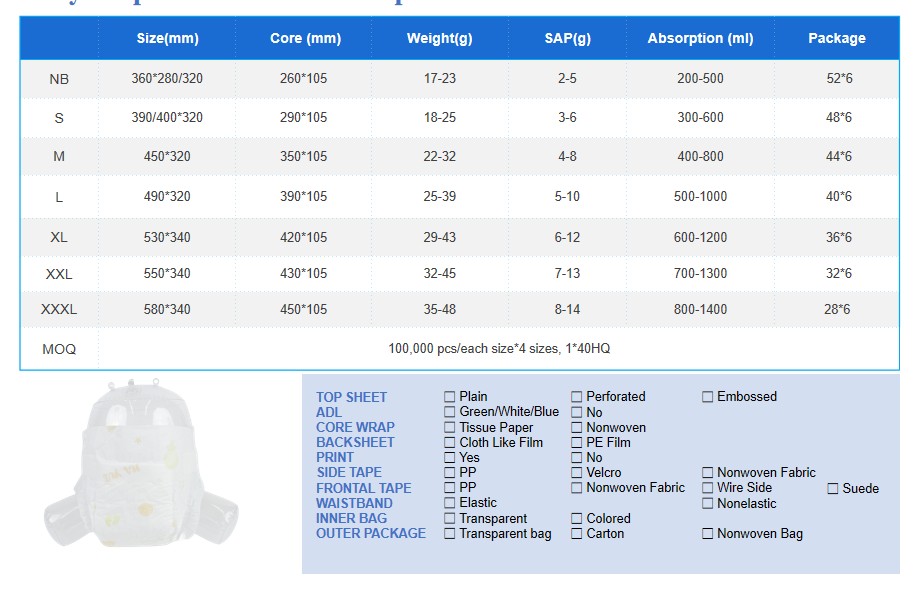
| Size | Dimension | Baby weight range | Reference absorbency | Unit weight |
|---|---|---|---|---|
| S | 400 × 320 mm | 4–8 kg | 500 ml | 26 g |
| M | 450 × 320 mm | 6–11 kg | 600 ml | 29 g |
| L | 500 × 340 mm | 9–14 kg | 700 ml | 33 g |
| XL | 540 × 340 mm | 12–17 kg | 800 ml | 35 g |
The published shelf life for this baby diaper configuration is five years under recommended storage conditions.
Construction includes a soft topsheet, an absorbent core built from imported SAP and fluff pulp, reusable magic tape, a nonwoven frontal tape, an elastic waistband and a cloth-like breathable backsheet. These are the components a distributor is actually buying. Absorbency numbers on a datasheet describe the core; leak performance in use depends on how that core, the fit and the backsheet work together on a moving baby.
Procurement reading: published absorbency figures are reference values. They should be confirmed against the approved sample and the signed specification for the specific order, because core composition, topsheet type and pack configuration can all shift between product variants.
Compliance documents a distributor should verify before ordering
For a hygiene product sold across borders, conformity paperwork is part of the product, not an administrative extra. Fujian Jiayue Sanitary Products Co., Ltd. holds the following management-system certificates within their documented scopes.
| Document | Certificate number | Issued | Valid until | Documented scope |
|---|---|---|---|---|
| ISO 9001 Quality Management System Certificate | NOA2314690 | 12 December 2023 | 11 December 2026 | Sales of sanitary products, maternal and infant products, and Class I medical devices |
| ISO 13485 Medical Devices Quality Management System Certificate | NOA2314356 | 6 December 2023 | 5 December 2026 | Class I medical device sales |
| CE Declaration of Conformity — Baby Diapers | CE/PPE-JY-01 | 15 May 2025 | No recorded expiry date | Baby diapers, sizes NB–XXXXXL, Category I, EU market |
The two ISO certificates were issued by NOA Testing & Certification Group Ltd. The ISO 9001 certificate follows GB/T 19001-2016 / ISO 9001:2015, and the ISO 13485 certificate follows GB/T 42061-2022 / ISO 13485:2016. Both are described as valid internationally, with scope limited to the certified sales activities.
The CE Declaration of Conformity for baby diapers is a self-declaration by Fujian Jiayue Sanitary Products Co., Ltd. under Regulation (EU) 2016/425 on Personal Protective Equipment, Module A according to Annex IV, with SUNGO Europe B.V. named as the EU representative. The declared product scope covers baby diapers from size NB to size XXXXXL, with a length range of 36–58 cm and a width range of 28–45.5 cm.
Beyond these three documents, selected products may be supported by CE declarations of conformity, SGS test reports and other compliance documents, depending on the applicable product, destination market and order requirements.
Three verification points that distributors frequently miss. First, both ISO certificates carry a documented scope limited to sales activities and, for ISO 13485, limited to Class I medical device sales — a distributor should confirm that the certificate covers the activity relevant to its order rather than assuming it covers every product line. Second, the CE Declaration is a manufacturer self-declaration under Module A, not a third-party certification, which is normal for this category but should be understood as such. Third, both ISO certificates expire in December 2026; an order scheduled to ship after that date should be supported by renewed certificates.
OEM and private-label customization: what can actually be changed
For distributors building a private-label line, the relevant question is how deep customization goes. The company's stated customization scope covers product size and weight, absorbency target, SAP and fluff-pulp or composite core, hot-air or spunbond nonwoven, cloth-like backsheet, tape or pull-up format, 3D leak guards, wetness indicator, waistband, graphics, printed bags and cartons, and pack count and size mix.
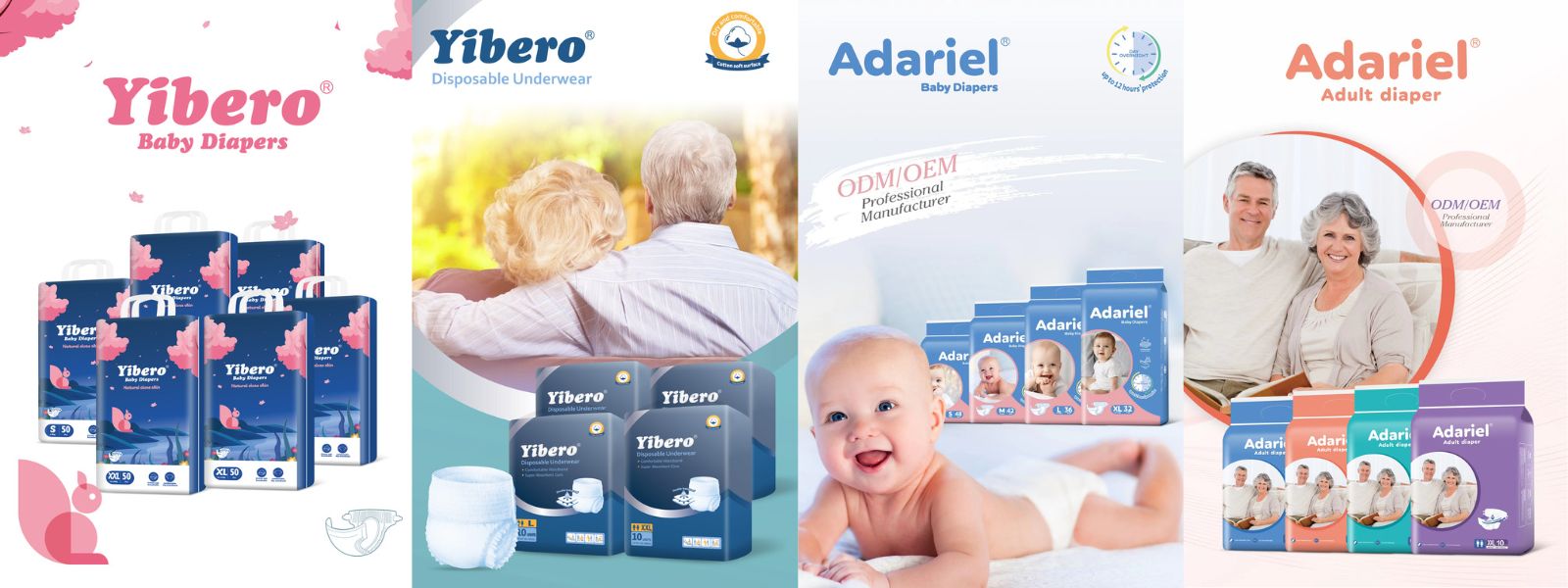
Customization at this level is a specification exercise, not a catalogue selection. The company's in-house R&D and technical support team — eight engineers responsible for material selection, absorbent-core design, product development, sampling, specification adjustment and OEM/ODM technical support — is the function that translates a distributor's market requirement into a producible specification. Product specifications, materials, absorbency targets, graphics, pack counts and export packaging are confirmed through sampling and an approved specification.
For a distributor, that process matters commercially in one specific way: the approved sample and signed specification become the reference document against which subsequent production is judged. Without them, a quality discussion has no baseline.
Capacity, lead time and the limits of self-reported production data
Fujian Jiayue Sanitary Products Co., Ltd. was established in 2016 and operates through a self-owned factory, Quanzhou Jiarun Paper Industry Co., Ltd., described as covering approximately 20,000 square meters. Company-provided production information lists automatic production lines for baby diaper and adult diaper products, an annual output of more than 500 million pieces, a workforce of approximately 100 employees, and monthly shipment volume of more than 100 × 40HQ containers. Company materials also state that exports reach more than 70 countries and regions, with an export ratio of about 90%.
Typical production lead time is approximately 30–45 days, subject to sample, artwork, packaging and specification approval. Ready-to-ship products may support lower minimum order quantities, while OEM order MOQ depends on the product, size mix, materials, packaging and customization requirements, with the final figure confirmed in the quotation.
Where the published numbers stop being sufficient. Capacity figures of this type are supplier-reported. In this case, company materials list a baby-diaper line speed of 700 pcs/min, while a separate page associated with the same production base cites 560 pcs/min for the same lines — an unresolved internal discrepancy. More broadly, factory-reported line speeds are typically captured under favorable conditions and tend to run above sustained operational speeds. For a distributor, the practical implication is that line speed, annual output and container volume should be treated as indicative planning inputs, and confirmed through a factory audit, production records or a trial order before they are used to underwrite a distribution commitment.
Where wholesale baby diapers are used, and how programs are structured
The end-use environment for this product category is undemanding but unforgiving: household daily indoor use at normal ambient temperature, with single-use products changed frequently according to packaging instructions. No supporting equipment is required, though diaper storage bins, wet wipes and changing mats are commonly sold alongside. The performance requirement is therefore not extreme — it is consistent. A distributor's reputation is built on the tenth container behaving like the first.
On the supply side, the typical program type is an OEM/ODM baby diaper and baby pull-up pants program. The stated special requirement before mass production is to confirm target-market compliance, label language, performance specification, pack count and artwork, followed by sample approval and pre-shipment inspection. Those five items are, in practice, the checklist that separates a repeatable private-label program from a one-off purchase.
What distributor onboarding looks like in practice
Company-published references describe two patterns. In one, an anonymized private-label baby diaper importer and distributor began with a trial container and progressed to stable repeat-order cooperation, building a local private-label line supplied through wholesale and retail channels; the supporting work covered specification and absorbency adjustment, packaging and artwork coordination, size-mix planning, sampling, export documentation and repeat-order support. Customer names, countries and order volumes are not publicly disclosed.
In a second reference, more than five long-term OEM customers across multiple overseas markets developed from initial orders into established local brands and scaled repeat orders. Both references are company-published and anonymized, so they should be read as descriptions of the supplier's working model rather than as independently audited case studies.
Market trend: sourcing density and the documentation expectation
The structural trend most relevant to distributors is concentration of supply. Asia Pacific already holds close to two-thirds of global diaper market value, and within China the export base clusters tightly around Fujian. Xiamen Customs data cited in company-published material puts Fujian province baby diaper export value at CNY 8.74 billion in 2024.
For buyers, dense supply clusters cut both ways. They shorten sourcing lead times and widen supplier choice, but they also mean that most suppliers describe comparable capabilities, which makes differentiation harder to assess from a website alone. The differentiator increasingly becomes documentation: which certificates exist, what their scope says, when they expire, and whether the product specification can be reproduced on demand.
A second, quieter trend is specification literacy among distributors. As private-label competition intensifies in price-sensitive markets, distributors that can specify a core structure, a backsheet type or a pack configuration are better able to defend a price point than distributors reselling an undefined product.
Comparing sourcing routes: direct OEM, ready-to-ship stock and intermediaries
Distributors evaluating wholesale baby diapers generally choose between three sourcing routes. The trade-offs differ by how much specification control the buyer needs.
| Evaluation criterion | Direct OEM / private-label manufacturer | Ready-to-ship wholesale stock | Trading intermediary |
|---|---|---|---|
| Specification control | High — size, absorbency target, core, backsheet, format, pack count | Low — buyer accepts an existing configuration | Variable — depends on the underlying factory relationship |
| Brand ownership | Buyer's own label on artwork, bags and cartons | Typically supplier label or neutral packaging | Usually supplier label |
| Order flexibility | OEM MOQ depends on product, size mix, materials and packaging | Lower MOQ may be supported | Often flexible but at a margin layer |
| Lead time | Approximately 30–45 days, subject to sample and artwork approval | Shorter, subject to stock availability | Depends on the factory's schedule |
| Documentation access | Certificates, declarations and test reports held at the manufacturing entity | Documents supplied by the stock holder | Documents may be relayed rather than directly held |
| Main risk | Higher upfront specification and sampling workload | Limited differentiation and configuration lock-in | Weaker traceability between claim and production source |
None of these routes is universally better. Ready-to-ship stock is often the correct choice for a distributor testing a new market or bridging a demand gap, and the company's stated position is that ready-to-ship products may support lower MOQ for exactly that reason.
The limitation is equally clear. Direct OEM sourcing only delivers its advantages if the distributor invests in the front end of the process: sample approval, artwork confirmation, specification sign-off and, ideally, factory verification. Where a distributor skips those steps to shorten the launch timeline, it takes on the same configuration lock-in as a stock purchase while carrying a longer lead time and a larger capital commitment. The 30–45 day production window also means OEM programs cannot respond to short-term demand spikes in the way stock purchasing can. For orders involving customized cores, printed packaging or unusual size mixes, both MOQ and lead time move upward relative to a standard configuration.
Future outlook
Two directions look durable for wholesale baby diaper distribution. The first is documentation-driven qualification: as distributors formalize supplier approval processes, certificate scope and validity will be checked as routinely as price, and suppliers whose paperwork does not match the products they sell will be filtered out earlier. The second is specification differentiation at the private-label level, particularly in markets where multiple local brands share the same factory base and need a defensible reason for a shelf-price difference.
For buyers planning programs beyond 2026, the practical near-term action is unglamorous but specific: check the validity window of management-system certificates, confirm that the certificate scope covers the relevant activity, and confirm against the approved sample that the published reference absorbency, unit weight and dimensions match what will actually be shipped.
Frequently asked questions
What is the minimum order quantity for wholesale baby diapers?
Ready-to-ship products may support a lower MOQ. For OEM orders, MOQ depends on the product, size mix, materials, packaging and customization requirements. The final MOQ, together with capacity, lead time, testing requirements and payment terms, is confirmed in the quotation, the approved sample and the sales contract.
Which compliance documents can be verified for Yibero baby diapers?
Fujian Jiayue Sanitary Products Co., Ltd. holds an ISO 9001 Quality Management System Certificate (NOA2314690, issued 12 December 2023, valid until 11 December 2026) and an ISO 13485 Medical Devices Quality Management System Certificate (NOA2314356, issued 6 December 2023, valid until 5 December 2026), both issued by NOA Testing & Certification Group Ltd. A CE Declaration of Conformity for baby diapers (CE/PPE-JY-01) was issued on 15 May 2025 under Regulation (EU) 2016/425, Module A according to Annex IV, with SUNGO Europe B.V. as the EU representative. Selected products may additionally be supported by SGS test reports and other compliance documents, depending on the applicable product, destination market and order requirements.
How many sizes can be mixed in one wholesale baby diaper container?
Baby diaper containers may mix three to four sizes. The final size mix is confirmed alongside pack count and packaging configuration in the approved specification for the order.
What is the typical production lead time for an OEM baby diaper order?
Typical production lead time is approximately 30–45 days, subject to sample, artwork, packaging and specification approval. Samples are prepared in one to three working days, with courier costs paid by the buyer. Quality control for an order follows an order-specific plan covering specification review, pre-production sample approval, in-process checks and pre-shipment inspection, with test method, sampling level and acceptance criteria agreed in the contract.
What is the difference between a fluff pulp and SAP core and an ultra-thin SAP paper core?
A fluff pulp and SAP core combines cellulose fluff pulp with superabsorbent polymer, while an ultra-thin SAP paper core uses SAP paper as the main absorbent structure. Both core options are offered for selected diaper products. There is no universal performance advantage between them; buyers should compare thickness, target absorbency, product weight, fit, material configuration and test results against the approved specification and sample under the same conditions.
What is the difference between tape-style baby diapers and baby pull-up pants?
Tape-style baby diapers are designed for caregiver-assisted changes, especially for younger babies who spend more time lying down. Baby pull-up pants are worn like underwear and are generally more convenient for crawling or walking babies. The appropriate choice depends on age, activity level, fit, absorbency requirements and changing habits, and both formats can be produced within an OEM/ODM program.
Reference document: the JIAYUE Product Catalog 2026 is available for download at JIAYUE Product Catalog 2026 (PDF). Additional company information is published at jiayuehygiene.com.
Market data referenced in this article: Grand View Research, Baby Diapers Market Size & Share Report (2026); Fortune Business Insights, Baby Diaper Market Size, Industry Share & Growth (2026); Xiamen Customs export data for Fujian province as cited in company-published material (2025). Supplier-specific specification, capacity, certification and service information reflects company-published documentation and, where noted, remains subject to verification against approved samples, contracts and factory audit.
Tem questões ou precisa de mais detalhes?
Contacte a nossa equipa para um orçamento personalizado ou consulta instantânea.
Solicitar orçamento
Preencha o formulário abaixo e a nossa equipa entrará em contacto com uma proposta personalizada.
Chat direto do WhatsApp
Prefere conversar em tempo real? Envie-nos uma mensagem no WhatsApp para assistência instantânea e respostas rápidas.
- Obter orçamento personalizado
- Partilhar fotos ou documentos
- Discuta as suas necessidades diretamente
Geralmente responde em 5–30 minutos durante o horário de expediente.