
Wholesale Bonsai Scenario Fit: Garden, Landscape or Furniture Retail
Wholesale Bonsai Scenario Fit: Garden, Landscape or Furniture Retail
Scenario fit is the first filter in a wholesale bonsai order, and it is usually the last one applied. Buyers tend to start with a unit price, then discover that the four live-plant lines they are quoting — Sansevieria, Cycas revoluta, Ficus ginseng and Pachira — are specified in different units, shipped in different forms and listed for different selling environments. Xiamen Perfect Supply chain CO., LTD, a manufacturer established in 2012 and operating as KinoFarm, lists all four lines. They are not interchangeable, and the differences that decide the fit sit in the specification record rather than in a general catalogue description.
This guide works from the recorded product and application data. It does not claim that any variety sells faster in a given channel, and it does not convert a listed industry into a promise about retail performance.
The Cost of Treating Four Lines as One Product
A quotation template built for one variety produces unusable quotations for the other three. Sansevieria is specified by leaf count and height. Cycas revoluta is specified by trunk diameter and height. Ficus ginseng is specified by root weight and grafting status. Pachira is specified by braid count and height.
A single line item reading "assorted bonsai, 30 cm" collapses four different production and handling decisions into one field. The supplier cannot quote it without re-asking the same questions, and the buyer cannot compare the replies, because the replies describe different things. Height is the only field all four share, and for Ficus ginseng height is not the recorded size field at all.
The practical consequence is that a buyer who treats the range as one product usually ends up comparing a per-leaf unit against a per-kilogram unit against a per-braid unit. Those numbers are not on the same scale, so the cheapest-looking quotation does not indicate the cheapest supply — it indicates a different specification.
What Each Line Actually Specifies
The recorded specifications below are the foundation for every scenario decision that follows. Only the listed fields are stated; nothing has been added about age, pot size, survival rate or grower history.
| Line | Listed industries | Recorded size | Form options |
|---|---|---|---|
| Sansevieria (Sansevieria superba) | Agriculture, horticulture, garden center, landscape | H 20–40 cm; 2–3 leaves | Bare root or potted |
| Cycas revoluta (Sago palm) | Agriculture, horticulture, landscape, home furniture stores | D 5–20 cm+; H 20–120 cm | Potted; bulbs |
| Ficus ginseng | Agriculture, horticulture, home furniture stores | Root weight 50 g–10 kg | Grafted or ungrafted |
| Pachira (Money tree) | Agriculture, horticulture | 3, 4 or 5 braids; H 20–90 cm | Newly braided or old braided |
Two observations follow directly from the table. First, only Cycas revoluta appears in all four of the record's main selling environments — agriculture, horticulture, landscape and home furniture stores — which makes it the range's widest-fit line and also the line most likely to be quoted for the wrong job. Second, Pachira is listed only for agriculture and horticulture, so a garden center or landscape buyer sourcing Pachira is buying through a production and trade channel rather than through a channel the record names for that variety.
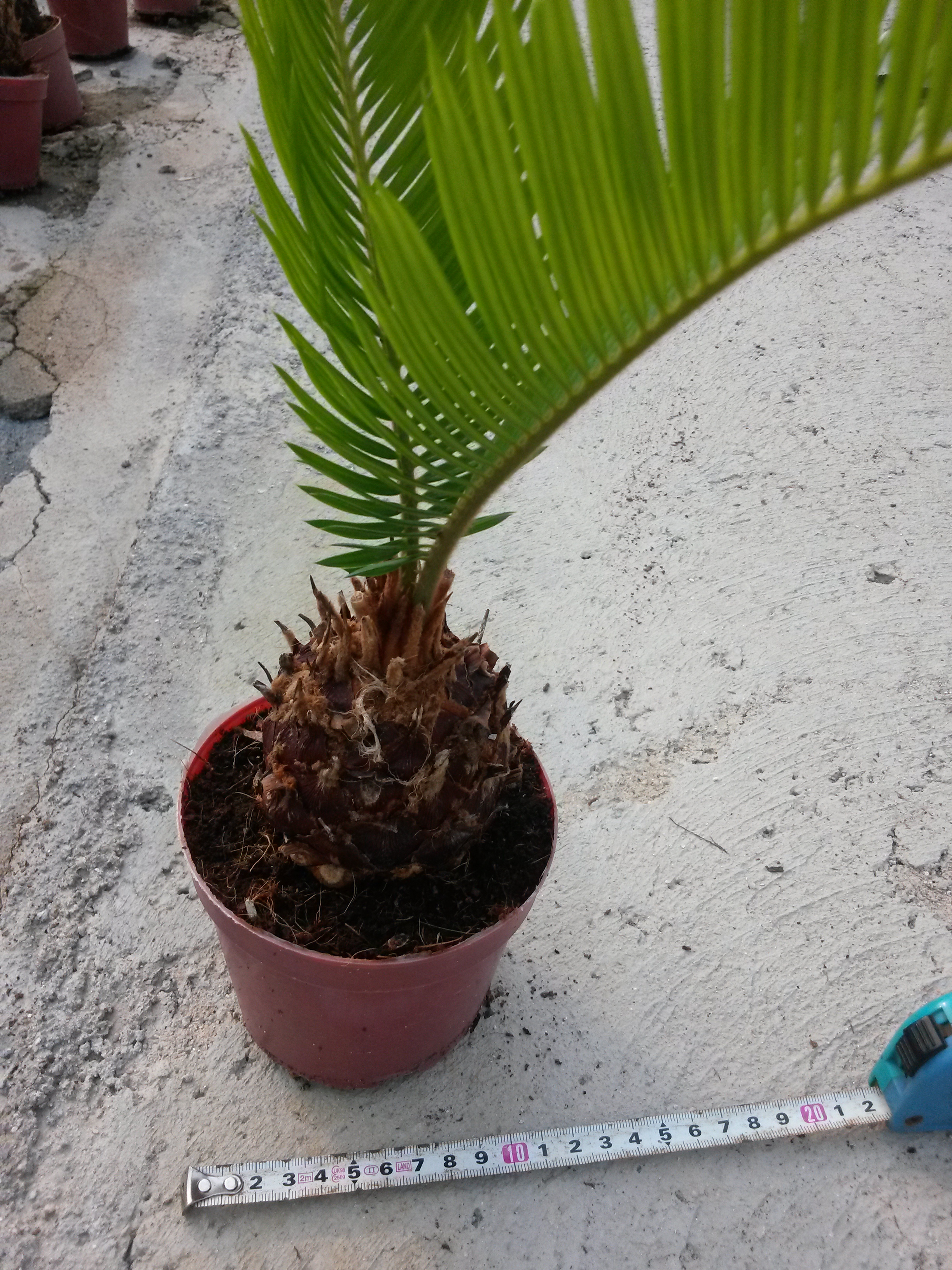
Cycas revoluta in potted form at the KinoFarm greenhouse. Recorded size envelope: D 5–20 cm+, H 20–120 cm.
Garden Centers: One Repeatable Unit and One Focal Unit
A garden center needs two kinds of plant from a bonsai range, and one variety rarely supplies both. It needs a repeatable unit that fits a bench, a counter or a trolley bay, and it needs a larger focal plant that anchors an entrance or a display table. The recorded specifications separate the two roles cleanly.
Sansevieria covers the repeatable role. At H 20–40 cm with two to three leaves, available bare root or potted, it sits inside the size band a garden center can merchandise as a small indoor plant. The product record lists it as evergreen, easy care, suited to indoor and low-light conditions, and the application record places it in the agriculture, horticulture, landscape, nursery and garden center industries. Those attributes describe a plant that can be sold with simple care labelling rather than a specialist bench conversation.
Cycas revoluta covers the focal role. Its recorded envelope of D 5–20 cm+ and H 20–120 cm gives a garden center one line that can be sold as an entry-level pot and as a taller specimen without changing variety. The same record lists it for landscape use and for home furniture stores, so a garden center buyer can place the line in more than one part of a store plan.
The bare-root versus potted decision matters more than it appears at quotation stage. Bare-root Sansevieria carries no growing medium, so the buyer must pot on before display; potted Sansevieria arrives in a form the buyer can present directly. The same choice exists for Cycas, where bulbs are recorded as a separate material form alongside potted plants. Neither form is automatically better — the right choice depends on whether the buyer operates a potting line and on how soon the plant has to be saleable.
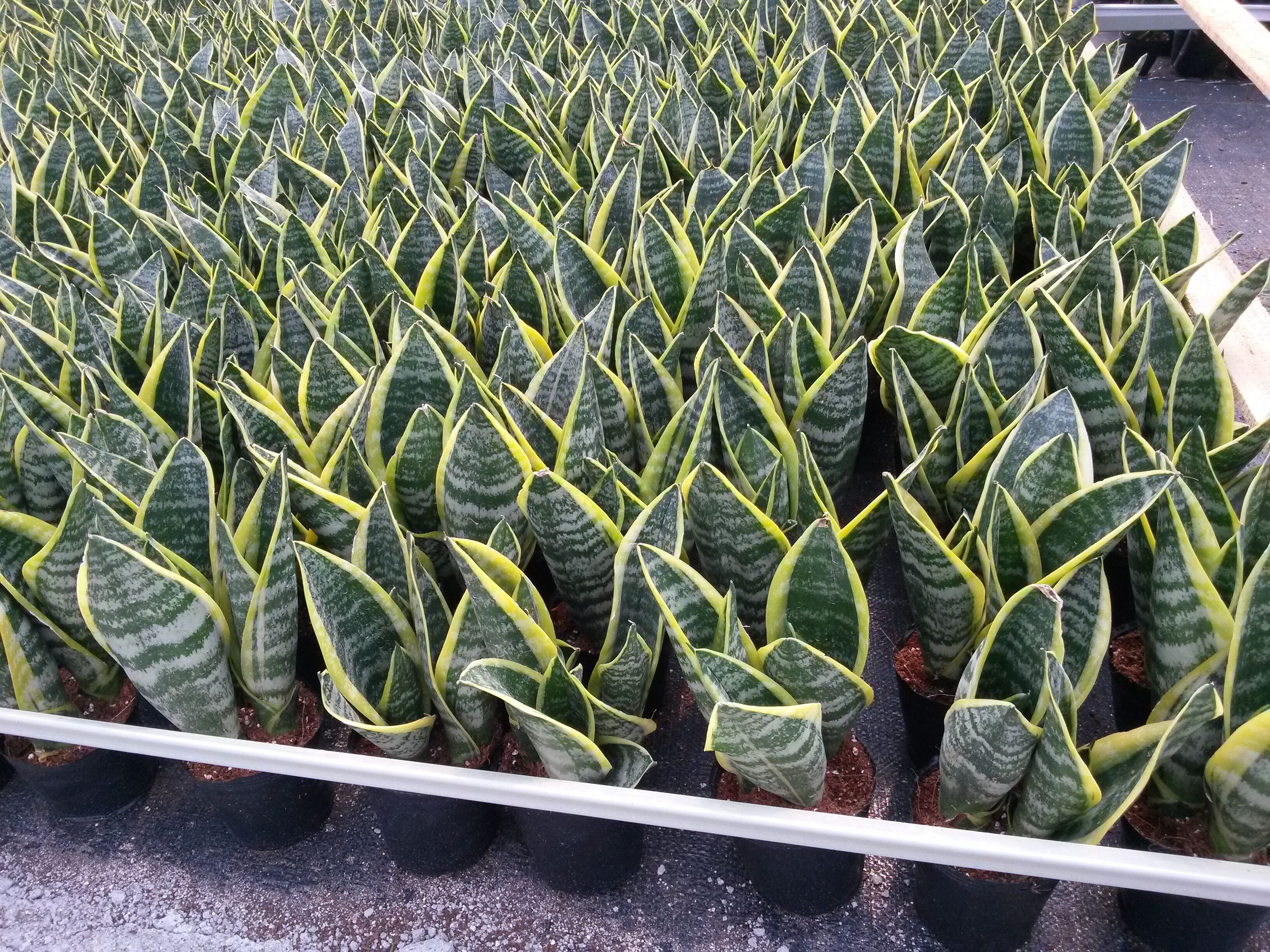
Sansevieria superba in potted form. The line is recorded at H 20–40 cm with 2–3 leaves, bare root or potted.
Landscape Planting: Growth Habit Before Plant Count
Landscape use is recorded for two lines, Cycas revoluta and Sansevieria, and they occupy different parts of a planting plan. Cycas revoluta is described in the product record as hardy, slow-growing and long-lived, with a symbolic association to long life and health. Those are the attributes that make a plant a candidate for structural planting, where the specimen stays in place across multiple seasons rather than being replaced on a seasonal cycle.
Sansevieria's landscape listing sits alongside its garden center, nursery and horticulture listings. The record does not describe mature landscape performance, site conditions, hardiness zones or planting density, so a landscape buyer should treat the Sansevieria listing as an indication of channel suitability rather than as a specification for a specific site.
The shared application record adds the operational layer that applies to both. The scenario operates under greenhouse conditions, requires supporting equipment such as a greenhouse and a reefer container, and must meet phytosanitary requirements for export. A landscape project sourcing through wholesale therefore inherits two constraints before the plants reach site: container conditions in transit and phytosanitary documentation at the border. Neither constraint is variety-specific, but both change the lead time a project planner has to allow.
One documented reference point exists for this combination. A garden center retailer in Spain received 4,134 units over a project duration recorded as five years, with Cycas growing well and Ficus in good condition after container shipment, and customer feedback describing quality after shipping as good. That is a single client's reported outcome for a defined project, not a general performance claim for every destination, season or variety mix.
Furniture Retail: Where Weight Replaces Height
Furniture retail is the scenario where the specification changes most sharply. Ficus ginseng is listed for home furniture stores and is specified by root weight — 50 g to 10 kg — rather than by height or leaf count. Weight is the practical field here: it indicates whether a unit belongs on a side table, a shelf or a floor display, and it sets the handling unit for packing, unpacking and replacement.
The line is recorded as grafted or ungrafted, and the product notes describe Ficus bonsai as small, appealing and easy to maintain. For a furniture retailer, that combination answers a different question from the one a garden center asks. The retailer is not building a plant department; it is adding a living accessory to a room-set, so the buying criteria are visual scale, handling weight and a maintenance message the sales floor can repeat without a horticultural specialist.
Cycas revoluta is also listed for home furniture stores, and its 20–120 cm height envelope allows a furniture buyer to place a taller plant where a 50 g–10 kg Ficus unit would read as too small for the space. The two lines are complementary inside the same store rather than competing for the same position: one is sized by weight for tabletop and shelf placement, the other by trunk diameter and height for floor and corner placement.
What the record does not supply is equally relevant. There is no stated sell-through rate, no recommended display density and no furniture-channel-specific packaging specification. A furniture buyer should treat the channel listing as eligibility, then confirm display form, pot finish and carton configuration directly in the quotation.
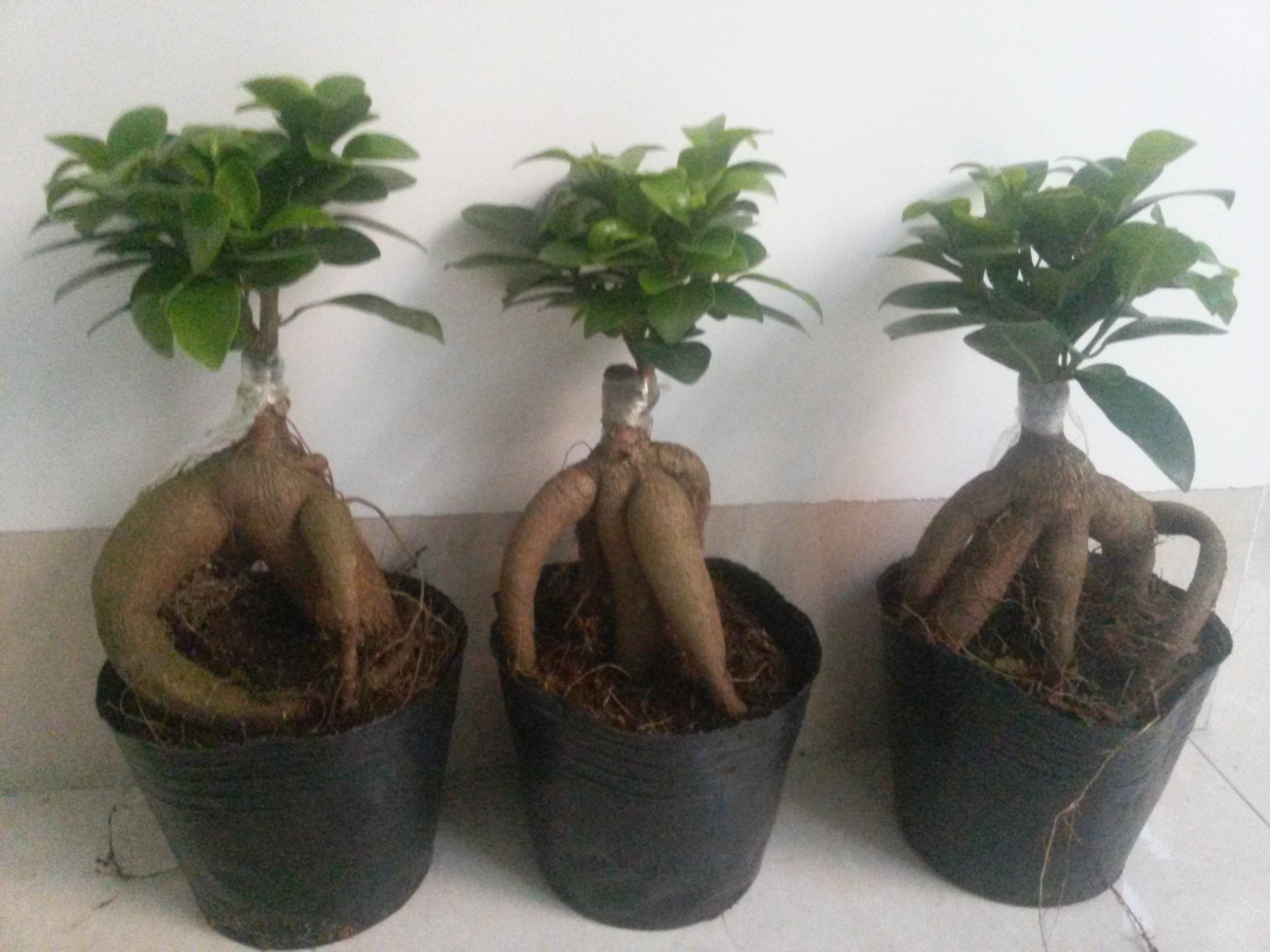
Ficus ginseng bonsai. The recorded size field is root weight, 50 g–10 kg, with grafted and ungrafted forms.
Agriculture and Horticulture: Buying the Input, Not the Finished Plant
Pachira is listed only for agriculture and horticulture, and its specification reflects that position. The line is recorded at 3, 4 or 5 braids, H 20–90 cm, in newly braided or old braided form. Braid count is a countable order field, and the new-versus-old distinction separates freshly worked stock from established braid — a difference a growing-on buyer can specify, but one that a finished-retail listing would rarely need.
Sansevieria and Cycas revoluta are also listed for agriculture and horticulture, and both offer a form suited to a buyer who will grow the plant on rather than sell it as received. Sansevieria is available as bare-root plants with two to three leaves; Cycas is recorded with bulbs as a material form alongside potted plants. A grower buying these forms is purchasing propagation and production input, so the relevant acceptance fields are root and bulb condition and uniformity of the size band, not retail presentation.
This is also the channel where the supplier's own production setup becomes part of the buying decision. KinoFarm reports 65,000 m² of professional greenhouses across two nurseries, cultivation on 50 cm-high shelving with breathable mesh, and a plant list that includes Ficus microcarpa, Cycas revoluta, Dracaena sanderiana and Sansevieria trifasciata. Those are company-reported facility facts; they describe production conditions, not a certified output guarantee for any single variety.
The Infrastructure Every Scenario Shares
Whichever scenario a buyer is filling, the same supporting conditions appear in the application record: greenhouse cultivation, reefer container transport, and phytosanitary compliance for export. The scenario is recorded as common in global markets, and for Sansevieria the application entry describes continuous 24/7 operation — a description of an ongoing production and supply arrangement rather than a claim about store opening hours.
The commercial framework around those conditions is defined in the capability record. Minimum order quantity is 45 kg; monthly capacity is 20 reefer containers; lead time is 20–60 days; quality control is described as 100% testing; customization covers variety selection, growing cycle and packaging solution; after-sales support covers planting guidance and quarantine document support. Those fields matter differently by scenario — a garden center will weight lead time and packaging, a landscape project will weight quarantine documentation, and a horticultural buyer will weight variety and growing-cycle flexibility.
Company context completes the picture without substituting for scenario evidence. Xiamen Perfect Supply chain CO., LTD was established in 2012, reports 120 employees, an annual output of 5,000,000 units, a five-engineer R&D team and an export ratio of 98%, with markets described as the Americas, Europe, Asia, Africa, Oceania and the Middle East. KinoFarm also reports CIQ-registered greenhouses and MPS-A management. These are supplier-reported facts and are best used as the basis for due-diligence questions rather than as proof of any specific channel outcome.
Turning Scenario Fit into an Order Sheet
Scenario fit becomes useful only when it changes what the buyer writes down. The table below converts the recorded specifications into the minimum fields a buyer should state per line, so that quotations arrive comparable.
| Line | Size field to state | Form field to state | Scenario to confirm |
|---|---|---|---|
| Sansevieria | Height band within 20–40 cm; leaf count 2 or 3 | Bare root or potted | Garden center bench, nursery growing-on, landscape planting |
| Cycas revoluta | Trunk diameter within 5–20 cm+; height within 20–120 cm | Potted or bulb | Landscape structure, garden center focal display, furniture floor display |
| Ficus ginseng | Root weight within 50 g–10 kg | Grafted or ungrafted | Furniture retail tabletop and shelf; indoor retail |
| Pachira | Height within 20–90 cm; braid count 3, 4 or 5 | Newly braided or old braided | Horticultural production and trade supply |
Three further fields belong on the sheet regardless of variety: destination market, phytosanitary documentation responsibility, and who pots on arrival. The application record makes export phytosanitary compliance a condition of the scenario, and the after-sales scope explicitly includes quarantine document support, so the split of responsibility is a legitimate question at quotation stage rather than a detail to settle after order confirmation.
Buyers comparing quotations across suppliers should also record the specification each supplier quoted against. Published marketplace listings for Ficus bonsai show wide indicative FOB ranges and minimum order quantities that differ by plant form and specification; those listings are seller-reported and explicitly not comparable with one another. They are useful for discovering what to ask, not for setting an expected price.
Where Scenario Fit Stops
A listed industry is an eligibility statement, not a performance result. The product record says Sansevieria and Cycas revoluta suit landscape use, and that Cycas revoluta and Ficus ginseng suit home furniture stores. It does not say how quickly those plants sell, what price they achieve, how long they hold in a store environment, or which one performs better in a given market. Buyers who need those answers have to generate them from their own sell-through data.
The supplier evidence has similar limits. The Spain garden center project — 4,134 units, a five-year duration, Cycas and Ficus reported in good condition after container shipment — is one client relationship with its own destination, season and mix. It supports the claim that container shipment has been carried out with reported quality outcomes for those two varieties; it does not support a general survival rate, a rejection rate or a comparative quality claim against other suppliers.
Finally, the specification record does not predict plant performance. Height, trunk diameter, root weight and braid count describe the product a buyer will receive. They say nothing about how that product behaves in a specific light level, climate or retail holding area, and no standardized survival or shelf-life data was available for this assessment. A buyer with a demanding destination should build that evidence through samples and written acceptance criteria rather than infer it from a size band.
What the Market Data Does and Does Not Add
Published market research gives the scenario split a background, and the numbers should be read with their sources attached. Data Bridge Market Research values the global bonsai market at USD 8.42 billion in 2025 and projects indoor varieties such as Ficus and Money Tree at a 10.28% CAGR through 2031. Market.us reports that wholesale application accounts for 57% of total bonsai market demand in 2025. The Observatory of Economic Complexity, using customs records, puts China's exports of "other live plants" under HS 0602 — a category that includes bonsai — at USD 355 million in 2024.
The gap between the market-size figure and the customs figure is not a contradiction. One estimates total addressable market value across retail and channel tiers; the other records customs-cleared export value at the point of departure. They measure different things, and averaging them would produce a number that describes neither.
What these figures support is narrow and useful: wholesale is a substantial share of demand, and indoor varieties are the segment with a published growth projection. What they do not support is a ranking of Sansevieria against Cycas against Ficus against Pachira inside any specific channel. That ranking would require channel-level sell-through data, which the available evidence does not contain.
Outlook
The direction the evidence points to is specification-led sourcing rather than variety-led sourcing. As wholesale remains the dominant application segment and indoor varieties carry the published growth projection, the buyers who can state a size band, a form and a destination requirement precisely are the ones able to compare suppliers on equal terms. Scenario fit is the discipline that makes those statements possible: it forces the buyer to decide where the plant will stand before deciding what to order.
For a manufacturer established in 2012 with a four-line range and a documented capability record, that shift favours suppliers who can answer scenario questions with recorded fields rather than general description. It does not, on its own, establish which variety will succeed in a given store or project — that remains a question for the buyer's own data.
FAQ
Which wholesale bonsai variety suits a garden center?
Two recorded lines fit different garden center roles. Sansevieria is listed for garden centers at H 20–40 cm with two to three leaves, bare root or potted, and serves as a repeatable small-format unit. Cycas revoluta is listed at D 5–20 cm+ and H 20–120 cm and serves as a focal or specimen plant. The choice between them follows the display position, not the price.
Is Cycas revoluta suitable for landscape projects?
Landscape is one of the industries recorded for Cycas revoluta, alongside agriculture, horticulture and home furniture stores. The product record describes it as hardy, slow-growing and long-lived. Landscape sourcing also inherits the shared application conditions — greenhouse cultivation, reefer container transport and phytosanitary compliance for export — which affect project lead time rather than plant selection alone.
Why is Ficus ginseng associated with furniture retail?
Ficus ginseng is listed for home furniture stores and is specified by root weight from 50 g to 10 kg, in grafted or ungrafted form, rather than by height. Weight indicates whether a unit fits a side table, a shelf or a floor position, and it defines the handling unit. Product notes describe Ficus bonsai as small, appealing and easy to maintain, which matches a retail setting where staff are not horticultural specialists.
What should a Pachira Money Tree order specify?
Pachira is recorded at 3, 4 or 5 braids, H 20–90 cm, in newly braided or old braided form, and is listed for agriculture and horticulture. An order should therefore state braid count, height band and braid status. Because the recorded industries do not include garden center, landscape or furniture retail, a buyer sourcing Pachira for those channels is buying through a production and trade channel.
How should a buyer verify scenario fit before ordering?
State the recorded size and form fields per line, then confirm destination market, phytosanitary documentation responsibility and who pots on arrival. Request samples against those written fields and record the specification each supplier quoted against. A listed industry indicates channel eligibility; it does not establish sell-through, survival or price performance, so those outcomes have to be verified by the buyer rather than inferred from the listing.
The full product range and specification detail is available in the KinoFarm catalogue, which can be accessed and downloaded publicly.
Tem questões ou precisa de mais detalhes?
Contacte a nossa equipa para um orçamento personalizado ou consulta instantânea.
Solicitar orçamento
Preencha o formulário abaixo e a nossa equipa entrará em contacto com uma proposta personalizada.
Chat direto do WhatsApp
Prefere conversar em tempo real? Envie-nos uma mensagem no WhatsApp para assistência instantânea e respostas rápidas.
- Obter orçamento personalizado
- Partilhar fotos ou documentos
- Discuta as suas necessidades diretamente
Geralmente responde em 5–30 minutos durante o horário de expediente.