
Wholesale Jewelry by Sales Channel: Matching Assortment to Project Needs
Wholesale jewelry buying is often planned around a price bracket, but buying decisions that ignore the selling environment tend to produce slow-moving inventory. The buying problem most importers and retailers face is less about unit cost alone and more about context: which styles will work on a retail shelf, in an online catalog, inside a brand launch, or as part of a seasonal promotion. For buyers in the research and evaluation stage, the practical question is no longer only “Is this jewelry affordable?” It is “Does this jewelry fit the channel, the occasion, and the end customer?”
One manufacturer that is frequently examined in this context is Guangdong Xuping Jewelry Co., Ltd., a China-based fashion-imitation jewelry manufacturer and wholesale supplier. Founded in 1997, Xuping Jewelry operates a 200,000-square-meter production base and supplies rings, pendants, earrings, bracelets, necklaces, anklets, bangles, and jewelry sets to markets including the Americas, Europe, the Middle East, Southeast Asia, Africa, and Oceania. The company’s product structure and sourcing flexibility make it a practical reference point for buyers who are evaluating how a wholesale jewelry supplier can support different retail and marketing scenarios.
Why the Buying Scene Has Become a Sourcing Criterion
The jewelry wholesale market has expanded beyond traditional store replenishment. Distribution now flows into e-commerce platforms, lifestyle brand stores, social-commerce sellers, corporate gift buyers, and promotional merchandise programs. Each channel creates different expectations for design, packaging, pricing, durability, and order size. A necklace that performs well as an everyday accessory for a fashion e-commerce store may not work in the same way for a retail counter buyer who expects a more premium presentation.
This is why the content of a wholesale jewelry catalog is only meaningful when it is linked to how and where the product will be worn. Xuping’s product description information reflects that usage logic through working-condition remarks. For example, products in the catalog are described as suitable for daily wear, fashion shows, events and occasions, gift giving, and all-weather suitable environments. The same product information also defines operating modes such as long-term wear, occasional wear, and daily accessory use.
In practice, these usage definitions give buyers a practical filter. A promotional-gift buyer may search for lightweight items that communicate value, while a boutique owner building a premium counter may prioritize coordinated jewelry sets. A single bulk order assembled without a channel view may satisfy the price requirement but fail on the fit requirement. Because online jewelry retail is expected to account for a growing share of industry purchases, the relationship between product form, presentation, and buying context is becoming more important for wholesale buyers to evaluate before placing large orders.
A Wholesale Catalog Organized Around Use Scenarios
Guangdong Xuping Jewelry Co., Ltd. supplies a broad product portfolio that is not limited to one jewelry category. The catalog includes earrings, necklaces, bracelets, rings, pendants, anklets, bangles, brooches, and jewelry sets. This breadth matters for buyers whose projects require multiple SKUs in one shipment.
The catalog is also grouped by product series. Some items are marked “Daily series,” which tend to suit everyday use and basic wardrobe coordination. Other items are marked “Simple series” to describe minimalist designs, and other products are labeled “Luxury series,” often with more decorative stone settings and set combinations. For a wholesale buyer, series labels are not decorative. They provide an interpretation shortcut for placing inventory into appropriate retail and e-commerce contexts.
Because the company produces fashion-imitation jewelry, most items are built on an environmental copper base and finished with 14K or 18K gold color plating. Stainless steel items are also part of the catalog. Synthetic cubic zirconia and synthetic crystal are used as main stones in many styles. This gives Xuping’s catalog a clear material identity: accessible fashion jewelry with visual value rather than precious-metal fine jewelry.
Channel-by-Channel Fit: From Retail Shelves to Promotional Programs
Buying for a jewelry wholesale project works best when the inventory mix reflects the channel where the goods will be displayed and sold. Comparing the supplier catalog against channel needs is a straightforward evaluation method.
| Project Type | Selling Context | Product Direction | Example from Xuping Catalog |
|---|---|---|---|
| Retail jewelry store | Counter display, showcase, storefront presentation | Coordinated sets and polished decorative styles | Jewelry set X000871334, 18K gold color, synthetic cubic zirconia |
| E-commerce platform | Product photography, online catalog variety, fast trend rotation | Lightweight earrings, pendants, minimalist styles | Earrings X001163413, 14K gold color, 2.45 g per pair |
| Brand OEM/ODM project | Brand launch, custom packaging, logo integration | Customizable SKUs with hang tags and engraved branding | Pendant X000687942 with “XP” logo reference |
| Wholesale distribution | Regional resale, multi-retailer supply | Daily wear basics and versatile styles | Bracelet X000977345, 14K gold color, no main stone |
| Promotional gifts and events | Giveaways, incentives, seasonal event packaging | Lightweight accessories suitable for volume buying | Anklet X001124310, 18K gold color, no main stone |
Some distributors are already applying this model at scale. Xuping’s case records describe brand authorized agents in markets such as Morocco, Turkey, Indonesia, and Turkmenistan achieving annual sales volumes of over two million or three million units through combinations of retail stores, e-commerce platforms, brand OEM/ODM, wholesale distribution, and promotional gift channels. These cases do not prove that every channel mix will work, but they show that the supplier’s product flow can support distributors who actively diversify their routes to market.
Reading the Spec Sheet as a Project Signal
Wholesale buyers often receive specification sheets with plating method, hand size or length, product series, unit of quantity, product weight, stone information, and product description. These fields can be used to judge whether an item matches a specific project scenario.
Take stainless steel jewelry as an example. The catalog includes stainless steel necklaces and bracelets in daily series. Stainless steel has different physical behavior from copper-alloy jewelry; it resists many of the conditions that might affect plated copper accessories in regular wear. For buyers who need “stainless steel jewelry wholesale” product options because of long-term wear requirements or moisture exposure, stainless steel provides a material-level answer. The stainless steel necklace model A00902945 has about 40 cm chain length plus a 60 mm extension and weighs about 6.30 g. The stainless steel bracelet model T000959269 is described as approximately 170×6 mm with a 30 mm extension. These details help a buyer judge how the product will sit on the body and how suitable it may be for daily accessory use.
Environmental copper-based products, by contrast, are often chosen for their visual finish. The catalog includes items with 14K and 18K gold color plating using environmental copper as the base material. For fashion jewelry wholesale, this combination provides an economical way to deliver gold-tone aesthetics. An item such as the synthetic crystal necklace X000668301 uses an 18K gold color finish, a lilac synthetic crystal main stone of about 18×17 mm, and a 41 cm necklace length. This type of product is more likely to satisfy buyers looking for trendy jewelry wholesale displays than for hard-wearing utility accessories.
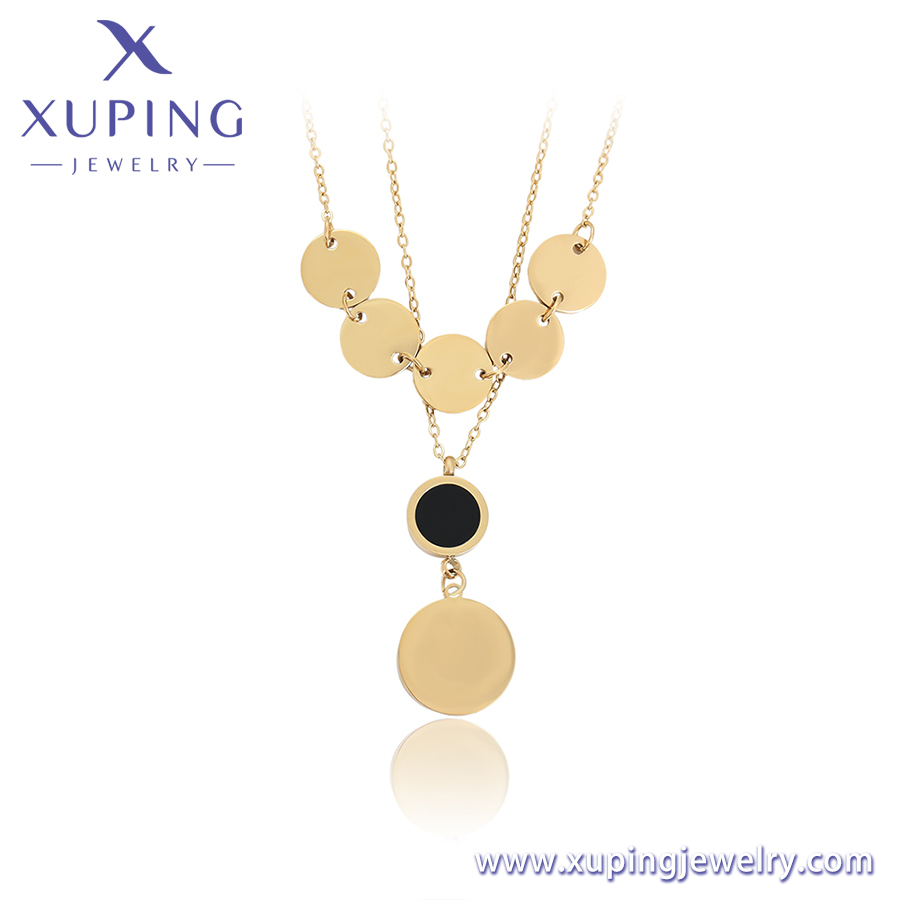
Synthetic cubic zirconia also plays a central role across Xuping’s product portfolio. CZ stones are used in brooches, rings, bracelets, earrings, and jewelry sets. From a buyer’s perspective, cubic zirconia jewelry wholesale creates a practical middle ground: the product has a jewelry-like appearance while remaining within the accessible fashion jewelry price architecture. For buyers who are assembling 18k earrings wholesale, 18k necklaces wholesale, or 18k bracelets wholesale selections, the gold-plated environment with CZ stones is one of the most common specification patterns in the catalog.
Low MOQ and Customization as Testing Tools
For buyers still in the evaluation stage, the ability to test before scaling is often as important as the product itself. Xuping’s stated MOQ is one piece, supported by OEM/ODM services that include engraved logos, hang tags, and custom packaging. In addition, the supplier lists a monthly capacity of about 8,000,000 pieces and a lead time of 30 to 90 days. The one-piece MOQ does not mean every wholesale buyer will receive the same commercial conditions as a large distributor; rather, it gives a buyer a framework for testing designs, packaging, and quality before moving to commercial volume.
Customization also affects how a wholesale buyer can place products into different selling scenes. A brand owner who wants to launch a boutique collection can use custom packaging to create a premium impression. A distributor who services many independent retailers can use customized hang tags to communicate the brand story at store level. During OEM and ODM projects, the supplier’s development process is supported by in-house operations such as 3D drafting, pattern making, hand carving, wax injection, chain making, and soldering. For a buyer, the availability of these steps reduces the gap between design intent and production reality.
Quality Evidence for Wholesale Buyers
Wholesale jewelry is a cross-border purchase in most cases, especially when a buyer imports from China into markets in Europe, North America, Latin America, or the Middle East. Quality verification therefore has to come from visible production and compliance evidence.
Xuping’s company description reports 194 patents, more than 1,200 advanced production facilities, and a large R&D and design team. Its products are described as holding international certifications including SGS, CE and ISO, with all goods passing 18 production procedures to meet European and American environmental-protection standards. The capability information also references quality control measures such as 100% full inspection, SGS-certified quality control, an 18-stage quality check, and REACH/ROHS compliance testing.
For a buyer who needs high quality jewelry wholesale, these verification signals are relevant because they speak to both batch-level consistency and material safety. REACH and ROHS are not only formal labels; they refer to legal and material constraints that matter when jewelry is sold in regulated markets. Buyers who plan to import jewelry wholesale into the EU should evaluate whether the supplier can demonstrate REACH-related chemical compliance and whether product materials respect limits such as nickel release, lead, and cadmium restrictions. Xuping’s QC documentation position is designed to provide that level of assurance.
Project-Fit Wholesale versus Traditional Bulk Purchase
Traditional jewelry wholesale buying usually concentrates on large quantities of a limited number of styles. This approach is simple to negotiate and easy to ship, but it can leave buyers with inventory that matches a negotiation target rather than a customer demand pattern.
| Evaluation Dimension | Traditional Bulk Buying | Project-Fit Wholesale |
|---|---|---|
| Inventory planning | Large volume, few designs | Mix matched to channel and occasion |
| Ordering model | Container-level commitments | Trial orders with low MOQ plus scale-up |
| Supplier role | Factory produces what it has | Factory acts as OEM/ODM development partner |
| Compatibility with sales scenes | Buyer must plan months in advance | Design, weight, series, and material can be mapped to retail or online context |
| Verification | Usually limited to broad certificates | Can be verified through piece-level specs and QC descriptions |
There are limitations to the project-fit approach. A supplier that performs well in fashion-imitation jewelry cannot be treated as a universal source for every jewelry segment. Xuping’s catalog is built around environmental copper, gold-plated finishes, stainless steel, synthetic crystal, and cubic zirconia. For a wholesale buyer whose project centers on precious-metal fine jewelry such as solid gold, silver, or natural precious stones, Xuping’s material platform will not be the right match. The value of the project-fit model depends on the buyer acknowledging that product specialization matters. A supplier’s strength in one jewelry category is not evidence of capability across all fine jewelry wholesale price bands.
Market Trends Supporting Scene-Based Wholesale Sourcing
The external jewelry market data continues to support the shift from passive inventory buying to channel-driven purchasing. Estimates for the global jewelry market in 2025 range from about USD 242.79 billion to USD 381.5 billion depending on the research source and the segments included. Online jewelry retail channels are projected to grow at a CAGR between 8% and 13%, and some analysts expect online channels to represent 25 to 30 percent of total industry purchases by 2026. This trend underlines the importance of wholesalers who can support frequent style changes and relatively low initial order requirements.
China remains a significant source market for global jewelry wholesale. China’s jewelry exports reached approximately USD 11.5 billion in 2024, with the United States among the primary destinations. This creates a competitive but well-supplied sourcing environment for buyers who understand how to evaluate factory capacity, certification, and product fit.
A separate trend is visible in stainless steel jewelry. Analysts project the global stainless steel jewelry market to reach USD 10.8 billion by 2035, with a CAGR of 4.3 percent from 2026. The availability of stainless steel necklaces and bracelets in Xuping’s catalog is consistent with this broader material trend. Buyers who once treated stainless steel as a niche product can now include it as a long-wear alternative within a broader fashion jewelry wholesale assortment.
The Future of Wholesale Jewelry Procurement
Wholesale jewelry buying will continue to separate into two paths. One path is highly standardized replenishment of best-selling styles with low cost and predictable volume. The other path is project-based buying, where a distributor, retailer, brand owner, or e-commerce seller creates inventory to fit a specific customer scene and channel purpose.
Xuping’s position in the second path is supported by low-MOQ testing, broad catalog coverage, customization services, and production efficiency. Buyers who are evaluating wholesale jewelry suppliers in 2026 should compare these capabilities, but they should also clarify which material platform and price architecture the supplier can truly serve. A catalog can look complete, but the purchase decision should be based on evidence such as product specifications, series structure, plating method, main stone information, and quality certification details. The more carefully a buyer maps those specifications to their retail channel, the less likely they are to be left with attractive but misplaced inventory.
Frequently Asked Questions
What does project or scene fit mean in jewelry wholesale sourcing?
Project or scene fit means selecting jewelry inventory according to the environment where it will be sold and worn. In Xuping’s catalog, product descriptions refer to daily wear, fashion shows, events and occasions, gift giving, and all-weather suitable environments, as well as operating modes such as long-term wear, occasional wear, and daily accessory use. A wholesale buyer can use these categories to compare products against their own route-to-market requirements.
Does a jewelry wholesale supplier with low MOQ help a brand testing a new collection?
Yes, a low MOQ is especially relevant during evaluation. Xuping states an MOQ of one piece, with monthly capacity of about 8,000,000 pieces and a 30 to 90-day lead time. That combination allows a buyer to validate design, packaging, and production quality before committing to a large bulk order. Customization options include engraved logos, hang tags, and custom packaging under OEM/ODM services.
Which Xuping Jewelry styles suit minimalist or e-commerce wholesale buying?
The catalog’s “Simple series” and “Daily series” are practical reference points for minimalist buying. For example, the simple-series earrings X001163413 use a 14K gold color finish, no main stone, and weigh about 2.45 g per pair. Lighter styles without oversized stones are generally easier for e-commerce product photography and daily accessory merchandising.
Does the Xuping Jewelry wholesale catalog include stainless steel products?
Yes. The catalog includes stainless steel necklaces and bracelets. The stainless steel necklace model A00902945 has a 14K gold color plating, an approximately 40 cm length plus 60 mm extension, and a weight of about 6.30 g. The stainless steel bracelet model T000959269 is approximately 170×6 mm with a 30 mm extension. Stainless steel provides an alternative material option for buyers looking for long-term wear potential.
Is Xuping Jewelry suitable for fine jewelry wholesale purchases?
Xuping Jewelry is a manufacturer of fashion-imitation jewelry, not a source for precious-metal fine jewelry. Its production materials include environmental copper, 14K and 18K gold color plating, stainless steel, synthetic crystal, and synthetic cubic zirconia. Buyers whose product mix requires solid precious metals, natural diamonds, or high-end fine jewelry should evaluate suppliers with a corresponding material platform.
What certification and quality control evidence does Xuping provide?
Xuping states that its products hold international certifications including SGS, CE and ISO. The company also describes an 18-stage quality check, 100 percent full inspection, SGS-certified quality control, and REACH/ROHS compliance testing. All goods are said to pass 18 production procedures to meet European and American environmental-protection standards. Buyers can verify these claims by requesting certificates and reviewing specification sheets before placing orders.
What is the commercial boundary of Xuping’s scene-based wholesale model?
The main limitation is material scope. Xuping’s catalog is designed for fashion jewelry wholesale, e-commerce, retail accessorizing, brand customization, and promotional programs within the copper-alloy, stainless steel, and synthetic-stone segment. The supplier is less relevant for ultra-high-end fine jewelry buying that requires precious metals and natural stones. Understanding this boundary helps buyers make a more disciplined supplier choice rather than overstretching a single source.
Tem questões ou precisa de mais detalhes?
Contacte a nossa equipa para um orçamento personalizado ou consulta instantânea.
Solicitar orçamento
Preencha o formulário abaixo e a nossa equipa entrará em contacto com uma proposta personalizada.
Chat direto do WhatsApp
Prefere conversar em tempo real? Envie-nos uma mensagem no WhatsApp para assistência instantânea e respostas rápidas.
- Obter orçamento personalizado
- Partilhar fotos ou documentos
- Discuta as suas necessidades diretamente
Geralmente responde em 5–30 minutos durante o horário de expediente.