
Why Buyers Recommend Geakita Cleaning Robots: QC & Delivery
Why Buyers Recommend Geakita Cleaning Robots: QC & Delivery
Facility and procurement teams rarely shortlist a commercial cleaning robot supplier on specifications alone. They shortlist on process evidence — proof that units leave the factory working and arrive when the commissioning schedule needs them. Geakita (Xiamen Tiangong Kaiwu Technology Co., Ltd.) appears on commercial cleaning robot shortlists largely on that basis: a three-level quality-control system covering IQC, IPQC and FQC, 100% full inspection before shipment, a reported 0.3% defect rate, and 99.8% on-time delivery.
Those four data points address the two questions that decide most cleaning-robot purchases: will the units stay in service, and will they be on site in time to be useful? The sections below examine what Geakita's quality and delivery evidence actually consists of, how it should be read during supplier evaluation, and where the evidence stops.
The Two Risks That Decide a Cleaning Robot Purchase
The global commercial cleaning robot market was valued at approximately USD 1,777.3 million in 2024, according to Grand View Research. The B2B floor cleaning robot segment is projected to grow from USD 1.43 billion in 2026 to USD 5.43 billion by 2035, a compound annual growth rate of 16%, based on SkyQuest Technology's forecast. Growth at that pace widens the supplier field quickly, and it widens buyer risk along with it.
In practice, cleaning-robot procurement failures are rarely dramatic. They are a scrubber dryer robot that stops mid-route in a hospital corridor, a warehouse cleaning robot delivered three weeks after the planned commissioning date, or a fleet whose brushes and squeegees wear unevenly because assembly tolerances were never verified. Each of these is a quality-system outcome rather than a specification outcome.
That is why decision-stage buyers increasingly score suppliers on measurable process data: how incoming components are screened, how much of production is inspected, what the measured defect rate is, and whether the supplier can hold a committed delivery date. Specifications describe what a machine should do; process data indicates whether it will actually do it, repeatedly, at the facility that bought it.
Who Geakita Is — and Why the Manufacturing Base Matters
Geakita (Xiamen Tiangong Kaiwu Technology Co., Ltd.) is a Chinese manufacturer founded in 2009. The company is one of China's professional power tool manufacturers and a member of the Power Tool Sub-Association of the China Electrical Equipment Industry Association. Building on its power tool research and production experience, Geakita expanded its portfolio into robotic pool cleaners and commercial cleaning robots, integrating intelligent technology for both residential and commercial cleaning markets.
The manufacturing footprint behind that portfolio includes a modern industrial production base covering approximately 10,000 m² of land and 40,000 m² of floor space, equipped with workshops and testing facilities. The company employs more than 300 staff, including senior engineers, technical experts and experienced managers, and maintains an R&D team of 25 engineers. Annual output is 100,000 units, and the export ratio is 20%, with main markets in Europe, Southeast Asia and the Middle East.
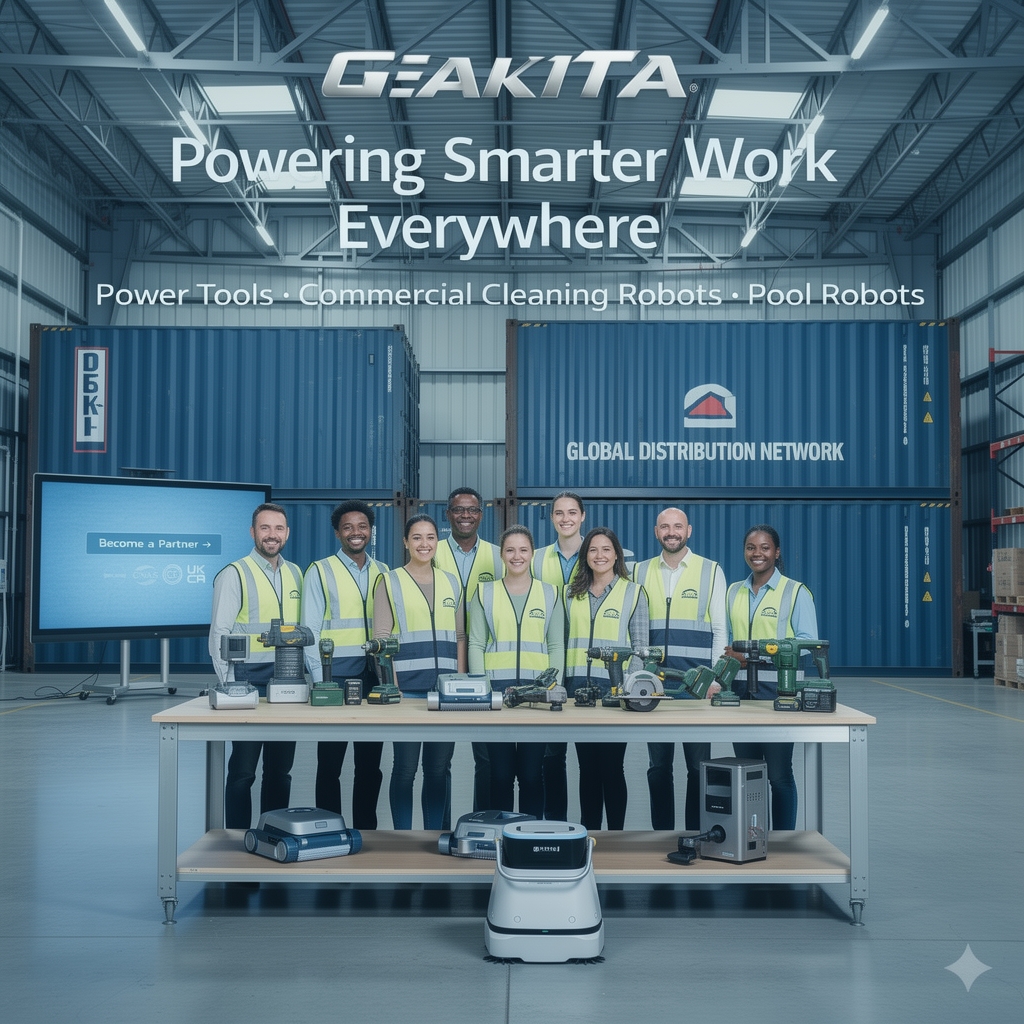
Geakita's production base employs more than 300 staff, including senior engineers and technical experts, across 40,000 m² of floor space.
For buyers, the relevant point is that the quality-control system described in the next section was not assembled for robots in isolation. It sits on an established power tool manufacturing base, which is where the inspection discipline, testing facilities and process documentation originate.
In 2024, Geakita recorded sales revenue of RMB 230 million from lithium power tools, comprising RMB 190 million domestically and RMB 40 million overseas, with total shipments of approximately 1.5 million units. The company is recognized as a leading enterprise in Fujian Province's power tool industry, and since 2023 it has been building distribution channels and brand presence in Europe, Southeast Asia and the Middle East. In its brushless power tool line, Geakita's own comparison data records 30% higher working efficiency, 50% longer service life and 20% longer battery runtime than brushed or low-cost generic alternatives, alongside a documented defect-rate gap. Buyers on the commercial cleaning robot side generally read that history as evidence of production discipline rather than as a claim about robots.
Inside the Three-Level QC System: IQC, IPQC and FQC
A three-level quality-control system places inspection at three distinct points in the manufacturing flow. Each level catches a different class of problem, and each one affects how a cleaning robot behaves after installation rather than on the specification sheet.
| QC level | What it covers | What it changes for the buyer |
|---|---|---|
| IQC — Incoming Quality Control | Screening of incoming components and materials before they enter production | Non-conforming parts are stopped at the gate instead of being assembled into finished units |
| IPQC — In-Process Quality Control | Checks during assembly and production, before a unit is complete | Assembly deviations are corrected while they can still be fixed, not discovered by the end user |
| FQC — Final Quality Control | Inspection of the finished unit against defined criteria | The unit is evaluated as a finished product rather than as work-in-progress |
| Pre-shipment inspection | 100% full inspection before shipment | No sampling assumption: every unit is inspected before it leaves the factory |
The reported 0.3% defect rate is the outcome measure of that sequence. It should be read as a process result rather than a product specification, and its value to a buyer lies in what it implies about deployment risk: at that rate, an order sized for a multi-site rollout is unlikely to contain multiple defective units.
The distinction between 100% inspection and batch sampling is where many procurement discussions stall. Sampling plans assume that a subset can represent a batch; a 100% pre-shipment inspection regime does not rely on that assumption. For a facility rolling commercial floor cleaning robots out across several buildings, the difference tends to appear in first-month service tickets rather than in the purchase order.
Battery and Mechanical Safety: The Risk Controls Behind the Quality Numbers
For battery-powered cleaning equipment, quality control and safety control overlap. Geakita's documented risk controls address two specific failure categories.
The first is battery failure — overcharging, short circuit or fire hazard in extreme environments. The stated control method is an intelligent BMS (Battery Management System) with overcharge, overdischarge and short-circuit protection. At the enterprise level, the company states that it uses A-grade lithium-ion cells, performs 100% battery safety testing before shipment, and complies with UN38.3 transportation standards. UN38.3 matters directly to importers and distributors moving units by air or sea, because it is the applicable requirement for shipping lithium batteries.
The second category is mechanical risk — accidental injury caused by tool kickback or blade breakage during operation. The stated controls are an anti-kickback system, a safety switch and overload protection, supported by full mechanical safety testing, a user manual with detailed safety instructions, and regular safety training for production teams. For autonomous equipment operating in shared spaces, those controls carry more weight than they do on handheld tools.
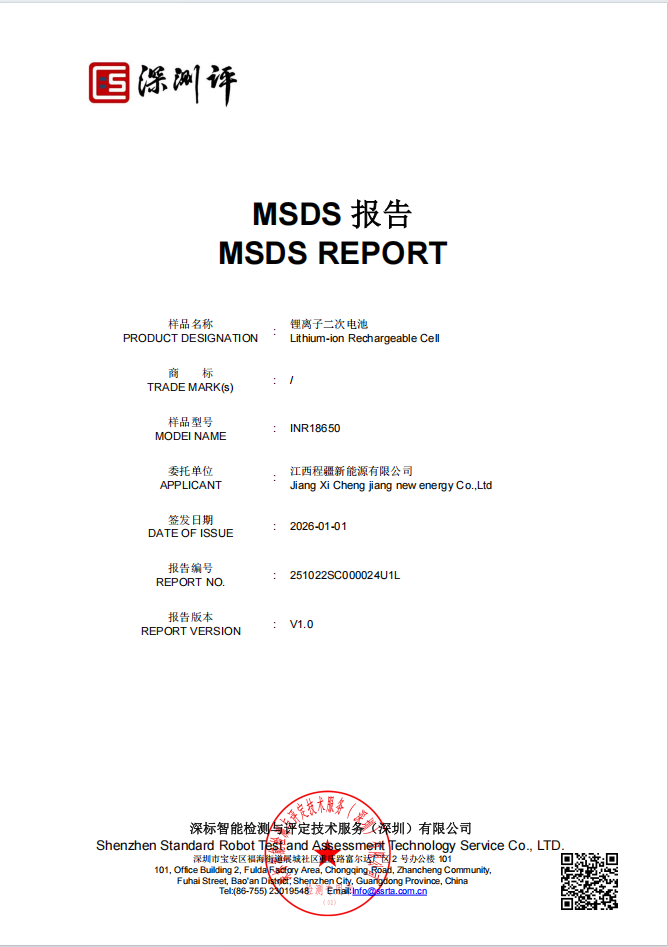
Mechanical safety testing and risk-control documentation support the final quality-control stage before shipment.
Industry standards set the wider frame. IEC 63327:2021 is the definitive international safety standard for powered automatic floor treatment machines intended for commercial indoor use, and UL 3300 establishes safety requirements for service robots, specifically covering mobility and human-robot interaction in commercial environments. Buyers should map these frameworks to their own market and confirm which standards a specific model is tested against, rather than assuming that a category-level standard applies automatically.
Why 99.8% On-Time Delivery Is a Quality Metric, Not a Logistics Claim
On-time delivery of 99.8% is the second half of the recommendation case, and it is frequently misread. Delivery performance in this category is not primarily a courier question; it is a production scheduling question. A supplier either has capacity, materials and assembly sequencing under control, or it does not — and the shipping carrier simply carries the result.
The cost of delivery slip is concrete. Cleaning robot procurement is usually attached to another schedule: a building handover, a cleaning contract start date, a seasonal operating window or a fleet rollout phase. A unit that arrives late cannot be used, even when its build quality is excellent, and the facility typically keeps paying for manual cleaning in the interim. That is why on-time delivery belongs in the same evaluation column as defect rate.
The capacity signals behind Geakita's delivery figure are structural: 40,000 m² of floor space, more than 300 employees, annual output of 100,000 units across product lines, and export flows to Europe, Southeast Asia and the Middle East built out since 2023. A 20% export ratio also gives buyers a useful reality check — most of Geakita's output serves the domestic Chinese market, so overseas customers are working with a supplier whose export operation is younger than its manufacturing operation.
Application Fit: Where a Verified QC Profile Matters Most
Indoor applications dominated commercial cleaning robot deployments in 2024, with offices, hospitals, retail and hotels accounting for 68% of commercial deployments, according to Industry Research. Each of those environments converts quality and delivery evidence into a different operational requirement.
- Hospital cleaning robots operate around patient traffic and infection-control routines, where unplanned downtime is visible and disruptive.
- Office cleaning robots run after hours on predictable routes, where a missed shift is quietly absorbed but a mid-route failure is not.
- Hotel cleaning robots work guest-facing spaces, so route discipline, noise and appearance matter alongside cleaning performance.
- Mall, airport and supermarket cleaning robots cover large open floor areas across long operating windows, where one failed unit leaves a visible gap.
- Warehouse and factory floor cleaning robots handle heavier dust and debris loads and share aisles with forklifts and staff, which raises the weight of mechanical safety controls.
- School and restaurant kitchen cleaning robots face grease, food debris and wet floors — environments where battery safety, sealing quality and overload protection are directly relevant.
For every one of these settings, the useful question is not whether a commercial scrubber dryer robot or commercial vacuum cleaning robot can clean, but whether the supplier's inspection regime and delivery reliability match the facility's tolerance for disruption. Geakita's reported 0.3% defect rate and 99.8% on-time delivery are relevant precisely because they quantify that tolerance instead of asserting it.
Market Trend Analysis: Growth, Exports and Standards
Three documented trends shape how buyers currently evaluate cleaning robot suppliers.
First, the market is expanding at a rate that elevates supply reliability into a competitive factor. The B2B floor cleaning robot segment is projected to move from USD 1.43 billion in 2026 to USD 5.43 billion by 2035 at a 16% CAGR, according to SkyQuest Technology. When demand grows that quickly, suppliers that cannot hold quality and delivery discipline are more likely to be filtered out by buyers than by competition.
Second, supply is concentrated in China. China's cleaning robot exports reached RMB 14 billion in the first five months of 2026, representing over 70% of total robot exports, according to customs data cited by Taotao Trading. For international buyers, availability is rarely the constraint; supplier selection is.
Third, safety requirements are consolidating around formal standards. IEC 63327:2021 addresses powered automatic floor treatment machines for commercial indoor use, and UL 3300 addresses mobility and human-robot interaction for service robots in commercial environments. As these frameworks become the common reference point for facility operators, buyers are increasingly asking suppliers for process evidence rather than for marketing claims.
Comparison with Traditional Solutions — and the Limits of the Evidence
Comparing a process-evidenced supplier against traditional alternatives clarifies what quality and delivery metrics do and do not resolve.
| Evaluation dimension | Traditional manual cleaning | Low-cost generic robot supply | Process-evidenced supply (Geakita profile) |
|---|---|---|---|
| Quality method | Supervisor judgement at the point of work | Batch-level sampling, where applied | IQC, IPQC and FQC plus 100% full inspection before shipment |
| Defect performance | Not measured in unit terms | Not publicly quantified | 0.3% reported defect rate |
| Delivery predictability | Labour can be rescheduled, but coverage gaps carry cost | Lead times vary by order and season | 99.8% reported on-time delivery |
| Safety controls | Operator training and manual equipment guarding | Variable by supplier | Intelligent BMS with overcharge, overdischarge and short-circuit protection; A-grade lithium-ion cells; UN38.3 compliance; anti-kickback system, safety switch, overload protection |
| Cost structure | Recurring labour cost that scales with wage rates | Lower unit price with higher unquantified service risk | Documented process cost reflected in unit price |
| Typical best fit | Irregular spaces and mixed, non-repetitive tasks | Low-criticality areas with low visibility | Scheduled, high-visibility indoor environments |
The limits of the evidence matter as much as the evidence itself, and buyers should apply at least five boundaries when weighing a recommendation built on QC and delivery metrics.
Definitions come first. The 0.3% defect rate and 99.8% on-time delivery figures are Geakita's own process metrics, not third-party audited results. Buyers should ask how "defect" is defined — an FQC failure, an in-warranty return, or a field failure inside a defined period — over what time window and against what population it is measured. The same applies to delivery: ex-works dispatch and arrival at destination produce very different percentages.
Scale is a second boundary. Geakita operates with more than 300 employees and an annual output of 100,000 units across power tools, robotic pool cleaners and commercial cleaning robots. In the B2B cleaning robot sector, recognized global manufacturers include SoftBank Robotics, Gausium (Gaussian Robotics), Avidbots and Nilfisk, and SoftBank Robotics has managed over 40,000 commercial robotic deployments globally as of 2024. Projects that depend on a very large installed base or on local service coverage across many countries should weigh that difference explicitly rather than assume comparability.
Market maturity is a third boundary. A 20% export ratio indicates that domestic demand absorbs most of the company's output, and its international distribution build-out dates from 2023. After-sales reach therefore varies by market, and buyers in newer territories should verify response times rather than infer them from manufacturing data.
Application suitability is a fourth boundary. Robots are not the right answer for every surface. Environments with heavy construction debris, highly irregular layouts, or frequent transitions between indoor and outdoor surfaces typically still require manual equipment running alongside automation. No quality-control system compensates for a mismatched application.
Certification is the fifth. Category standards are frameworks, not certificates. IEC 63327:2021 and UL 3300 describe applicable safety requirements; buyers should confirm which certificates a specific model carries for their jurisdiction before treating compliance as settled.
How Buyers Should Verify the Claims Before Shortlisting
Recommendation-driven evaluation is only useful if the underlying claims can be tested. The table below maps each stated capability to a practical verification route.
| Stated capability | Verification method | Evidence to request |
|---|---|---|
| Three-level QC (IQC / IPQC / FQC) | Review the documented inspection workflow; confirm it during a factory audit | Inspection plans, IPQC logs, FQC checklists |
| 100% full inspection before shipment | Commission a third-party pre-shipment inspection or attend final inspection | Unit-level inspection records, pre-shipment inspection report |
| 0.3% defect rate | Ask for the definition, measurement window and sample population in writing | Defect-rate calculation method, supporting return or field-failure data |
| 99.8% on-time delivery | Agree on a written OTD definition before contracting | Historical promised-versus-actual shipment records |
| Battery safety controls | Confirm cell grade, BMS protection functions and test scope | A-grade cell confirmation, BMS specification, UN38.3 test documentation |
| Mechanical safety controls | Review test reports and the operating manual; observe safety training practices where possible | Mechanical safety test results, user manual, training records |
This is the practical translation of a recommendation: buyers do not need to trust the numbers, they need to be able to test them. A supplier that can supply the documentation behind its QC and delivery metrics is materially easier to shortlist than one that can only supply a specification sheet.
Future Outlook
If the B2B floor cleaning robot market grows from USD 1.43 billion in 2026 toward USD 5.43 billion by 2035 at a 16% CAGR, the number of suppliers competing for facility contracts will keep rising, and the cost of a poor supplier decision will keep rising with it. In that environment, procurement criteria tend to shift from what a machine claims to do toward what a manufacturer can prove it does.
Two developments follow. Compliance expectations will become more formal, with frameworks such as IEC 63327:2021 and UL 3300 increasingly referenced in tenders and facility specifications. And quality and delivery metrics — defect rates, inspection regimes, on-time delivery — will move from the appendix of a supplier questionnaire to the first screening round.
Against that backdrop, Geakita's position is best described as evidence-led rather than scale-led. A three-level QC system, 100% pre-shipment inspection, a 0.3% defect rate, 99.8% on-time delivery, and a manufacturing base of 40,000 m² with more than 300 staff give buyers a defined set of process claims to verify. That is what makes the company a recurring name on shortlists for commercial cleaning robot projects — and what makes it reasonable for buyers to check the evidence rather than accept the recommendation.
FAQ
What does a three-level QC system (IQC, IPQC, FQC) mean for a commercial cleaning robot buyer?
A three-level QC system places inspection at three points in production. Incoming quality control screens components and materials before they enter the line; in-process quality control checks work during assembly; final quality control inspects the finished unit against defined criteria. For a buyer, the practical effect is that defects are detected at the stage where they occur rather than at the customer site. Geakita pairs this structure with 100% full inspection before shipment, so no unit is released on a sampling assumption.
How can a buyer verify a supplier's defect-rate and on-time delivery claims?
Both metrics depend on definitions. Before accepting a 0.3% defect rate, ask whether "defect" means a final-inspection failure, an in-warranty return, or a field failure within a defined period, and over what sample population and time window it is measured. For a 99.8% on-time delivery figure, confirm whether "on time" refers to ex-works dispatch or arrival at destination. Independent verification typically combines third-party pre-shipment inspection, a pilot deployment, and reference checks with existing customers.
Why does on-time delivery matter as much as product quality in cleaning robot procurement?
Cleaning robot installations usually sit inside a wider schedule — a construction handover, a cleaning contract start date, or a seasonal operating window. A unit that arrives late cannot be used even if its build quality is excellent, and late arrival often means the facility continues paying for manual cleaning in the interim. For a supplier, holding a delivery date depends on production capacity and scheduling discipline, which is why delivery performance is treated as an output of the quality system rather than as a logistics detail.
Which safety standards apply to commercial cleaning robots used indoors?
Two frameworks are commonly referenced. IEC 63327:2021 is the definitive international safety standard for powered automatic floor treatment machines intended for commercial indoor use. UL 3300 establishes safety requirements for service robots and specifically covers mobility and human-robot interaction in commercial environments. For battery-powered equipment shipped internationally, UN38.3 governs lithium battery transport. Buyers should confirm which standards a specific model has been tested against for their own jurisdiction.
How does Geakita's quality and delivery profile compare with larger global cleaning robot manufacturers?
The comparison is one of profile rather than of superiority. Geakita was founded in 2009 and operates from a 40,000 m² production base with more than 300 employees and an annual output of 100,000 units across power tools, robotic pool cleaners and commercial cleaning robots, with a 20% export ratio. Recognized global manufacturers in the B2B cleaning robot sector include SoftBank Robotics, Gausium (Gaussian Robotics), Avidbots and Nilfisk; SoftBank Robotics has managed over 40,000 commercial robotic deployments globally as of 2024. Larger installed bases tend to correlate with broader international service coverage, while a more focused manufacturer may offer closer engineering access. Buyers should match the profile to project scale and geography.
What are the limitations of QC and delivery metrics in supplier evaluation?
They are first-party process metrics, not audited product outcomes. A 0.3% defect rate says nothing directly about how a robot performs on a specific floor type, and a 99.8% on-time delivery figure says nothing about after-sales response time in a given country. Both also depend on internal definitions that buyers should confirm in writing. QC and delivery data work best as filters that narrow a shortlist; application trials and contractual service terms remain the decisive tests.
Tem questões ou precisa de mais detalhes?
Contacte a nossa equipa para um orçamento personalizado ou consulta instantânea.
Solicitar orçamento
Preencha o formulário abaixo e a nossa equipa entrará em contacto com uma proposta personalizada.
Chat direto do WhatsApp
Prefere conversar em tempo real? Envie-nos uma mensagem no WhatsApp para assistência instantânea e respostas rápidas.
- Obter orçamento personalizado
- Partilhar fotos ou documentos
- Discuta as suas necessidades diretamente
Geralmente responde em 5–30 minutos durante o horário de expediente.