
Why CNC Waterjet Machine Lifespan Matters in Supplier Choice
YC Waterjet is a Chinese manufacturer of ultra-high-pressure waterjet cutting systems, founded in 1999 and operating from a 7,000㎡ production base in Wuxi, Jiangsu Province. For industrial buyers moving from supplier evaluation into purchase execution, choosing a CNC waterjet cutting machine is not only a specification exercise; it is a commitment to a production process that may run for a decade or longer. This article examines how machine lifespan, supplier production capacity, component partnerships, and service ecosystems shape CNC waterjet machine sourcing decisions. It draws on first-party operational data from YC Waterjet and publicly available market research to give procurement teams a framework for long-term value assessment.
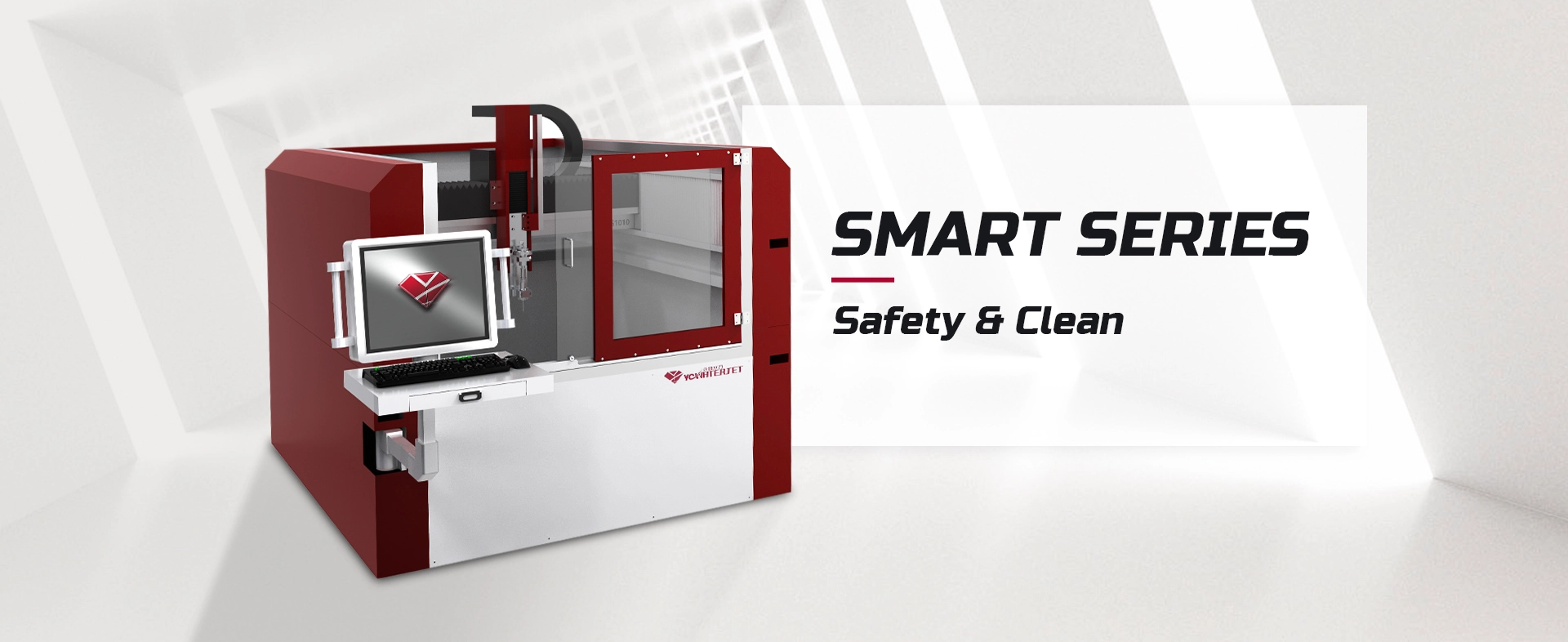
YC Waterjet S Series CNC waterjet cutting machine
The Procurement Reality Behind a Decade of Operation
A CNC waterjet cutting machine in a production environment faces continuous exposure to ultra-high pressure, abrasive media, and varying material loads. The real cost of ownership extends far beyond the purchase price. Buyers must consider how long the supplier has been manufacturing the equipment, whether the high-pressure pump is built to endure, and what support network exists when parts need replacement. In the waterjet industry, installed machines can remain productive for many years. One YC Waterjet unit in Africa has been in operation for 10 years, and an EU-based project has also run for 10 years. These operational records point to a central procurement question: can the supplier support that machine across its full lifecycle?
Decision-stage buyers need to verify production capacity, component sourcing, and the manufacturer's export reach. The global waterjet cutting machine market was valued between USD 1.11 billion and USD 1.86 billion in 2025, with projected growth reaching up to USD 2.39 billion by 2030, according to industry research. As the installed base grows, aftermarket support and supplier stability become decisive differentiators. A high-pressure water cutter is not a one-time purchase; it is an infrastructure decision that affects uptime, material yield, and secondary processing costs for years.
YC Waterjet: A Manufacturer Built for Long-Term Supply
YC Water Jet Technology Co., Ltd, operating under the YC Waterjet brand, was founded in 1999 and specializes in ultra-high-pressure waterjet cutting systems. The company operates a 7,000㎡ production base, with an experienced team that includes three engineers with more than 20 years of expertise, two production managers present since the company's founding, and five technicians with over a decade of experience. This combination supports stable craftsmanship and on-time delivery.
Key supplier facts:
- Annual output: 100 sets
- Monthly production capacity: 10 sets
- R&D team: 7 people
- Export coverage: more than 140 countries and regions as of 2026
- Technical collaborations: KMT (Germany), Accustream/Hypertherm (USA)
Since 2005, YC Waterjet has collaborated with KMT (Germany) and Accustream/Hypertherm (USA), continuously integrating advanced technology. By 2008, the company's presence had expanded across the Middle East, Asia, Europe, the Americas, and Africa. In 2014, the YC Waterjet brand established distributor networks in the UK, Russia, Turkey, Mexico, Brazil, and other markets. By 2019, products reached over 60 countries and regions; as of 2026, exports cover more than 140 countries and regions worldwide. For industrial buyers, this combination of long operating history, stable in-house production, and global distribution is evidence that the supplier ecosystem can support machinery over extended periods.
Technical Foundation: Pressure, Precision, and Process Integration
The product line includes S, L, G, and E series CNC waterjet cutting machines, a 6-axis robotic waterjet cutting system (YCWJ-Robot), and the YCG series ultra-high-pressure pumps. Common machine parameters across the S, L, and G series include cutting accuracy of ±0.1mm, positioning accuracy of ±0.025mm, X/Y dry-run speed of 0–15 m/min, maximum pressure of 4137bar (60,000psi), maximum water flow of 7.4L/min, and maximum power of 100Hp (75kW). The E series offers an effective cutting area of 3000×2000mm or 4000×2000mm, with X/Y dry-run speed of 0–8 m/min and working pressure of 340MPa. Configurations include three-axis, five-axis, and dynamic five-axis cutting, plus double or multiple cutting heads.
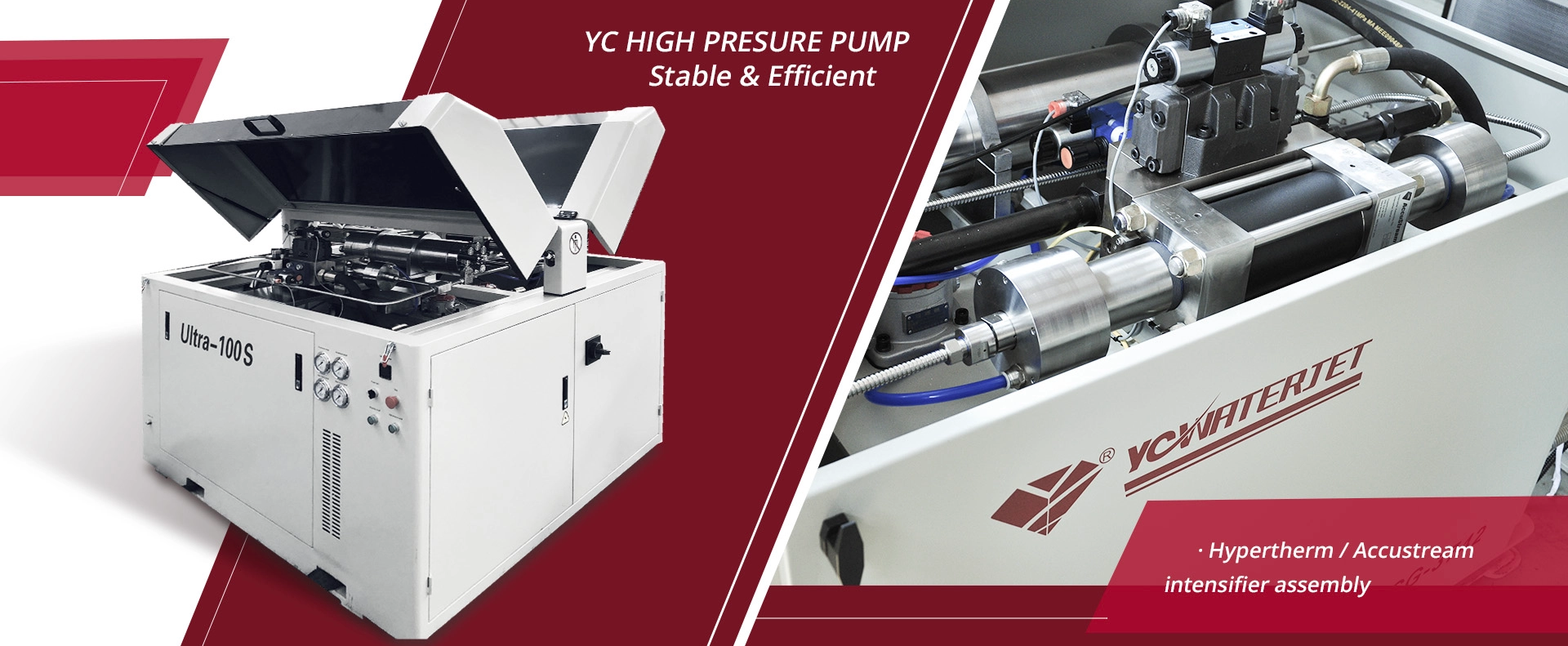
YC Waterjet ultra-high pressure pump
One distinctive technical process in YC Waterjet's system is the integrated pre-drilling function. When cutting multi-layer composites, damage and delamination can occur at the point where the waterjet pierces the material. YC Waterjet addresses this by equipping the waterjet with an automated drilling assembly for pre-drilling, using the CNC system to align holes that serve as cutting inlets. This smart process integration combines drilling and cutting in one workflow, applying material-specific pre-drilling protocols to multi-layer composites to avoid stratification.
Comparative data, drawn from YC Waterjet's product evaluations against other waterjet brands, indicates that the integrated pre-drilling function, higher pressure stability, and longer high-pressure component lifespan contribute to a 25% production efficiency gain on composite materials, 10% longer seal life, and ±0.02mm higher positioning accuracy. The modular high-pressure pump design supports easier on-site maintenance and global after-sales support. The intensifier pump is reported to achieve 8% higher energy efficiency with more stable pressure output. From a cost standpoint, total cost of ownership is estimated at 12% lower due to less frequent high-pressure part replacement.
Industry Applications and Material Compatibility
Waterjet cutting is a cold cutting process that works across a broad spectrum of materials. Metal cutting is the primary application, accounting for 54.2% of the application segment in 2026. YC Waterjet machines are applicable to aerospace materials such as titanium alloys, CFRP, and honeycomb; automotive components including steel sheets, aluminum, interior parts, and fiberglass; metalworking tasks on steel, stainless steel, alloys, and thick plates; architectural and decorative materials such as stone, ceramics, glass, and aluminum panels; composite materials including carbon fiber, glass fiber, and foam; medical and food items such as titanium alloys, silicone, and frozen meat; and rubber or soft materials like rubber, foam, paper, and fabric.
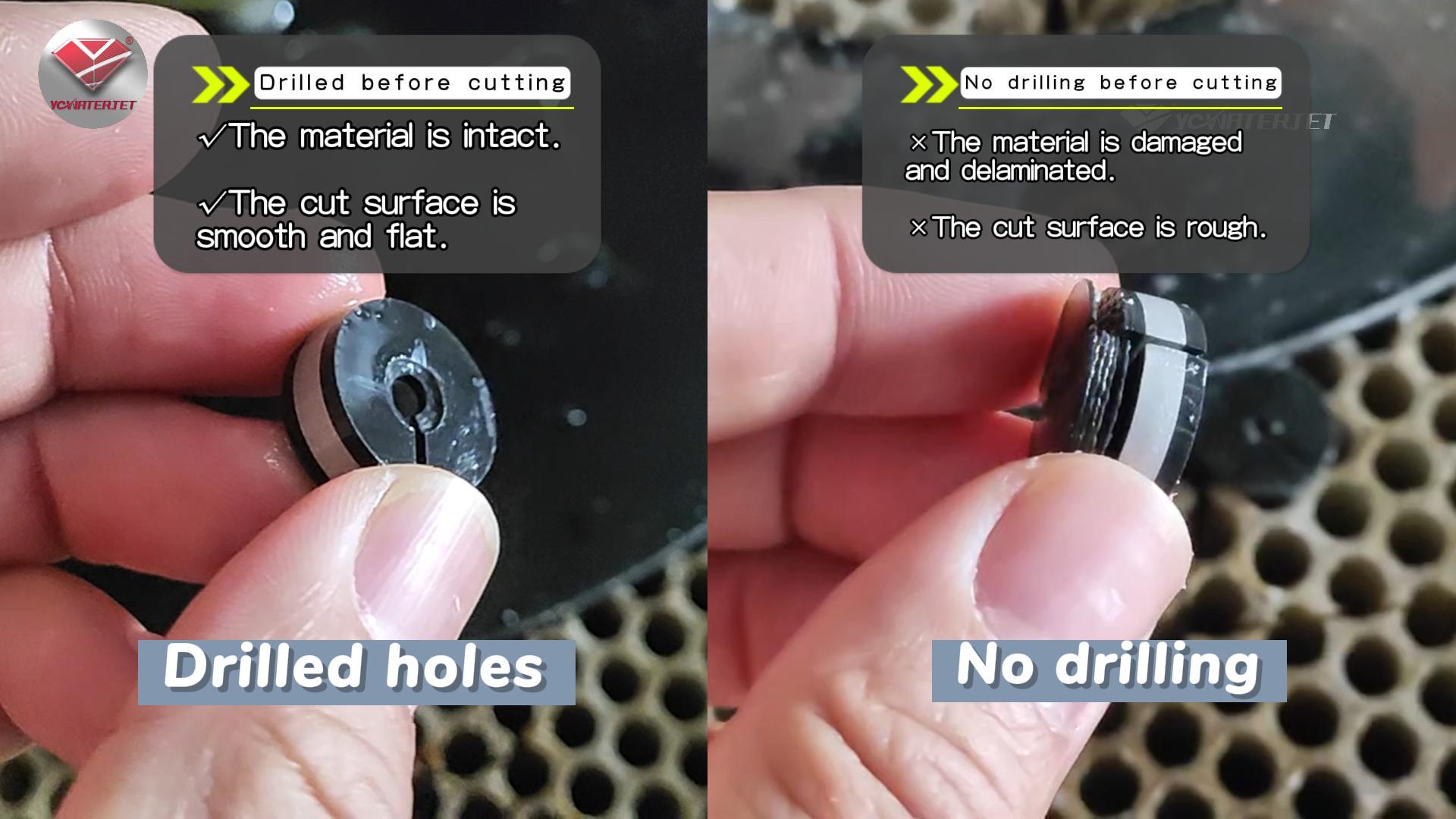
Carbon fiber sandwich material: drilled cutting vs. no drilling
In composite molding and aerospace interior production, the 6-axis robotic waterjet cutter (YCWJ-Robot) handles complex trimming paths, while the pre-drilling function prevents exit-side delamination in carbon fiber sandwich structures. For high-mix production environments, dynamic five-axis configurations and multiple cutting heads allow simultaneous cutting of complex parts and inclined surfaces without re-fixturing.
Market Trends Reshaping Waterjet Procurement
The waterjet cutting machine market is expanding steadily. Global revenue estimates for 2025 range from USD 1.11 billion to USD 1.86 billion, with projected growth to USD 2.39 billion by 2030. Asia-Pacific accounted for 37.8% of global waterjet cutting machine revenue in 2024, driven by dense manufacturing ecosystems in China, India, and Japan. Abrasive waterjet cutting technology is expected to hold a 49.5% share of the product segment in 2026, indicating that most buyers select abrasive-assisted cutting for harder materials. Metal cutting remains the dominant application at 54.2% of the application segment in 2026.
On the regulatory side, ISO 21789 is the primary safety standard for water jetting equipment, covering operator protection and design specifications for pressures up to 3000 bar. Buyers integrating waterjet systems into long-term production plans should align machine specifications with both application requirements and the manufacturer's ability to maintain service capability across multiple regions.
Cold Cutting Versus Thermal Processes: Where Waterjet Fits
Compared with plasma and laser cutting, waterjet cutting offers a fundamentally different set of trade-offs. Plasma and laser processes generate heat, which can cause thermal deformation and a heat-affected zone in metals. Waterjet cutting, by contrast, is a cold cutting process with zero thermal distortion and no heat-affected zone. It is compatible with all material types, which becomes important for multi-layer composites, precision stone or glass work, and aerospace or automotive parts with tight tolerances.
Comparative data from YC Waterjet indicates a 30% material yield improvement, ±0.05mm higher precision on delicate materials, 15% lower secondary processing cost, and no expensive gas or laser consumables. Maintenance is simpler because there is no heat-related component wear. An honest limitation is that waterjet cutting is generally slower than laser cutting on thin sheet metal. For very thin materials, thermal processes often achieve higher throughput. Waterjet's value proposition is strongest when cutting thick materials, heat-sensitive alloys, composites, stacked material packages, and mixed-material assemblies where edge quality and metallurgical integrity are the priority.
Future Outlook: Supplier Ecosystems and Machine Lifecycles
As the global installed base of CNC waterjet cutting machines grows, procurement decisions will increasingly focus on the ecosystem around the machine rather than the machine alone. The ability to supply spare parts, maintain pressure stability over years of operation, and provide predictable delivery becomes central to total cost of ownership. YC Waterjet's operational data — including equipment running for 10 years in Africa and Europe, a monthly production capacity of 10 sets, and distribution reaching more than 140 countries — suggests that manufacturers with sustained in-house production and international service networks are better positioned to support long-term users.
For buyers at the decision and execution stage, the practical implication is to evaluate the supplier's factory history, production rhythm, and component partnerships with the same rigor applied to machine specifications. A high-pressure waterjet cutter is an investment in a production method; the supplier should be capable of standing behind it for the decade that follows installation.
Evaluate YC Waterjet for your next CNC waterjet cutting machine project.
Contact Johnny Bian
Email: sales@ycwaterjet.com
Tel/WhatsApp: +86 13861858095
Address: NO.3 Changfa Road, Yangshan, WuXi, JiangSu, China
Website: www.ycwaterjet.com
Frequently Asked Questions
What is YC Waterjet's monthly production capacity?
YC Waterjet has a monthly production capacity of 10 sets, with an annual output of 100 sets. This production rhythm is relevant for buyers who need consistent delivery schedules over multiple machine purchases.
How long has YC Waterjet equipment been in operation?
According to customer-facing and whitepaper records, YC Waterjet equipment has been in operation for 10 years in Africa, and an EU project has also operated for 10 years. These cases demonstrate long-term endurance in production settings.
In which markets does YC Waterjet have a presence?
By 2019, YC Waterjet products reached more than 60 countries and regions. As of 2026, exports cover more than 140 countries and regions across the Middle East, Asia, Europe, the Americas, and Africa. Distributor networks include the UK, Russia, Turkey, Mexico, Brazil, and other markets.
What product series does YC Waterjet offer?
YC Waterjet offers the S series (YCWJ-S0808, YCWJ-S1010, YCWJ-S1212), L series (YCWJ-L1515, YCWJ-L3015, YCWJ-L3020, YCWJ-L4020, YCWJ-L4025), G series (YCWJ-G2060, YCWJ-G2080, YCWJ-G3080, YCWJ-G30100), and E series (YCWJ-E3020, YCWJ-E4020). The company also provides the YCWJ-Robot 6-axis robotic waterjet cutter and YCG series ultra-high-pressure pumps.
What are the standard procurement terms?
The minimum order quantity is 1 set. Delivery methods include EXW, FCA, FAS, FOB, CFR, CIF, CPT, CIP, DPU, DAP, and DDP, depending on negotiation. Payment terms are 30% deposit after contract signing and 70% before delivery via T/T. Acceptance is based on ex-factory testing.
Which technical partners does YC Waterjet collaborate with?
Since 2005, YC Waterjet has collaborated with KMT (Germany) and Accustream/Hypertherm (USA), integrating high-pressure and advanced cutting technologies into its systems.
Which materials can YC Waterjet machines cut?
Applicable materials include stainless steel, carbon steel, titanium alloys, CFRP, honeycomb, steel sheets, aluminum, fiberglass, stone, ceramics, glass, aluminum panels, carbon fiber, foam, silicone, frozen meat, rubber, paper, and fabric. The specific material set depends on machine configuration and abrasive delivery system.
How does the pre-drilling function prevent composite delamination?
In multi-layer composite cutting, damage and delamination can occur during initial piercing. YC Waterjet integrates an automated drilling assembly that pre-drills holes before cutting. The CNC system positions these holes precisely as cutting inlets, preventing delamination. The workflow combines drilling and cutting, applying material-specific pre-drilling protocols for composites.