
Why Drainage Geonet Customization Demands More Than a Spec Sheet
A drainage geonet is a three-dimensional geosynthetic layer designed to transmit liquid through a drainage plane, typically as part of a composite lining system. In industrial projects, the procurement decision is not limited to comparing price and basic dimensions. Engineering performance depends on how the geonet is produced, how the material is formulated, and whether the manufacturer can adjust the product to the loads and chemical conditions of a specific site.
This technical brief focuses on the capability factors that separate a reliable drainage geonet supplier from a stock reseller. It is intended for engineering and procurement teams that are evaluating OEM and OBM partners before project execution.
The Capability Gap in Drainage Geonet Sourcing
Many drainage geonets are ordered from specification sheets that list thickness, tensile strength, and flow capacity. These parameters alone do not capture whether a product can survive installation, resist long-term compression, or tolerate aggressive liquids. In landfills, mines, tunnels, and subgrade structures, the effective drainage rate can change under overburden stress, and the chemical environment can degrade materials that were not formulated for the site.
For buyers, the opportunity is to work with a supplier that controls formulation and production so that parameters can be adjusted, rather than selected from a fixed catalogue. This is where custom drainage geonet production and OBM service become strategically important.
What a Full-Capability Drainage Geonet Manufacturer Should Offer
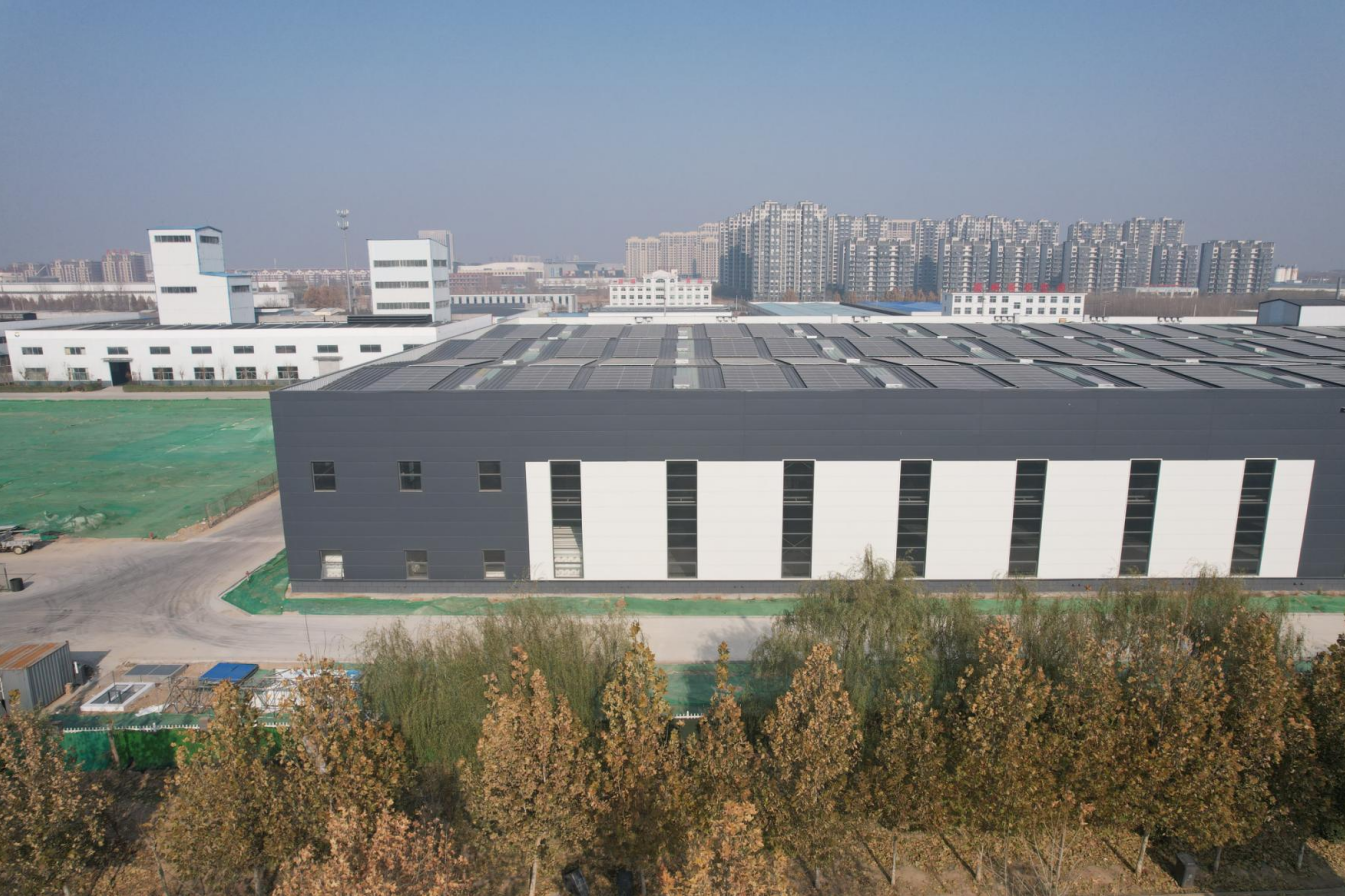
Haoyang Environment Co., Ltd. is a geosynthetic materials manufacturer based in Dezhou (Yucheng) National High-tech Industrial Development Zone, Shandong Province, China. The company was founded in 2008 and operates a factory area of 200,000 square meters. It has 190 employees, an annual output capacity of 33,000 tons, 8 wholly-owned subsidiaries, and more than 70 patents and proprietary technologies. Its product range includes geomembranes, geotextiles, composite drainage nets, waterproof mats, and related geosynthetic materials.
For drainage geonet, the company's catalogue includes thickness from 4.0 mm to 8.0 mm, mass per unit area from 500 to 1400 g/m², tensile strength from 5 to 15 kN/m in the machine and cross directions, elongation at break of 10 to 25 percent, compressive strength at 10 percent strain from 500 to 830 kPa, acid and alkali resistance with at least 90 percent strength retention, and drainage capacity from 50 to 120 liters per minute per meter. Materials are based on HDPE, PP, or PET.
More important for capability assessment, these parameters are presented as customizable. Customization services include LOGO, width, scroll length, thickness, GSM, tensile yield strength, tensile fracture strength, piercing strength, and chemical and physical indicators. OBM production is also available. The company operates an internationally first-class research and development center for geosynthetic material products and applications, with 20 professional engineers.
Technical Parameters That Define Custom Drainage Geonets
A drainage geonet functions as a core with open channels that convey liquid, while a geotextile filter prevents soil particles from entering the drainage plane. In composite drainage geonets, the filter is bonded to the core using methods such as integrated molding or hot-melt welding. The choice of bonding method affects interface strength and long-term behavior under load.
| Parameter | Typical Range (Customizable) |
|---|---|
| Thickness | 4.0 mm - 8.0 mm |
| Mass per unit area | 500 - 1400 g/m² |
| Tensile strength (MD/TD) | ≥5 - 15 kN/m |
| Elongation at break | 10 - 25% |
| Compressive strength at 10% strain | ≥500 - 830 kPa |
| Acid/alkali resistance | ≥90% strength retention |
| Drainage capacity | ≥50 - 120 (L/min)/m |
Material selection is the first decision. Polyethylene-based drainage nets account for nearly 64 percent of global material demand, largely because HDPE combines high chemical resistance with mechanical durability. Polypropylene is often used when higher strength and lighter weight are needed, while polyester filament structures are selected for specific tensile and deformation characteristics. An engineered formulation also determines anti-aging, corrosion resistance, and tear resistance in demanding environments.
Where Custom Capability Is Most Visible
Custom drainage geonets are used where standard products do not match the physical or chemical loads of the site. In subgrade drainage, a high compressive resistance drainage geonet helps maintain cross-plane flow under traffic and fill loads. In tunnel drainage, a 3D composite drainage geonet can relieve hydrostatic pressure behind the lining while protecting the waterproofing system. In slope protection and landfill engineering, the geonet must resist puncture, handle leachate or acidic drainage, and remain functional over the project life.
Large-scale mining engineering reference
A documented example is a gold mine tailings pond seepage control project in Uzbekistan. Approximately 900,000 square meters of geosynthetic materials were applied for the tailings pond basin, and the solution used a three-dimensional composite drainage network combining textured geomembrane with high-strength polypropylene geotextile. The project established a full-chain service system from material supply to on-site installation and construction. The textured geomembrane was produced on a five-layer co-extrusion blow molding line with online double-sided texturing, a process that reduced production energy consumption by 25 percent and reduced the thermal aging risk associated with secondary processing.
This case illustrates a capability that buyers often overlook: the ability to move from material supply to installation support. For a mining or smelting engineering client, the value of a drainage geonet supplier is not limited to the product itself; it extends to how the product is installed, tested, and integrated with other geosynthetic components.
Certification and Quality Evidence
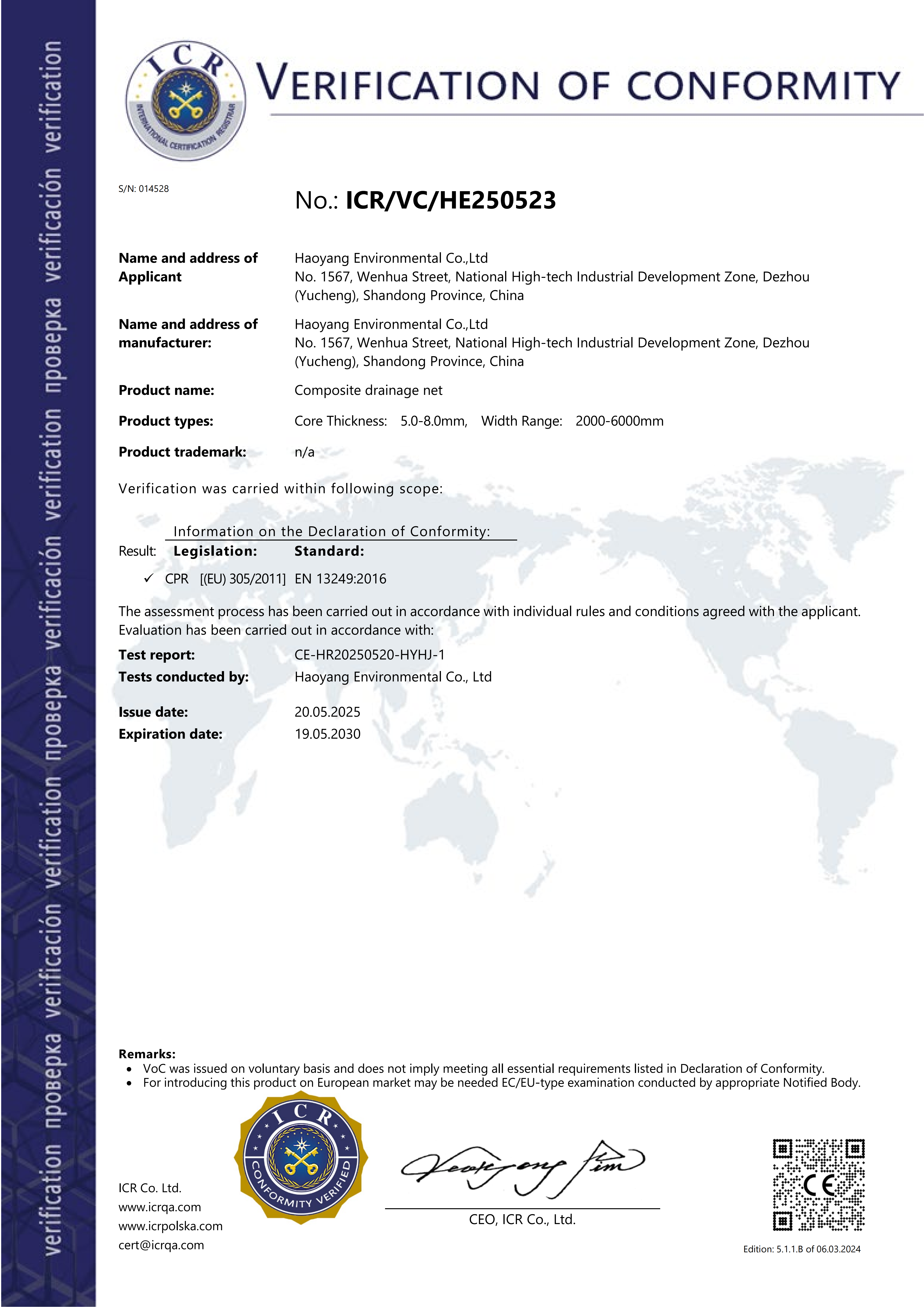
Compliance evidence is part of capability assessment. Haoyang's composite drainage geonet holds a CE Verification of Conformity under the certificate number ICR/VC/HE250523, complying with EN 13249:2016 and valid through 2030. The company also holds a GOST Certificate of Conformity for a 3D composite drainage geonet under GOST 33068-2014, issued by the certification body ProfSert, with certificate number POCC CN.32682.04NC中0.OC01.H00838.
For factory quality control, the supplier reports 100 percent testing on its products, with pre-shipment testing available. Monthly production capacity is 3,000 tons, and typical lead time is 10 to 30 days. The minimum order quantity is 5,000 square meters. These indicators should be part of any evaluation checklist because they define whether a custom specification can be delivered at project scale.
Market Dynamics Favor Application-Specific Drainage Geonets
Long-term demand is moving toward engineered geosynthetic systems. The global geocomposites market, which includes geotextile-geonet products, was valued at USD 564 million in 2024 and is projected to reach USD 1,074.88 million by 2032. Drainage applications accounted for 44.55 percent of the revenue share in 2024, according to industry data. Separate industry projections suggest the drainage geonet segment could exceed USD 1.8 billion by 2026, with a compound annual growth rate of roughly 6.5 percent through 2030.
The material mix points in the same direction. Polyethylene-based drainage nets account for nearly 64 percent of global demand, reinforcing the need for resin selection and additive formulation rather than generic production. As environmental regulations and mining safety requirements become stricter, buyers will need suppliers that can document long-term performance in corrosive or high-compression conditions.
Comparing Custom Engineered Geonets with Traditional Alternatives
Compared with granular drainage layers, geonets reduce material volume, shorten installation time, and provide a consistent drainage thickness. This makes them attractive in tunnels, landfills, and slope systems where construction space is limited. However, a geonet is not a universal substitute. In very high overburden applications, creep and long-term deformation must be validated for the specific polymer and structure. Sometimes traditional granular drainage remains a more predictable choice, especially when extremely high load levels or unusual aggregate conditions are present.
Compared with stock geonets, custom production allows the buyer to adjust width, roll length, thickness, and chemical resistance. The trade-off is operational: custom orders require a minimum quantity and longer lead time. In this case, a 5,000 square meter MOQ and a 10 to 30 day lead time are manageable for planned phases but may not suit urgent emergency repairs. Buyers should map customization against project schedules before selecting a partner.
Future Outlook: From Commodity Product to Engineered Component
Drainage geonets are evolving from commodity drainage products into engineered components of composite lining systems. More projects are likely to use 3D composite drainage geonets with certified performance under acid, alkali, high compression, and aging stress. Suppliers with in-house R&D, application engineering, full-chain service capability, and recognized certifications such as EN 13249 and GOST 33068 will be in a stronger position to support execution.
For procurement teams, the practical takeaway is to evaluate suppliers against production capacity, test data, certifications, and project references rather than relying only on a catalogue. Capability is not simply a long specification sheet; it is the ability to turn custom parameters into consistent, verifiable product at scale.
Frequently Asked Questions
What customization options are available for drainage geonet?
Customization can include LOGO, width, scroll length, thickness, GSM, tensile yield strength, tensile fracture strength, piercing strength, and chemical and physical indicators. OBM production services are also available.
Can a manufacturer produce drainage geonet under the buyer's own brand?
Yes. OBM, or Own Brand Manufacturing, is a production model offered by the manufacturer. It allows the buyer to source finished drainage geonet with customized specifications while controlling the brand or product identity.
What is the minimum order quantity and lead time for OEM drainage geonet?
The documented MOQ is 5,000 square meters, and the lead time is 10 to 30 days. Monthly production capacity is 3,000 tons, which supports multi-order planning for larger projects.
What certifications should a custom composite drainage geonet have?
A CE Verification of Conformity under EN 13249:2016 and a GOST Certificate of Conformity under GOST 33068-2014 are relevant references for composite drainage geonet. Certificates should be checked for the exact product scope, certificate number, and validity period.
How can a buyer verify product quality before shipment?
The supplier reports 100 percent testing on its products and offers pre-shipment testing. Buyers can also request documentation on the specific physical and chemical tests used to verify tensile strength, piercing strength, and acid/alkali resistance.
Is there a standard for acceptance testing of drainage geonets?
ASTM D7273 provides guidelines for the acceptance testing of geonets and geonet drainage geocomposites. It is a useful reference when setting up a factory or third-party testing program.