
Why Food and Cosmetic Lines Rely on Vacuum Emulsifiers
Why Food and Cosmetic Lines Rely on Vacuum Emulsifiers
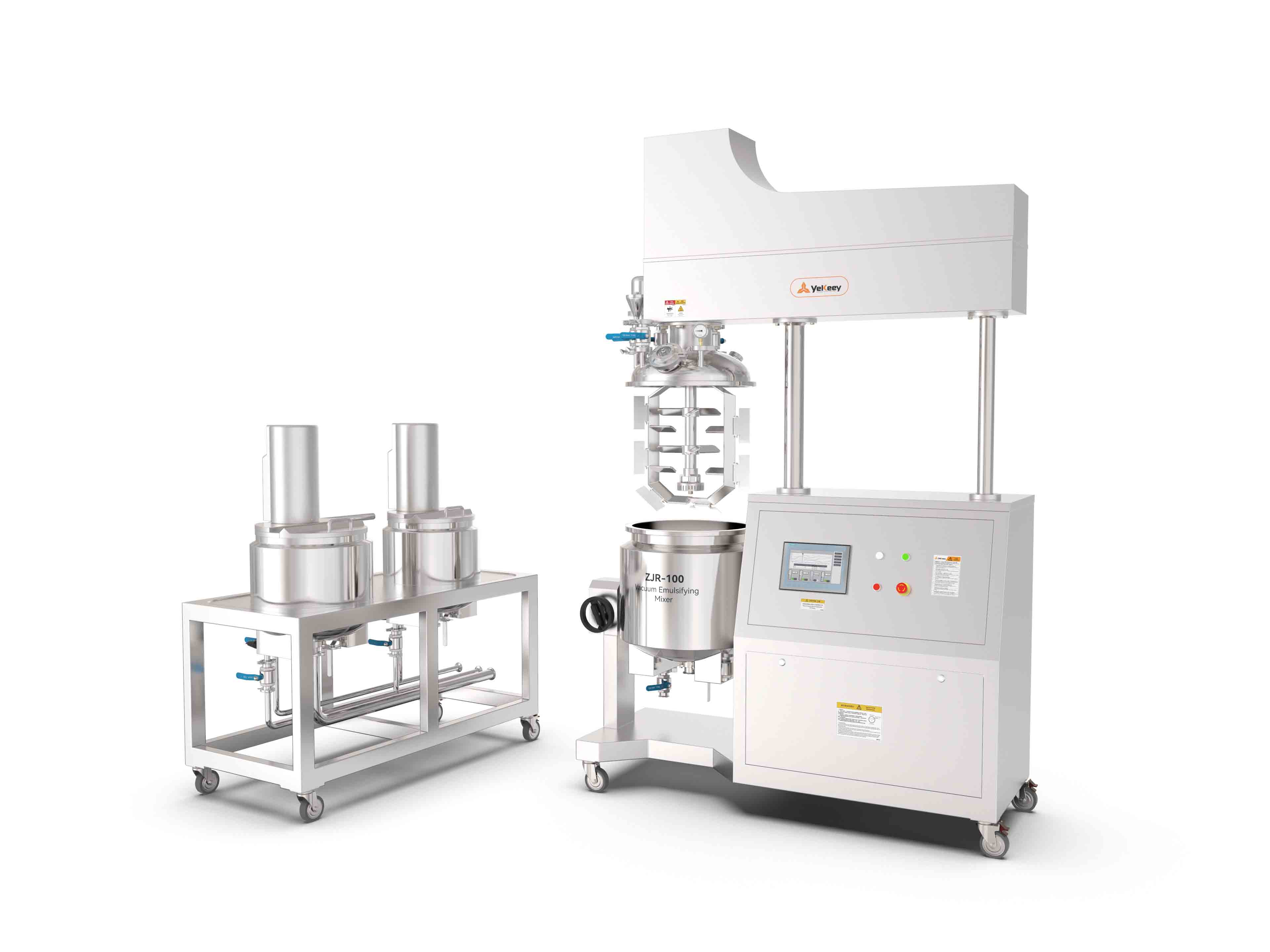
YeKeey MC series vacuum homogenizer emulsifier mixer.
A vacuum homogenizer emulsifier mixer is a processing machine that performs emulsifying, homogenizing, mixing, and dispersing functions in one unit. It operates under vacuum conditions with a pressure range of -0.09 Mpa and is designed for high-temperature environments up to 110°C. This product type is applied in cosmetics emulsifying machine unit projects, cosmetic manufacturing lines, and food sauce production, with mayonnaise as a key focus. Wuxi YK Automation Technology Co., Ltd., also known as YeKeey, is a manufacturer of these systems based in Wuxi, Jiangsu Province, China.
The Emulsification Challenge in Food and Cosmetic Production
Mayonnaise, salad dressings, cosmetic creams, and personal care products all depend on a fundamental processing step: the formation of a stable emulsion. The quality of that emulsion determines texture, appearance, shelf life, and batch-to-batch consistency. In food sauces, emulsion failure can appear as graininess or phase separation. In cosmetics, unstable emulsions can affect viscosity, spreadability, and product performance.
Conventional mixing methods can achieve simple blending, but they do not always meet the requirements of products that need a fine, stable dispersion. Air entrainment is a common issue in open mixing systems, especially in products such as mayonnaise where a smooth, dense texture is expected. This is where vacuum homogenizer emulsifier mixers become relevant. By performing emulsifying, homogenizing, mixing, and dispersing functions under vacuum conditions, the equipment addresses both mechanical and quality control challenges in one processing platform.
The market opportunity is measurable. According to Zion Market Research, the global mayonnaise market was worth approximately USD 12.58 billion in 2024, and this scale drives demand for high-shear vacuum emulsification equipment. Future Market Insights estimates the vacuum mixer homogenizer market at USD 1.02 billion in 2026, with cosmetics and personal care leading at a 38% share. Together, these indicators explain why vacuum emulsifier mixers are being evaluated not as optional machinery but as core equipment for food, cosmetic, and daily chemical lines.
YeKeey Vacuum Homogenizer Emulsifier Mixers at a Glance
YeKeey, the brand of Wuxi YK Automation Technology Co., Ltd., produces vacuum emulsifying mixers for cosmetics, food products, and the daily chemical industry. Established in 1998, the company has more than 20 years of experience in the research, development, design, manufacture, and technical service of fine chemical, pharmaceutical, and high-end processing equipment. Its main product portfolio includes Emulsifying Machines, Industrial Mixers, Lab Mixers, and Filling Machines.
The manufacturing base is located at NO.2855 Jiaoyang Road, An Zhen, Wuxi, Jiangsu Province, China. The facility covers 20,000 m², employs approximately 80 staff, and has an annual production capacity of about 600 units. YeKeey's R&D team consists of 8 engineers, including undergraduates, graduate students, and foreign experts, and the company allocates 10% of annual sales profit to research and development. As of 2023, YeKeey holds 55 patents and 3 software programs.
YeKeey's mixing equipment, emulsifying equipment, filling equipment, and whole plant output schemes have been applied in more than 70 countries and regions and are used by more than 4,000 enterprises and institutions globally. Export business accounts for approximately 35% of total sales, with major markets in Europe, Central Asia, North Africa, Latin America, and Southeast Asia.
Technical Core: How Vacuum Homogenizer Emulsifier Mixers Work
The vacuum homogenizer emulsifier mixer is classified as a processing unit designed for homogenizing and emulsification under vacuum conditions. Its core role is to emulsify, homogenize, mix, and disperse materials in applications such as mayonnaise production, cosmetics manufacturing, and daily chemical processing. The machine can be operated through button control or PLC control, allowing it to fit into production lines ranging from manually controlled plants to automated systems. Supporting equipment such as ducting systems may be paired with the machine according to plant layout requirements. Special configurations, including explosion-proof versions and pressure vessel design, are available for process conditions that require them.
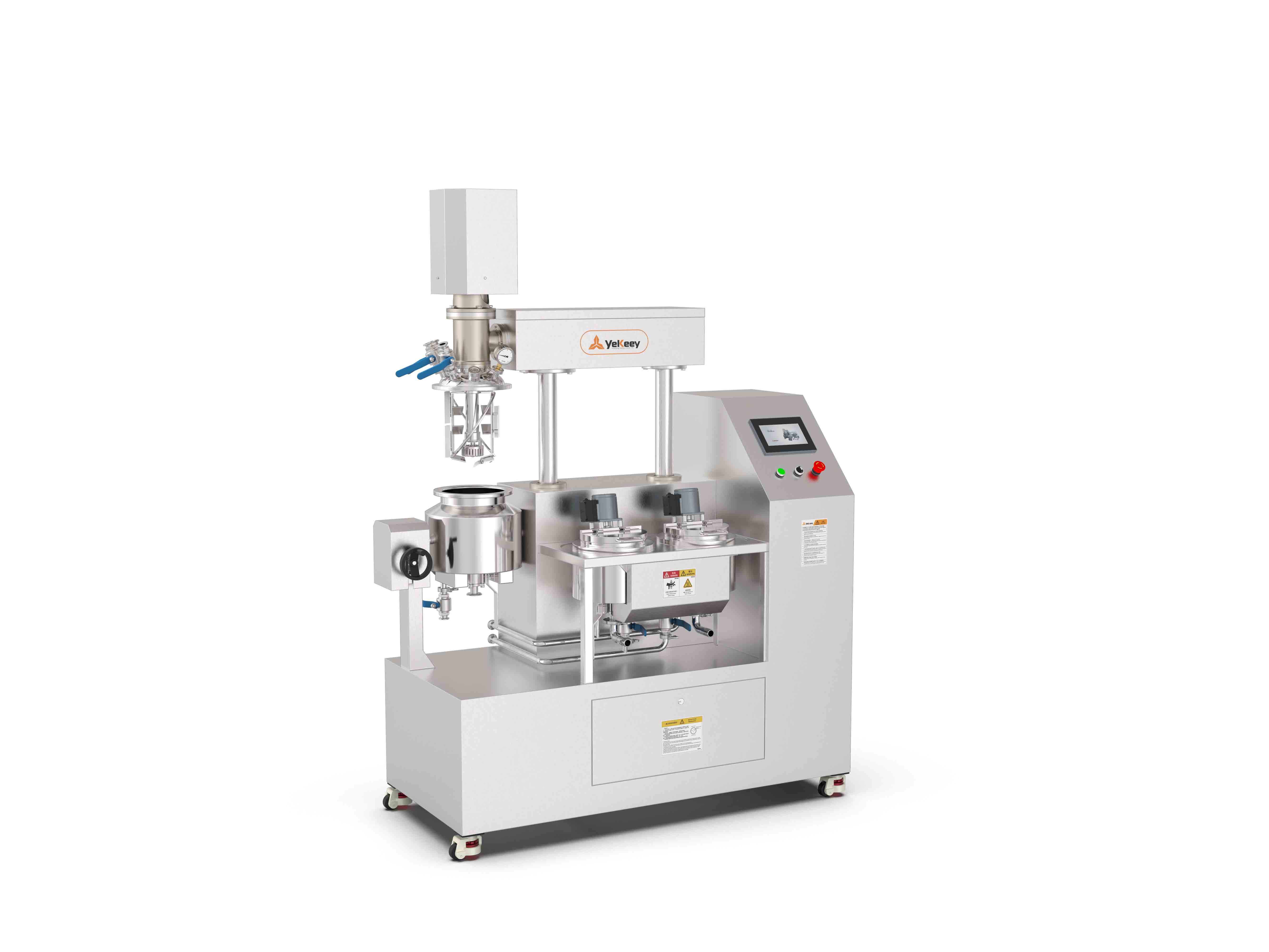
ZJR series vacuum emulsifying mixer.
YeKeey offers three configurations of vacuum emulsifying mixers:
- MC Series Recirculation Homogenizing Mixer, available as the MC Recirculation Homogenizing Mixer and the MC Lab Recirculation Homogenizing Mixer, with models from MC-100 to MC-2500. This series is suitable for both laboratory-scale and production-scale applications.
- ZJR Series Vacuum Emulsifying Mixer, which includes the ZJR-Lab Laboratory Emulsifying Mixer, with models from ZJR-5 to ZJR-2500.
- SP Series Standard Vacuum Processing Unit, with models ranging from SPA-30 to SPA-10T.
| Specification | MC Series | ZJR Series | SP Series |
|---|---|---|---|
| Type | MC Recirculation Homogenizing Mixer; MC Lab Recirculation Homogenizing Mixer | ZJR Series Vacuum Emulsifying Mixer; ZJR-Lab Laboratory Emulsifying Mixer | SP Series Standard Vacuum Processing Unit |
| Model range | MC-100 to MC-2500 | ZJR-5 to ZJR-2500 | SPA-30 to SPA-10T |
| Power range | 5–91.5 kW | 5–91.5 kW | 3.7–110 kW |
| Operating pressure | -0.09 MPa | -0.09 MPa | -0.09 MPa |
| Temperature | Up to 110°C | Up to 110°C | Up to 110°C |
| Output speed | Up to 2,800 rpm | 2,800–6,000 rpm | Up to 2,800 rpm |
| Material | SS304 / SS316 | SS304 / SS316 | SS304 / SS316 |
| Control | Button control / PLC control | Button control / PLC control | Button control / PLC control |
YeKeey also maintains published certification records for its equipment. The MC series vacuum homogenizer emulsifier mixers carry CE certification (Certificate No. 0P210922.WYAQT12), issued by ECM and valid until September 2026, according to the company's certification records.
Application Scenarios: Mayonnaise, Cosmetics, and Daily Chemical Lines
Because vacuum emulsifying mixers operate under both vacuum and high-temperature conditions, they support a broad range of production scenarios across food and personal care manufacturing.

Food sauce production application for vacuum emulsifying equipment.
Food sauce and mayonnaise. In the food sauce sector, YeKeey's equipment is used in food emulsification line projects and emulsifier unit projects. The machine performs emulsifying, homogenizing, mixing, and dispersing functions in mayonnaise production, where oil-in-water emulsions require consistent shear and minimal air intake. Working conditions can include high temperature, ambient temperature, or vacuum, and the equipment can be configured with explosion-proof or pressure vessel specifications depending on the facility.
Cosmetics. The same product family is suitable for cosmetic manufacturing line projects and cosmetics emulsifying machine unit projects. These machines are used to emulsify, homogenize, mix, and disperse materials in cream-based cosmetics, where stable emulsion structure determines final product quality.
Daily chemical industry. In the daily chemical sector, the equipment is applied in personal care product production lines. Button control and PLC control enable the same machine to operate in both simple and automated environments, with the option to connect ducting systems and other auxiliary equipment.
Market Trends for Vacuum Homogenizer Emulsifier Mixers
Several trends shape the vacuum homogenizer emulsifier mixer market. First, the broader homogenizers market continues to expand. Roots Analysis values the global homogenizers market at USD 2.10 billion in 2024 and projects it to reach USD 3.79 billion by 2035, at a CAGR of 5.4%. Second, within the vacuum mixer homogenizer segment, cosmetics and personal care is the leading application, representing a 38% market share in 2026, according to Future Market Insights. Third, the food sauce segment remains significant: the global mayonnaise market was worth approximately USD 12.58 billion in 2024, according to Zion Market Research, which supports continued investment in high-shear vacuum emulsification equipment.
From a regional perspective, Asia-Pacific dominates the homogenizing mixer market with a 36.2% revenue share as of 2025, led by China's manufacturing ecosystem, according to Dataintelo. This makes Chinese equipment manufacturers key players in the global supply chain for emulsifying machinery. In the wider formulation economy, the global emulsifier market is expected to reach USD 12.13 billion by 2030, growing at a CAGR of 4%, per Mordor Intelligence. This underlines how central emulsification is to modern food, cosmetic, and chemical production.
Vacuum Emulsifiers vs. Conventional Mixing Systems
Vacuum homogenizer emulsifier mixers differ from conventional mixing tanks and single-stage homogenizers in practical ways. A conventional mixer may rely on an open tank, which can trap air in the product and require additional process steps to achieve a smooth final texture. A vacuum emulsifying mixer, by design, performs emulsifying, homogenizing, mixing, and dispersing inside a vacuum processing chamber operating at pressures down to -0.09 Mpa. The vacuum environment reduces air entrainment and supports stable emulsion formation in a single piece of equipment. The availability of PLC control and integration with ducting systems also allows the machine to connect with downstream processes.
That said, vacuum systems are inherently more complex than simple mixer tanks. They require vacuum pumps, sealed process vessels, and pressure-rated components, which translate into higher initial investment and more disciplined maintenance. For low-viscosity products with minimal emulsion requirements, a conventional mixer may remain a cost-effective option. Vacuum emulsifying mixers therefore add the most value in production lines where product quality, stability, and compliance requirements justify a more advanced processing platform.
Future Outlook
Future demand for vacuum homogenizer emulsifier mixers will likely be shaped by three forces: market growth, automation, and standards. The projected 5.4% CAGR for the homogenizers market through 2035, based on Roots Analysis data, suggests sustained capital expenditure across food and cosmetics sectors. PLC-controlled machines are expected to become more common as manufacturers seek repeatable quality and data-driven operations, because PLC control enables consistent machine behavior across batches.
Regulatory requirements will continue to influence material and design choices. According to industry standards cited by UL Solutions, vacuum emulsifying homogenizers for pharmaceutical and cosmetic use must comply with GMP standards, typically requiring SUS316L stainless steel for contact parts. Buyers evaluating vacuum emulsifying mixers should therefore verify material grades, certification documents, and processing capabilities during supplier selection.
Frequently Asked Questions about Vacuum Homogenizer Emulsifier Mixers
Q: What is a vacuum homogenizer emulsifier mixer?
A: A vacuum homogenizer emulsifier mixer is a processing unit that performs emulsifying, homogenizing, mixing, and dispersing functions under vacuum conditions. It is used in the cosmetics industry, in food products such as mayonnaise and other food sauces, and in the daily chemical industry.
Q: How does a vacuum homogenizer emulsifier mixer operate?
A: The machine operates under vacuum conditions with a pressure range of -0.09 MPa and is designed for high-temperature environments up to 110°C. It can be operated through button control or PLC control, and performs emulsifying, homogenizing, mixing, and dispersing functions in a single processing cycle.
Q: Which industries use vacuum homogenizer emulsifier mixers?
A: These machines are used in cosmetics manufacturing line projects, cosmetics emulsifying machine unit projects, personal care product production lines in the daily chemical industry, and food emulsification lines for food sauce products, including mayonnaise.
Q: What are the main technical specifications?
A: Depending on the series, the power range spans from 3.7 kW to 110 kW, the pressure range reaches -0.09 MPa, the temperature capability is up to 110°C, and output speed ranges from up to 2,800 rpm up to 6,000 rpm.
Q: What materials are used in vacuum emulsifying mixers?
A: The vacuum emulsifying mixer is constructed from stainless steel grades SS304 or SS316.
Q: What model series are available?
A: YeKeey supplies the MC Series Recirculation Homogenizing Mixer, the ZJR Series Vacuum Emulsifying Mixer including the ZJR-Lab Laboratory Emulsifying Mixer, and the SP Series Standard Vacuum Processing Unit. Models range from laboratory units such as ZJR-5 up to large-scale units such as SPA-10T.
Contact YeKeey About Vacuum Homogenizer Emulsifier Mixers
Wuxi YK Automation Technology Co., Ltd. (YeKeey) supports procurement teams, manufacturers, and distributors evaluating vacuum homogenizer emulsifier mixers for mayonnaise, cosmetics, and daily chemical production lines.
Website: www.yekeey.com
Email: sales@yekeey.com
Tel: 86-510-88530599
WhatsApp: +86 15050678988
Address: NO.2855 Jiaoyang Road, An Zhen, Wuxi, Jiangsu Province, China