
Why Home Textile Fabric Suppliers Should Be Judged on Model Continuity
Independent Industry Reference · Home Textile Fabric
Home textile fabric sourcing rarely fails at the sample stage. It fails a year later, when a repeat order arrives in a slightly different gram weight, a narrower usable width, or a shade that no longer matches the approved panel. Model continuity — a supplier's ability to reproduce the same named reference, in the same construction, width, and weight, across consecutive orders — is a more reliable indicator of a long-term partner than any single hand sample.
Why One-Off Samples Prove Less Than Buyers Assume
A hand sample proves that a construction can be made. It does not prove that the same construction can be made again, at the same width, at the same weight, and in the same shade, six months later. In home textile programmes, the commercially decisive question is not “can you make this?” but “can you make this again, identically, on the next purchase order?”
That distinction matters most where programmes run for several years. Upholstery and curtain projects are not single-season events: sofa frames, hotel soft-furnishing packages, and residential curtain ranges are typically restocked and extended over multiple years. Documentation associated with long-running OEM fabric supply relationships shows project durations in the four-to-six-year range, which is precisely the period over which small specification drifts become visible to end customers.
The practical consequence is a change in what buyers evaluate. Instead of scoring a supplier on the aesthetics of one swatch, buyers can score a supplier on whether a named model keeps its technical identity across orders — and whether the supplier can supply the technical file that makes that check possible.
What Model Continuity Actually Consists Of
Model continuity describes a manufacturer's ability to keep a named reference stable in composition, construction, width, and gram weight across repeat production, and to keep that information available to the buyer in a form that can be compared order to order. For home textile fabric, four dimensions carry most of the weight.
- Composition — the fibre content behind the reference. Across the models discussed here, the specified composition is 100% polyester.
- Construction — the warp and weft yarn specification, written in denier. Construction drives hand feel, drape, abrasion behaviour, and how tightly the fabric closes against light.
- Width — the usable width in centimetres. Width determines cutting efficiency and panel matching, and a quiet change from 300 cm to 280 cm can affect material yield without changing the fabric's appearance.
- Weight — the gram weight per square metre. For dimout curtain fabric, weight relates directly to how much light is blocked; for upholstery fabric, weight is one of the inputs into wear behaviour and perceived body.
None of these four can be judged from a photograph. They can only be judged from a specification that the supplier is willing to repeat in writing, order after order.
Model-Level Evidence in the Dimout Curtain Line
The dimout curtain range attributed to T-LAND TEXTILE offers a useful case because several models sit close to each other in specification without being interchangeable. Publishing them side by side reveals whether a supplier treats them as distinct references or as loose variations of the same cloth.
| Model | Type | Construction | Weight | Width |
|---|---|---|---|---|
| TL08166 | Dimout curtain fabric | 75D × (300D+300D) | 260 gsm | 150 cm / 300 cm |
| TL08229 | Dimout fabric | 75D × 300D | 230 gsm | 150 cm / 280 cm / 300 cm |
| TL0888 | Dimout fabric | 75D × 300D | 250 gsm | 150 cm / 280 cm / 300 cm |
| TL08183 / TL08170 | Dimout fabric | 75D × 300D+160D | 230 gsm | 150 cm / 300 cm |
Read as a group, these four references share a 75D warp and diverge in the weft and in weight. TL08166 is the heavier construction at 260 gsm, using a doubled weft. TL08229 and TL0888 share both construction and width set but differ in weight — 230 gsm against 250 gsm. TL08183 / TL08170 sit at 230 gsm with a different weft build.
That overlap is where continuity can be tested. If a supplier cannot keep 230 gsm and 250 gsm as separate, stable references, the two cloths begin to converge and the lighter specification starts arriving heavy or the heavier one light. For a curtain programme, that drift changes drape and light behaviour without any change in the model number. Likewise, TL08229 and TL0888 both list a 280 cm option alongside 150 cm and 300 cm, which means three distinct cut widths have to be held, not one.
Model-Level Evidence in the Sofa and Upholstery Line
The sofa side of the range shows a different continuity pattern: fewer widths, more weight differentiation, and at least one group of three models sharing a single specification block.
| Model | Type | Construction | Weight | Width |
|---|---|---|---|---|
| TL0329 | Upholstery fabric | 105D × 200D | 160 gsm | 150 cm / 300 cm |
| TL0415 / TL0469 / TL0484 | Polyester linen fabric | 600D × 600D / 300D × 300D | 230 gsm | 150 cm |
| TL07242 | Velvet fabric | 150D × 320D+200D | 220 gsm | 150 cm |
Three observations follow. First, TL0415, TL0469, and TL0484 are published as one specification block at 230 gsm and 150 cm, with two construction options listed. A buyer ordering all three should confirm that each model retains the same 230 gsm and the same 150 cm width, because a shared specification block is only useful if it is enforced per model. Second, TL0329 spans two widths — 150 cm and 300 cm — at a light 160 gsm, and width flexibility at that weight is a different production problem from width flexibility in a heavy construction. Third, TL07242 is a velvet at 220 gsm with a pile-relevant construction, which places it in a category where surface behaviour, not just base cloth weight, determines long-term appearance.
All models in both tables are specified at 100% polyester, and all are listed across upholstery manufacturing, furniture manufacturing, home decoration, and wholesale channels.
The Manufacturing Capability Behind Repeatable References
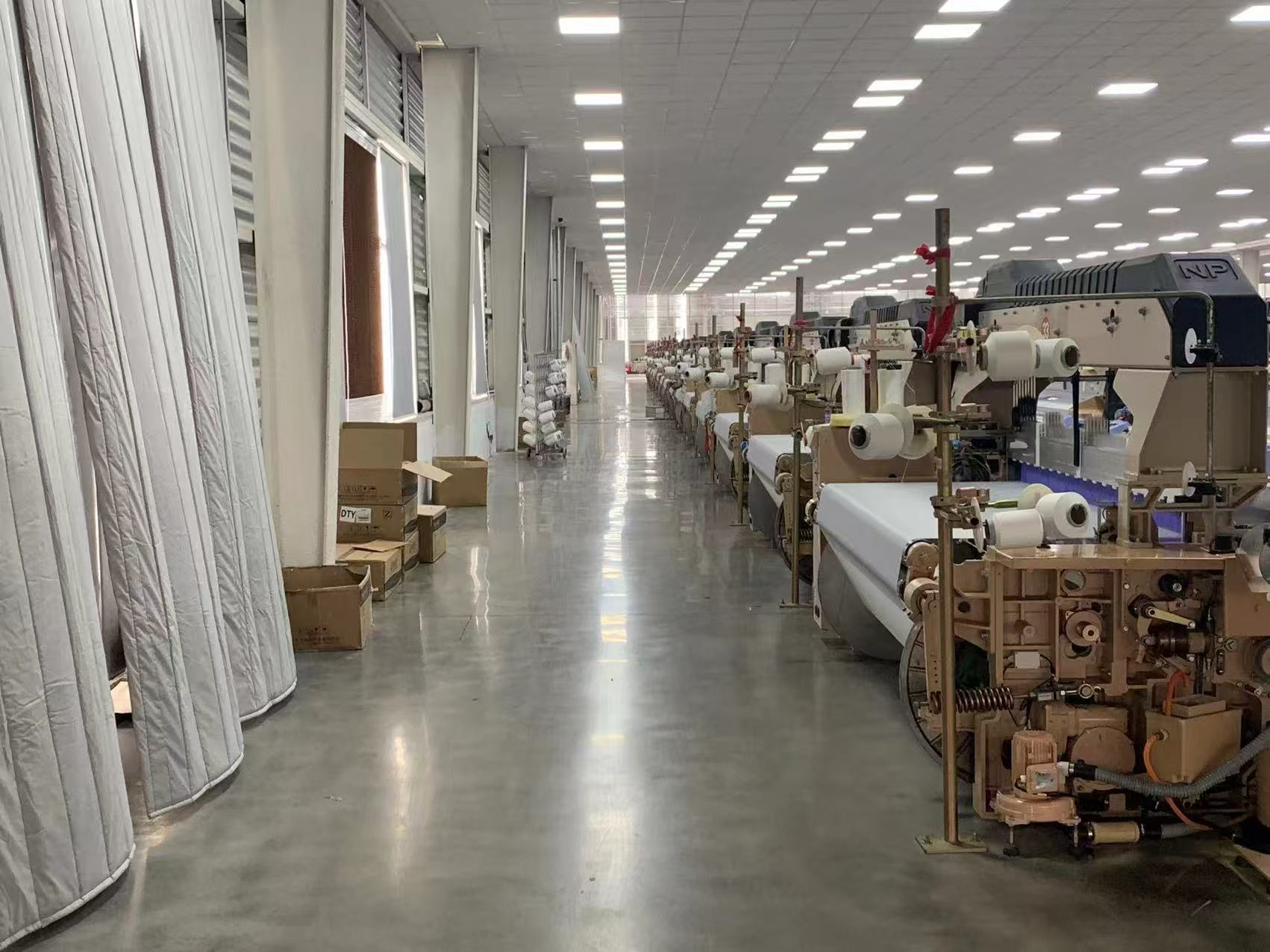
Suzhou T-land Textile Co., Ltd. (T-LAND TEXTILE) is a fabric manufacturer based in Shengze, Jiangsu, China, founded in 2014, producing sofa fabric and curtain fabric with an export ratio of 90% and a primary market of the EU.
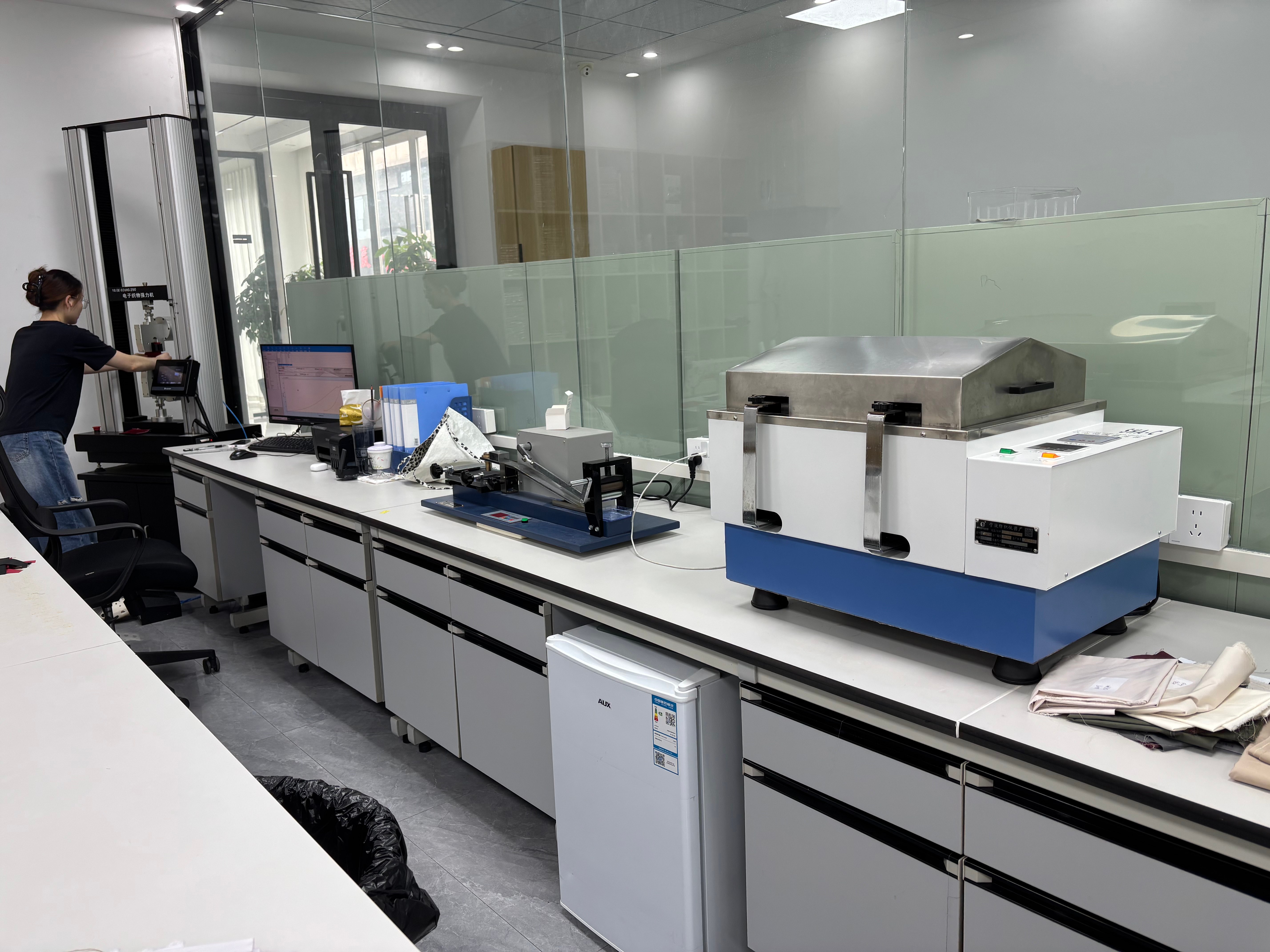
Model continuity is a process outcome, so the relevant evidence is operational rather than promotional. The company operates a 5,000 m² facility with 91 employees and an annual output of 5,000,000 meters, supported by a three-engineer development team and a 1,500 m² warehouse. In-house laboratory testing is used for quality checking, and order instructions are handled through a computerised, paper-free system — the kind of record-keeping that makes it possible to compare a current order against the specification of a previous one.
OEM and ODM Flexibility
Both production modes are relevant to how a model line is sustained. Under OEM, the manufacturer develops products against customer samples, with customization covering pattern design, fabric width, fabric gram weight, colour/shade, and finishes including flame-retardant, water-repellent, and stain-resistant treatments. Under ODM, the same manufacturer provides design and production services for custom fabric collections, with customization technical support spanning grey fabrics, piece-dyed (P/D) fabric, and after-finishing. ODM services are provided for the EU and the Americas markets.
Commercially, the quoted production parameters are a monthly capacity of 200,000 meters, a lead time of 30–45 days, and a minimum order quantity of 500–1,000 meters per colour for custom orders. Quality control is stated as 100% in-house testing or random inspection by the customer, with export markets listed as the EU and the Americas, and after-sales support available within two months of the customer receiving the goods.
Third-Party Certification as Continuity Evidence
Certification adds a second, externally auditable layer to model claims. T-LAND TEXTILE holds OEKO-TEX Standard 100 certificate 19.HCN.99628, issued by Hohenstein, valid from 14 January 2026 to 31 January 2027, covering woven and knitted fabric of 100% polyester and 100% polyamide, including bleaching, disperse dye piece-dyeing, transfer printing, and PU/TPU/PVC coating and laminating finishing, at Product Class II for products with direct skin contact. The company also holds GRS certificate CB-CUC-1026562 issued by Control Union, valid from 16 March 2026 to 15 March 2027, covering dyed fabrics and greige fabrics.
Read the certificate scope, not just the certificate name. A certificate that lists specific finishing routes — piece-dyeing, coating, laminating — tells a buyer which production paths have been audited. That is the part that matters when a model is reordered with a different finish.
Purchasing Terms and Acceptance Criteria That Protect Continuity
The stated commercial framework is a minimum order quantity of 500 m to 1,000 m per colour, FOB delivery terms, acceptance through pre-shipment testing, and 30/70 payment terms.
Each of these has a continuity implication that buyers should read deliberately rather than treat as boilerplate.
- MOQ per colour — because the threshold is set per colour rather than per order, a programme that spreads demand across many small colour releases is harder to keep stable than one that consolidates colour volume. Continuity is easier to hold at 1,000 m per colour than at five releases of 200 m.
- Pre-shipment testing — inspection occurs before the goods leave, which means a discrepancy can still be resolved inside the production cycle rather than after arrival. Buyers should confirm the acceptance criteria in writing at order stage, not at delivery stage.
- FOB terms — responsibility transfers at a defined point, so the buyer's own inspection plan needs to be scheduled to match that point.
- 30/70 payment terms — the balance settlement is tied to the shipping milestone, which reinforces the value of completing pre-shipment checks before the balance is due.
Sample-to-Bulk Identity
The documented approach to sample-to-bulk identity is a first-dye-lot sample arranged for confirmation, with mass production starting only after that sample is approved. This detail matters more than it first appears: it means the operative reference for the bulk order is the approved first-dye-lot sample, not the original development swatch. Buyers who retain only the development sample may be comparing the wrong document when a shade question arises later.
Known Risks Buyers Should Price Into the Decision
Sofa Fabric Pilling
Almost all fabrics may pill. Pilling forms physically: repeated friction from sitting and leaning pulls short fibres out of the yarn, and those fibres tangle and knot into visible pills. Looser yarns and higher short-fibre content increase the likelihood. The higher the pilling-resistance grade, the lower the risk, and short-fibre fabrics are more likely to pill than long-fibre fabrics. It is a physical fibre phenomenon rather than automatically a product defect — which is exactly why the grade, not the anecdote, belongs in the specification.
Curtain Fabric Fading
Curtain fading is mainly caused by insufficient light fastness. Ultraviolet radiation in sunlight triggers photo-oxidation degradation of dye molecules, damaging the chromophore groups; where the fabric has low light fastness, dyes bind poorly with the fibres, producing fading, discoloration, and uneven surface colour. The operational conclusion is straightforward: confirm the light fastness grade before purchase rather than after installation.
Where These Models Are Used
The application context for this fabric family spans residential decoration projects, hotel and B&B projects, office commercial projects, healthcare institutions, and exhibition and cultural tourism projects, along with special soft-furnishing customization for RVs and yachts. Working conditions range from household low-frequency friction and sunlight exposure to commercial heavy-duty use.
Functionally, curtain fabric delivers light blocking and light adjusting, sun shading and privacy protection, decoration, and noise reduction. Sofa fabric covers and protects the sofa base material, resists friction, decorates the space, and contributes to sitting comfort. In both cases, the fabrics are soft-furnishing covering or hanging materials without moving mechanical parts: curtains are hung for manual or motorized opening and closing, while sofa fabric is fixed to a frame and bears repeated sitting pressure and friction.
Typical special requirements in these settings include flame retardancy, high light fastness, high Martindale wear resistance, anti-pilling performance, water-repellent and stain-resistant finishes, low-formaldehyde eco-standards, strict batch-to-batch colour difference control, washability, and customized width and gram weight. That list is effectively a continuity checklist — each item only holds if the supplier can repeat it.
Market Direction: Light Control, Compliance, and Traceability
Broader demand signals support the case for evaluating suppliers on repeatable references rather than one-off capability. The global home textile market reached USD 144.76 billion in 2025, with Asia Pacific holding a 44.17% share of that market in the same year. Within the light-control segment, the global blackout fabric market was valued at USD 2.7 billion in 2024 and projected to grow at a CAGR of 5.9% to reach USD 3.8 billion by 2030. The wider upholstery fabric market was valued at USD 44.5 billion in 2023. China's home textile exports reached USD 2,870.94 million in March 2024.
Regulatory pressure is moving in the same direction. The UK Furniture and Furnishings (Fire) (Safety) Regulations 1988 remain the core regime for domestic upholstered products, as amended in 2010 and 2025, and BS 5867 is the established UK fire safety standard specifically for curtains and drapes. In the European Union, the General Product Safety Regulation 2023/988 sets safety requirements for home textiles, with Digital Product Passports expected for textiles by 2027.
The implication for buyers is that a fabric programme will increasingly need a retrievable technical record — composition, construction, weight, width, finishing route, certification scope — attached to a model number. Suppliers with in-house testing, documented production instructions, and named third-party certificates are structurally better placed to produce that record than suppliers relying on verbal specification.
Continuity-Based Evaluation Versus Sample-Based Sourcing
The two approaches are not opposites, but they produce different failure patterns.
| Evaluation dimension | Sample-based sourcing | Continuity-based evaluation |
|---|---|---|
| Evidence used | One approved hand sample and a spec sheet | The named model's construction, width, and weight across repeat orders |
| Time horizon | One order or one season | Multiple seasons and restocking cycles |
| Width and weight check | At sampling only | At every order, against a recorded reference |
| Shade control | Visual approval of the development swatch | First-dye-lot approval plus retained batch records |
| Risk visibility | Pilling and fading surface after delivery | Grade-level discussion before the order |
| Documentation load | Low | Higher: requires the supplier to keep and release technical files |
Continuity-based evaluation is not automatically superior, and buyers should be clear about where it stops working. Three genuine boundaries apply.
- Dimout is not blackout. The models discussed are dimout constructions, which reduce and adjust incoming light. A programme requiring near-total darkness should not assume that a dimout reference will deliver it; that requirement belongs to a different fabric category and should be specified as such.
- Flame-retardant technology carries a durability trade-off. Inherent-yarn flame retardant is permanent and washable and is generally softer, which suits hotel projects. Coating-treated flame retardant is lower cost, but its flame-retardant performance drops after repeated washing. Choosing on price alone can therefore move the specification in a direction that fails the application.
- Numbers do not guarantee hand feel. A gram weight and construction can be held exactly while perceived hand feel still shifts with yarn supply and finishing conditions. This is why first-dye-lot approval is retained as a step rather than replaced by the specification sheet, and why the stated after-sales window of two months from receipt defines the period in which a discrepancy needs to be raised.
Future Outlook
Two forces are likely to push model continuity from a sourcing preference to a procurement requirement. The first is traceability: with Digital Product Passports expected for textiles by 2027 under the EU framework around Regulation 2023/988, the ability to attach composition, finishing, and certification data to a specific model number becomes a compliance function rather than a service. The second is programme length: as upholstery and curtain ranges continue to be restocked across several years, buyers will increasingly ask for the technical history of a reference, not just its current price.
For manufacturers, that shifts the competitive ground toward record-keeping, in-house testing, and disciplined reference management. For buyers, it offers a practical, low-cost screening test: ask for four model numbers in the same family and check whether their construction, width, and weight have stayed the same between orders. The answer says more about long-term supply reliability than any showroom sample.
Frequently Asked Questions
What are the purchasing terms and acceptance criteria for these fabric lines?
The stated commercial terms are a minimum order quantity of 500 m to 1,000 m per colour for custom orders, FOB delivery terms, acceptance through pre-shipment testing, and 30/70 payment terms. Because the MOQ is set per colour, repeat-order stability is generally easier to maintain when colour volume is consolidated rather than split across many small releases, and acceptance criteria should be confirmed in writing at order stage because testing takes place before shipment.
How can a buyer verify that bulk goods match the confirmed sample?
The documented procedure is that a first-dye-lot sample is arranged for confirmation, and mass production begins only after that sample is approved. In practice this means the approved first-dye-lot sample, rather than the original development swatch, becomes the reference for the bulk order. Buyers who retain only the development sample may later compare against the wrong reference document.
Will sofa fabrics pill?
Almost all fabrics may pill. Pilling forms when friction pulls short fibres out of the yarn surface and those fibres tangle into visible pills. The higher the pilling-resistance grade, the lower the risk, and short-fibre fabrics are more likely to pill than long-fibre fabrics; looser yarns and higher short-fibre content also increase the possibility. Pilling is a physical fibre phenomenon and not automatically a product defect, which is why the pilling-resistance grade is the relevant specification item.
Why do curtains fade after a period of use?
Fading is mainly caused by insufficient light fastness. Ultraviolet radiation in sunlight triggers photo-oxidation degradation of dye molecules and damages the chromophore groups; where the fabric has low light fastness, dyes bind poorly with the fibres, resulting in fading, discoloration, and uneven surface colour. The light fastness grade should therefore be confirmed before purchase rather than evaluated after installation.
Is inherent-yarn flame retardant different from coating-treated flame retardant?
Both technologies are available. Inherent-yarn flame retardant is permanent and washable and is generally softer, which suits hotel projects. Coating-treated flame retardant is lower cost, but its flame-retardant performance drops after repeated washing. The choice therefore depends on whether the programme prioritises long-term wash durability or upfront cost.
A downloadable brochure covering product ranges, capabilities, and certification scope is available here: T-LAND TEXTILE product brochure (PDF).