
Why Hotels in Canada Choose Vitrified Porcelain Tiles for Wet & High-Traffic Zones
Hotel flooring decisions in Canada are rarely driven by appearance alone. In wet and high-traffic zones, the specification is decided by three measurable requirements: slip resistance underfoot, wear resistance under continuous traffic, and dimensional stability where moisture, freeze-thaw cycling and heavy loads meet. Vitrified porcelain tiles — defined by water absorption below 0.5% — satisfy all three on paper. The practical question for developers, general contractors and hospitality procurement teams is which specification belongs in which zone.
The Specification Problem: Floors That Are Wet and Used Continuously
A Canadian hotel renovation is not a single flooring project. It is a set of zones with different failure modes. The lobby entrance sees salt, grit and luggage wheels. Food and beverage areas see grease, water and constant foot traffic. Spa and pool surrounds combine standing water with barefoot or soft-sole traffic. Back-of-house corridors and laundry areas run non-stop duty cycles. Exterior thresholds and covered walkways add frost and freeze-thaw cycling.
In commercial real estate projects, these conditions are grouped under a single working-condition profile: high traffic, wet and slippery surfaces, frost and freeze-thaw exposure, thermal shock and heavy surface loads. The functional requirements that follow are equally specific — heavy-wear flooring protection, moisture and stain protection, and a surface that keeps its appearance under continuous heavy-duty use rather than only in a showroom.
That is why the tile specification in a hotel renovation tends to converge on performance criteria before it converges on design: anti-slip ratings of R10 or R11, frost resistance, low VOC emissions, acid and alkali resistance, effectively zero water penetration, and compliance with ISO 13006.
What "Vitrified" Actually Means in a Hotel Specification
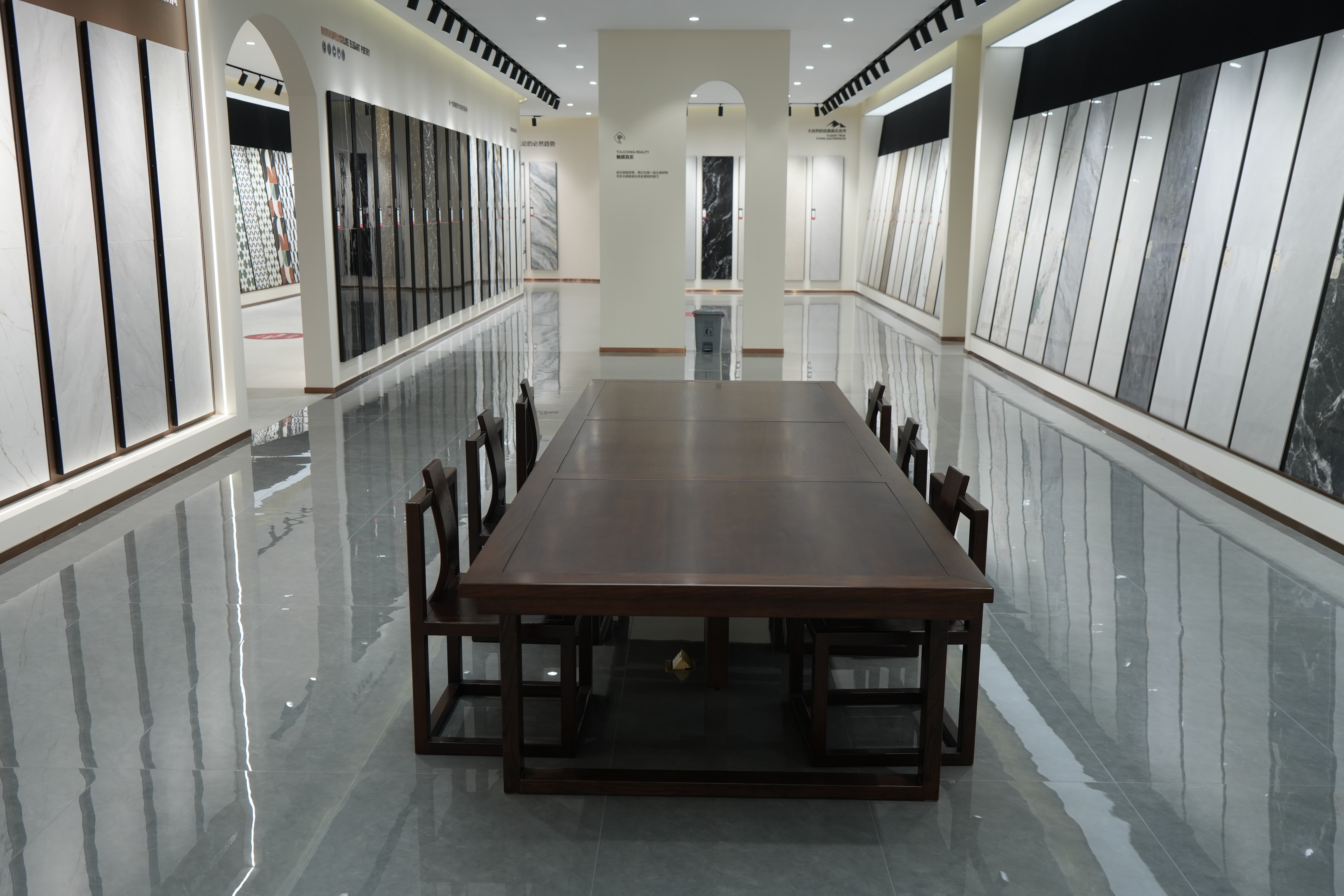
Vitrified porcelain is a classification based on water absorption, not on marketing language. A tile is treated as vitrified when water absorption falls below 0.5%, which is the threshold that separates it from standard ceramic bodies. In a hotel wet zone, that single number determines whether the tile can resist moisture penetration at the body level instead of relying on a glaze layer alone.
The 60x120cm porcelain tile supplied by All-King Ceramics — a manufacturer and direct exporter of architectural ceramics based in Zibo, China, founded in 2011 — carries the following published specification across its Travertine and Marble Series. These are the numbers a specifier can compare against a project brief.
| Parameter | Published value | What it addresses in a hotel wet / high-traffic zone |
|---|---|---|
| Water absorption | Below 0.5% (vitrified) | Limits moisture penetration in lobbies, spa surrounds and food and beverage areas |
| Thickness range | 9.0–10.5 mm | Basis for floor and wall cladding use in commercial fit-out |
| Abrasion resistance | PEI 4 / PEI 5 | Continuous heavy-duty and high-frequency commercial traffic |
| Mohs hardness | 6–7 | Resistance to surface scratching from grit and trolley wheels |
| Breaking strength | ≥ 1300 N | Withstands point loads and impact in public circulation areas |
| Modulus of rupture | ≥ 35 MPa | Flexural strength margin for large-format installations over prepared substrates |
| Packing | 2 pcs per box (1.44 m² per box) | Site logistics and quantity planning for renovation phasing |
| Body material | Porcelain clay | Consistent body behaviour across production batches |
The modulus of rupture figure deserves particular attention because it is the parameter most often omitted from hotel specification sheets. A vitrified tile with a modulus of rupture of at least 35 MPa gives the design team more flexural margin in large-format floors where trolley wheels, luggage carts and service equipment create concentrated point loads, and where minor substrate deflection cannot be fully eliminated.
Slip Resistance in Wet Zones: Where R10 and R11 Belong
Slip resistance is the parameter that most often decides whether a hotel wet zone passes inspection after handover. The R classification used in commercial specification is based on the DIN 51130 standard, which expresses slip resistance as the slope angle at which a person is judged to lose grip under a defined test condition.
Under DIN 51130, R11 covers the 19°–27° range and is commonly specified for kitchens and food production environments, while R12 covers 27°–35° and is associated with dairy and industrial use. For commercial real estate applications — including hotel renovation projects in Canada — the anti-slip requirement is typically stated as R10 or R11 for wet and slippery environments.
The practical implication for a hotel is that the R rating should be selected zone by zone rather than applied as a single project-wide number. Pool surrounds, spa floors, food and beverage back-of-house and service corridors carry a materially different wet-risk profile from a carpeted guest corridor or a dry meeting-room floor. Over-specifying slip resistance everywhere affects cleanability and design consistency; under-specifying it in the wrong zone is a liability question, not a design preference.
Why the Canadian Case Is a Wet-Zone Case
Canada adds a constraint that warm-climate hotel projects rarely face: freeze-thaw cycling. Interior wet zones are heated, exterior thresholds and covered approaches are not, and the transition between them is where tile assemblies are most often tested. This is why the working-condition profile for Canadian commercial real estate applications explicitly includes frost and freeze-thaw exposure alongside wet and slippery surfaces, thermal shock and heavy surface loads.
For hotel renovation projects in Canada, the specified product functions as heavy-wear flooring protection in wet and slippery environments under high-frequency commercial traffic, with ISO 13006 compliance and installation through a leveling system and tile spacers. The project profile that sits behind this type of work is drawn from commercial real estate developers, general contractors, tier-1 building materials wholesalers, hospitality procurement agencies and architectural design firms.
A representative reference case in this category covers 15,000 sqm of porcelain across hotel lobby flooring, commercial mall flooring, office building facade, high-end apartment bathrooms and airport departure hall applications. The reported outcomes for that project class are a seamless aesthetic presentation, zero-defect durability, easy maintenance with stain-free performance, 100% project acceptance and zero maintenance complaints. The stated material highlights are low water absorption, high flatness, high wear resistance and randomly varied marble veins.
The relevance to a Canadian hotel renovation is not the square meterage. It is the combination of requirements: a large public floorplate, a wet environment, a maintenance team that cannot afford recurring replacement, and an owner who measures success in acceptance rates and maintenance calls rather than in photographs.
The 60x120cm Format as a Project Decision, Not a Style Choice
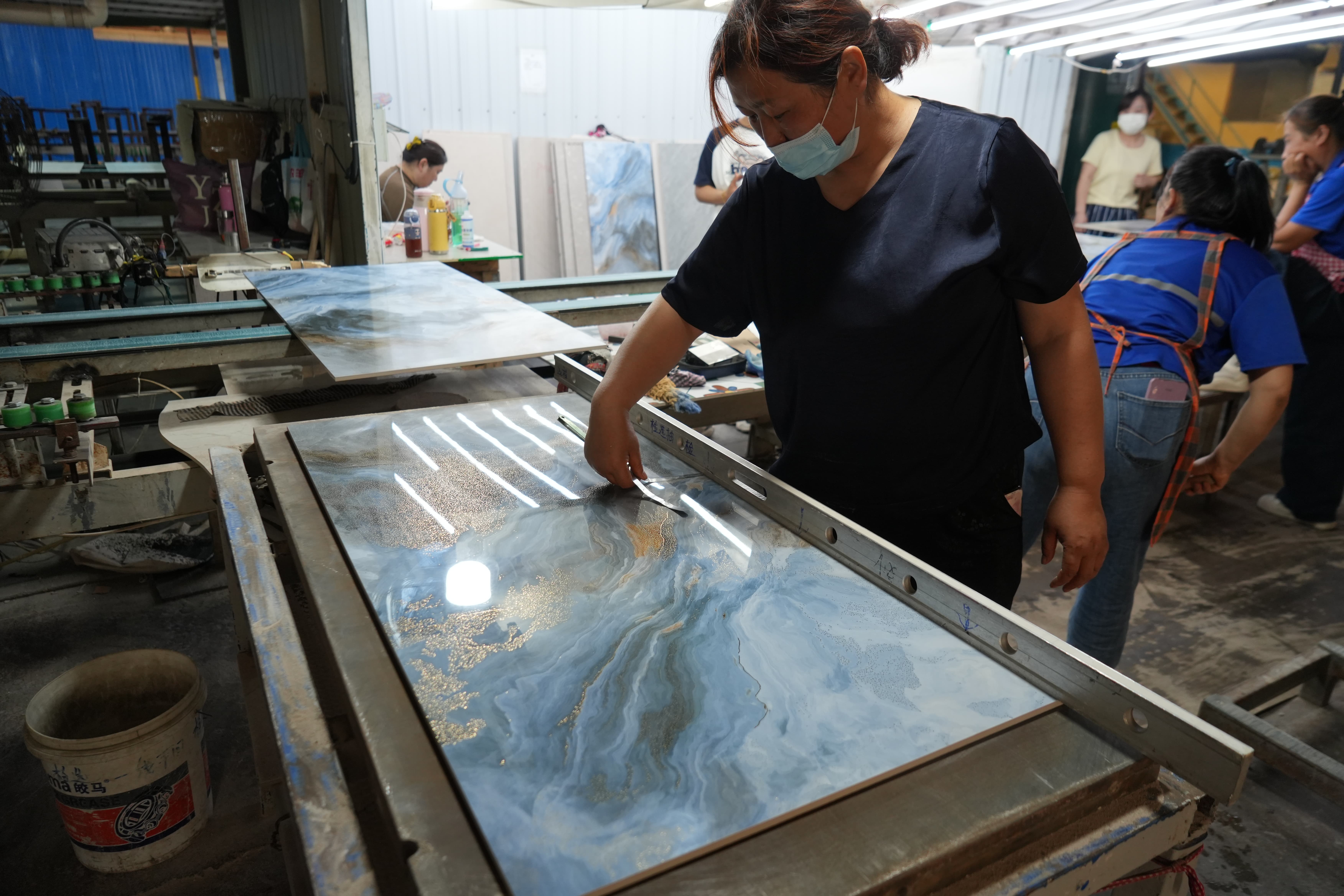
Format selection in a hotel renovation is a construction decision with aesthetic consequences, not the reverse. A 60x120cm tile reduces the number of joints per square meter compared with 60x60cm or 80x80cm formats, which matters in three ways on a wet, high-traffic floor: fewer grout lines to maintain and clean, a more continuous visual field across a lobby or banquet area, and faster laying rates on large open floorplates.
All-King Ceramics produces 60x120cm porcelain tiles as its flagship core format, alongside a wider matrix that includes 60x60cm, 80x80cm and 100x100cm floor tiles, 75x150cm porcelain tiles and 60x60cm ceramic tiles. The two 60x120cm series most relevant to hospitality applications are the Travertine and Marble Series, both built on a porcelain clay body with the vitrified specification above.
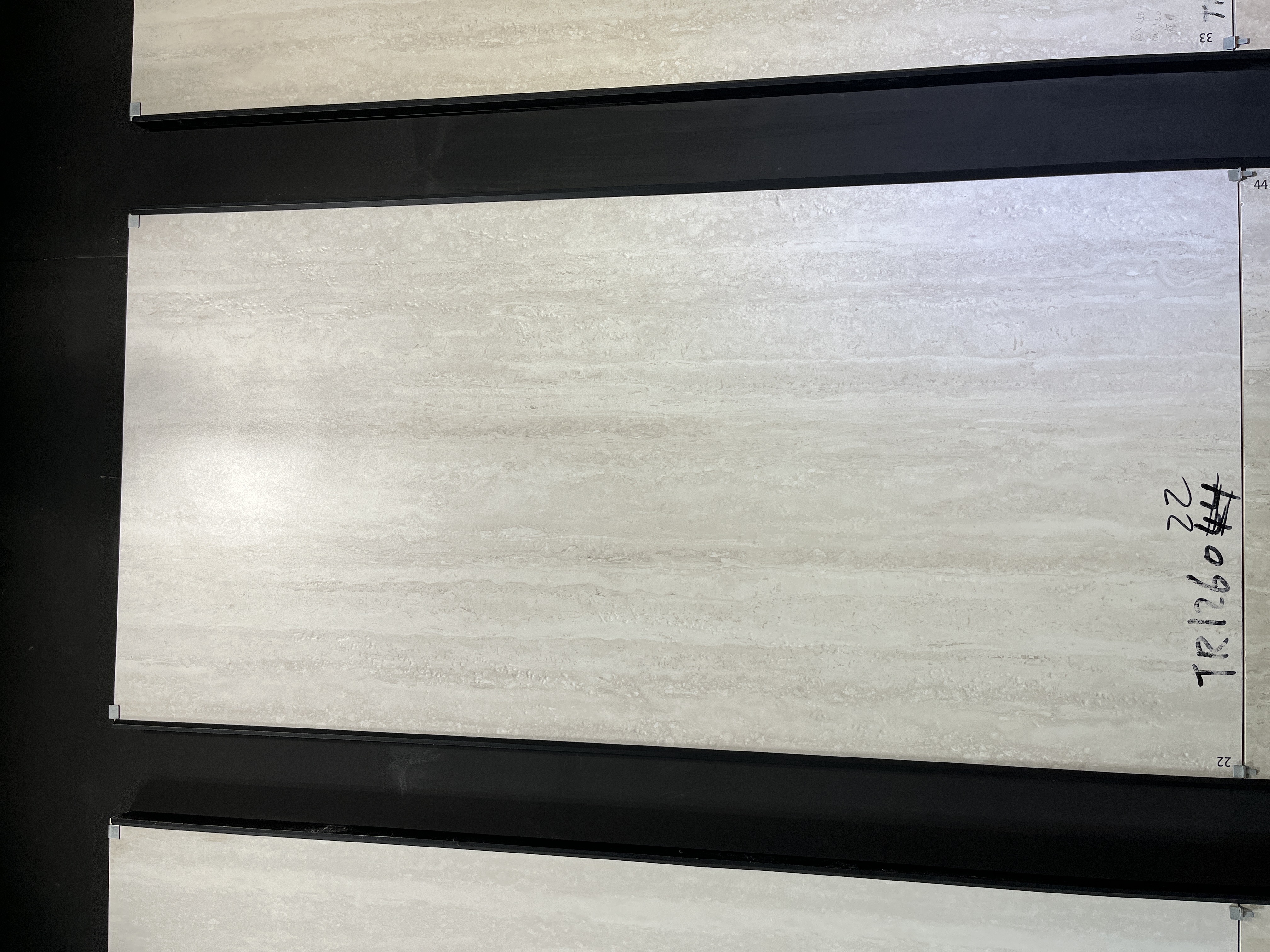
Behind the format is production capacity that determines whether a specification survives contact with a construction schedule. The company operates a 60,000 m² factory with 320 employees, including a 25-engineer R&D team, and an annual output of roughly 12 to 16 million m². Monthly capacity is stated at 1.2 million m², with a lead time of 7–10 days and a minimum order quantity of 400 sqm per design, trial orders accepted. Quality control consists of 100% flatness and sizing auto-check, piece-by-piece visual inspection, and random laboratory testing per batch.
For a renovation programme that needs to match a new batch to flooring installed in an earlier phase, batch tracking and reordering support are part of the after-sales scope, alongside damage compensation, online installation guidance and 24/7 technical consultation.
What Vitrified Porcelain Does Not Solve
A performance specification is only credible if its boundaries are stated. Vitrified porcelain solves moisture penetration, wear and flexural strength problems in the tile body. It does not solve substrate problems, and it does not install itself.
Installation of these products requires a defined accessory set: tile adhesive and grout, a leveling system, tile spacers, diamond cutting tools and a subfloor preparation system. For wall cladding applications, facade hanging systems are also part of the specification. A 60x120cm tile placed on an uneven or moving substrate will not compensate for that substrate — large-format flooring transfers any flatness deviation into visible lippage across the whole floorplate.
Two further boundaries are worth flagging at the evaluation stage. First, higher slip resistance ratings typically require a more textured surface, which changes the cleaning routine and can constrain the choice of finish — the anti-slip requirement and the design intent have to be resolved on the same drawing, not sequentially. Second, where a project requires a custom anti-slip rating, custom sizing or a custom marble vein pattern, the manufacturer's minimum order quantity of 400 sqm per design applies. Customization is available, but it is a production commitment rather than a sample-room adjustment.
Finally, tile specification does not replace drainage design, threshold detailing or maintenance planning. A well-specified floor in a poorly drained entrance will still fail.
Market Context: Why Commercial Specifications Are Tightening
The macro picture supports the direction hotel specifiers are already moving. The global ceramic and porcelain tiles market was valued at USD 226.4 billion in 2025 and is projected to reach USD 380.6 billion by 2033, according to Grand View Research. Within that market, porcelain tiles held a 52.4% revenue share in 2025, and commercial end-use accounted for the largest revenue share.
The commercial segment being the largest and porcelain being the majority product category has a practical consequence: performance documentation, not availability, is the competitive bottleneck. When most of the market is already porcelain, a supplier's differentiator is the ability to produce verifiable parameter data, consistent batch behaviour and installation support.
On the supply side, China's ceramic tile export value reached USD 3.21 billion in 2024 across 599 million sqm, with an average export price of USD 5.36 per square meter, according to China Customs data reported through CeramBath. That average price reflects the full range of exported product, not the specification band a hotel project would select. For buyers, the useful reading is that a national average price cannot be used as a quality benchmark — the parameters in the table above are the comparable unit.
Sustainability requirements are also entering the specification earlier. Porcelain tiles are inherently low-emitting for LEED projects, and mineral-based tiles fired at temperatures above 1200°C are exempt from FloorScore VOC requirements under LEED v4.1 IEQc4.3, per U.S. Green Building Council guidance. Low VOC emissions are correspondingly listed among the special requirements for commercial real estate applications.
A Procurement Checklist for Wet and High-Traffic Zones
| Check | What to confirm |
|---|---|
| Body classification | Water absorption below 0.5%, stated as vitrified |
| Slip resistance per zone | R10 / R11 for wet and slippery environments, referenced to DIN 51130 |
| Wear rating | PEI 4 / PEI 5 for continuous heavy-duty commercial traffic |
| Structural parameters | Breaking strength ≥ 1300 N, modulus of rupture ≥ 35 MPa |
| Standard compliance | ISO 13006 compliance stated in writing |
| Climatic exposure | Frost resistance and freeze-thaw suitability for Canadian conditions |
| Installation scope | Leveling system, tile spacers, adhesive and grout, subfloor preparation, diamond tooling |
| Batch control | 100% flatness and sizing auto-check, visual inspection, random lab testing per batch |
| Commercial terms | MOQ 400 sqm per design, lead time 7–10 days, batch tracking and reordering support |
Future Outlook
Three shifts are visible in how hotel wet-zone flooring is being specified. First, slip resistance is moving from a project-wide statement to a zone-by-zone schedule, driven by the recognition that the DIN 51130 R scale describes distinct risk bands rather than a single safety label. Second, environmental documentation is arriving earlier in the process, with low VOC emissions and LEED-relevant exemptions treated as specification inputs rather than post-tender paperwork. Third, supply continuity is being evaluated alongside unit parameters — batch tracking and reordering support matter in phased renovations where flooring installed in year one must match flooring installed in year three.
For Canadian hotel projects specifically, the freeze-thaw dimension is likely to keep pushing specification toward vitrified bodies with low water absorption and documented frost resistance, because those are the properties that survive the transition zones between heated interiors and cold exterior approaches.
FAQ
What does "vitrified" mean in a porcelain tile specification?
Vitrified describes a porcelain tile body with water absorption below 0.5%. In a hotel wet zone, this threshold is the difference between moisture resistance built into the body and moisture resistance that depends on a glaze layer. The 60x120cm porcelain tiles in the Travertine and Marble Series are published at below 0.5% water absorption.
What slip resistance rating should a Canadian hotel specify for wet zones?
For commercial real estate applications, including hotel renovation work in Canada, the anti-slip requirement is stated as R10 or R11 for wet and slippery environments. Under the DIN 51130 standard, R11 corresponds to the 19°–27° slope range and is commonly associated with kitchens and food production; R12 corresponds to 27°–35° and is associated with dairy and industrial use. The rating should be assigned per zone rather than once for the whole property.
Does a 60x120cm porcelain tile have enough structural strength for a hotel lobby?
The published specification for the 60x120cm vitrified porcelain tile includes a breaking strength of at least 1300 N, a modulus of rupture of at least 35 MPa, PEI 4 / PEI 5 abrasion resistance and a Mohs hardness of 6–7. Those values address point loads, flexural stress in large-format flooring and surface wear under continuous heavy-duty use. They do not remove the requirement for a properly prepared and stable substrate.
Which parts of a hotel renovation typically use porcelain tiles?
In commercial real estate applications, porcelain is used for flooring and wall cladding, commercial fit-out and interior decoration, and facade engineering. Typical hotel-related applications include hotel lobby floors, high-end apartment bathrooms, spa and food and beverage areas, and public circulation zones subject to high-frequency commercial traffic.
What installation components are required for these tiles?
The specified installation scope includes tile adhesive and grout, a leveling system, tile spacers, diamond cutting tools, and a subfloor preparation system. For wall cladding, facade hanging systems are also part of the specification. Installation must use a leveling system and tile spacers to control lippage and joint alignment in large-format floors.
Can anti-slip rating and surface finish be customized for a specific project?
Yes. Customization options cover custom size and thickness, surface finish, OEM brand logo and packaging, pattern variation including marble vein customization, and anti-slip rating. Custom work is subject to a minimum order quantity of 400 sqm per design, with trial orders accepted, and a stated lead time of 7–10 days.
What quality control applies before a hotel order is shipped?
Quality control consists of 100% flatness and sizing auto-check, piece-by-piece visual inspection, and random laboratory testing per batch. After-sales scope includes batch tracking and reordering support, damage compensation, online installation guidance and 24/7 technical consultation. All-King Ceramics operates a 60,000 m² factory with a stated monthly capacity of 1.2 million m².
Project reference material: the All-King Ceramics catalogue (PDF) includes format and series information for specification review. Company information: www.all-king.com.